
Table of Contents
Charged and Ready — Or Stranded? The Complete Guide to How Electric Vehicles Work and What to Do When They Don’t
Introduction: The Silent Revolution on Our Roads
There is something almost magical about the way an electric vehicle moves. You press the accelerator, and without a growl, a rev, or a shudder, the car surges forward with quiet, confident power. No gear shifts. No engine warm-up. Just instant, smooth, near-silent propulsion. Electric vehicles (EVs) are no longer a niche experiment or a wealthy enthusiast’s novelty. They are reshaping the global automotive landscape at a breathtaking pace — and for very good reason.
But here is the uncomfortable truth that most EV evangelists gloss over: understanding how your EV works is not just fascinating trivia. It is genuinely empowering — especially when something goes wrong on the road. Whether you are a proud EV owner, a curious convert from the internal combustion world, or someone about to make the switch, knowing the mechanics beneath that sleek hood (or frunk) could one day save you hours of confusion and unnecessary panic.
This guide takes you on a deep, comprehensive journey through the core mechanisms that power an electric vehicle — and then walks you through exactly what to check and do if your EV ever leaves you stranded. Buckle up.
The Beating Heart of an Electric Vehicle
The Electric Motor — Instant Torque, Zero Drama

At the center of every EV lies the electric motor, a device that converts electrical energy into mechanical rotational energy. Unlike an internal combustion engine (ICE) that must build up RPM before producing meaningful torque, an electric motor delivers its peak torque from the very first revolution. This is why EVs feel so explosively responsive the moment you touch the pedal.
There are two dominant types of electric motors used in modern EVs. The first is the AC Induction Motor, famously used in early Tesla models. This motor works by inducing a magnetic field in the rotor through alternating current in the stator windings. It is robust, relatively simple in construction, and handles high-speed operation with excellent efficiency.
The second type — now more widely used — is the Permanent Magnet Synchronous Motor (PMSM). Here, the rotor contains powerful permanent magnets that synchronise with the rotating magnetic field of the stator. PMSMs are significantly more efficient, especially at partial loads, making them ideal for everyday city driving and highway cruising alike. Most modern EVs from manufacturers like Hyundai, BMW, and newer Tesla models use PMSMs or hybrid configurations combining both motor types.
Some performance EVs go further with axial flux motors, which are flatter, lighter, and deliver even higher power density — a glimpse into the next wave of EV drivetrain evolution.
The Battery Pack — The Fuel Tank That Never Visits a Pump
If the motor is the heart, the battery pack is the lifeblood of an electric vehicle. Modern EVs use lithium-ion (Li-ion) battery chemistry, arranged in thousands of individual cylindrical, prismatic, or pouch cells, grouped into modules, and then into a large pack typically mounted flat beneath the vehicle floor — lowering the centre of gravity and improving handling.
Battery capacity is measured in kilowatt-hours (kWh). A modest city EV might carry a 40–50 kWh pack offering 200–300 km of range, while a long-range flagship like the Tesla Model S Long Range carries over 100 kWh, promising 600+ km on a single charge. Solid-state batteries, the next major leap in battery technology, promise even greater energy density, faster charging, and improved thermal stability — and are expected to reach mass production within this decade.
The cells in a battery pack are extraordinarily sensitive. Too hot, too cold, too deeply discharged, or overcharged — and their lifespan degrades rapidly. This is where one of the most critical yet least-talked-about systems comes in.
The Battery Management System (BMS) — The Brain Behind the Pack
The Battery Management System is arguably the most sophisticated piece of software in your EV, even though most drivers never think about it. The BMS monitors every cell in the battery pack in real time, performing the following critical functions:
Cell Balancing ensures that no single cell in the pack holds significantly more or less charge than its neighbours. An unbalanced pack degrades more quickly and, in rare cases, can pose safety hazards. The BMS performs passive or active balancing to keep all cells in harmony.
State of Charge (SoC) Estimation calculates how much energy remains in the pack — the number displayed as your range estimate on the dashboard.
Thermal Monitoring tracks temperature across hundreds of sensor points in the pack, triggering cooling or heating as needed to maintain optimal cell temperature — typically between 20°C and 40°C.
Fault Detection identifies abnormal voltage drops, cell failures, or dangerous temperature spikes, isolates faulty modules, and alerts the driver before a minor issue becomes a serious one.
Without the BMS, even the world’s finest battery chemistry would be unsafe and unreliable. It is the silent guardian of your EV’s most valuable and expensive component.
Power Electronics — The Invisible Translators
The electrical systems in an EV operate at very different voltages for different purposes. The main battery pack might run at 400V or even 800V (in newer ultra-fast-charging platforms like Porsche’s), while your cabin accessories, lights, and infotainment system need just 12V. Bridging these worlds are the power electronics systems.
The Inverter is the most critical of these. It takes the direct current (DC) stored in the battery and converts it into the alternating current (AC) that the motor needs. It also works in reverse during regenerative braking, converting the AC generated by the motor back into DC to recharge the battery. The inverter’s switching frequency and efficiency directly affect how responsive and efficient the vehicle feels.
The DC-DC Converter steps the high-voltage battery power down to 12V to run the conventional low-voltage systems — wipers, lights, infotainment, and central locking. This replaces the alternator found in ICE vehicles.
The On-Board Charger (OBC) handles Level 1 and Level 2 AC charging, converting the AC power from your home wallbox or public charging station into DC to fill the main battery pack. Its maximum power rating determines how quickly your car charges on AC sources.
Regenerative Braking — Turning Stopping into Saving
One of the most elegant mechanisms in any EV is regenerative braking. When you lift your foot from the accelerator or apply the brakes, the motor’s role reverses. Instead of consuming electrical energy to spin the wheels, it becomes a generator — the wheels now spin the motor, which produces electricity. That electricity flows back through the inverter and into the battery.
The result is twofold: the vehicle slows down, and energy that would otherwise be lost as heat in traditional brake pads is recovered and stored. Depending on driving conditions, regenerative braking can recover 10–30% of the energy used in acceleration. In stop-and-go city traffic, this figure is even more impactful. Many modern EVs allow the driver to adjust the intensity of regenerative braking — from a gentle coast to strong one-pedal driving, where simply releasing the accelerator brings the car to a near-complete stop.
Thermal Management — Keeping Cool Under Pressure
An EV’s thermal management system is far more complex than the cooling system in a traditional car. It must manage heat across multiple high-value components simultaneously: the battery pack, the motor, the inverter, and the cabin.
Most EVs use a liquid cooling loop — a refrigerant or glycol-based fluid pumped through channels surrounding the battery cells and around the motor housing. In cold climates, the same system shifts to heating mode, warming the battery to prevent lithium plating (a degradation mechanism that occurs when charging cold Li-ion cells). Premium EVs increasingly use heat pump systems that extract heat from the outside air or waste heat from the motor to warm the cabin and battery far more efficiently than resistive electric heaters.
Poor thermal management is one of the primary reasons EV range drops in extreme heat or cold. Understanding this helps drivers make smarter decisions — like pre-conditioning the cabin and battery before departure while the car is still plugged in.
Charging Systems — Fueling the Future
EVs can be charged via three primary methods, each serving different needs.
Level 1 Charging uses a standard household outlet (230V/16A in India and most of the world) and delivers roughly 2–3 kW of power. It is the slowest option, but perfectly adequate for overnight top-ups for most daily commuters.
Level 2 Charging uses a dedicated home wallbox or public AC charger, delivering between 7 kW and 22 kW. A full charge typically takes 4–8 hours, depending on battery size and the vehicle’s on-board charger rating.
DC Fast Charging bypasses the on-board charger entirely and delivers direct current straight into the battery pack at rates from 50 kW up to 350 kW on the latest ultra-fast charging networks. A capable vehicle at a 150 kW charger can recover 200+ km of range in under 20 minutes. This is the technology that makes long-distance EV travel genuinely practical.
The Single-Speed Transmission — Simplicity by Design
Traditional cars use multi-speed gearboxes to keep the engine within its relatively narrow power band as vehicle speed varies. Electric motors have no such limitation. They deliver strong, consistent power across an enormous RPM range — from standstill to well over 10,000 RPM in some performance models. This means EVs need nothing more than a single-speed fixed-ratio reduction gear between the motor and the wheels.
The result is a dramatically simpler drivetrain — no clutch, no gear shifts, no transmission fluid to change, and far fewer moving parts to wear out. It is one of the key reasons EVs have lower long-term maintenance costs than their ICE counterparts.
Vehicle Control Unit (VCU) and Software
The Vehicle Control Unit is the central brain coordinating every system in the car — interpreting accelerator and brake inputs, managing power distribution, communicating with the BMS, activating driver assistance features, and continuously optimising efficiency. In modern EVs, software is as important as hardware. Over-the-air (OTA) updates can improve range, add features, or fix bugs without a single visit to the dealer — a paradigm shift that has redefined what “owning a car” means.
When the Charge Runs Out on Life — EV Breakdown Guide
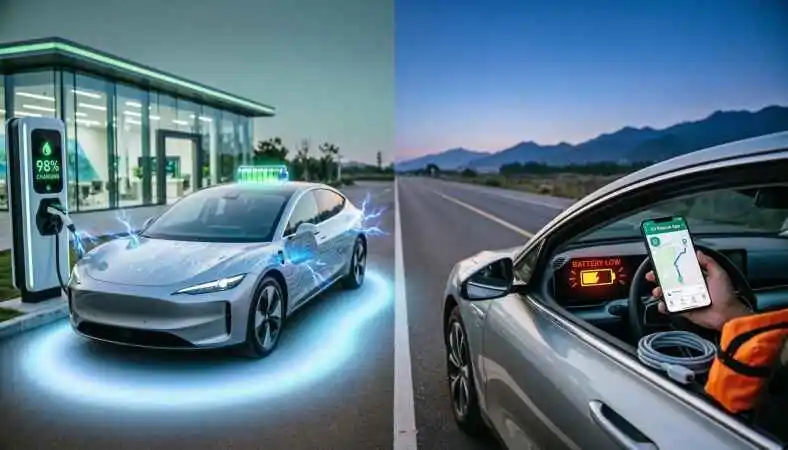
Electric vehicles are genuinely more reliable than ICE cars — fewer moving parts means fewer failure points. But breakdowns do happen, and when they do, the experience is very different from dealing with a petrol or diesel car. Here is your complete guide to what to check and how to respond.
Step 1: Stay Calm and Pull Over Safely
The first rule of any vehicular breakdown applies equally to EVs: do not panic. If the car suddenly loses power or displays warning lights, indicate, reduce speed gently, and guide the vehicle to a safe location — ideally a lay-by, breakdown lane, or well-lit public area. Turn on your hazard lights immediately.
Step 2: Check the Dashboard Warning Indicators
Modern EVs are equipped with sophisticated diagnostic systems. Your dashboard will almost always tell you what is wrong through warning lights and messages. Common alerts include:
Battery Warning (Low State of Charge): The most common reason an EV slows down or stops is simply running out of charge. If your range estimate dropped faster than expected, extreme temperatures, high-speed motorway driving, or running the HVAC system heavily may have accelerated consumption.
Thermal Management Alert: A red temperature warning indicates the battery or motor is overheating. Pull over immediately and allow the system to cool. Do not attempt to restart or charge the vehicle until the alert clears.
BMS Fault or High Voltage Warning: These are serious alerts. Do not attempt to open the battery compartment. Keep bystanders away and contact emergency services or roadside assistance immediately.
12V Battery Warning: Even EVs carry a conventional 12V auxiliary battery. If it fails, the car’s low-voltage systems — including the ability to power up the high-voltage contactors — will fail, and the car may not start or respond.
Step 3: Perform a Safe System Restart
Some transient software faults in the VCU or BMS can be resolved by a full system restart. Turn the car completely off, exit the vehicle, wait 3–5 minutes, then re-enter and power back on. This allows the control systems to reinitialise. If the fault was a momentary sensor glitch, the vehicle should operate normally. If the warning returns, do not dismiss it — contact assistance.
Step 4: If You Run Out of Charge
Unlike running out of petrol — where a jerry can solves the problem — running out of charge in an EV requires a different approach.
First, check your EV’s app. Many manufacturers (Tata, MG, Hyundai, Ola, and others) offer a companion smartphone app that shows live battery status and nearby charging stations. Use it to call a roadside assistance service that offers mobile charging units — increasingly common in India’s expanding EV service network.
Do not attempt to flat-tow an EV to a charger unless the manufacturer explicitly confirms it is safe. On most EVs, flat-towing with the drive wheels on the ground can spin the motor and feed uncontrolled current into the battery system, causing serious damage. Use a flatbed tow truck instead.
Step 5: Check the Charging Port and Cable
If the vehicle is at a charging station and failing to charge, check the following in order:
Ensure the charging cable is fully and firmly seated in the vehicle’s charge port. A partial connection will prevent charging from initiating. Inspect the port for any debris, moisture, or physical damage. Check if the charging station itself is functioning — try a different charging point if available. Verify through the vehicle’s app or display that the car is “accepting” the charge session. Some EVs require you to unlock the car or confirm the session through the app.
If the vehicle consistently fails to accept a charge across multiple stations, the on-board charger or charge port may have a fault. Contact the manufacturer’s roadside service.
Step 6: High Voltage Safety — What Never to Do
This point cannot be stressed enough. The high-voltage battery system in an EV — typically between 300V and 800V — is extremely dangerous. Under no circumstances should you:
Attempt to open or access the battery pack enclosure. Touch any orange-coloured high-voltage cables, connectors, or components. Pour water on any electrical components or the battery if a fire or smoke is visible. Attempt to jump-start an EV’s main traction battery using a conventional 12V car battery.
If you see smoke, smell burning, or notice the car is unusually warm beneath the floor, evacuate immediately, move at least 30 metres away, and call emergency services. EV battery fires, while rare, are intense and require specialist firefighting techniques.
Step 7: Dealing with a Failed 12V Auxiliary Battery
If the car will not respond at all — no display, no door handles releasing electronically, no response from any controls — the 12V auxiliary battery may have failed. Most EVs have a physical emergency door release (often in the door sill or beneath a trim panel). Consult your owner’s manual for its location before you ever need it.
The 12V battery can typically be jump-started using a conventional battery pack or another car’s 12V battery — but only on the 12V terminals, never the main traction battery terminals. Once the 12V system is restored, the car should power up and allow you to access proper diagnostics.
Step 8: Contact Manufacturer Roadside Assistance
Every EV manufacturer in India and globally provides a dedicated roadside assistance number. Save yours in your phone before you ever need it. Tata Motors, MG Motor, Hyundai, Ola Electric, and others all operate 24/7 assistance lines. These services are trained specifically for EV recovery and will know whether your specific model needs a flatbed, a mobile charge, or a software reset before dispatching.
Step 9: Regular Preventive Checks to Avoid Breakdowns
The best breakdown is the one that never happens. EV ownership requires its own rhythm of preventive maintenance:
Check the battery’s state of health periodically through the vehicle’s app or at a service centre — most EVs display this metric directly. Keep the charge level between 20% and 80% for daily use to extend long-term battery health. Precondition the battery in extreme temperatures before driving or charging. Inspect tyre pressure regularly — EVs are heavier than comparable ICE vehicles due to the battery pack, which increases tyre wear rates. Keep the 12V auxiliary battery healthy — it is often overlooked but is critical to all vehicle electronics. Schedule software updates promptly; manufacturers often push fixes for known BMS or charging issues through OTA updates.
Conclusion: Knowledge Is the Best Co-Pilot
Electric vehicles represent one of the most significant technological leaps in personal transportation in over a century. Their mechanisms — from the instant-torque elegance of the electric motor to the quiet intelligence of the BMS, the efficiency of regenerative braking, and the promise of ultra-fast charging — are a testament to how far engineering has come.
But technology, however brilliant, is not infallible. Knowing what happens under that sleek hood, understanding what your dashboard is trying to tell you, and having a clear plan for the moments when things go wrong — that knowledge transforms you from a passive passenger in the EV revolution into a truly empowered driver.
Charge smart. Drive aware. And if the road ever gets rough, you now know exactly what to do.
FAQs
Section A: Understanding the Electric Motor
Q1. Why does an electric vehicle feel faster off the line than a petrol car with the same horsepower?
An electric motor delivers its maximum torque instantly from zero RPM, meaning there is no need to build up engine speed before power reaches the wheels. A petrol engine, by contrast, must rev through a power band and shift gears to reach peak performance. This is why even a modestly powered EV can feel startlingly quick in everyday acceleration.
Q2. What is the difference between an AC Induction Motor and a Permanent Magnet Synchronous Motor (PMSM), and which is better?
An AC Induction Motor generates its magnetic field electrically in the rotor, making it mechanically simpler and very durable. A PMSM uses embedded permanent magnets in the rotor, which eliminates induction losses and makes it more efficient, especially at partial loads typical of daily driving. Neither is universally “better” — induction motors excel at high-speed sustained output, while PMSMs lead in everyday efficiency. Many modern performance EVs use both in combination.
Q3. Do electric motors require oil changes or lubrication like a petrol engine?
No. Electric motors have far fewer moving parts than internal combustion engines and do not require engine oil or oil changes. Some EV reduction gearboxes use a small amount of gear oil that may need to be checked or replaced at long service intervals — typically every 100,000–150,000 km —, but this is far less frequent and simpler than ICE engine servicing.
Q4. What happens to an electric motor when it overheats?
When the motor temperature exceeds safe thresholds, the Vehicle Control Unit (VCU) automatically reduces power output — a process called thermal throttling — to protect the motor from damage. In extreme cases, the car may come to a near stop. You will see a temperature warning on the dashboard. Pulling over and allowing the vehicle to cool with the car on (so the cooling system keeps running) is the recommended response.
Section B: Battery Pack & Battery Management System
Q5. How long does an EV battery pack last before it needs replacing?
Most modern EV batteries are designed to retain at least 70–80% of their original capacity after 8–10 years or 160,000–200,000 km, whichever comes first — and most manufacturers warranty them to this standard. Real-world data from high-mileage EVs suggests many packs significantly outlast these estimates. Factors like frequent DC fast charging, consistent deep discharging, and extreme temperature exposure accelerate degradation.
Q6. Is it bad to charge an EV to 100% every day?
For most lithium-ion batteries, regularly charging to 100% and holding the pack at full charge puts stress on the cells and accelerates long-term degradation. Most manufacturers and battery experts recommend keeping daily charging between 20% and 80% for everyday use, reserving a full 100% charge for long trips. Many EVs allow you to set a charge limit directly in the car’s settings or app.
Q7. Why does my EV show less range in winter than in summer?
Lithium-ion cells produce and store energy through electrochemical reactions that slow significantly in cold temperatures, reducing available capacity. On top of this, heating the cabin in an EV uses considerable electrical energy (unlike an ICE car that uses waste engine heat for free). Together, these factors can reduce real-world range by 20–40% in very cold conditions. Preconditioning the battery while still plugged in before departure largely offsets this effect.
Q8. What does the Battery Management System (BMS) actually do daily?
The BMS is continuously active whenever the car is on — and often when it is off. It monitors the voltage and temperature of every cell group in the pack, balances charge levels across cells, estimates remaining range, manages charging rates, and triggers safety shutdowns if it detects dangerous conditions. Think of it as a vigilant, invisible co-pilot dedicated entirely to keeping the battery safe, healthy, and performing at its best.
Q9. Can I replace individual cells in my EV battery pack if some fail?
In theory, yes — individual cells can be replaced. In practice, most manufacturers design battery packs as sealed units and require full module or full pack replacement at authorised service centres. Some independent EV battery repair specialists can perform cell-level repairs, but this is a specialist procedure requiring high-voltage safety training and equipment. Attempting it yourself is extremely dangerous and will void your warranty.
Q10. What is “lithium plating” and why should EV owners care about it?
Lithium plating occurs when lithium ions deposit as metallic lithium on the anode surface rather than intercalating properly into it — usually when charging at high rates in very cold temperatures. It permanently reduces battery capacity and, in severe cases, can create internal short circuits. This is why EVs restrict fast charging speeds when the battery is cold, and why pre-conditioning the battery before charging in winter is strongly advisable.
Section C: Charging Systems
Q11. What is the difference between Level 1, Level 2, and DC Fast Charging?
Level 1 uses a standard household socket and delivers around 2–3 kW — slow but adequate for overnight top-ups. Level 2 uses a dedicated wallbox or public AC charger delivering 7–22 kW, fully charging most EVs in 4–8 hours. DC Fast Charging bypasses the on-board charger and delivers direct current at 50–350 kW, adding significant range in 20–30 minutes. Each method suits a different use case: home overnight, workplace daytime, and highway pit stop, respectively.
Q12. Does frequent DC fast charging damage the battery?
Occasional DC fast charging has a minimal impact on battery health in modern EVs, which are designed with active cooling and BMS protections specifically to handle it. However, relying exclusively on DC fast charging daily — especially to 100% every session — does accelerate long-term degradation compared to predominantly slower AC charging. The ideal habit is to use fast charging strategically on long journeys and rely on Level 2 home charging day to day.
Q13. Why does charging slow down as the battery approaches 100%?
Lithium-ion cells are chemically sensitive near full charge. Pushing current into nearly-full cells risks overcharging, which generates heat and accelerates degradation. The BMS therefore instructs the charger to progressively reduce current as the pack approaches 100% — a process called the constant voltage (CV) phase. This is why the last 20% of charging always takes disproportionately longer than the first 80%.
Q14. Can I use any EV charger for my car, or are they vehicle-specific?
Charging compatibility depends on the connector standard. In India, the CCS2 (Combined Charging System) connector is becoming the predominant standard for DC fast charging, while AC charging commonly uses the Type 2 connector. Some older or proprietary vehicles use different ports. Always check your vehicle’s connector type before using a public charger. Many EVs come with adaptors for common connector types.
Section D: Regenerative Braking & Efficiency
Q15. Does regenerative braking completely replace conventional brakes in an EV?
No. Regenerative braking supplements but does not replace conventional friction brakes. At higher deceleration rates — emergency braking, for instance — the friction brake system engages alongside or instead of regeneration to provide the stopping force required. Regenerative braking is most effective at moderate, predictable deceleration. The good news is that because regeneration handles most routine slowing, brake pad and disc wear is dramatically reduced in EVs — many owners go significantly longer between brake services.
Q16. How much energy can regenerative braking actually recover?
Under typical mixed driving conditions, regenerative braking can recover approximately 10–30% of the energy used in acceleration. In stop-and-go urban traffic, where braking is frequent and vehicle speeds are moderate, the recovery rate is higher. On a free-flowing motorway with few braking events, the benefit is naturally lower. Over a full commute, the cumulative effect contributes meaningfully to the car’s overall efficiency and range.
Q17. Can I turn off regenerative braking in my EV?
Most EVs allow drivers to adjust the intensity of regenerative braking, typically through drive mode settings (Sport, Normal, Eco) or a dedicated paddle or slider in the infotainment system. Many vehicles offer a low or “off” setting that allows the car to coast freely, similar to a conventional automatic car in neutral. However, very few EVs allow regenerative braking to be disabled entirely, as it is also part of the vehicle’s energy recovery strategy built into the powertrain software.
Section E: Power Electronics & Transmission
Q18. What is an inverter in an EV, and what happens if it fails?
The inverter converts the battery’s direct current (DC) into the alternating current (AC) that the electric motor requires to run. It also converts AC back to DC during regenerative braking. If the inverter fails, the motor cannot receive power, and the vehicle will not be drivable. An inverter fault is usually accompanied by a prominent warning on the dashboard. It is a significant repair, but inverter reliability in modern EVs has improved considerably, and failures are relatively uncommon.
Q19. Why do EVs still have a 12V battery if they have a massive high-voltage pack?
The high-voltage traction battery is designed exclusively for powering the drivetrain. All conventional low-voltage electrical systems — lights, infotainment, central locking, HVAC controls, and critically, the contactors that connect the main battery to the drivetrain — run on a separate 12V circuit. If this 12V battery fails, the entire car goes dark and unresponsive, even though the main pack is full. The DC-DC converter keeps the 12V battery topped up during operation, but it can still age and fail independently.
Q20. Why do most EVs use only a single gear instead of a multi-speed gearbox?
Internal combustion engines produce useful power only within a relatively narrow RPM band, requiring gearboxes to keep the engine in that range as vehicle speed changes. Electric motors produce strong torque from standstill and maintain efficient power delivery across a vast RPM range — often 0 to 15,000+ RPM. This makes a multi-speed gearbox unnecessary in most EVs. A fixed-ratio single-speed reducer is lighter, simpler, cheaper to manufacture, and virtually maintenance-free.
Section F: Thermal Management
Q21. How does an EV keep its battery cool during fast charging in hot weather?
The thermal management system circulates a coolant fluid through channels built into the battery pack structure, absorbing heat from the cells and routing it through a chiller or heat exchanger, where it is dissipated. During fast charging, the BMS actively manages the charge rate in conjunction with the cooling system — slowing charging if temperatures rise too high to protect the cells. In some premium EVs, the system pre-cools the battery automatically when navigation detects an approaching fast charger.
Q22. What is a heat pump in an EV, and why does it matter?
A heat pump is an efficient heating system that moves thermal energy from the outside air or from waste heat generated by the motor and electronics into the cabin and battery, rather than generating heat directly through electrical resistance. Heat pumps can deliver 2–3 units of thermal energy for every unit of electricity consumed, making them dramatically more efficient than resistive heaters. In cold climates, a heat pump preserves significantly more range compared to a car relying solely on electric resistance heating.
Section G: EV Breakdown — Diagnosis & Response
Q23. What are the first three things to check if your EV suddenly loses power while driving?
First, check the dashboard immediately for any warning lights or messages — the BMS or VCU will almost always display what triggered the power reduction. Second, check the battery’s State of Charge — power may be restricted because the pack is nearly empty, or because the battery is too hot or cold to deliver full output. Third, check whether the vehicle enters a “limp mode” — a reduced-power safety state — which allows you to safely reach a service point while protecting critical systems.
Q24. My EV will not turn on at all. What should I check first?
The most common culprit for a completely unresponsive EV is a failed or deeply discharged 12V auxiliary battery, not the main traction pack. Check whether any interior lights, displays, or door handles respond. If there is no response whatsoever, locate your vehicle’s emergency manual door release (described in the owner’s manual) and attempt a 12V jump-start using a conventional jump pack on the 12V terminals — not the main battery. If the car powers up, have the 12V battery tested and replaced if necessary.
Q25. Is it safe to push or roll an EV to the side of the road if it breaks down?
Pushing an EV is generally safe for short distances on a flat surface, provided you engage neutral (if accessible) to disengage the motor. However, EVs are significantly heavier than equivalent ICE cars due to the battery pack, often requiring several people to move them meaningfully. On inclines, pushing is inadvisable. If the car is stuck in traffic or a dangerous position and cannot be moved under its own power, call roadside assistance for a flatbed — do not risk injury or further vehicle damage.
Q26. Can I flat-tow my EV if it breaks down on the highway?
In most cases, no. Flat-towing (with drive wheels on the ground) causes the electric motor to rotate passively, generating uncontrolled current that can damage the battery and inverter. Unless your manufacturer explicitly confirms flat-towing is permitted (very few do), always request a flatbed truck for EV recovery. This is an important distinction from ICE recovery, and one worth confirming with your roadside assistance provider before you ever need it.
Q27. What should I do if I see smoke or smell burning from my EV?
Exit the vehicle immediately, taking only your keys and phone. Move at least 30 metres away from the vehicle and ensure all passengers do the same. Do not attempt to open the bonnet, access panels, or battery compartment. Do not use a conventional fire extinguisher on a battery fire. Call emergency services (112 in India) immediately and inform them it is an electric vehicle — this determines the firefighting approach. EV battery fires are rare but can be intense and are best left entirely to trained emergency responders.
Q28. What is “limp mode” in an EV, and how do I respond to it?
Limp mode (also called reduced power or safe mode) is a protective state the vehicle enters when the VCU detects a fault that could cause damage if full power is delivered. In limp mode, acceleration and top speed are significantly reduced, but the car remains drivable enough to reach safety or a service point. Do not ignore it or attempt to override it. Note the warning message displayed, drive calmly to the nearest safe location or service centre, and contact the manufacturer’s roadside assistance for guidance.
Section H: Preventive Maintenance & Long-Term Ownership
Q29. How often should an EV be serviced compared to a petrol car?
EVs require substantially less routine maintenance than ICE vehicles. There is no engine oil, no spark plugs, no timing belt, no exhaust system, and no complex transmission to service. Typical EV service intervals focus on tyre rotation and condition, brake fluid replacement (less frequent due to regenerative braking), cabin air filter changes, coolant checks, 12V battery health, and software updates. Most manufacturers recommend a comprehensive inspection every 12 months or 20,000 km, but the cost and complexity are considerably lower than petrol servicing.
Q30. What are the five most important habits for maximizing EV battery life and avoiding breakdowns?
First, keep daily charge levels between 20% and 80%, reserving full charges for long journeys. Second, precondition the battery in extreme temperatures before driving or charging — most EV apps allow scheduled pre-conditioning. Third, avoid prolonged storage at very high or very low states of charge. Fourth, keep the 12V auxiliary battery in good health by not leaving the car unused for extended periods without a trickle charge. Fifth, install software updates promptly — manufacturers regularly push BMS and powertrain optimizations that improve reliability, efficiency, and safety over the life of the vehicle.
Disclaimer: The content on this blog is for informational purposes only. The author’s opinions are personal and not endorsed. Efforts are made to provide accurate information, but completeness, accuracy, or reliability are not guaranteed. The author is not liable for any loss or damage resulting from the use of this blog. It is recommended to use the information on this blog at your own discretion.
