
Table of Contents
Where Ancient Civilizations Meet Wild Mountains: The Ultimate Travel Guide to Georgia (The Country)
Nestled between the Greater Caucasus mountains and the Black Sea, Georgia is Europe’s best-kept secret — a land of golden wine, towering medieval towers, and hospitality so warm it will rearrange your idea of what travel can feel like.
Introduction
There is a country in the world where you can sip 8,000-year-old wine while sitting beneath a snow-capped volcanic peak, then fall asleep listening to a polyphonic choir echoing through a cave monastery. That country is Georgia — not the American state, but the ancient Caucasian nation that sits at the crossroads of Europe and Asia, bordered by Russia to the north, Turkey and Armenia to the south, and Azerbaijan to the east.
Georgia is the kind of destination that ruins you for ordinary travel. It has the rugged scale of Iceland, the culinary passion of Italy, the historical density of Greece, and a warmth of people that defies comparison. And yet, in 2025, it remains magnificently underrated — a place where you will find UNESCO-listed monasteries entirely to yourself on a Tuesday afternoon and stumble into spontaneous feasts with strangers who insist you are their guest.
Whether you are a solo backpacker, a honeymooning couple, a foodie chasing the origins of wine, or an adventure junkie hungry for mountains, Georgia will deliver something extraordinary. This guide covers everything you need — the iconic sights, the hidden gems, how to get here, how to move around, where to eat, and the practical details that make a trip seamless.

Getting to Georgia
By Air
Tbilisi International Airport (TBS) is the main gateway and is served by numerous international airlines. Direct flights are available from major European hubs including Istanbul, Dubai, Vienna, Warsaw, and Amsterdam. Turkish Airlines, Wizz Air, Flydubai, and Georgian Airways are among the most popular carriers. Kutaisi International Airport (KUT), in western Georgia, serves budget routes across Europe, particularly from the UK, Germany, and Ukraine. Batumi Airport (BUS) also receives seasonal charter flights.
Flight times are approximately 4–5 hours from Western Europe, 2.5 hours from Istanbul, and 3 hours from Dubai.
By Land
Georgia shares land borders with Turkey, Armenia, and Azerbaijan. The Sarpi border crossing between Turkey and Georgia is popular and well-organized. Frequent buses and shared minivans (marshrutkas) connect Tbilisi with Yerevan (Armenia) and Baku (Azerbaijan). Land entry from Russia via the Kazbegi–Vladikavkaz crossing (the Georgian Military Highway) is technically possible but not advised due to ongoing geopolitical tensions.
Visa
Citizens of over 95 countries — including the EU, USA, UK, Canada, and Australia — can enter Georgia visa-free for up to one year. This is one of the most generous visa policies in the world and a huge draw for digital nomads and long-term travelers.
Best Time to Visit
Georgia is a year-round destination, but the ideal windows are:
Spring (April–June): Wildflowers carpet the mountains, temperatures are pleasant (15–25°C), and the harvest season is beginning. This is the best time for trekking and sightseeing without summer crowds.
Autumn (September–November): The grape harvest (Rtveli) happens in September and October, making this the most celebrated time in wine country. Colors are dramatic, the air is crisp, and Tbilisi buzzes with festivals.
Summer (July–August): Hot in the cities (up to 38°C in Tbilisi) but perfect for the Black Sea coast at Batumi and for high-altitude trekking in Kazbegi and Svaneti. Expect larger crowds.
Winter (December–February): Ski resorts at Gudauri are world-class and uncrowded by Western European standards. Tbilisi in December is magical, decorated for the Orthodox Christmas celebrated on January 7th.
Top Sightseeing Places in Georgia
Tbilisi — The Living Museum
Georgia’s capital is one of the most visually distinctive cities in the world. The old town (Dzveli Tbilisi) is a labyrinth of balconied wooden houses draped with wisteria, Orthodox church domes jostling with Persian-style bath houses (the famous sulphur baths of Abanotubani), and medieval walls climbing the hillside to the Narikala Fortress. Walk across the ornate Peace Bridge, ride the cable car to the Kartlis Deda (Mother of Georgia) statue for panoramic views, and explore the Rustaveli Avenue cultural corridor, lined with theatres, galleries, and the Georgian National Museum. The Fabrika creative hub and the Dry Bridge flea market give Tbilisi a wonderfully eclectic, bohemian edge.
Kazbegi (Stepantsminda) — Mountains of Legend
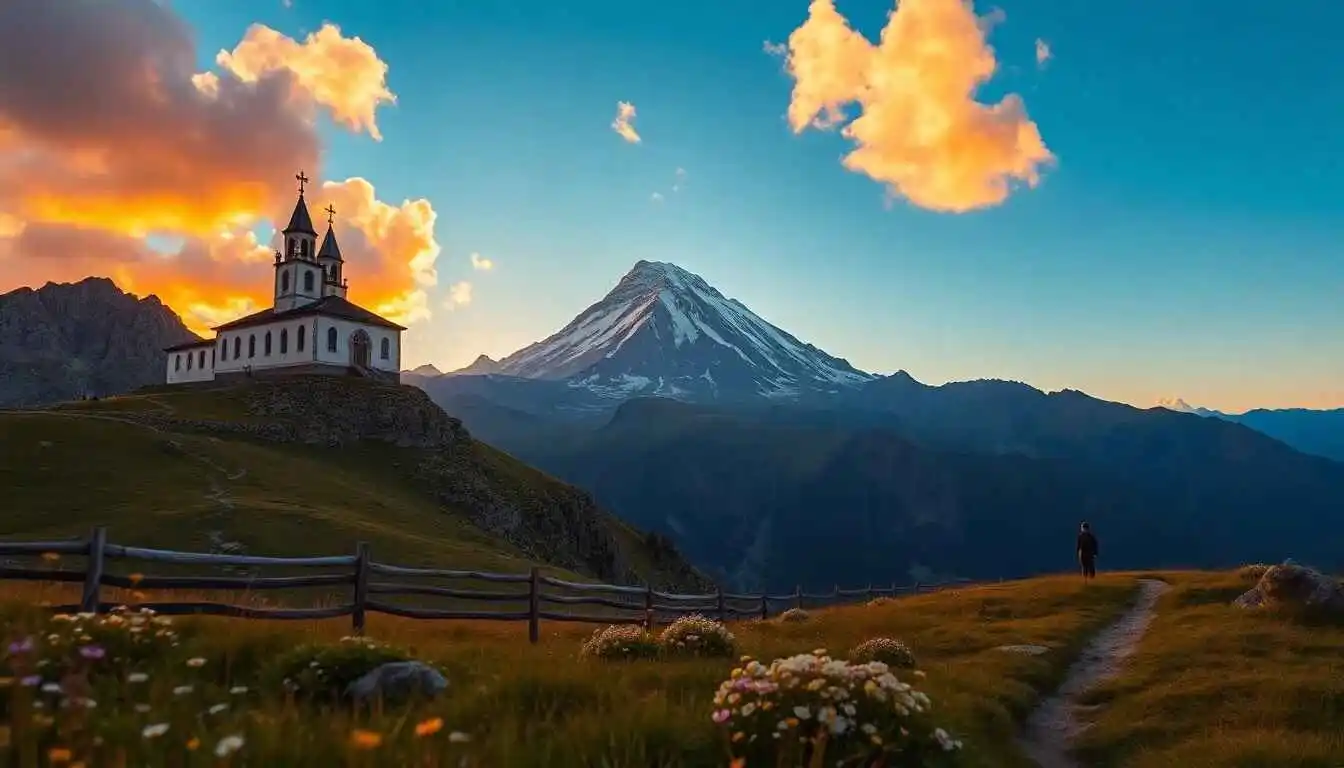
A four-hour drive north of Tbilisi along the dramatic Georgian Military Highway, Kazbegi is home to one of the most photographed scenes in the Caucasus: the 14th-century Gergeti Trinity Church (Tsminda Sameba), sitting on a 2,170-metre promontory with the 5,047-metre Mount Kazbek directly behind it. The hike to the church takes 2–3 hours from town and rewards trekkers with views that feel almost impossible. The surrounding Kazbegi National Park offers multi-day hikes through alpine meadows, glaciers, and remote villages.
Mtskheta — Georgia’s Spiritual Heart
Just 20 kilometers from Tbilisi, Mtskheta is Georgia’s ancient capital and a UNESCO World Heritage Site. The Svetitskhoveli Cathedral, dating to the 11th century and built over the spot where Christ’s robe is said to be buried, is the holiest site in the country. The Jvari Monastery, perched dramatically on a clifftop above the confluence of the Mtkvari and Aragvi rivers, is visible from the highway and utterly breathtaking at sunrise.
Vardzia — The Cave City
Carved into the volcanic cliffs of the Erusheti Mountain in southern Georgia, Vardzia is a 12th-century rock-hewn monastery complex that once housed up to 50,000 people across 3,000 rooms. Built under Queen Tamar, it includes a church, wine cellars, a royal chamber, and miles of tunnels. The drive through the Javakheti plateau to reach it is half the adventure.
Kakheti — The Wine Soul of Georgia
Georgia is widely credited as the birthplace of wine, with an unbroken tradition of winemaking stretching back 8,000 years. Kakheti, the eastern wine region centered on the towns of Telavi and Sighnaghi, is where this story lives most vividly. Visit family-run wineries to see the traditional qvevri (clay amphora) method of winemaking. Sighnaghi, a walled hilltop town dubbed “the city of love,” offers stunning Alazani Valley views and dozens of excellent wine tasting rooms.
Svaneti — The Towers of Time
The remote high-mountain region of Svaneti in northwestern Georgia is one of the last truly wild places in Europe. The Svanetian people have lived in medieval defensive towers (koshkebi) for a thousand years, and dozens still stand in every village. The regional capital of Mestia is the base for skiing, trekking, and exploring, while the village of Ushguli, at 2,100 meters, is one of the highest continuously inhabited settlements in Europe and a UNESCO World Heritage Site.
Batumi — The Black Sea Riviera
Georgia’s subtropical second city on the Black Sea coast blends Art Deco architecture, gleaming modern skyscrapers, a lively boulevard, botanical gardens, casinos, and beaches into one dizzyingly energetic place. The Batumi Botanical Garden, established in 1912, spans 113 hectares and is one of the finest in the world. Batumi is Georgia’s summer capital — warm, loud, and endlessly entertaining.
Borjomi — Mineral Springs and Forests
Famous across the former Soviet Union for its mineral water, Borjomi is a charming spa town in central Georgia set within a gorge of forested mountains. The mineral springs in the public park are free to drink from directly. The nearby Borjomi-Kharagauli National Park is Georgia’s largest protected area and excellent for hiking and mountain biking.
Activities and Experiences
Paragliding: Gudauri and Kazbegi are prime locations for tandem paragliding with jaw-dropping Caucasus Mountain views.
Skiing and Snowboarding: Gudauri ski resort (2,200–3,300m) rivals’ Alpine resorts at a fraction of the price, with excellent powder conditions from December to April.
Wine Tasting Tours: Kakheti offers organized tours from Tbilisi or self-guided cellar visits in villages like Kvareli, Telavi, and Gurjaani.
Sulphur Baths: Tbilisi’s historic Abanotubani district has private Sulphur bath rooms for rent — the silky, therapeutic mineral water is an experience unique to this city.
Rafting and Kayaking: The Mtkvari and Rioni rivers offer white-water rafting. The Martvili Canyon in western Georgia is a stunning location for boat tours through turquoise gorges.
Horseback Riding: Village-based horse treks are popular in Kazbegi, Svaneti, and Tusheti, one of Georgia’s most remote and spectacular highland regions.
Polyphonic Choir Concerts: Georgian polyphonic singing is on the UNESCO Intangible Cultural Heritage list. Live performances in Tbilisi’s old town churches or restaurants offer a genuinely moving cultural experience.
Culinary Classes: Several cooking schools in Tbilisi teach khinkali dumpling-making, churchkhela (walnut-and-grape candy), and khachapuri (cheese bread) preparation.
Local Commutation
Marshrutka (Minivan): The backbone of Georgia’s public transport system. These shared minivans connect every town and village and are cheap but often crowded and erratically timed. Ideal for the adventurous budget traveler.
Train: Georgian Railway connects Tbilisi to Batumi, Kutaisi, Zugdidi (for Svaneti), and Borjomi. Night trains with sleeper carriages are comfortable and scenic.
Metro: Tbilisi has a clean and cheap metro system with two lines covering most key areas of the city. A single journey costs 1 GEL (Georgian Lari), approximately 0.35 USD.
City Buses: Tbilisi, Batumi, and Kutaisi have extensive bus networks. A Metro money card is used for both the metro and buses in Tbilisi.
Taxis and Ride-hailing: Bolt and Yandex Go apps work reliably in all major Georgian cities and are inexpensive by international standards. Always use the app rather than flagging street taxis to avoid overcharging.
Car Rental: Renting a car unlocks Georgia’s hidden regions — essential for Kazbegi, Kakheti, Vardzia, and Svaneti. Roads vary from excellent to challenging mountain tracks. A 4WD is recommended for rural areas. International driving licenses are accepted.
Where to Eat — Georgian Cuisine and Restaurant Picks
Georgian food is magnificent — hearty, flavorful, and built around communal feasting. The traditional table, or supra, is a philosophy as much as a meal: dozens of dishes arriving continuously, presided over by a tamada (toastmaster) offering eloquent toasts.
Khinkali: Juicy soup dumplings filled with spiced meat (or mushroom and cheese for vegetarians). The correct technique is to hold by the top knot, bite a small hole, slurp the broth, then eat. Do not eat the knot — it is the handle.
Khachapuri: Georgia’s soul food — a boat-shaped bread filled with melted sulguni cheese and topped with an egg and butter. The Adjaruli style from Batumi is the most indulgent version.
Mtsvadi: Georgian-style skewered meat (pork or lamb), grilled over vine wood for a smoky, irreplaceable flavor.
Badrijani Nigvzit: Fried aubergine rolls stuffed with a spiced walnut paste — a perfect vegetarian dish.
Churchkhela: Strings of walnuts dipped in thickened grape juice and dried — Georgia’s version of an energy bar, sold at every market.
Restaurant Recommendations:
- Shavi Lomi, Tbilisi — Celebrated for modern Georgian cooking in a beautiful old-town setting.
- Barbarestan, Tbilisi — Menu inspired by a 19th-century Georgian cookbook; extraordinary and unique.
- Culinarium Khasheria, Tbilisi — Essential stop for Georgian craft beer and classic dishes.
- Machakhela, Batumi — Reliable, affordable, and delicious chain restaurant for Georgian staples.
- Pheasant’s Tears, Sighnaghi — A legendary winery-restaurant where natural wines and seasonal food come together in Kakheti’s most charming town.
- Café Littera, Tbilisi — Fine dining set in the Georgian Writers’ Union garden; impeccably presented modern Georgian cuisine.
Practical Travel Tips
Currency: The Georgian Lari (GEL) is the currency. ATMs are widely available. USD and EUR can be exchanged easily at banks and exchange bureaux (savaluto). Cards are accepted in most Tbilisi restaurants and hotels.
Language: Georgian is the official language and uses a unique script (Mkhedruli) that is unlike any other writing system. English is spoken by most people in tourism, hospitality, and the younger urban population. Russian is still widely understood by older Georgians.
Safety: Georgia is considered one of the safest countries in the region. Petty crime is low, and solo travel — including for women — is generally very safe. Normal urban vigilance applies.
SIM Card: Purchase a local SIM at the airport or in Tbilisi from Magti or Geocell for cheap data. A 10GB tourist package costs approximately 15 GEL.
Power: Georgia uses 220V, Type C/F plugs (standard European). Bring an adapter if coming from the UK or the USA.
Health: No mandatory vaccinations. Tap water is safe to drink in Tbilisi. Pack basic medications, as pharmacies are plentiful, but prescription norms differ.
Budget: Georgia is exceptionally good value. A comfortable mid-range traveller can expect to spend USD 50–80 per day, including accommodation, food, local transport, and activities.
FAQS
- Do I need a visa to visit Georgia?
Citizens of over 95 countries, including the EU, USA, UK, Australia, and Canada, can visit Georgia visa-free for up to 365 days. Check the official Georgian e-Visa portal for your specific nationality.
- What currency is used in Georgia?
The Georgian Lari (GEL) is the official currency. USD and EUR are widely accepted for exchange. Cards are accepted in cities, but carry cash for rural areas and markets.
- Is Georgia safe to travel solo?
Yes, Georgia is widely considered one of the safest countries for solo travel in the region, including for solo female travelers. Violent crime is rare, and hospitality to strangers is deeply cultural.
- What language do people speak in Georgia?
The official language is Georgian (Kartuli), written in the unique Mkhedruli script. English is widely spoken in tourism and hospitality, especially among younger people in cities.
- What is the best time of year to visit Georgia?
Spring (April–June) and autumn (September–November) are ideal for most visitors. Summer is perfect for beaches and high-altitude trekking; winter is excellent for skiing.
- How do I get from Tbilisi Airport to the city centre?
The Tbilisi metro (Rustaveli or Liberty Square stations, reached from Isani station) is the cheapest. Bolt or Yandex Go taxis are convenient and cost around 20–30 GEL. An express bus also connects the airport.
- Is Georgia an expensive destination?
No. Georgia is very budget-friendly by European standards. A mid-range traveler spends around USD 50–80/day, including accommodation, food, and transport.
- What is the food like in Georgia?
Georgian cuisine is rich, hearty, and extraordinarily flavorful. Highlights include khinkali (soup dumplings), khachapuri (cheese bread), mtsvadi (grilled meat), and an astonishing variety of walnut-based dishes.
- Can I drink the tap water in Georgia?
Yes, tap water in Tbilisi is safe to drink. In rural areas or small towns, bottled water is recommended.
- What is Georgian wine, and why is it special?
Georgia is considered the birthplace of wine, with an 8,000-year tradition. The qvevri method — fermenting wine in clay amphorae buried underground — produces unique amber (skin-contact) wines unlike anything else in the world.
- How do I travel between Georgian cities?
Options include marshrutka (shared minivans), train (reliable for Tbilisi–Batumi), and rental car. Bolt-style taxis and private transfers are also widely available.
- Is it possible to visit Georgia on a budget?
Absolutely. Street food, guesthouses, and public transport make Georgia one of the most backpacker-friendly countries in Europe/Asia. USD 30–40/day is very comfortable on a budget.
- How do I get from Tbilisi to Kazbegi?
Marshrutkas depart daily from Didube Bus Station in Tbilisi (around 10–15 GEL, 3–4 hours). Private transfers cost around 80–120 USD. The scenic drive along the Georgian Military Highway is worth it.
- Can I hike to Gergeti Trinity Church?
Yes. The hike from Stepantsminda village takes 2–3 hours (approximately 10km round trip) with 700m elevation gain. It is a moderate-to-difficult hike with no technical sections, but altitude and gradient should be respected.
- What is the must-visit wine regions?
Kakheti (eastern Georgia) is the primary wine region, centred on Telavi, Sighnaghi, and Gurjaani. Kakheti produces around 70% of Georgia’s wine.
- What religions are practiced in Georgia?
Georgian Orthodox Christianity is the dominant faith, practiced by roughly 80% of the population. Muslims are a significant minority, particularly in Adjara and Kvemo Kartli regions. Georgia has a proud tradition of religious tolerance.
- Can I visit Georgia in winter?
Yes! Gudauri ski resort is world-class and far less crowded than its European counterparts. Tbilisi in winter is atmospheric, and Orthodox Christmas (January 7th) is a beautiful time to visit.
- What should I wear when visiting Georgian churches?
Women are required to cover their heads and shoulders; men must not wear shorts. Scarves and skirts are often available at church entrances. Respecting these customs is important.
- Is internet and mobile connectivity reliable in Georgia?
Yes. 4G coverage is good in cities and major tourist areas. A local SIM (Magti or Geocell) offers excellent data rates. Most hotels, cafes, and restaurants offer Wi-Fi.
- What is the Georgian tradition of the supra?
The supra is Georgia’s traditional feast — a table laden with dozens of dishes, presided over by a tamada (toastmaster) who offers elaborate toasts to family, guests, peace, and love. Being invited to a supra is one of travel’s great privileges.
- How do I get to Svaneti?
Fly from Tbilisi to Mestia (Vanilla Sky Airlines, approximately 1 hour) or take a shared minivan from Zugdidi (5–6 hours on a winding mountain road). A train from Tbilisi to Zugdidi (overnight sleeper) is a scenic option.
- Is Batumi worth visiting?
Yes, especially in summer. Batumi offers a unique mix of beach life, Art Deco architecture, modernist towers, a botanical garden, and a lively nightlife scene — all in a subtropical climate.
- Are there vegetarian and vegan options in Georgia?
Yes, more than many visitors expect. Georgian cuisine includes many naturally plant-based dishes — badrijani nigvzit (aubergine with walnuts), lobiani (bean bread), pkhali (vegetable-walnut bites), and mushroom or cheese khinkali.
- What is Vardzia, and how do I get there?
Vardzia is a 12th-century cave monastery complex carved into a volcanic cliffside in southern Georgia. Access is by car or marshrutka from Akhaltsikhe (40 minutes). It is best combined with a visit to the Rabati Castle in Akhaltsikhe.
- Is Georgia LGBTQ+ friendly?
Georgia’s cities, particularly Tbilisi, have a small but growing LGBTQ+ community, and Pride events have been held in recent years. However, conservative social attitudes are prevalent across much of the country. Public displays of affection are advised against outside of liberal urban spaces.
- Can I rent a car in Georgia?
Yes. International driving licenses are accepted. Rental costs are low by European standards. A 4WD vehicle is strongly recommended for mountain regions such as Kazbegi, Svaneti, and Tusheti.
- What souvenirs should I bring home from Georgia?
Top picks include qvevri wine (especially natural amber wine), churchkhela (walnut-grape candy), chacha (Georgian grappa), handmade wool or felt items, Adjarian woodwork, and antique items from the Dry Bridge market in Tbilisi.
- What is chacha?
Chacha is Georgia’s traditional grape-based spirit — similar to Italian grappa or Turkish raki. It is often homemade, can be eye-wateringly strong (50–70% ABV), and will be pressed upon you everywhere. Accept graciously.
- How many days do I need to see Georgia?
A minimum of 7–10 days covers Tbilisi, Kazbegi, Mtskheta, and Kakheti. Two weeks allows the addition of Batumi, Svaneti, or Borjomi. Three weeks lets you explore Georgia properly — and you will still want to return.
- Is Georgia a safe destination for families with children?
Yes. Georgians adore children, and families with young travelers will find warm welcomes everywhere. Family-run guesthouses are charming, and the combination of mountains, castles, cave cities, and beaches makes Georgia endlessly engaging for children of all ages.
Disclaimer: The content on this blog is for informational purposes only. The author’s opinions are personal and not endorsed. Efforts are made to provide accurate information, but completeness, accuracy, or reliability are not guaranteed. The author is not liable for any loss or damage resulting from the use of this blog. It is recommended to use the information on this blog at your own discretion.
