
Table of Contents
Laos Unveiled: The Ultimate Travel Guide to the Land of a Million Elephants
Introduction
In the heart of Southeast Asia lies a country that time seems to have gently bypassed. While its neighbors—Thailand, Vietnam, and Cambodia—race towards modernization with bustling metropolises and neon-lit skylines, Laos remains the sleepy, serene soul of the region. Known historically as the “Land of a Million Elephants,” Laos is a tapestry of mist-shrouded mountains, emerald-green rice paddies, and the meandering Mekong River that serves as the lifeblood of the nation.
Traveling to Laos is not just about ticking sights off a checklist; it is about immersing yourself in a rhythm of life dictated by nature and spirituality. It is the sound of saffron-robed monks collecting alms at dawn, the taste of spicy jeow bong (chili paste) on sticky rice, and the sight of a golden sunset reflecting off an ancient temple spire. This comprehensive guide covers everything you need to know—from the vibrant streets of Luang Prabang to the limestone karsts of Vang Vieng—ensuring your journey through this landlocked paradise is seamless and unforgettable.
How to Get There
Laos is landlocked, bordered by China to the north, Vietnam to the east, Cambodia to the south, and Thailand and Myanmar to the west. Despite its geographical isolation, getting into the country has become increasingly convenient over the last decade.
By Air There are three main international gateways:

- Wattay International Airport (VTE) in Vientiane: The capital’s airport is the primary hub for international flights. It connects directly with major Asian cities like Bangkok, Hanoi, Ho Chi Minh City, Kuala Lumpur, Singapore, and Seoul.
- Luang Prabang International Airport (LPQ): This airport serves the cultural heart of the country and is a popular entry point for tourists wanting to skip the capital. Direct flights are available from Bangkok, Chiang Mai, Hanoi, and Siem Reap.
- Pakse International Airport (PKZ): Located in the south, this is the entry point for those visiting the Bolaven Plateau and the 4000 Islands. Flights mainly arrive from Ho Chi Minh City and Siem Reap.
By Land Crossing into Laos is an adventure in itself and is popular among backpackers doing the “Southeast Asia Loop.”
- From Thailand: The most popular crossing is the First Thai-Lao Friendship Bridge between Nong Khai (Thailand) and Vientiane (Laos). Another scenic option is the Second Thai-Lao Friendship Bridge between Mukdahan and Savannakhet. For those heading north, the Chiang Khong/Huay Xai crossing is the gateway to the slow boat journey down the Mekong.
- From Vietnam: There are several border crossings, with the most frequented being the Nam Can border connecting Vinh (Vietnam) to Phonsavan (Laos), and the Lao Bao border leading to Savannakhet.
- From Cambodia: The main crossing is at Voeung Kam/Dong Calor, connecting Stung Treng in Cambodia with the 4000 Islands region in Laos.
By River For a truly cinematic arrival, take the “Slow Boat” from Houay Xai (on the Thai border) down the Mekong River to Luang Prabang. This two-day journey offers a rustic view of river life, though it requires an overnight stop in the village of Pak Beng.
Documents to Carry and Visa Requirements
Navigating the bureaucracy is generally straightforward in Laos, but preparation is key to avoiding hiccups at the border.
Visa on Arrival (VOA) Most Western tourists (including those from the US, UK, EU, Australia, and Canada) are eligible for a Visa on Arrival. This is valid for 30 days.
- Cost: Approximately USD 30–42 (prices vary by nationality; Thai Baht is sometimes accepted but at poor exchange rates).
- Requirements:
- A passport with at least six months of validity remaining.
- Two recent passport-sized photos (4×6 cm).
- The exact visa fee in US Dollars (cash is king; crisp, undamaged bills are preferred).
- A filled-out application form (provided on arrival or on the plane/bus).
E-Visa To streamline the process, Laos has introduced an E-Visa system available through the official government website. This allows travelers to apply online and receive a digital visa before they travel, saving time at immigration counters at major airports and land borders.
Important Documents Checklist
- Passport: Ensure it is valid for at least 6 months beyond your entry date.
- Travel Insurance: While not strictly enforced at the border, it is highly recommended. Medical facilities outside Vientiane can be basic, and evacuation to Thailand may be necessary for serious issues.
- Vaccination Certificates: No mandatory vaccinations are required for entry unless you are arriving from a yellow-fever-endemic country. However, carrying your COVID-19 vaccination record is still a good practice as regulations can change.
- Printed Itinerary & Hotel Bookings: Immigration officers occasionally ask for proof of onward travel or accommodation details. Having a printed copy of your first hotel reservation is a smart precaution.
- Driver’s License: If you plan to rent a motorbike or car, an International Driving Permit (IDP) is legally required. Local police often check for this at checkpoints.
Places to Visit: The Must-See Destinations
Laos offers a diverse range of environments, from the spiritual north to the tropical south.
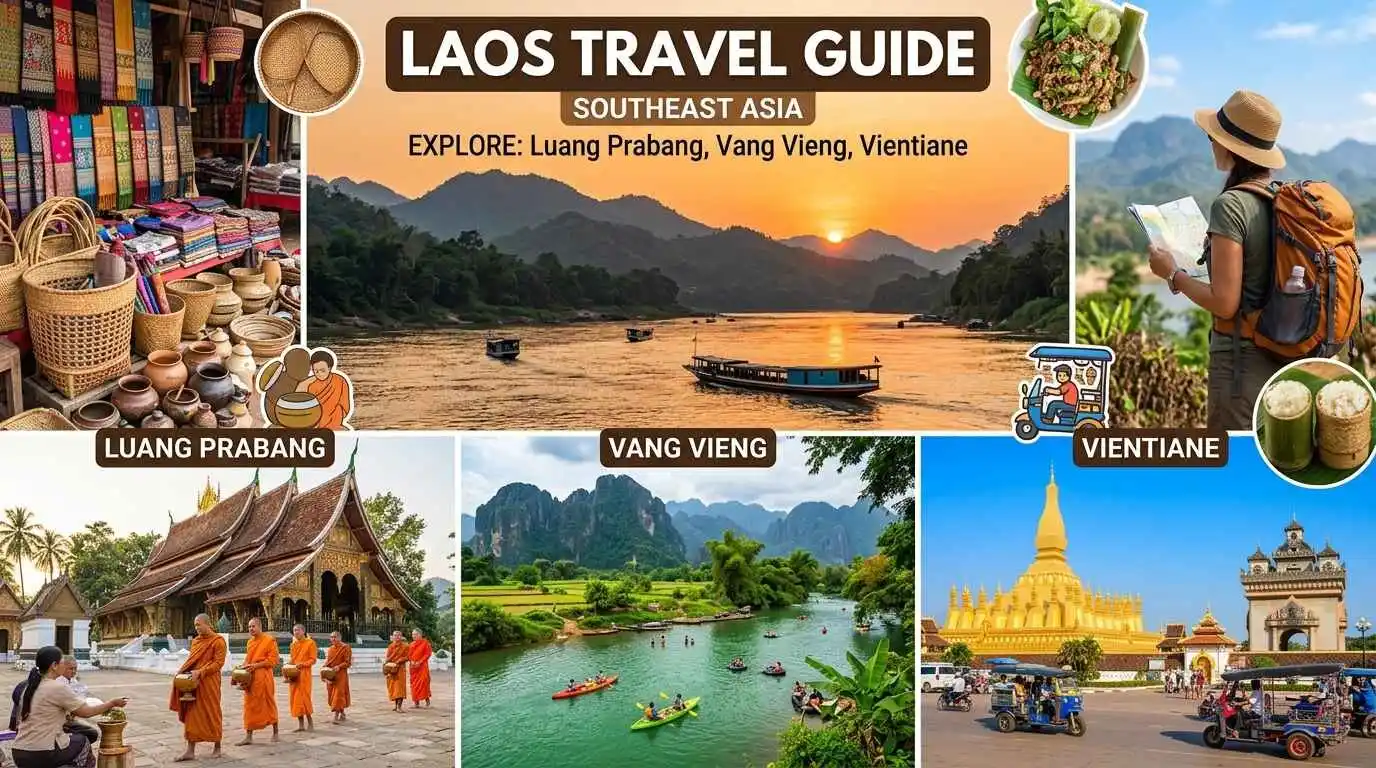
- Luang Prabang: The Spiritual Heart A UNESCO World Heritage Site, Luang Prabang is often cited as the most beautiful city in Southeast Asia. It is a peninsula nestled between the Mekong and Nam Khan rivers, famous for its fusion of traditional Lao architecture and European colonial influences.
- Highlights: Wake up at dawn to witness the Alms Giving ceremony (Tak Bat), where hundreds of monks walk silently through the streets. Visit the Royal Palace Museum and climb Mount Phousi for panoramic views. Don’t miss the turquoise cascades of the Kuang Si Falls, located just 45 minutes outside the city.
- Vang Vieng: Adventure Capital Once notorious for wild tubing parties, Vang Vieng has reinvented itself. Set against a dramatic backdrop of limestone karsts and rice paddies, it is now a hub for eco-tourism and adventure.
- Highlights: Explore the Blue Lagoons (1, 2, and 3), go hot air ballooning for a sunrise view, or explore the vast cave systems like Tham Chang. The Nam Song River offers kayaking and tubing, but in a much more relaxed manner than in the past.
- Vientiane: The Laid-Back Capital Vientiane feels more like a large town than a capital city. It retains a sleepy charm with wide boulevards and French colonial villas.
- Highlights: Pha That Luang (the Great Stupa) is the most important national monument. Patuxai (Victory Gate) offers a view of the city from the top. Visit the quirky Buddha Park (Xieng Khuan), a riverside sculpture park filled with bizarre statues.
- The Plain of Jars (Phonsavan) Located in Xieng Khouang Province, this mysterious archaeological landscape features thousands of giant stone jars scattered across the highlands. Their origin remains debated, with theories ranging from ancient burial sites to whiskey storage for giants.
- Highlights: Visiting Sites 1, 2, and 3. The area is also significant for its history as one of the most heavily bombed regions during the Secret War. The MAG (Mines Advisory Group) visitor center is a humbling stop.
- The 4000 Islands (Si Phan Don) In the deep south, the Mekong River fans out into a maze of waterways and islands. This is the closest Laos gets to a beach destination.
- Highlights: Relax on Don Det (backpacker favorite) or the quieter Don Khon. Spot the rare Irrawaddy dolphins at the Cambodian border and visit the majestic Khone Phapheng Falls, the largest waterfall in Southeast Asia.
- Bolaven Plateau Rising above the heat of the lowlands, this plateau is famous for its cool climate, coffee plantations, and waterfalls.
- Highlights: Trekking through ethnic minority villages, sipping fresh Lao coffee at the source, and visiting the thundering Tad Fane and Tad Yuang waterfalls.
Activities: What to Do
Laos is a playground for nature lovers and culture enthusiasts.
- Trekking and Eco-Tourism: The northern provinces, particularly around Luang Namtha and Phongsaly, offer excellent trekking. The Nam Ha National Protected Area is renowned for community-based trekking, where you stay in village homestays.
- The Gibbon Experience: Located in Bokeo Province, this unique conservation project allows visitors to stay in treehouses accessible only by zip-line, flying over the canopy of the rainforest.
- Water Activities: Kayaking the Mekong or the Nam Ou River offers a perspective of the country you can’t get from the road. Tubing in Vang Vieng remains a classic, though safety standards have improved.
- Cooking Classes: In Luang Prabang or Vientiane, take a cooking class to learn the art of Lao cuisine, starting with a trip to the local market to buy ingredients.
- Yoga and Wellness: With its slow pace, Laos is perfect for wellness retreats. Several centers in Luang Prabang and Vang Vieng offer yoga, meditation, and massage courses.
Moving Around: Transportation Tips
Getting around Laos is part of the adventure, but it requires patience. The roads are often winding and mountainous, meaning distances that look short on a map can take a long time to cover.
By Bus and Minivan. This is the primary mode of transport for locals and tourists.
- VIP Buses: These are the most comfortable option for long journeys (e.g., Vientiane to Luang Prabang). They usually have air conditioning and are larger, offering more stability on winding roads.
- Minivans: Faster but often driven aggressively. They can be cramped for tall travelers.
- Sleeping Buses: Common on overnight routes (like Vientiane to Pakse). The beds are often narrow and stacked bunk-style.
By Domestic Flight, Lao Airlines connects major cities (Vientiane, Luang Prabang, Pakse, Phonsavan). Flying is the quickest way to cover large distances and offers stunning aerial views of the mountains, though it is significantly more expensive than bus travel.
By the River The Mekong and Nam Ou rivers are historic highways. The slow boat to Luang Prabang is a classic experience. For a premium price, you can charter a private long-tail boat, which allows you to stop at villages and caves along the way.
By Tuk-Tuk and Jumbo Within cities, tuk-tuks (called jumbos in Laos) are the go-to for short trips. Always negotiate the price before you get in. In Vientiane, taxi apps like Loca and Grab are becoming available, offering fixed pricing and air-conditioned cars, which is a welcome alternative to haggling.
By Motorbike Renting a motorbike is popular in places like Vang Vieng and Luang Prabang. However, traffic in Vientiane can be chaotic, and road conditions in rural areas can be treacherous (potholes, dust, livestock). If you ride, always wear a helmet and drive defensively.
Accommodations: Where to Stay
Laos offers accommodation ranging from ultra-budget dorms to ultra-luxury resorts.
Luxury in Luang Prabang, the luxury scene is defined by converted French colonial mansions and boutique retreats.
- Top picks: Amantaka (secluded elegance), Belmond La Résidence Phou Vao (infinity pool with views), and Avani+ Luang Prabang.
- In Vang Vieng, Riverside Boutique Resort offers a blend of comfort and style.
Mid-Range There is a healthy selection of 3-4 star hotels and guesthouses that offer great value. Look for places around the Night Market in Luang Prabang or the riverfront in Vientiane. Prices usually range from $30–$60 USD per night, often including breakfast.
Budget/Backpacker Hostels are abundant in Vang Vieng and Don Det. You can find a bed in a dorm for as low as $3–$5 USD or a basic private room for $10. Be sure to check reviews for cleanliness and noise levels, as insulation is often poor in budget buildings.
Homestays. For an authentic experience, opt for a homestay in a rural village (often organized through trekking tours in Luang Namtha). This provides a direct insight into the daily life of the Lao people.
Eat Outs: A Culinary Journey
Lao cuisine is one of the most underrated in Southeast Asia. It is fresh, spicy, and heavily reliant on fresh herbs and sticky rice.
Must-Try Dishes
- Laap (Larb): The national dish. It is a “salad” of minced meat (chicken, beef, duck, or fish) seasoned with fish sauce, lime juice, toasted rice powder, and heaps of fresh mint and coriander. It can be served raw (laap sien) or cooked (laap suk).
- Khao Soi: Not to be confused with the coconut-curry version found in Thailand, Lao Khao Soi is a noodle soup with a rich pork and tomato broth, served with fermented soybeans and fresh herbs.
- Tam Mak Hoong (Papaya Salad): The Lao version of the Thai Som Tam. It is punchier and more savory, often using Padaek (fermented fish sauce) and crab paste.
- Mok Pa: Fish steamed in banana leaves with herbs, lemongrass, and chili.
- Khao Niew (Sticky Rice): Eaten with almost every meal. It is served in a small bamboo basket and eaten with your hands.
Where to Eat
- Street Stalls: Often the best and cheapest food. Look for busy stalls with high turnover.
- Night Markets: The Luang Prabang Night Market is famous for its “buffet” stalls where you fill a plate with various dishes for a set price. The Vientiane Night Market offers a variety of grilled fish and meats.
- Cafes: Due to the French colonial influence, the coffee culture and bakery scene are excellent. In Vientiane and Luang Prabang, you can find incredible croissants, baguettes, and Lao coffee (robusta beans, strong and chocolatey).
Practical Tips and Cultural Etiquette
