
Table of Contents
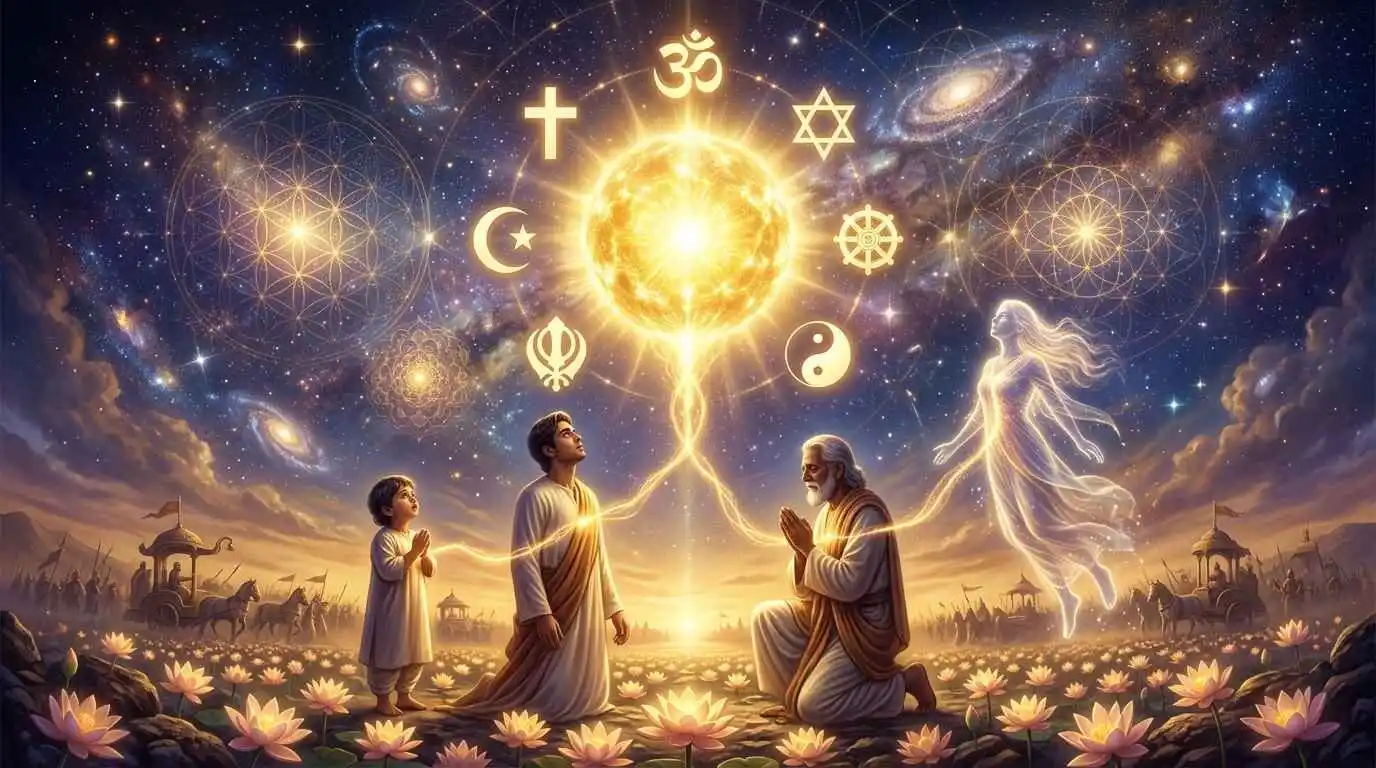
The Deathless Self: What the Bhagavad Gita’s Most Profound Verses Reveal — And How the World’s Great Religions Agree
“One who thinks that Spirit is a slayer, and one who thinks Spirit is slain, are both ignorant. Because Spirit neither slays nor is slain.” — Bhagavad Gita, Chapter 2, Verses 19–22
Introduction: A Truth That Transcends Time
More than 5,000 years ago, on the battlefield of Kurukshetra, a conversation took place that would become one of humanity’s most enduring philosophical monuments. The warrior Arjuna, overwhelmed by grief at the prospect of fighting his own kinsmen, collapsed in anguish — his bow falling from his hands, his spirit broken. What followed was not a battle plan. It was a revelation about the very nature of reality, the self, and what it means to exist.
Lord Krishna’s response to Arjuna’s despair began with perhaps the most radical idea in all of ancient philosophy: grief over death is rooted in a fundamental misunderstanding of what we are. The body changes. The body perishes. But the Spirit — the Atman, the true Self — does not. It cannot be cut by weapons. It cannot be burned. It cannot be wetted by water or dried by wind. It is eternal, indestructible, and beyond the reach of birth and death.
These verses — particularly the second chapter’s verses 19 through 22 — are not mere poetry. They represent a complete philosophical system: a vision of consciousness that is uncaused, unborn, undying, and untouched by the constant flux of the material world. And what makes them even more astonishing is how frequently, in how many different languages, cultures, and centuries, the same essential truth has been independently arrived at by spiritual traditions across the globe.

This is the story of those verses — their meaning, their depth, and their remarkable resonance with the world’s great religious and philosophical traditions.
The Verses: Understanding What Krishna Actually Said
“One Who Thinks Spirit Is a Slayer…”
The opening declaration is a direct challenge to ordinary perception. In everyday consciousness, we identify completely with the body. When the body is threatened, we believe we are threatened. When the body dies, we believe we die. Krishna identifies this identification as the root of all suffering — and declares it simply and completely wrong.
The one who believes Spirit can slay — perhaps the aggressor who imagines that taking a life grants some ultimate power — and the one who believes Spirit can be slain — perhaps the victim who believes death is the end — are both operating from the same fundamental error. They have confused the vessel for the ocean. They have mistaken the temporary costume for the eternal actor wearing it.
This is not a metaphor. In the Vedantic understanding, the Atman — the individual Spirit or Self — is identical in essence to Brahman, the universal consciousness underlying all existence. It does not merely survive death. It was never born in any meaningful sense that would subject it to death. It is before birth and posterior to death, untouched by the drama playing out between these two events.
“Just as a Living Being Acquires Bodies…”
The second movement of these verses introduces one of the most powerful analogies in world literature. Just as a single continuous person moves through childhood, youth, and old age — wearing different bodies, with different capabilities, different appearances, different names in the world’s perception — without ever ceasing to be the same essential person, so the Spirit moves through lifetimes.
The child’s body and the elder’s body are radically different. An old photograph of yourself at age five might show someone you barely recognize. The cells that composed that child’s body are largely gone. The hormones, the neural architecture, the size, the capabilities — all transformed beyond recognition. Yet there is a continuous thread of identity that persists. Something that knows: I was that child. I am now this adult.
Krishna invites us to extend this recognition one step further. If identity can persist across the enormous changes within a single lifetime, why should we assume it cannot persist across the transition we call death? The form changes. The essential witness does not.
“The Wise Are Not Deluded by This”
The final phrase is perhaps the most important. Wisdom, in this context, is not intellectual cleverness. It is not the accumulation of information. It is the direct recognition — deeply felt, not merely intellectually grasped — that you are not your body. You are not your thoughts. You are not your emotions. You are the awareness in which all of these arise and pass away.
This recognition does not make the wise indifferent to life or callous toward suffering. It liberates them from the specific, crippling fear that underlies so much human behavior: the terror of non-existence. When you know at a cellular level — or rather, at a level deeper than cells — that you cannot cease to exist, the quality of your engagement with life changes entirely. You can act with full commitment without being paralyzed by the fear of loss.
Hinduism: The Source and the Context
Within the Vedantic tradition from which these verses arise, the teaching of Atman — the immortal self — is the very spine of the entire philosophical system.
The Upanishads, which predate the Bhagavad Gita and form its philosophical foundation, are saturated with this recognition. The Chandogya Upanishad contains the famous instruction of the sage Uddalaka to his son Shvetaketu: “Tat tvam asi” — “That thou art.” You are not separate from the ground of all being. You are it. The individual self, when seen clearly, is not a fragment of the divine but the divine itself, seen from a particular angle.
The Katha Upanishad contains a striking parallel to the Gita verses: “The knowing Self is not born, nor does it die.” And further: “This ancient one is unborn, eternal, undecaying. It is not killed when the body is killed.” These are not the Gita verses — they are a separate text, written at a separate time, arriving at precisely the same conclusion.
The concept of reincarnation — samsara — in Hindu philosophy provides the cosmological framework in which the body-changing analogy operates. The soul journeys through multiple incarnations, accumulating and working through karma, the moral weight of action and intention. Liberation — moksha — comes when the illusion of the separate self dissolves entirely, and the individual Atman recognizes its identity with universal Brahman.
Buddhism: Impermanence, Non-Self, and the Stream of Consciousness
Buddhism presents a fascinating parallel and, at first appearance, a challenging counterpoint. The Buddha explicitly denied the existence of a permanent, unchanging self — the doctrine of anatman (non-self) is one of the three marks of existence in Buddhist philosophy, alongside impermanence (anicca) and suffering (dukkha).
At first glance, this seems to flatly contradict the Gita’s teaching of an immortal Atman. But the apparent contradiction dissolves under careful examination.
What Buddhism denies is not consciousness itself, but the ego — the constructed, defended, falsely permanent sense of self that ordinary humans mistake for who they are. This is precisely what Krishna also refutes. When he says that neither the slayer nor the slain truly exists in the ultimate sense, he is pointing to the unreality of the ego-identified self — the very thing Buddhism targets.
What continues across lifetimes in Buddhist thought is not a fixed soul-entity but a stream of consciousness — a santana — carrying the imprints of karma forward. The image used in Buddhist texts is the flame: when you light one candle from another, is the flame that passes the same flame or a different one? It is neither simply the same nor simply different. It is a continuity.
The Tibetan Buddhist tradition of the Bardo Thodol — the Tibetan Book of the Dead — describes in rich detail the journey of consciousness after physical death and before the next birth. The fundamental advice given to the dying and the dead is strikingly Vedantic: recognize the clear light of pure consciousness that arises at the moment of death as your own true nature. Do not be frightened by it. Merge with it.
The practical wisdom is identical across traditions: misidentification with the temporary is the source of suffering, and recognition of the deathless is the path to freedom.
Christianity: The Soul’s Immortality and Resurrection
Christian theology affirms the immortality of the soul with great force, though within a framework of creation rather than eternal pre-existence. In mainstream Christian teaching, each soul is uniquely created by God and does not pre-exist the body as in Hindu thought. But the soul’s destiny is eternal — it does not perish with the body.
The Gospel of John contains perhaps the most direct resonance with the Gita’s teaching: “I am the resurrection and the life. Whoever believes in me, though he die, yet shall he live” (John 11:25). And more radically: “Before Abraham was, I am” (John 8:58) — a declaration by Jesus of an identity that transcends the temporal, a consciousness that is before historical time.
St. Paul’s first letter to the Corinthians addresses the resurrection of the dead with an analogy that strikingly echoes Krishna’s body-changing metaphor: “What you sow does not come to life unless it dies. And what you sow is not the body that is to be, but a bare kernel… So is it with the resurrection of the dead. What is sown is perishable; what is raised is imperishable.” (1 Corinthians 15:36-42). The kernel and the plant are radically different in form — yet share an essential continuity.
The mystical tradition within Christianity moves even closer to the Vedantic position. Meister Eckhart, the 13th-century German mystic, spoke of the soul’s ground — the Seelenfünklein or “spark of the soul” — as being identical with the ground of God. “The eye through which I see God is the same eye through which God sees me,” he wrote — a statement that would not be out of place in the Chandogya Upanishad.
The Christian martyr’s tradition — from St. Stephen to the countless martyrs of the early church — was sustained by exactly the experiential conviction that Krishna articulates: death cannot touch what is essential. The body may be killed. The self cannot be.
Islam: The Ruh and the Return to God
Islamic theology holds that God breathes the ruh — the divine spirit — into each human being, and that this spirit returns to God after death. The Quran speaks with great certainty about life after death: “And they ask you about the soul. Say: The soul is of the command of my Lord, and you are not given of knowledge except a little.” (Quran 17:85).
The Quranic teaching of inna lillahi wa inna ilayhi raji’un — “Indeed, we belong to Allah and to Him we shall return” — encodes a cosmology of origin and return. Existence is a temporary separation from the divine source; death is the beginning of the journey back.
The Sufi tradition within Islam, represented by poets and mystics such as Rumi, Hafiz, and Ibn Arabi, moves into territory philosophically very close to the Gita’s teaching. Rumi’s Masnavi opens with the image of the reed flute crying for its origin — a metaphor for the soul’s longing for reunion with the divine from which it has been separated. His poetry returns again and again to the theme that death is not an ending but an unveiling:
“Die before you die, and discover that there is no death.”
This is not far from what Krishna teaches Arjuna. The “death” that must occur is the death of the ego-identified self — the illusion of separateness. What is revealed when that illusion dissolves is the deathless.
Ibn Arabi’s metaphysics of wahdat al-wujud — the unity of being — holds that all existence is a manifestation of the divine Being, and that the apparent multiplicity of individual selves is a play of the one divine reality. This is, in its essential structure, Advaita Vedanta in Arabic.
Judaism: The Neshamah and the Eternal Covenant
In Jewish thought, the neshamah — the highest dimension of the soul — is a portion of the divine light breathed into humanity at creation. The Kabbalah, the mystical tradition within Judaism, offers a rich map of the soul’s multi-layered nature: nefesh, ruach, neshamah, chayah, and yechidah — dimensions of being ranging from the animating vital force to the portion of the soul that is utterly unified with the divine.
The Zohar, the central text of Kabbalistic literature, teaches that souls descend from the divine realm into physical existence to fulfill a specific purpose, and after death return to their source. The physical lifetime is, in this framework, a brief sojourn in a foreign land — and death is the homecoming.
The Hasidic tradition intensifies this: the Ba’al Shem Tov, the 18th-century founder of Hasidism, taught that every individual soul is a flame lit from the divine fire, and that the purpose of spiritual practice is to become transparent to that original fire — to let the ego-self become so clear that the divine light shines through without obstruction.
Here again, the convergence with the Gita is striking. The soul is before the body, persists through it, and returns to its origin. The body-changing analogy of Krishna finds its Jewish parallel in the soul’s successive incarnations through multiple lifetimes — a teaching present in Kabbalistic texts such as the Bahir and the Zohar, where reincarnation (gilgul neshamot) is treated as a matter of course.
Sikhism: The Atma and Waheguru
Sikhism, founded in 15th-century Punjab by Guru Nanak, offers one of the most direct convergences with the Gita’s teaching on the immortal Self. The Guru Granth Sahib — the eternal, living scripture of Sikhism — is replete with verses affirming the soul’s immortality and the illusion of identifying with the temporary body.
Guru Nanak teaches: “The soul does not die; it does not drown. It does not burn in fire.” The resonance with Krishna’s declaration — that the spirit cannot be wetted, burned, or cut — is not coincidental but reflects the shared philosophical inheritance of the Indic tradition and, perhaps more profoundly, the shared territory of direct mystical experience.
The Sikh concept of hukam — divine will or cosmic order — and the soul’s journey through various forms before ultimately reuniting with Waheguru (the Wondrous Lord) mirrors the Hindu concept of the soul’s journey through samsara toward moksha. The goal in Sikhism is mukti — liberation from the cycle of birth and death — achieved through naam simran, the meditative repetition of the divine name, which gradually dissolves the ego and reveals the underlying divine reality.
Taoism and Ancient Chinese Philosophy: Wu Wei and the Undying Flow
The Tao Te Ching of Lao Tzu approaches the question of death from a different angle — but arrives at a compatible destination. The Tao — the underlying principle of all existence, the unnamed source from which all things arise and to which all things return — is eternal and beyond all concepts, including death.
“The Tao that can be named is not the eternal Tao.” This via negativa echoes the Upanishadic neti, neti — “not this, not this” — the approach to ultimate reality by negating all limited descriptions. The Atman, like the Tao, cannot be adequately captured by any positive description.
Lao Tzu writes: “Returning to the root is called stillness. Stillness is called returning to one’s destiny. Returning to one’s destiny is called the eternal.” The identification of the deepest self with the eternal is the same recognition the Gita points toward, expressed in the cosmological language of a different tradition.
Zhuangzi, the second great Taoist philosopher, faced the death of his wife with equanimity that shocked his contemporaries. He explained, “When she first died, do you think I didn’t grieve like anyone else? But I looked back to her beginning and the time before she was born… She was in the midst of the ten thousand things and passed through a magical transformation, and at the end of it, she died. It’s just like the progression of the four seasons.” The individual transformation — birth, life, death — within the larger continuity is precisely the body-changing wisdom Krishna articulates.
Ancient Egyptian Religion: Ka, Ba, and the Immortal Spirit
Among the oldest religious traditions in recorded history, the ancient Egyptian understanding of the soul offers a multi-layered vision of the self that anticipates the Vedantic framework in remarkable ways. The Egyptians understood the human person as comprising multiple spiritual dimensions: the Ka (vital force), the Ba (individual personality or soul), and the Akh (the immortal, transfigured spirit).
The entire apparatus of Egyptian funerary religion — mummification, the Book of the Dead, the elaborate preparation of tombs — was premised on a single conviction: the essential self continues beyond physical death. The body was preserved so that the Ka could return to it; the Ba traveled through the Duat (the underworld) to face judgment before Osiris; the Akh, if the deceased had lived rightly, achieved a state of eternal divine existence.
The Book of the Dead’s declaration — “I am Yesterday, Today, and Tomorrow” — is a claim to timeless identity that resonates with Krishna’s teaching. The wise in Egyptian tradition, as in the Gita, understood that the self that observes the body’s changes is not subject to those changes.
The Convergence: What All These Traditions Are Saying
Across the extraordinary diversity of language, culture, mythology, ritual, and theology represented by these traditions, a single recognition surfaces with remarkable consistency. Whether called Atman, Ruh, Neshamah, Soul, Tao, or Akh, the essential self is not identical with the body. It is not produced by the body. It is not destroyed when the body is destroyed.
This convergence is not a coincidence of borrowed ideas. These traditions developed in geographic and cultural isolation from each other. The Hebrew prophets were not reading the Upanishads. The Taoist sages were not consulting the Zohar. The mystics of Sufism arrived at their conclusions through a different language and a different scripture than the Christian contemplatives.
What they share is not a common text but a common experience — the experience of consciousness turning its attention upon itself and discovering, beneath the layers of body, emotion, and thought, something that is before all of them. Something that does not move when the body moves, does not age when the body ages, does not fear what the body fears.
This is what Krishna calls the witness of the body’s journeys. This is what all these traditions are pointing toward, each in its own language, through its own symbols, along its own path.
The Living Relevance: What These Verses Mean for Today
In an age of unprecedented material advancement and, paradoxically, unprecedented existential anxiety, the teaching of these verses is not merely of philosophical interest. It speaks directly to the deepest source of human suffering: the terror of impermanence, the anguish of loss, the paralysis that comes from over-identifying with what is temporary.
Grief is real and should not be bypassed. Loss is real and should be honored. But beneath grief lies a question that is rarely examined: What is the thing I am afraid of losing? When you look closely, you discover that what you fear losing is not merely the person or the thing — but your own sense of being. And that sense of being, as these verses declare across five millennia and every inhabited continent, is not in danger.
Modern neuroscience and quantum physics have begun, tentatively and metaphorically, to explore territory that these traditions mapped long ago. Consciousness remains the deepest mystery in science — the so-called “hard problem” of explaining why there is subjective experience at all. Some physicists, including the late David Bohm and the late John Wheeler, have proposed frameworks in which consciousness is fundamental rather than derived — not produced by matter but underlying it.
This is, in the language of physics, what the Upanishads said in Sanskrit, what the Tao Te Ching said in Classical Chinese, and what these verses of the Bhagavad Gita say in the poetry of a battlefield conversation that was never really about war.
Conclusion: The Gift of the Deathless View
The warrior Arjuna received these teachings in the most extreme circumstances imaginable — on the edge of a battlefield, in the grip of devastating grief and moral confusion. And that, perhaps, is their deepest message about context. This wisdom is not for the meditation retreat only, not for the temple or the monastery. It is for the moment of maximum pressure, maximum grief, maximum confusion.
When the ground gives way. When loss feels absolute. When the darkness seems final.
At that moment, across five thousand years and every inhabited continent, the world’s wisest voices have said the same thing in different tongues: Look more carefully at what you are. The part of you that is looking cannot be touched by what you are looking at. You are the witness of the journey, not the vehicle making it.
The body changes from childhood to youth to age. A new body follows death, as natural as one season following another. The wise are not deluded by this — not because they do not feel, but because they feel everything from a place that is not threatened by any of it.
This is the gift of the deathless view. Not an escape from life, but a full and fearless entry into it.
Frequently Asked Questions
- What is the source of these verses?
They come from the Bhagavad Gita, Chapter 2, verses 19–22, part of a dialogue between Lord Krishna and the warrior Arjuna before the Battle of Kurukshetra.
- What does “Spirit” refer to in these verses?
Spirit refers to the Atman — the individual self or consciousness — which in Vedantic philosophy is identical in its essential nature with Brahman, the universal divine consciousness.
- What is the difference between Atman and Brahman?
Atman is the individual self; Brahman is the universal self or ground of all being. Advaita Vedanta holds that they are ultimately the same — the apparent difference is the result of cosmic illusion (maya).
- Why does Krishna say the slayer and slain are both ignorant?
Because both are operating under the illusion that the Spirit — the true self — can be affected by physical death. It cannot be, because it is not a physical entity.
- What is the body-changing analogy trying to show?
It demonstrates that a continuous identity persists through radical changes in physical form — just as you remain “you” from childhood to old age despite complete physical transformation.
- Does this teaching encourage indifference to death and killing?
No. It teaches non-attachment to the temporary body without denying the reality of suffering or the moral weight of action. Krishna’s teaching is embedded within a complex ethical framework, not a justification for violence.
- What is the concept of reincarnation in Hinduism?
Reincarnation (samsara) is the journey of the soul through multiple lifetimes, accumulating karma until liberation (moksha) is achieved through spiritual realization.
- How does Buddhism differ from Hinduism on the immortal soul?
Buddhism denies a fixed, permanent soul (anatman) but affirms a continuum of consciousness that carries karma across lifetimes — different in metaphysics but convergent in practical insight.
- Does Christianity believe in the pre-existence of the soul?
Mainstream Christianity does not affirm the soul’s pre-existence before birth, unlike Hinduism. However, Christian mysticism approaches this territory in its emphasis on the soul’s divine ground.
- What do Sufi mystics like Rumi say about death?
Rumi teaches that physical death is not the end but a transformation — a return to the divine source. His instruction to “die before you die” refers to ego dissolution during earthly life.
- What is the Islamic concept of the Ruh?
The Ruh is the divine spirit breathed into humans by God. It returns to God after death. Sufi tradition explores this return as the soul’s reunion with its origin.
- What does Judaism teach about the soul’s immortality?
Jewish tradition, especially Kabbalah, teaches a multi-layered soul that pre-exists in the divine realm, incarnates for spiritual purposes, and returns to God. The Zohar explicitly teaches reincarnation (gilgul neshamot).
- What does Sikhism say about the soul’s journey?
The Guru Granth Sahib affirms the soul’s immortality and its journey through multiple forms before reuniting with Waheguru. The goal is mukti — liberation from the cycle of birth and death.
- How does Taoism relate to the Gita’s teaching?
Taoism’s concept of the eternal Tao — the unnameable source to which all things return — parallels the Vedantic Brahman. Zhuangzi’s philosophical acceptance of death resonates directly with the Gita’s wisdom.
- What did ancient Egyptians believe about the soul after death?
They believed the essential self (Akh) achieved eternal divine existence after death, provided the person had lived rightly. The elaborate funerary system was designed to support this journey.
- What is Advaita Vedanta?
Advaita (non-dual) Vedanta is the school of Hindu philosophy associated with Adi Shankaracharya that holds that individual consciousness (Atman) and universal consciousness (Brahman) are ultimately the same.
- Is the Gita’s teaching compatible with modern science?
Some physicists and consciousness researchers have proposed frameworks in which consciousness is fundamental rather than produced by matter — a position that resonates with the Vedantic view, though science has not confirmed this.
- What is the “hard problem” of consciousness?
It refers to the philosophical difficulty of explaining why and how physical processes give rise to subjective experience — a problem that has led some thinkers to consider whether consciousness might be fundamental to reality.
- What is Maya in Hindu philosophy?
Maya is the cosmic illusion that causes the one divine reality to appear as a multiplicity of separate selves and objects. Recognizing Maya is the beginning of liberation.
- What is moksha?
Moksha is liberation from the cycle of birth, death, and rebirth — the realization of the identity of Atman and Brahman, resulting in permanent freedom from suffering.
- Did Meister Eckhart’s teachings align with Vedanta?
Remarkably closely. His teaching that the soul’s ground is identical with God’s ground parallels Advaita Vedanta’s Atman-Brahman identity, though developed entirely within the Christian mystical tradition.
- What is the Tibetan Book of the Dead?
The Bardo Thodol is a Tibetan Buddhist text that describes the states of consciousness after death and guides the dying and deceased toward liberation. It teaches recognition of pure consciousness at death.
- How does the concept of karma relate to reincarnation?
Karma is the moral weight of intentions and actions that accumulates across lifetimes. The soul takes on new bodies to work through karma until the slate is cleared and liberation is achieved.
- What is anicca in Buddhism?
Anicca is impermanence — the recognition that all conditioned phenomena, including the physical body, are constantly changing. This aligns with the Gita’s teaching that the body is temporary.
- What is the Zohar?
The Zohar is the central text of Jewish Kabbalistic mysticism, attributed to Rabbi Shimon bar Yochai. It contains extensive teachings on the soul’s nature, its journey, and its relationship to the divine.
- What practical difference does believing in the immortal self make?
It transforms the relationship with fear, grief, and mortality. Those who genuinely recognize their identity as before the body can act with commitment and courage without being paralyzed by the terror of loss.
- Is reincarnation exclusively a Hindu and Buddhist concept?
