
Table of Contents
Childhood, Youth, Old Age, Death: The One Sentence in the Gita That Rewrites How You See Change
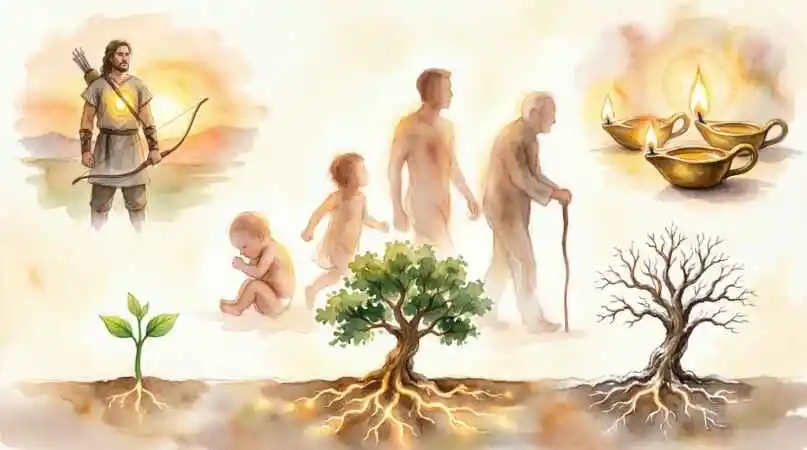
Somewhere on a battlefield, moments before a war that will decide the fate of a kingdom, a warrior lowers his bow and refuses to fight. His cousins, teachers, and childhood friends stand arrayed on the opposing side, and the thought of killing them has hollowed him out completely. It is in this moment of total collapse that Krishna offers not comfort, but a single, quietly devastating observation about the nature of change itself: just as a living being acquires a childhood body, a youth body, and an old-age body during this life, similarly it acquires another new body after death. The wise are not deluded by this.
This is verse 2.13 of the Bhagavad Gita, and it is easy to read past it quickly, tucked as it is among some of the text’s more famous later lines. But sit with it for even a moment and its logic starts to feel almost unfair in its simplicity. You have already lived through several bodies in this single lifetime. The infant body you were born with no longer exists in any physical sense. The child’s body that followed it is gone too, replaced cell by cell, feature by feature, by the adolescent body, and then the adult body, and eventually, for those who live long enough, the aged body. And yet, through every one of those transformations, something continuous persisted — a sense of being the same ‘you’ who once could not walk, and who may one day struggle to walk again.
Krishna’s argument is that death is simply one more entry on that same list. Not a rupture in the pattern, but a continuation of it — the next change in a sequence you have already been living through, uninterrupted, since the day you were born. The wise, the verse says, are not deluded by this. They do not treat this particular transition as categorically different from all the others that came before it.
This piece unpacks that claim carefully: what the verse is actually saying, why the specific example of childhood-to-youth-to-old-age was chosen rather than any other metaphor, what it means to be ‘undeluded’ in the Gita’s sense, and how this two-and-a-half-thousand-year-old teaching continues to shape how millions of people relate to aging, loss, and mortality today.

1. The Setting: Why This Teaching Arrives in a Moment of Grief
It matters enormously that this verse is not delivered as abstract philosophy in a quiet classroom. It arrives on a battlefield, addressed to a man named Arjuna who has just watched his own resolve dissolve entirely at the sight of relatives he is about to fight. His grief is not hypothetical. It is immediate, physical, and specific — he names people he recognizes across the field, describes his limbs trembling, and states plainly that he would rather be killed than fight.
Krishna’s response, of which this verse is an early and foundational piece, does not dismiss Arjuna’s grief as irrational or weak. It reframes the object of that grief. The teaching is not ‘do not feel loss,’ but rather ‘examine carefully what is actually being lost.’ If the body has already been changing continuously and dramatically throughout a person’s life without erasing their essential identity, then the assumption that death represents a total and final erasure of that identity deserves scrutiny rather than simple acceptance.
This context matters because it shows the teaching was never meant as a cold, detached observation. It was offered as something closer to first aid — a way of steadying a person in the exact moment their grief threatens to overwhelm their capacity to think or act at all.
It is also significant that Krishna does not begin with an appeal to scripture or authority. He begins with something Arjuna, and every listener since, can verify directly from their own life: the simple, undeniable fact of having already lived through radical bodily change without ceasing to exist. The argument is built from the ground up, starting with lived experience rather than doctrine, which is part of why it has continued to resonate across so many centuries and cultural contexts far removed from its original setting.
“Death is framed not as a rupture in the pattern, but as a continuation of it — the next change in a sequence you have already been living through since the day you were born.”
2. The Analogy Itself: Three Bodies, One Continuous Witness
The specific example Krishna chooses is deliberately mundane. He does not reach for an exotic metaphor. He points to something every single listener has already lived through directly: the transition from a child’s body to a youth’s body, and from a youth’s body to an old-age body. There is no philosophical argument needed to establish that these transitions happen. Every person in the audience has experienced at least the first two firsthand.
What the verse asks the listener to notice is something subtler than the fact of physical change itself. It asks them to notice that despite radical, undeniable transformation at the level of the body — different size, different strength, different appearance, different capabilities — there remains a continuous sense of being the one who is undergoing the change. The child who could not yet speak and the adult who now reflects on that childhood are, in some meaningful sense, the same experiencer, even though almost nothing about the physical body has stayed the same.
This continuous experiencer is what later verses of the Gita go on to name explicitly as the atman, or self, distinct from the body it inhabits. Verse 2.13 does not yet use that technical vocabulary; it simply builds the intuitive case for it, using an experience so ordinary that virtually no one can honestly deny having lived through it themselves.
There is a quiet elegance in choosing an example this close to home. A listener cannot dismiss the analogy as merely theoretical, because doing so would require denying their own lived history. This is part of what separates the verse’s method from a purely dogmatic assertion: it does not ask the listener to accept something wholly outside their experience, but rather to look more closely at an experience they already possess and had perhaps simply never examined this carefully before.
3. Extending the Pattern: Why Death Is Framed as ‘Another’ Change, Not a Different Category
The rhetorical move in this verse is precise, and it is worth slowing down to see exactly how it works. Krishna does not simply assert that the soul survives death as a new claim requiring its own separate justification. He extends a pattern the listener has already accepted as true. If body-change across childhood, youth, and old age does not destroy the underlying self, then the burden of proof shifts: why would this next transition, from an old-age body to no body, or to a new body, suddenly be different in kind rather than merely different in degree?
This is a subtly different argument from simply asserting an afterlife on faith. It is an argument by continuity, inviting the listener to test the new claim against a pattern of change they have already personally verified. Whether or not a reader ultimately accepts the metaphysical conclusion, the structure of the reasoning is worth appreciating on its own terms: it does not ask for blind belief in something wholly unfamiliar, but for the extension of a familiar, lived pattern one step further than the listener has previously been willing to take it.
The word used for this transition, dehantara-prapti, translates roughly to ‘the attainment of another body.’ The choice of ‘attainment’ rather than a more neutral or negative term is itself notable; it frames what follows death not as loss but as arrival, mirroring the way we do not typically describe growing from childhood into youth as something tragic, but as something natural and expected.
4. What It Means to Be ‘Undeluded’: The Gita’s Specific Use of Dhira
The verse’s closing phrase, often translated as ‘the wise are not deluded by this,’ uses the Sanskrit word dhira, which carries a slightly different flavor than the English word ‘wise’ suggests on its own. Dhira implies steadiness, firmness, and composure under pressure — closer to ‘the steady-minded’ or ‘the unshaken’ than to ‘the intellectually clever.’ It is not primarily a claim about book knowledge or philosophical sophistication.
This distinction matters because it reframes what the verse is actually asking of its reader. It is not asking for the intellectual acceptance of a metaphysical proposition as a prerequisite for peace. It is describing a particular quality of mind — steadiness in the face of change — that can be cultivated through understanding, reflection, and practice, rather than a fixed trait some people simply possess and others do not.
Delusion, in this context, specifically refers to mistaking a temporary, changing phenomenon for something permanent and final, and reacting with disproportionate distress as a result. The dhira person is not necessarily someone who feels no grief at all. They are someone whose grief is not compounded by the additional, avoidable suffering that comes from believing a natural transition is instead a total catastrophe.
This also clarifies why the verse pairs so naturally with practice rather than mere belief. Steadiness of the kind dhira describes is not typically achieved simply by hearing an argument once and accepting its conclusion intellectually. Like physical composure under pressure, it tends to be built gradually, through repeated exposure to the underlying insight until it becomes something closer to an ingrained disposition than a memorized fact.
5. A Teaching About Aging as Much as a Teaching About Death
Because this verse is most often cited in discussions of death, it is easy to overlook that the majority of its actual content is about aging, not dying. Three of the four bodies mentioned — childhood, youth, and old age — occur entirely within an ordinary lifespan, with no reference to death at all. Death is mentioned almost as an afterthought, the final item in a list the listener has already been living through for decades.
This structure quietly does something valuable for how a person relates to aging itself. Many people experience the transition into middle and older age with a private sense of loss, mourning the body and capacities of youth as though something has gone permanently wrong. The Gita’s framing suggests a different lens: aging is not a deviation from a correct, fixed state, but simply the next scheduled transition in a process that has been running, uninterrupted, since birth. The old-age body is not a corruption of the true self any more than the child’s body was.
Read this way, the verse offers a kind of preparation long before death becomes an immediate concern. A person who has genuinely internalized that childhood, youth, and old age are all equally valid, equally temporary expressions of the same underlying continuity is, in principle, already partway toward the steadiness the verse describes with respect to death itself.
This reframing has practical weight for how a person might approach later decades of life. Rather than treating an aging body as a diminished or lesser version of a ‘real’ younger self, the verse’s logic suggests each stage carries its own complete validity, simply as the current expression of a continuity that has always been changing form. This does not deny the real physical and practical challenges that can accompany aging, but it does offer an alternative to experiencing those challenges as an identity crisis layered on top of them.
6. Common Objections and How the Verse Anticipates Them
A natural objection arises quickly: continuity of memory and personality across childhood, youth, and old age is at least partially observable and verifiable, while continuity across death is not something any living person can directly confirm through ordinary experience. This is a fair distinction, and the verse does not attempt to erase it through argument alone; the broader teaching of the Gita addresses it through a combination of philosophical reasoning, meditative practice, and what practitioners describe as direct inner experience rather than empirical proof in the conventional scientific sense.
A second common objection is that the analogy, however elegant, does not obligate belief. A person can accept that the self persists through bodily change within a single life while still remaining genuinely uncertain about what, if anything, persists after death. The Gita does not treat this uncertainty as a failure of faith so much as an invitation to further inquiry; verses that follow 2.13 go on to build out additional reasoning, using different arguments and metaphors, precisely because a single verse is understood as an opening rather than a complete proof.
It is also worth noting that this teaching does not ask a person to be indifferent to death or to devalue the present life in favor of some future one. The Gita’s broader teaching consistently emphasizes engaged action within the current life; the point of steadiness in the face of death is to enable clearer, less fear-driven action here and now, not to encourage detachment from present responsibilities.
“The dhira person is not necessarily someone who feels no grief at all. They are someone whose grief is not compounded by the additional suffering of believing a natural transition is a total catastrophe.”
7. Modern Parallels: Identity, Change, and the Psychology of Continuity
Contemporary psychology and philosophy of mind have independently grappled with strikingly similar questions about what, if anything, makes a person ‘the same’ person across radical change. Nearly every cell in the human body is gradually replaced over the course of years, memories are reconstructed and revised each time they are recalled rather than played back like an unedited recording, and personality traits shift measurably across a lifespan. In a strictly material sense, the person reading this sentence shares remarkably little literal substance with the child they once were.
And yet the felt sense of continuous identity persists robustly across all of this change, which is part of why questions about personal identity remain a genuinely active area of philosophical inquiry rather than a settled matter. The Gita’s verse anticipates this puzzle by locating continuity not in the material substance of the body at all, but in something the text treats as categorically distinct from it — a move that, whatever one’s metaphysical conclusions, at minimum reframes the puzzle in a useful way.
This is part of why the verse continues to resonate well beyond its original religious and philosophical context. Even readers who do not share the Gita’s specific metaphysical framework often find the underlying observation, that identity survives dramatic bodily change throughout a single lifetime, to be a genuinely useful lens for thinking about their own experience of growing older.
Some contemporary philosophers describe personal identity as a matter of degree or convention rather than a fixed metaphysical fact, which is itself an interesting echo of the Gita’s approach: rather than treating the self as an obvious, unquestioned given, both traditions invite a closer, more deliberate examination of what continuity actually consists of, even if they ultimately arrive at different conclusions about its nature.
8. Living the Teaching: What Steadiness Looks Like in Practice
If dhira describes a cultivated steadiness rather than an innate trait, the natural next question is how that steadiness is actually built. Traditional commentary on this verse generally points toward a combination of study, reflection, and direct practice rather than any single technique. Repeated reflection on one’s own past transitions — genuinely recalling what it felt like to move from childhood into adolescence, or from youth into midlife — can make the abstract logic of the verse concrete and personally verified rather than merely accepted on authority.
Meditative practices aimed at observing the mind itself, rather than merely the content of one’s thoughts, are also frequently recommended as a way of directly noticing the continuity the verse describes: the same quality of awareness that witnessed childhood experiences is, upon close inspection, recognizably the same quality of awareness witnessing the present moment, despite everything else having changed entirely.
Practically, this teaching is often applied less as a single dramatic insight and more as a repeated, ongoing practice — returning to the observation whenever fear of aging, illness, or death arises, and using it as a specific, concrete reminder rather than a vague, general comfort. Over time, practitioners describe this repetition as gradually softening the intensity of fear-driven reactions, even when the underlying uncertainty about what follows death remains fully intact.
Final Thoughts: Small Changes, Real Resilience
It is worth returning, at the end, to where this teaching was first spoken: not in a quiet monastery, but in the middle of a battlefield, to a man whose hands were shaking and whose grief had made him unable to move. That context is not incidental. It is a reminder that this verse was never meant to function as a comfortable abstraction, safely detached from real loss. It was offered as something a person could actually hold onto in the moment their grief threatened to overwhelm them entirely.
The claim at the center of the verse is disarmingly simple: you have already survived enormous, irreversible change many times over, in ways so ordinary that you rarely stop to marvel at them. The infant, the child, the adolescent, the young adult, and eventually the elder are, in the most literal physical sense, not the same body at all. And yet something has persisted through every one of those transitions, steady enough that you can read this sentence and recognize, without hesitation, that all of those bodies were somehow you.
Whether or not that continuity extends beyond death in the specific way the Gita describes is a question this single verse does not fully settle, and it does not pretend to. What it offers instead is a shift in framing sturdy enough to stand on its own: the next transition, whatever it turns out to be, belongs to the same pattern you have already been living through your entire life. The wise, the verse says, are not deluded by this. Perhaps the most practical takeaway is simply the invitation to notice that pattern for yourself, in your own life, before the question of death ever needs to be asked at all.
Arjuna, by the end of the Gita’s full teaching, does eventually pick his bow back up — not because his grief was erased, but because his understanding of what was actually at stake had shifted. That shift began with a single, deceptively simple observation about a pattern he had already been living his entire life: childhood, youth, old age, and one more change still to come. It remains, more than two thousand years later, one of the more quietly persuasive invitations in any spiritual tradition to look at your own life closely enough to see that pattern for yourself.
FAQs
| Question | Answer |
| What verse of the Bhagavad Gita describes the soul acquiring a new body after death? | This teaching comes from Bhagavad Gita chapter 2, verse 13, spoken by Krishna to Arjuna at the beginning of their dialogue on the battlefield. |
| What is the main analogy used in this verse? | The verse compares the soul’s transition into a new body after death to the body’s natural transitions through childhood, youth, and old age within a single lifetime. |
| Why does Krishna use childhood, youth, and old age as the example? | These are universally lived experiences that every listener has already personally undergone, making the analogy concrete and self-verified rather than requiring blind belief in something unfamiliar. |
| What does the word ‘dhira’ mean in this context? | Dhira is often translated as ‘the wise,’ but more precisely conveys steadiness, firmness, and composure under pressure, rather than purely intellectual wisdom. |
| What does it mean to not be ‘deluded’ according to this verse? | It refers to not mistaking a natural, temporary transition, such as death, for a total catastrophe or a fundamentally different category of change than the transitions already experienced in life. |
| What is the context in which this verse was spoken? | It was spoken on a battlefield to the warrior Arjuna, who had become overwhelmed with grief at the thought of fighting his own relatives and teachers. |
| Does this verse suggest death should not be grieved at all? | The teaching reframes the object of grief rather than dismissing grief entirely, encouraging a person to distinguish between natural sorrow and additional, avoidable distress caused by misunderstanding the nature of change. |
| What Sanskrit term is used for ‘acquiring another body’ after death? | The term dehantara-prapti is used, which translates roughly to ‘the attainment of another body,’ framing the transition as an arrival rather than strictly a loss. |
| Is this verse considered proof of reincarnation? | It presents a philosophical argument by analogy rather than empirical proof, inviting the listener to extend a familiar pattern of change one step further rather than asserting the claim on faith alone. |
| How does this teaching relate to the concept of the atman or self? | The verse builds an intuitive case for a continuous self, later referred to explicitly as the atman in subsequent verses, distinct from the physical body it inhabits. |
| Why is this teaching described as being about aging as much as about death? | Three of the four bodies mentioned in the verse, childhood, youth, and old age, occur entirely within a single lifetime, making the verse largely about the nature of change during life itself. |
| Can this verse help with fear of aging, not just fear of death? | Yes, many readers apply the verse’s logic to reframe aging as a natural continuation of an ongoing process rather than a loss of one’s true or authentic self. |
| Does the verse claim the self experienced during childhood is identical to the self experienced now? | It suggests a continuous witnessing presence persists through bodily change, even though the physical body and many personality traits have changed substantially over time. |
| How does modern psychology relate to this ancient teaching? | Contemporary discussions of personal identity similarly examine how a sense of continuous selfhood persists despite constant physical and psychological change, echoing the verse’s underlying observation. |
| What objection is commonly raised against this analogy? | A common objection is that continuity across childhood, youth, and old age is directly observable, while continuity across death is not something that can be empirically confirmed through ordinary experience. |
| Does the Gita address this objection elsewhere in the text? | Yes, subsequent verses build additional reasoning and metaphors, since a single verse is understood within the tradition as an opening argument rather than a complete, standalone proof. |
| Does this teaching encourage detachment from present life and responsibilities? | No, the broader teaching of the Gita consistently emphasizes engaged action in the present life, using steadiness about death to enable clearer action now rather than encouraging withdrawal from responsibility. |
| How can a person practically cultivate the steadiness described by ‘dhira’? | Traditional approaches include reflective study, recalling one’s own past life transitions, and meditative practices focused on observing the continuity of awareness itself. |
| Is this verse specific to Hindu philosophy, or does it appear elsewhere? | While this specific verse and phrasing are unique to the Bhagavad Gita, questions about the continuity of self through change appear across many philosophical and religious traditions in different forms. |
| What is the significance of Arjuna’s emotional state when this teaching is given? | Arjuna’s visible grief and paralysis frame the teaching as a practical response to acute emotional distress rather than as detached academic philosophy. |
| Does accepting this verse require religious belief? | The underlying observation about continuity through bodily change during one’s life can be appreciated on its own terms, even by readers who do not share the Gita’s specific metaphysical conclusions about the afterlife. |
| Why might this verse be comforting to someone grieving a loved one’s death? | It offers a framework in which death is understood as a continuation of an existing pattern of change, rather than an unprecedented and incomprehensible rupture, which some readers find eases acute grief. |
| What does the verse imply about the value of the body itself? | The verse does not devalue the body but distinguishes it from the continuous self that inhabits it, treating each life stage’s body as a valid, if temporary, expression of that continuity. |
| How is this teaching typically interpreted by scholars and commentators? | Commentators generally agree on its core message of continuity through change, though interpretations vary in how literally to read the specific claims about reincarnation and the nature of the afterlife. |
| Does this verse suggest all forms of grief indicate a lack of wisdom? | No, the verse targets the specific delusion of mistaking a natural transition for total annihilation, not the presence of grief itself, which is treated as a natural human response. |
| Can this teaching be applied outside of a religious context? | Many readers apply its underlying logic secularly, using it as a psychological reframe for accepting change and impermanence throughout life, independent of specific metaphysical beliefs. |
| What role does memory play in the continuity described by this verse? | While memory contributes to a sense of continuous identity, the verse points to something the tradition considers more fundamental than memory alone, namely a continuous underlying witnessing presence. |
| Why does the verse compare death to ‘acquiring’ rather than ‘losing’ something? | The choice of the word ‘acquiring’ frames the transition as an arrival rather than strictly a loss, mirroring how growth from childhood to youth is not typically described as tragic. |
| Is there a risk of using this teaching to dismiss legitimate grief? | Traditional interpretation cautions against using the teaching to suppress or dismiss grief; the intent is to reduce unnecessary additional suffering, not to deny the reality or validity of loss. |
| What is the broader significance of this verse within the Bhagavad Gita as a whole? | It serves as an early foundational argument in Krishna’s teaching to Arjuna, setting up later, more detailed discussions of the nature of the self, duty, and the practice of steady, non-attached action. |
Disclaimer: The content on this blog is for informational purposes only. The author’s opinions are personal and not endorsed. Efforts are made to provide accurate information, but completeness, accuracy, or reliability are not guaranteed. The author is not liable for any loss or damage resulting from the use of this blog. It is recommended to use the information on this blog at your own discretion.
