
Table of Contents
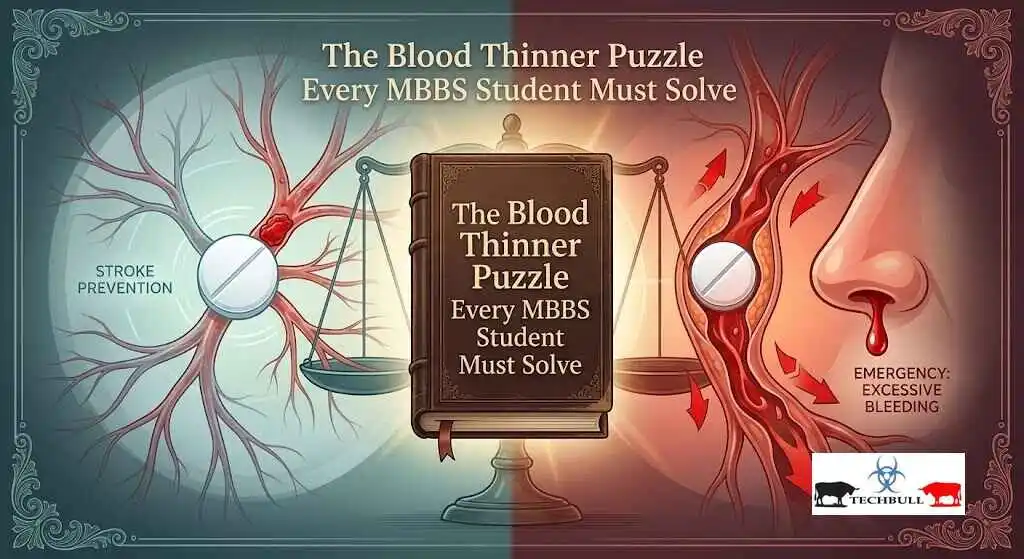
Why Does One Small Tablet Stop A Stroke But Also Turn A Nosebleed Into An Emergency? The Blood Thinner Puzzle
A Patient, A Nosebleed, And A Question That Follows Every One
Mr. Thomas, a 62-year-old retired schoolteacher, walked into the casualty of a busy teaching hospital in Kerala holding a blood-soaked handkerchief to his nose. The bleeding had started an hour earlier and simply would not stop. His son, standing beside him, kept repeating one detail to every nurse and intern who passed by: “He is on a blood thinner, doctor. For his heart.”
Mr. Thomas had suffered a heart attack eight months earlier. A stent was placed in his left anterior descending artery, and since then he had been taking a combination of aspirin and clopidogrel every single day. Nobody had told him that a course of over-the-counter cold medicine, taken for a viral fever three days earlier, could quietly add fuel to a bleeding risk that was already sitting in his blood.
For the interns posted in casualty that evening, Mr. Thomas became more than a patient. He became a live lesson. Why does a tablet meant to protect the heart end up threatening the nose? Why do some patients on blood thinners still form dangerous clots, while others bleed from something as small as a shaving cut? And how does a doctor decide, in the middle of the night, whether to stop the blood thinner, reduce the dose, or simply reassure the family and observe?
The senior resident on duty that night used the case as an impromptu teaching moment, gathering four interns around the casualty desk once Mr. Thomas had been stabilised with local pressure and nasal packing. She asked a simple question that none of them could answer confidently at first: was this nosebleed happening because of the aspirin, the clopidogrel, the cold medicine, or some combination of all three acting together? That single unanswered question is exactly what this article sets out to resolve.

This single case captures the entire tension that blood thinners represent in medicine: the fine line between preventing a fatal clot and causing a dangerous bleed. Understanding that line, not just memorising drug names for the exam, is what separates a doctor who prescribes safely from one who prescribes only by habit. This article walks you through that line the way a bedside discussion would, minus the white coat.
“The fine line between preventing a fatal clot and causing a dangerous bleed is the whole story of blood thinners.”
What Are Blood Thinners, Really? (Definition And Overview)
The term “blood thinner” is a patient-friendly phrase. It does not actually make blood thinner in the way that adding water thins milk. What these medicines really do is interfere with the body’s clotting system, either by slowing down the chemical cascade that forms a clot or by stopping platelets from sticking together. The medical umbrella term for this whole group is antithrombotic therapy, and it sits at the crossroads of cardiology, haematology, and general medicine.
Almost every ward you rotate through as a student, from cardiology to orthopaedics to obstetrics, will have at least one patient on some form of antithrombotic drug. That is precisely why understanding this topic properly, rather than memorising it the night before an exam, will serve you for the rest of your career.
It also helps to remember that the body’s clotting system is not something to be switched off completely. The goal of every blood thinner is a careful shift of balance, tilting the scale just enough to prevent a harmful clot without removing the body’s ability to seal an everyday cut or a surgical wound. That balance is the reason doses are so carefully individualised for each patient.
Anticoagulants, Antiplatelets, And Thrombolytics Are Not The Same Family
Students often lump every “blood thinner” into one basket, and this is exactly where confusion begins on the wards and in exams alike.
Anticoagulants act on the clotting factors circulating in plasma. Heparin, warfarin, and the newer direct oral anticoagulants all belong here. They are the mainstay of treatment for venous clots such as deep vein thrombosis, and for stroke prevention in atrial fibrillation.
Anti platelets act on platelets, the small cell fragments that clump together at the site of a vessel injury. Aspirin and clopidogrel are the most familiar names here. They form the backbone of therapy after a heart attack or a stent placement, situations where arterial clots dominate the picture.
Thrombolytics are a different category altogether. Instead of preventing a clot from forming, they dissolve one that has already formed. Drugs such as alteplase are given in acute ischemic stroke or massive pulmonary embolism, usually within a narrow time window, because they carry the highest bleeding risk of the three groups.
Keeping these three families separate in your mind is the first real step toward understanding blood thinners, because each one is chosen for a different kind of clot, sitting in a different part of the vascular tree.
The Physiology Behind The Clot — Why The Body Needs This Balance
To understand any drug that interferes with clotting, you first need to understand why clotting exists at all, and how finely it is normally regulated in a healthy body.
The Coagulation Cascade In Plain Language
When a blood vessel is injured, the body activates a chain reaction of clotting factors, numbered I through XIII, that eventually converts fibrinogen into fibrin. Fibrin strands form a mesh that traps blood cells and seals the injury shut. This chain reaction is called the coagulation cascade, and it has two starting points, the intrinsic and the extrinsic pathways, which meet at a common pathway that leads to fibrin formation.
Warfarin blocks the liver’s ability to make vitamin-K-dependent factors, namely II, VII, IX, and X. Heparin boosts the activity of antithrombin, a natural brake built into the cascade. Direct oral anticoagulants block a single factor directly, either thrombin, also called factor IIa, or factor Xa, which gives them a more predictable effect than warfarin from patient to patient.
Platelets — The Body’s First Responders
Before the coagulation cascade even finishes its work, platelets have already rushed to the site of injury. They stick to exposed collagen, change shape, release chemical signals that recruit more platelets to the area, and finally link together using a receptor called glycoprotein IIb/IIIa. This early platelet plug is especially important in arteries, where blood flow is fast and the vessel wall damage is often related to a ruptured atherosclerotic plaque.
This is exactly why heart attacks are treated with antiplatelets first, and deep vein thrombosis is treated with anticoagulants first. The dominant type of clot in each condition points directly to the dominant drug class needed to fight it.
A useful way to remember this in the exam hall is the phrase “white clot, red clot.” Arterial clots are platelet-rich and appear paler, which is why they respond best to antiplatelets. Venous clots are fibrin-rich and trap more red cells, which is why they respond best to anticoagulants. It is a simplification, but it is a genuinely useful one on the wards.
Types Of Blood Thinners You Will See On The Wards
Antiplatelet Drugs
Aspirin irreversibly blocks an enzyme called cyclooxygenase-1, reducing the platelet’s ability to produce thromboxane A2, a chemical that promotes clumping. Because the effect is irreversible, a single platelet stays affected for its entire ten-day lifespan. Clopidogrel and its newer cousins, prasugrel and ticagrelor, block the P2Y12 receptor on platelets instead. After a stent is placed, patients are typically kept on both an aspirin and a P2Y12 blocker together for a defined period, a strategy known as dual antiplatelet therapy.
Anticoagulants — Heparins And Vitamin K Antagonists
Unfractionated heparin acts fast and is easily reversed with protamine sulfate, which makes it useful in hospital settings, in dialysis, and just before surgery. Low molecular weight heparin, given as a subcutaneous injection, has a more predictable dose-response relationship and is commonly used for DVT prophylaxis on surgical and medical wards. Warfarin remains widely prescribed across India because of its low cost, but it requires regular INR monitoring and carries many food and drug interactions, particularly with green leafy vegetables rich in vitamin K.
Direct Oral Anticoagulants (DOACs)
Dabigatran, rivaroxaban, apixaban, and edoxaban act directly on a single clotting factor and do not usually require routine blood monitoring. They are increasingly preferred for atrial fibrillation and venous thromboembolism where cost is not a limiting factor, though affordability still restricts their wider use in many Indian hospital settings compared with warfarin.
Thrombolytics
Thrombolytics are reserved for true emergencies, such as acute ST-elevation myocardial infarction when timely access to a cath lab is not possible, acute ischemic stroke within the golden window, and massive pulmonary embolism with hemodynamic compromise. Their bleeding risk, including the feared complication of intracranial haemorrhage, means strict eligibility checklists must be completed before a single drop is given.
Case Study — The Patient Who Taught A Ward Full Of Interns About INR
A 68-year-old woman with a mechanical mitral valve, replaced six years earlier, was admitted with sudden weakness of her right arm and slurred speech. Her attendants mentioned that she had missed her warfarin doses for nearly ten days after running out of tablets during a family function in another town.
Her INR on admission was 1.1, far below the target range of 2.5 to 3.5 required for a mechanical mitral valve. A CT scan confirmed an embolic stroke, almost certainly from a clot that had formed inside her heart during the days her anticoagulation had lapsed.
The teaching point for the ward round that morning was simple but powerful: anticoagulation for a mechanical valve is not optional or occasional, it is continuous, because the artificial surface of the valve is a constant trigger for clot formation. Compare this with a patient on aspirin for primary prevention, where missing a few doses rarely causes an emergency of this scale. The consequences of stopping a blood thinner depend entirely on why it was started in the first place, and one case like this usually fixes that concept in a student’s memory far better than any textbook paragraph ever could.
Common Disorders And Diseases Where Blood Thinners Matter
Atrial Fibrillation And Stroke Prevention
In atrial fibrillation, the atria quiver instead of contracting properly, allowing blood to pool and clot, particularly inside the left atrial appendage. These clots can travel to the brain and cause an embolic stroke. The CHA2DS2-VASc score helps decide who genuinely needs anticoagulation, weighing factors such as age, hypertension, diabetes, and any prior stroke or transient ischemic attack.
Not every patient with atrial fibrillation needs anticoagulation, and this is a point many students get wrong in exams. A younger patient with a very low CHA2DS2-VASc score and no other risk factors may not need it at all, which is why the scoring system exists in the first place, to avoid exposing low-risk patients to unnecessary bleeding risk.
Deep Vein Thrombosis And Pulmonary Embolism
Prolonged immobilisation, major surgery, active cancer, and inherited clotting disorders such as Factor V Leiden all raise the risk of clots forming in the deep veins of the leg. If a piece of this clot breaks off and travels to the lungs, it becomes a pulmonary embolism, a potentially fatal event that anticoagulants aim to both prevent and treat.
This is also why every surgical ward in India routinely assesses DVT risk before a major operation. A patient undergoing a long orthopaedic surgery, for instance, may be started on low molecular weight heparin as prophylaxis well before any clot has actually formed, simply because the risk profile is already known in advance.
Myocardial Infarction And Stent Thrombosis
After a heart attack, especially one treated with a stent, dual antiplatelet therapy protects against the stent itself becoming a site of new clot formation, a feared complication called stent thrombosis that carries a very high mortality rate whenever it occurs.
Mechanical Heart Valves And Recurrent Clotting Disorders
Patients with mechanical heart valves need lifelong, tightly monitored anticoagulation, almost always with warfarin, since DOACs have shown clearly worse outcomes in this specific group of patients. Patients with antiphospholipid syndrome or other hereditary thrombophilias also often need long-term anticoagulation after even a single confirmed clotting event.
Bleeding Risk And Drug Interactions
The other side of this coin is bleeding. NSAIDs, certain antibiotics, herbal supplements, and even excessive alcohol intake can all interact with blood thinners and tip the balance toward haemorrhage. This is exactly what happened with Mr. Thomas and his innocent-looking cold medicine, and it is precisely why a thorough medication history must always include over-the-counter drugs and home remedies, not just prescription tablets.
Comparison Table: Major Blood Thinner Classes At A Glance
The table below is the kind of quick-reference summary that helps enormously both on the wards and while revising for a viva.
| Drug Class | Examples | Main Target | Monitoring Needed | Typical Use |
| Antiplatelets | Aspirin, Clopidogrel | Platelet aggregation | Usually none routine | Heart attack, stroke prevention, stents |
| Heparins (UFH/LMWH) | Heparin, Enoxaparin | Antithrombin activity | aPTT (UFH); usually none for LMWH | Acute DVT/PE, surgical prophylaxis |
| Vitamin K Antagonists | Warfarin | Factors II, VII, IX, X | Regular INR checks | Mechanical valves, atrial fibrillation |
| DOACs | Dabigatran, Rivaroxaban, Apixaban | Thrombin or Factor Xa | Usually none routine | Atrial fibrillation, VTE treatment |
| Thrombolytics | Alteplase, Streptokinase | Dissolves existing fibrin clot | Close inpatient monitoring | Acute stroke, massive PE, STEMI |
5 Evidence-Based Tips To Stay Safe On Blood Thinners
- Never skip or double a dose on your own
Missing a dose of warfarin ahead of a mechanical valve can be as dangerous as the case discussed above, while doubling a dose to “catch up” can push you straight into a bleeding emergency. If a dose is missed, the safest step is always to call the prescribing doctor rather than guess.
- Keep INR checks on schedule, and keep vitamin K intake consistent
Patients on warfarin do not need to avoid green leafy vegetables completely. What matters far more is eating a fairly consistent amount week to week, since sudden swings in vitamin K intake are what throw the INR off balance, not the vegetables themselves.
- Always disclose every over-the-counter medicine and supplement
Painkillers, cold remedies, and herbal supplements can all interact with blood thinners in ways patients rarely expect. A five-minute conversation about what else is being taken can prevent the kind of nosebleed emergency that brought Mr. Thomas into casualty.
- Know the warning signs of bleeding and act early
Blood in urine or stool, unusually heavy bruising, prolonged bleeding from small cuts, or a sudden severe headache should never be brushed aside in a patient on any blood thinner. Early reporting almost always leads to a simpler fix than waiting until the bleeding becomes severe.
- Carry a treatment card or wear a medical alert
In an emergency, a simple card mentioning the drug name, dose, and the reason it was started can change how quickly a treating doctor makes the right call, especially if the patient is unconscious, confused, or unable to give a clear history.
Blood thinners are not a single drug or a single idea, they are a whole spectrum of therapies, each tuned to a specific kind of clot, in a specific part of the circulation, for a specific patient. Mr. Thomas’s nosebleed and the stroke that followed a lapse in warfarin both point to the same underlying truth: these medicines demand respect, from doctors and patients alike, because the margin between protection and harm is often measured in a single missed dose or a single unnoticed interaction.
The next time you see “T. Aspirin 75 mg OD” or “Inj. Heparin” written on a case sheet, take a moment to ask why that particular drug was chosen over the others available. That single habit of questioning the reasoning behind a prescription, rather than simply accepting it, is what quietly turns a student into a safe and confident clinician.
Picture this. It is 2 AM in the casualty ward. A 65-year-old man, Mr. Sharma, is brought in by his panicked son. Mr. Sharma had a heart attack six months ago and had a stent placed. Since then, he has been taking a small blood-thinning tablet every morning.
Tonight, he had a simple nosebleed while watching TV. But instead of stopping in five minutes, it bled for an hour. His pillow is soaked in blood. His blood pressure is dropping. His son looks at you and says, “Doctor, this tablet is poison! It stopped his stroke, but it is going to kill him from a nosebleed. Stop it right now!”
How do you explain the paradox of blood thinners? And the biggest question patients always ask: Doctor, once I start this tablet, do I have to take it for the rest of my life?
The Puzzle: How Does One Pill Do Both?
To understand this, you have to understand how our blood works. Think of your blood like a plumbing system inside a house.
Normally, blood flows smoothly like water through pipes. If you get a cut, your body sounds an alarm. It rushes “bricks” (platelets) to the site to block the hole, and then pours “cement” (clotting factors like fibrin) over the bricks to make a permanent plug. Once the hole is sealed, the body cleans up the extra cement so the pipe does not get clogged.
A stroke or a heart attack happens when this alarm system goes off inside the pipes by mistake. A clot forms in a brain artery or a heart artery, blocking the flow.
What does a blood thinner do? It does not actually make your blood watery. That is a myth. Instead, it mutes the alarm system.
Some pills (like Aspirin or Clopidogrel) make the “bricks” (platelets) slippery so they cannot stick together.
Other pills (like Warfarin or Rivaroxaban) stop the “cement” (clotting factors) from forming
By muting the alarm, the pill stops a deadly clot from forming in the heart or brain. But, if you get a cut in your nose or stomach, that muted alarm means your body cannot stop the bleeding quickly. That is why a simple nosebleed becomes an emergency. The drug is working exactly as designed; it is just that the timing and location of the bleed are dangerous
The Million-Rupee Question: Is It Lifelong?
This is the part that confuses students the most. When a patient asks, “Do I have to take this forever?”, the correct medical answer is: It depends entirely on WHY you started it.
You cannot give a blanket “yes” or “no.” You must categorize the patient.
Scenario 1: When the Tablet is STRICTLY Lifelong
There are certain conditions where the risk of a clot is permanent because the underlying mechanical problem in the body cannot be fixed. If you stop the tablet, the patient will absolutely have a life-threatening clot within weeks.
Mechanical Heart Valves: If a patient has an artificial metal valve in their heart, their blood will constantly hit that metal and try to clot over it. They must take Warfarin lifelong. No exceptions.
Atrial Fibrillation (AFib): In this irregular heart rhythm, the upper chambers of the heart just quiver. Blood pools in the corners and forms clots, which then fly to the brain. Unless the heart rhythm is permanently fixed (which is rare), these patients need lifelong blood thinners
Clinical Pearl: In these patients, stopping the tablet suddenly is actually more dangerous than staying on it. When you stop certain blood thinners abruptly, the body goes into a “rebound” state and overproduces clotting factors for a few days. The stroke risk shoots through the roof
Scenario 2: When the Tablet is TEMPORARY (Short-Term
Not all clots mean a lifelong sentence. Sometimes the body just had a temporary bad day. In these cases, you stop the pill after a specific time.
A Provoked DVT (Deep Vein Thrombosis): If a 30-year-old patient gets a blood clot in their leg strictly because they were immobilized in bed for a week after a surgery, that is a “provoked” clot. You give them blood thinners for 3 to 6 months until the clot dissolves. After that, you stop the medicine. Their risk of another clot is now back to normal.
A Pulmonary Embolism (PE) from a long flight: Same concept. Treat for a few months, then stop.
Coronary Stents (The Middle Ground): This is tricky. When a patient gets a stent, the metal mesh can trigger a clot. They are usually put on “Dual Antiplatelet Therapy” (DAPT) – usually Aspirin plus one more pill. They take both for 6 to 12 months. After that, the body coats the stent with natural tissue, and the doctor will usually drop the second pill and keep them only on Aspirin lifelong (or stop everything if their cholesterol and lifestyle are perfect, though this is rare).
How Do You Manage the Nosebleed Without Stopping the Heart Protection?
So, back to Mr. Sharma in the casualty at 2 AM. His son wants you to stop the tablet. What do you do?
You cannot just stop a blood thinner in a stent patient. If you stop it, Mr. Sharma might have a massive heart attack on the table while you are treating his nose.
Here is the clinical approach you must follow:
- Local Control First: You treat the nosebleed locally. You pinch the nose, use ice packs, and if needed, put an anterior nasal pack to apply direct physical pressure to the bleeding vessel.
- Assess the Severity: Is the patient dizzy? Is their blood pressure dropping? Are they vomiting blood? If yes, it is a major bleed.
- The Medication Decision:
- If the bleeding stops with a simple pack, you reassure the family, keep the tablet stopped for one day only, and restart it the next morning
- If the bleeding is life-threatening and will not stop, you have to hold the blood thinner. But, because Mr. Sharma has a stent, you must immediately consult a cardiologist. They might admit him and give him a “bridging” medicine (like an IV drip of Heparin) which has a shorter lifespan in the body, so it can be stopped quickly if the bleeding gets worse, while still protecting the stent.
- Find the Cause: A simple nosebleed should not bleed for an hour, even on blood thinners. Check his blood pressure. Is it 180/110? High pressure is the real reason the nosebleed would not stop. Treat the blood pressure, and the bleeding stops
- The Takeaway for Your Ward Rounds
- Blood thinners are not “good” or “bad.” They are a tightrope walk
- When you are presenting a case to your professor, never just say, “The patient is on blood thinners.” You must say exactly what they are on, why they are on it, and whether it is temporary or permanent
If a patient is on lifelong Warfarin for a mechanical valve, and they come in with a minor stomach upset, you do not stop the Warfarin. You treat the stomach upset.
If a patient had a temporary leg clot after a surgery three months ago, and they come in with a severe stomach bleed, you stop the blood thinner immediately, because the original reason for the pill is gone
Learn the “why” behind the prescription, and you will solve the blood thinner puzzle every single time.
Frequently Asked Questions
- What is the simplest definition of a blood thinner?
A blood thinner mutes the body’s clotting alarm system. It does not make blood watery; it just makes it harder for “bricks” (platelets) or “cement” (clotting factors) to form a plug.
- Are anticoagulants and antiplatelets the same thing?
No, they target different parts of a clot. Antiplatelets make the “bricks” slippery, while anticoagulants stop the “cement” from forming.
- Why is aspirin considered a blood thinner if it is also a painkiller?
At low doses, aspirin mainly targets the “bricks” by making platelets slippery to prevent heart clots, rather than acting on pain pathways.
- What is the difference between warfarin and DOACs?
Warfarin blocks vitamin-K-dependent clotting factors and needs regular INR monitoring. DOACs block a single factor directly and have a predictable, fixed effect.
- Why does warfarin need INR monitoring but DOACs usually do not?
Warfarin’s effect fluctuates wildly with diet and other drugs, so INR checks confirm the dose is safe. DOACs are much more predictable and stable in the body.
- Can I eat green leafy vegetables while on warfarin?
Yes, but keep the amount consistent every week. Sudden changes in vitamin K intake are what disturb the INR, not the vegetables themselves.
- Why are heart attack patients given antiplatelets instead of anticoagulants?
Arterial clots that cause heart attacks are formed mainly from “bricks” clumping rapidly at a ruptured plaque, so antiplatelets target that exact mechanism.
- Why is DVT treated with anticoagulants instead of antiplatelets?
Venous clots form slowly in the legs and are driven mainly by the “cement” coagulation cascade, making anticoagulants the much more effective choice.
- What does dual antiplatelet therapy mean?
It means taking two antiplatelet drugs together, like aspirin plus clopidogrel, to completely paralyze the platelets from clumping on a fresh coronary stent.
- How long does dual antiplatelet therapy usually continue after a stent?
Usually 6 to 12 months, until the body naturally coats the metal stent with tissue. After that, the second pill is often dropped.
- What is the CHA2DS2-VASc score used for?
It estimates stroke risk in patients with atrial fibrillation where blood pools and clots in the quivering heart chambers, helping doctors decide who needs lifelong protection.
- Why do mechanical heart valve patients need lifelong warfarin instead of DOACs?
Because blood hitting an artificial metal valve will constantly try to clot over it. This permanent mechanical problem requires lifelong warfarin to prevent a fatal valve blockage.
- What is the target INR range for a mechanical mitral valve?
It is typically kept tightly between 2.5 and 3.5, though the exact target can vary slightly depending on the specific valve and patient factors.
- What happens if warfarin doses are missed for several days?
Stopping abruptly causes a dangerous “rebound” effect where the body overproduces clotting factors, sending the stroke risk through the roof.
- Why do thrombolytics carry a higher bleeding risk than other blood thinners?
Thrombolytics do not just prevent clots; they actively dissolve existing clots everywhere in the body, including any that are helpfully sealing a bleeding vessel.
- What is the golden window for thrombolytics in ischemic stroke?
It generally refers to the first few hours after symptom onset, within which dissolving the brain clot gives the best chance of recovery without catastrophic bleeding.
- Can NSAIDs be safely combined with blood thinners?
Generally no, NSAIDs add extra strain on the stomach lining and further mute the clotting alarm, making dangerous gastrointestinal bleeds much more likely.
- What are common warning signs of bleeding to watch for?
Because the alarm is muted, watch for blood in urine or stool, unexplained large bruises, a cut that will not stop, or a sudden severe headache.
- Why did Mr. Sharma’s nosebleed turn into an emergency?
The blood thinner was working exactly as designed, but because his clotting alarm was muted, a simple scratch in his nose could not seal itself off and kept bleeding.
- Is it safe to stop a blood thinner before a dental procedure?
Never stop it on your own. You must try local pressure first, because blindly stopping a stent patient’s pill for a dental bleed could trigger a fatal heart attack.
- What is the difference between unfractionated heparin and low molecular weight heparin? Unfractionated heparin works instantly and is easily reversed, making it great for hospital “bridging,” while low molecular weight heparin is given as a predictable daily shot.
- How is unfractionated heparin reversed in an emergency?
Protamine sulfate is given IV to instantly reverse heparin, which is why doctors use heparin as a safe “bridging” net when a patient has a severe bleed.
- What is glycoprotein IIb/IIIa and why does it matter?
It is the final locking mechanism that binds “bricks” together. Some specialized IV drugs block this receptor to completely shut down platelet clumping during a heart attack.
- Why is Factor V Leiden relevant to blood thinner discussions?
It is an inherited genetic mutation that makes the “cement” clot too easily, often requiring longer courses of anticoagulation after a simple leg clot.
- What is antiphospholipid syndrome?
It is an autoimmune condition where the body attacks its own blood vessels, causing rapid clotting in both arteries and veins, requiring strict, long-term anticoagulation.
- Do all patients on blood thinners need to carry a medical alert card?
Yes, it is highly advisable, because if an unconscious patient arrives in the ER, the doctors need to know immediately why their blood will not clot.
- Why is alcohol a concern for patients on blood thinners?
Excessive alcohol irritates the stomach lining and heavily interferes with liver enzymes, making the delicate balance of blood thinners dangerous to maintain.
- Can pregnant women be given blood thinners?
Yes, low molecular weight heparin is safe in pregnancy because it does not cross the placenta, while warfarin is strictly avoided due to severe fetal risks.
- Why do MBBS students need to understand this topic beyond exams?
Because managing blood thinners is a daily tightrope walk on the wards; you must know when a pill is temporary or lifelong to prevent both strokes and fatal bleeds.
- What is the single biggest safety principle with blood thinners?
Never stop a lifelong pill abruptly for a minor issue like a nosebleed, as the rebound clotting risk is far more deadly than the bleed itself; always consult the treating doctor.
⚕️Medical Disclaimer:
The information provided on this website is for general educational and informational purposes only and is not intended as a substitute for professional medical advice, diagnosis, or treatment. Always seek the advice of your physician or other qualified health provider with any questions you may have regarding a medical condition. Never disregard professional medical advice or delay in seeking it because of something you have read on this website.
