
Table of Contents
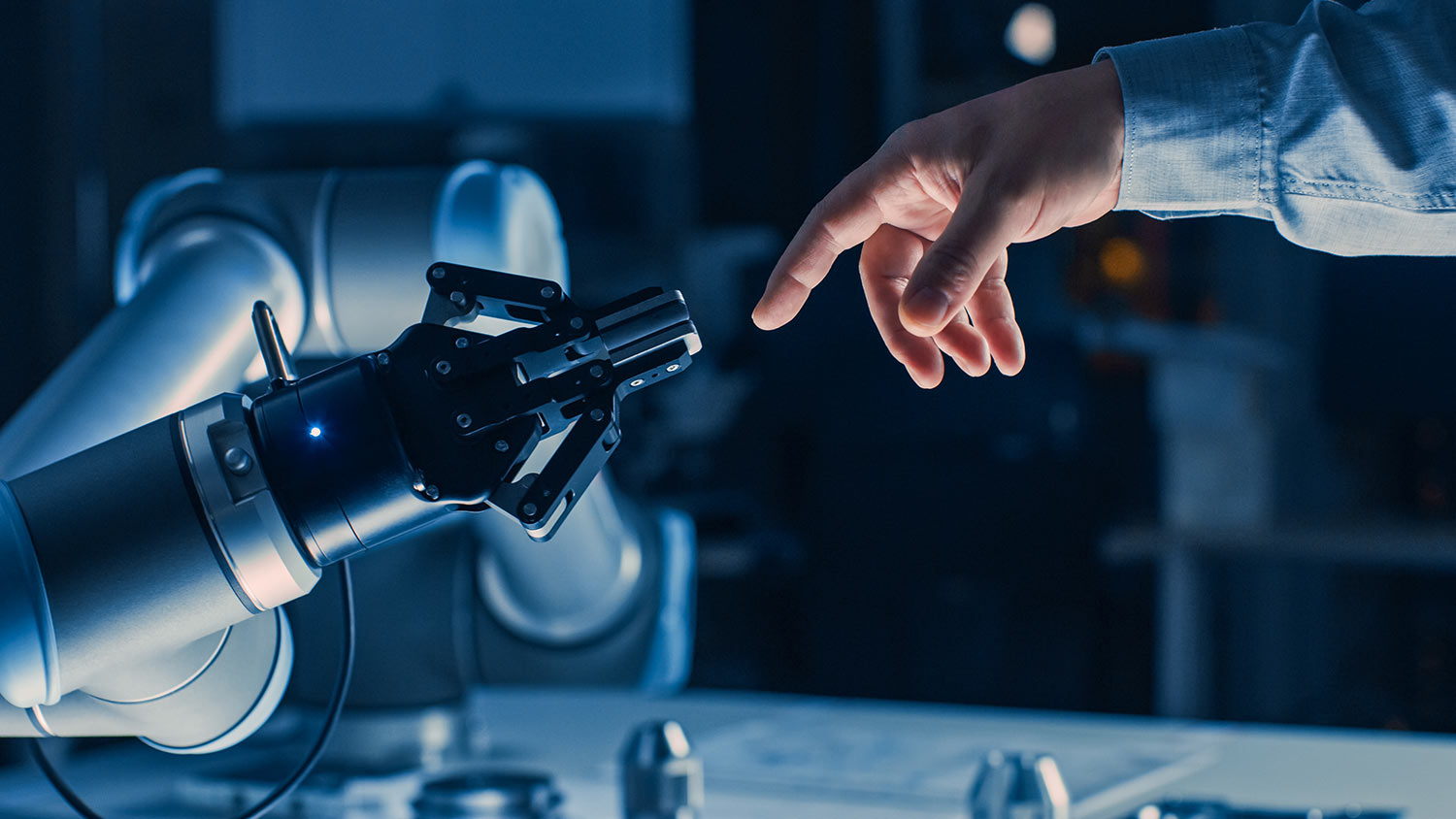
While imitation learning provides a fantastic starting point, true mastery often requires feedback and refinement. This is where sophisticated Human-Robot Interaction (HRI) comes in, transforming the learning process from a monologue into a dialogue.
One of the most intuitive methods is Kinesthetic Teaching. Here, the human physically grabs the robot’s arm and moves it through the desired motion. The robot’s motors go slack, allowing it to be led like a puppet. As the human moves the arm, the robot records the forces and joint angles. This is incredibly effective for teaching fine motor skills and the precise “feel” of a task, like the delicate pressure needed to insert a key into a lock or the specific motion of wiping a table clean.
A more advanced form of HRI is Corrective Feedback. The robot attempts a task it learned through imitation. It might successfully pick up a cup but move it slightly off-center. A human observer can then gently nudge the robot’s hand towards the correct position. This simple physical correction is a powerful piece of data. The robot’s learning algorithm understands that its previous action was slightly wrong and that the human’s correction is the desired outcome. It can then update its internal model to perform better on the next try. This creates a rapid feedback loop where the robot gets closer and closer to the ideal behavior with just a few corrections.
Perhaps the most futuristic frontier of HRI is learning from natural language. A robot is attempting to assemble a piece of furniture. A human watches and says, “No, turn the screwdriver a bit to the left.” The robot must not only understand the words but also connect them to the physical action it is currently performing. It needs to build a model linking spatial directions (“left,” “up”) and actions (“turn,” “push”) to its own motor commands. Research in this area, often combining large language models with robot control policies, is showing that robots can learn to follow complex, multi-step instructions given in plain English, dramatically lowering the barrier for non-experts to teach them new things.

Transfer Learning & Simulation: The Virtual Gym for Robots
Even with these efficient learning methods, training a robot exclusively in the real world has its drawbacks. It’s slow, expensive, and potentially dangerous—robots can break themselves or their surroundings during the learning process. This is where the twin concepts of Simulation and Transfer Learning come into play.
The idea is to create a hyper-realistic virtual environment—a physics sandbox—that perfectly mimics the real world. In this simulation, a robot can practice a task millions of times in a matter of hours. It can drop a virtual egg a thousand times, try to grasp a slippery object from every conceivable angle, and learn from its failures with zero real-world cost. This is the “practice makes perfect” phase, supercharged by the infinite patience of a computer.
The magic trick, however, is getting the skills learned in the pristine virtual world to work on a physical robot in the messy real world. This challenge is known as the “Sim-to-Real” gap. A robot that has only ever seen perfect, computer-generated objects might be confused by the complex textures, lighting variations, and imperfections of reality.
To bridge this gap, researchers use a clever technique called Domain Randomization. Instead of making the simulation look as realistic as possible, they make it look as weird as possible. In every training trial, they randomly change the lighting, the colors, the textures, the masses of objects, and even the physics parameters. The robot sees a cup rendered as a shiny red metal object in one trial, a matte blue plastic one in the next, and a fuzzy green one in a third. By training across this vast spectrum of weirdness, the robot is forced to learn the underlying principles of the task—like the geometry of grasping—rather than memorizing the specific visual appearance of any single object. When it’s finally deployed in the real world, the real objects look just like one more variation among the thousands it has already seen, allowing it to transfer its skills seamlessly.
Transfer Learning also applies between skills themselves. Once a robot has learned the fundamental motor primitives of “reaching,” “grasping,” and “lifting,” it can transfer this knowledge to learn more complex tasks much faster. A robot that has spent 1000 virtual hours learning to pour water from a pitcher can use that as a foundational skill to learn to scoop flour from a bag in a fraction of the time. This hierarchical learning is crucial for achieving robotics skill acquisition at a scale that can tackle long-horizon, multi-step tasks like cooking a meal or cleaning a room.
The Proof in the Pudding: Real-World Breakthroughs
This convergence of learning techniques is no longer just theoretical; it’s producing tangible results in labs and even early commercial products. We are seeing robots perform tasks that were unthinkable just a few years ago.
- In the Kitchen: Researchers at MIT’s Computer Science and Artificial Intelligence Laboratory (CSAIL) have trained robots to learn complex cooking tasks. By watching humans, a robot can learn to scoop, pour, and stir ingredients. Using corrective feedback, one can learn the delicate art of flipping a pancake without breaking it. These robots are not following a pre-written recipe; they are learning the physical actions of cooking, opening the door to robotic chefs that can adapt to new recipes on the fly.
- On the Factory Floor: Companies like Boston Dynamics are moving beyond single-purpose robots with their “Stretch” robot, designed for warehouse logistics. While its primary function is moving boxes, its underlying software is built on this new learning paradigm. It can be taught to handle new types of packages or perform different tasks in a warehouse with minimal reprogramming, simply by being shown what to do. This creates a new class of “collaborative robots” or “cobots” that can work safely alongside humans, learning new tasks from their human coworkers as the needs of the business change.
- In Healthcare: The stakes are highest in medicine, and precision is paramount. Researchers at Johns Hopkins University have used a combination of imitation learning and direct human control to train a robot to perform complex surgical tasks like laparoscopic surgery. The robot learns the basic motions from watching expert surgeons and then refines its technique under their direct guidance, potentially leading to more consistent and less invasive procedures.
- In the Home: The ultimate goal remains a general-purpose home assistant. While we’re not there yet, the progress is staggering. Robots are learning to sort clutter, fold laundry (a notoriously difficult task due to the deformable nature of fabric), and load dishwashers. These tasks require a level of perception and dexterity that was impossible for older robots. By learning from human demonstrations, they are beginning to master the subtle nuances of household chores.
The Horizon: Challenges, Ethics, and the Future of Work
As we stand on the precipice of this new era, it is crucial to look forward with both excitement and a clear-eyed view of the challenges that remain. The path from a robot that can flip one pancake to a robot that can run a diner is a long one, filled with technical and ethical hurdles.
Technical Hurdles:
- Long-Horizon Reasoning: While robots are getting good at single, short tasks, chaining dozens of these tasks together to achieve a complex goal (e.g., “make breakfast”) requires advanced planning and reasoning capabilities that are still in their infancy.
- Generalization: A robot that can wash a ceramic mug might not know how to wash a delicate wine glass. Achieving true generalization—the ability to apply a learned skill to a completely novel situation—is the final frontier.
- Fine Dexterity and Haptics: The sense of touch is incredibly complex. Teaching a robot to “feel” the difference between a ripe tomato and a hard one, or to handle a piece of paper without crumpling it, remains a massive challenge.
Ethical and Societal Questions:
- Job Displacement: The most immediate concern. As robots become more capable of learning physical tasks, what happens to the jobs in warehousing, food service, manufacturing, and even care work? The conversation must shift from simple replacement to a reimagining of work, where humans take on more supervisory, creative, and empathetic roles, managing teams of robotic assistants.
- Bias in Learning: If a robot primarily learns from demonstrations by a specific demographic, will it inherit and amplify the unconscious biases of its teachers? This could lead to inequitable outcomes in everything from healthcare to customer service.
- Safety and Autonomy: As robots learn more autonomously, their decision-making processes can become opaque “black boxes.” How do we ensure that a robot that has learned a new skill on its own will always operate safely within human-centric environments?
- Data Privacy: A robot learning in your home is constantly recording and analyzing data. What happens to this data? Who owns it? How do we prevent it from being misused?
Despite these challenges, the potential is too great to ignore. The future we are building is not one of robot overlords, but of robot partners. It’s a future where an elderly person can live independently longer, assisted by a robot that has learned their specific needs and preferences. It’s a future where scientists can delegate tedious lab work to a robotic apprentice that learns by watching them. It’s a future where disaster relief robots can be deployed into chaotic situations and learn to adapt and perform rescue tasks on the fly, guided by remote human experts.
The ultimate revolution in robotics is not about building stronger arms or faster processors. It is about building a bridge of understanding between humans and machines. By teaching robots to learn from us with minimal training, we are not just giving them new skills; we are teaching them about our world, our values, and our way of life. The apprentice in the machine is waking up, and it is watching our every move, ready to learn.
Disclaimer: The content on this blog is for informational purposes only. The author’s opinions are personal and not endorsed. Efforts are made to provide accurate information, but completeness, accuracy, or reliability are not guaranteed. The author is not liable for any loss or damage resulting from the use of this blog. It is recommended to use the information on this blog at your own discretion.
