
Table of Contents
The Fluid You Ignore Every Day Is Quietly Running Your Mouth (and Maybe Your Whole Body)
You wake up at 2 a.m. with a mouth so dry it feels like you swallowed a cotton ball. Or you’re mid-presentation, and suddenly your tongue sticks to the roof of your mouth like a stamp on an envelope. It’s a small, awkward moment most of us brush off. But here’s the thing: that fleeting discomfort is a tiny window into one of the most underrated, hardworking fluids in your entire body.
Saliva.
It’s the stuff you wipe off a baby’s chin, the stuff you swallow without thinking a thousand times a day. But if you’ve ever dealt with chronic dry mouth, you know that when saliva goes missing, life gets miserable fast—cavities multiply, speaking becomes a chore, and food turns into a bland, chewy obstacle course.
I’ve spent years digging into physiology and health writing, and I can tell you this: saliva is not just “spit.” It’s a biological multitool. It’s a buffer, a lubricant, a digestive starter, an immune bouncer, and a diagnostic goldmine all rolled into one watery package. And once you understand what it actually does, you’ll never look at a glass of water the same way again.

Let’s break it down—what saliva is, how it works, what it does, and why it deserves way more respect than it gets.
The Factory Floor: Where Saliva Actually Comes From
Most people assume saliva just “happens” in the mouth. Not quite. You’ve got a dedicated manufacturing system tucked around your jaw and cheeks, and it’s running around the clock.
The Big Three (and the Little Guys)
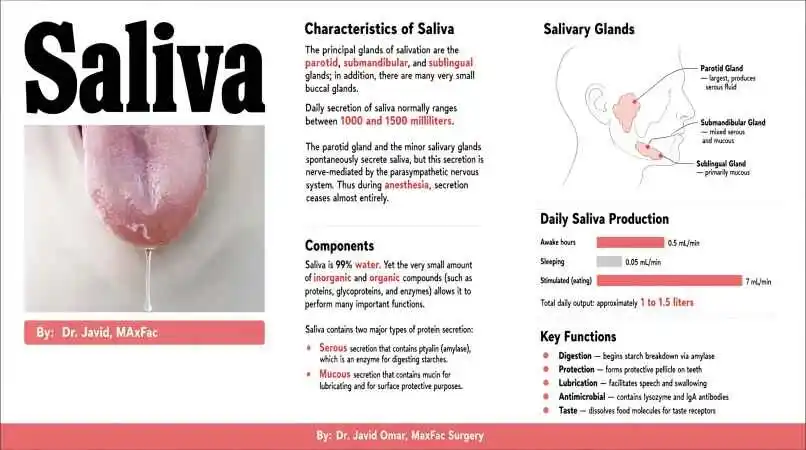
Your salivary glands come in two flavors: major and minor. The major ones are the heavy hitters:
- Parotid glands: The largest pair, sitting in front of your ears. They produce roughly 20–25% of your total saliva, mostly a watery, enzyme-rich fluid .
- Submandibular glands: Located under the floor of your mouth. These are the workhorses, contributing about 65–70% of your resting saliva .
- Sublingual glands: Under your tongue, contributing a smaller but still meaningful share—around 4–5% .
Then you’ve got hundreds of tiny minor glands scattered across your lips, cheeks, palate, and tongue. Together they add another 8–10% or so . It’s a distributed network, which is why even people with certain gland issues can still produce some moisture.
The Two-Stage Manufacturing Process
Here’s a detail that surprised me when I first learned it: saliva isn’t just filtered from blood. It’s actively built.
Stage one: Cells called acini at the ends of the gland ducts secrete a primary fluid that’s basically isotonic—same saltiness as your body fluids .
Stage two: As that fluid travels through the ducts, the gland cells swap ions around. They pull out sodium and chloride, push in potassium and bicarbonate. The result? A hypotonic final product—waterier than your blood, with a carefully tuned pH .
Why does that matter? That hypotonicity is actually useful for taste. It gives your taste buds a clean, low-salt medium to detect flavors against .
The Control System: Your Nervous System Has a Hand in This
Saliva flow is under autonomic control—the same system that regulates your heart rate and sweat.
- Parasympathetic stimulation (the “rest and digest” side) produces a watery, copious flow. Think about biting into a lemon—that sudden gush is parasympathetic action .
- Sympathetic stimulation (the “fight or flight” side) produces a thicker, more protein-rich saliva. It’s a smaller volume, but stickier .
The two systems actually cross-talk and synergize. It’s not a simple on/off switch; it’s a dimmer with two different color temperatures.
How Much Are We Talking?
A healthy adult produces roughly 1 to 1.5 liters of saliva per day . That’s a big range, and it fluctuates. During sleep, flow drops to nearly nothing—which is why morning breath is a thing and why you wake up parched. During meals, it ramps up dramatically. The rest of the time, it ticks along at a baseline rate of about 0.3–0.4 milliliters per minute .
What’s Actually In This Stuff? (Hint: It’s Not Just Water)
If you look at saliva under a microscope, you’d be forgiven for thinking it’s mostly water. It is—about 99% . But that remaining 1% is where the magic lives.
The Protein Arsenal
Researchers have identified over a thousand different proteins in human saliva, though only about 10% show up in meaningful quantities . The big players:
- Amylase: The starch-digesting enzyme. It starts breaking down carbs the moment you chew bread or pasta .
- Mucins: Large, slippery glycoproteins that form a protective slimy coating over every surface in your mouth. They’re the reason your cheeks don’t stick to your gums .
- Secretory IgA: An antibody that acts as a first-line immune defense, binding to pathogens and keeping them from colonizing .
- Proline-rich proteins (PRPs): These make up a huge chunk of your salivary protein content. Acidic PRPs bind to tooth enamel and form the acquired enamel pellicle—a protective film that shields your teeth from acid attacks .
- Lysozyme and other antimicrobials: Enzymes and peptides that directly damage bacterial cell walls .
The Inorganic Side
Saliva is also loaded with electrolytes: bicarbonate (the main buffer), calcium, phosphate, potassium, sodium, chloride, and trace amounts of fluoride and magnesium . The calcium and phosphate levels are carefully calibrated to be supersaturated relative to tooth mineral—meaning saliva is actually ready to re mineralize early cavities before they become real holes .
The pH Factor
Resting saliva pH typically sits between 6.0 and 7.0 . That’s slightly acidic to neutral. But the bicarbonate buffer system lets saliva neutralize acids from food and from stomach reflux, keeping your mouth and esophagus from getting chemically burned .
The Seven Jobs Saliva Does (That You Never Think About)
Let’s get into the functions. This is where saliva goes from “gross bodily fluid” to “unsung physiological hero.”
- Lubrication and Moistening: The Friction Reducer
Every time you speak, chew, swallow, or even just move your tongue, surfaces in your mouth are sliding against each other. Without lubrication, that would be agony. Mucins form a hydrated, slimy layer that coats your oral mucosa, teeth, and tongue, dramatically reducing friction .
This isn’t just comfort. It’s functional. Try swallowing a cracker without saliva. The bolus won’t form, it won’t slide down, and you’ll be coughing. Saliva is the grease in the gears of eating and speaking.
Practical tip: If you’re dealing with dry mouth from medication or aging, sip water frequently during meals. It’s not a perfect substitute for mucins, but it keeps things moving.
- Digestion: The Starter Pistol
Salivary amylase begins starch digestion in your mouth. It breaks complex carbs into smaller sugars, which is part of why a plain cracker starts tasting sweet if you chew it long enough . Saliva also contains lipase (in smaller amounts), which starts fat digestion .
But digestion isn’t just enzymes. Saliva dissolves food molecules so they can reach your taste buds. Without saliva, you literally couldn’t taste anything—the tastants need to be in solution to bind to receptors .
Real-world example: Ever notice how food tastes duller when your mouth is dry? That’s not just in your head. It’s chemistry.
- Taste and Smell: The Flavor Facilitator
Speaking of taste—saliva does more than dissolve. It also helps distribute tastants around your mouth and to the back of your throat where smell receptors pick up volatile compounds. The hypotonic nature of unstimulated saliva actually enhances your ability to detect subtle flavors .
- Buffering: The Acid Neutralizer
Every time you eat or drink something acidic—coffee, soda, citrus, wine—your teeth and esophagus take a hit. Saliva’s bicarbonate buffer neutralizes that acid, and the flow of saliva physically clears acidic residue from your mouth .
This is why people with low saliva flow get cavities so easily. Without the buffer, acid sits on enamel and dissolves it.
Actionable advice: If you’re going to have something acidic, don’t brush immediately. Your enamel is softened. Rinse with water, wait 30 minutes, then brush. Saliva will do its repair work in the meantime.
- Microbial Homeostasis: The Bouncer at the Club
Your mouth is a jungle. Hundreds of bacterial species live there, and most are harmless or even beneficial. Saliva keeps the peace.
How? Multiple mechanisms:
- Physical clearance: Swallowing carries bacteria away before they can overgrow .
- Antimicrobial proteins: Lysozyme, lactoferrin, and secretory IgA directly inhibit or kill pathogens .
- Buffering: By keeping pH stable, saliva discourages acid-loving cavity-causing bacteria .
- Pellicle formation: The protein film on teeth acts as a selective barrier, not a free-for-all buffet .
When saliva flow drops, the balance tips. Pathogens bloom. Thrush (oral fungal infection) becomes common. Cavities accelerate. It’s a vivid demonstration of how much saliva does when it’s gone .
- Tooth Protection and Remineralization: The Repair Crew
This one deserves its own spotlight. Saliva is constantly rebuilding your teeth.
- The acquired enamel pellicle: A protein film that forms within minutes of cleaning your teeth. It’s a renewable lubricant and a barrier against acid .
- Remineralization: Saliva is supersaturated with calcium and phosphate. When early enamel damage occurs (a “white spot” lesion), saliva can push minerals back into the tooth, reversing the damage before it becomes a cavity .
- Clearance: Swallowing removes food debris and acid, reducing the time teeth are under attack .
Bottom line: Your teeth are in a constant state of demineralization and remineralization. Saliva tips the balance toward repair. Without it, decay wins.
- Wound Healing and Tissue Repair: The Quiet Medic
Saliva contains growth factors and proteins that promote cell migration and tissue repair. Oral wounds—like a bitten cheek or a canker sore—heal faster than skin wounds of similar size, and saliva is part of the reason .
This is also why “licking your wounds” isn’t purely metaphorical. There’s some real biology behind the instinct, though I wouldn’t recommend it for serious cuts.
When Saliva Goes Missing: The Dry Mouth Reality Check
I’d be doing you a disservice if I didn’t talk about what happens when the system fails.
Hyposalivation—chronically low saliva flow—is more common than most people realize. It’s not just a minor annoyance. It’s a quality-of-life killer.
Common Causes
- Medications: This is the big one. Hundreds of drugs—antihistamines, antidepressants, blood pressure meds, diuretics—suppress saliva flow. If you’re on multiple medications, the effect compounds .
- Aging: Gland tissue changes with age, though aging alone isn’t usually the primary cause. It’s more about the medications that accumulate with age .
- Sjögren’s syndrome: An autoimmune condition that attacks salivary and tear glands. It’s a major cause of severe dry mouth in otherwise healthy people .
- Radiation therapy: Head and neck cancer treatment can permanently damage salivary glands .
- Dehydration, stress, and mouth breathing: Temporary but real.
What It Feels Like (and What It Does)
People with significant dry mouth describe:
- A sticky, dry feeling that water doesn’t fully fix
- Difficulty speaking for long periods
- Trouble swallowing dry foods
- Burning sensations
- Rapidly progressive cavities, especially at the gumline
- Frequent oral infections
The clinical consequences are serious: higher caries rates, periodontal disease risk, nutritional compromise (because eating becomes uncomfortable), and social anxiety about bad breath or difficulty speaking .
A note on “dry mouth” vs. hyposalivation: They’re related but not identical. You can feel dry while still producing normal saliva (subjective xerostomia), or you can have measurably low flow without noticing it as much. If you suspect a problem, a dentist or doctor can actually measure your flow rate.
The Weird and Wonderful: Saliva in History, Culture, and Faith
I’d be remiss not to mention that saliva has a cultural and spiritual history that predates modern physiology by millennia.
In the Bible, spittle appears in several healing narratives. In Mark 7:33, Jesus takes a deaf and mute man aside, spits, touches his tongue, and says “Ephphatha”—“Be opened” . In John 9:6, he spits on the ground, makes mud, and applies it to a blind man’s eyes .
Ancient physicians believed saliva had medicinal properties. The Gospel writers didn’t invent that idea; they used a familiar cultural trope and invested it with divine significance . Whether you read those stories as literal history or metaphor, they reflect a deep human intuition: there’s something potent about this fluid.
In many cultures, spitting was (and sometimes still is) a gesture of contempt or a ward against evil. It’s a bodily fluid that carries enormous symbolic weight—disgust, healing, intimacy, rejection.
I find it fascinating that the same substance that quietly keeps our teeth intact and our mouths comfortable has also been a prop in humanity’s oldest stories. Physiology and poetry, sharing the same water.
Frequently Asked Questions
- How much saliva does a person produce in a day?
About 1 to 1.5 liters for a healthy adult . That’s roughly 2 to 3 standard water bottles. It fluctuates with sleep, meals, hydration, and stress. - Why does my mouth get dry at night?
Saliva flow drops dramatically during sleep. Your body is conserving resources and you’re not eating or drinking. Mouth breathing makes it worse. Morning dry mouth is usually normal unless it’s severe and persistent. - Is swallowing saliva bad for you?
No. You swallow saliva constantly without thinking. It’s part of the normal clearance mechanism that keeps your mouth clean and your digestive tract lubricated. - Can you survive without saliva?
Not comfortably. You wouldn’t die immediately, but severe hyposalivation leads to rapid tooth decay, difficulty eating and speaking, and increased infection risk. It’s a serious medical issue. - What does saliva actually taste like?
Saliva itself has a very mild, slightly salty taste, but it’s mostly neutral. Its job is to dissolve other things so you can taste them. - Does saliva whiten teeth?
Not directly. But it does help maintain enamel and clear staining substances. The pellicle it forms can actually pick up some stains, but it also protects the tooth underneath. - Why does saliva make food taste better?
Saliva dissolves food molecules so they can reach taste receptors. It also distributes them around your mouth. Without saliva, taste perception drops significantly . - Is saliva antibacterial?
Yes, it contains lysozyme, secretory IgA, lactoferrin, and other antimicrobial compounds that inhibit or kill certain bacteria, viruses, and fungi . - Can you get sick from your own saliva?
Generally no. Your saliva contains your own immune components and is part of your defense system. However, saliva can transmit pathogens to others (which is why kissing and sharing drinks have some risk). - Why does my mouth water when I see or smell good food?
That’s a conditioned reflex. Your brain associates the sensory cues of food with eating, and it signals your salivary glands to prepare. It’s a beautiful example of anticipatory physiology. - Does saliva digest fat?
A little. Salivary lipase starts some fat digestion, though most fat digestion happens later in the small intestine . - What is the pH of saliva?
Resting saliva is typically pH 6.0 to 7.0 . After eating, it can dip temporarily, but the bicarbonate buffer brings it back up. - Can saliva transmit diseases?
Yes. Some viruses and bacteria can be transmitted through saliva, including herpes simplex, Epstein-Barr virus, and certain respiratory pathogens. That’s why kissing and sharing utensils carry some risk. - Why does spit get thick when I’m nervous?
Sympathetic stimulation produces thicker, more protein-rich saliva . It’s your body’s stress response changing the recipe. - Does saliva help with bad breath?
Yes, indirectly. Saliva clears food debris and bacteria. When flow drops, bacteria multiply and produce sulfur compounds. Dry mouth is a major cause of halitosis. - Can you use saliva for DNA testing?
Absolutely. Saliva contains epithelial cells and DNA, which is why spit kits are common for ancestry and genetic testing. It’s also being explored for disease biomarkers . - Is saliva production affected by water intake?
Yes. Dehydration reduces saliva flow. Staying hydrated helps maintain baseline production, though it won’t fix gland dysfunction. - What foods increase saliva flow?
Sour and acidic foods (lemon, vinegar) stimulate flow strongly. Chewing fibrous foods (apples, carrots) also mechanically stimulates saliva. Sugar-free gum is a practical way to boost flow between meals. - Can stress reduce saliva?
Yes. Chronic stress can alter autonomic balance and reduce flow. Acute stress changes the composition (thicker saliva). - Does saliva change with age?
Flow rate tends to decrease somewhat with age, but the bigger factor is the accumulation of medications and conditions that affect salivary glands . - What is the acquired enamel pellicle?
A thin protein film that forms on teeth within minutes of cleaning. It’s made largely from salivary proteins (especially PRPs) and acts as a protective barrier and lubricant . - Can dry mouth cause cavities?
Yes, dramatically. Saliva is your primary defense against tooth decay. Without it, acid sits on enamel, remineralization stalls, and cavities form rapidly . - Is spit the same as saliva?
Colloquially, yes. “Spit” usually refers to saliva that’s been expelled from the mouth. Physiologically, it’s the same fluid. - Why does my saliva feel foamy sometimes?
Foamy saliva can be a sign of reduced flow or changes in protein content. It’s often harmless, but persistent foamy saliva with dryness is worth mentioning to a dentist. - Does saliva contain stem cells?
Yes, salivary glands contain stem cells, and saliva itself contains some cells that can be harvested. This is an active area of regenerative medicine research. - Can you overdose on saliva?
No. Your body produces and swallows it continuously. There’s no toxic threshold. - Why does spitting feel refreshing after exercise?
It’s partly the physical act of clearing thick saliva and partly the reset of your mouth’s moisture balance. Exercise can temporarily thicken saliva due to sympathetic activation. - Does saliva help you swallow pills?
Yes. Saliva lubricates the pill and helps it slide down. Taking pills with water is still better, but saliva is the first step. - What medications cause dry mouth?
A huge list: antihistamines, antidepressants (especially tricyclics), anticholinergics, diuretics, blood pressure medications, and many others. If you’re on multiple meds, ask your doctor or pharmacist about dry mouth risk . - When should I see a doctor about dry mouth?
If you’re experiencing persistent dryness that affects eating, speaking, or sleep, or if you’re noticing rapid tooth decay, see a dentist or doctor. It could be a medication side effect, an autoimmune condition, or another treatable issue.
Stop Ignoring the Water in Your Mouth
Here’s what I want you to take away from all this: saliva is not an afterthought. It’s not just the stuff you wipe away. It’s a physiological system that touches digestion, immunity, dental health, sensory perception, and tissue repair. When it works, you never notice. When it fails, you notice everything.
So the next time you catch yourself with a dry mouth, or you see a baby drooling, or you bite into something sour and feel that involuntary gush—take a second. That’s your body doing something remarkable. A quiet, constant, watery miracle.
If you’re dealing with dry mouth, don’t just live with it. Talk to a professional. Sip water. Chew sugar-free gum. Protect your teeth. Your saliva is doing its best—give it some backup.
And if you found this useful, share it with someone who’s been complaining about dry mouth or who thinks spit is just… spit. They might learn something. I know I did.
⚕️Medical Disclaimer:
The information provided on this website is for general educational and informational purposes only and is not intended as a substitute for professional medical advice, diagnosis, or treatment. Always seek the advice of your physician or other qualified health provider with any questions you may have regarding a medical condition. Never disregard professional medical advice or delay in seeking it because of something you have read on this website.
Hashtags:
