
Table of Contents
The Soft Revolution: Why 2026 is the Year of the Cozy Gamer and the Antidote to Hustle Culture
Introduction: The Exhaustion of Excellence
The year is 2026. We are a decade and a half deep into the era of hyper-connectivity, and the human psyche is paying the price. For years, the dominant cultural narrative—both inside and outside of video games—was “the grind.” We optimized our mornings with bio-hacks, optimized our workflows with AI assistants, and optimized our leisure time with competitive ladders, kill-death ratios, and battle passes. Gaming, once the great escape, had become a second job. We logged into Call of Duty or League of Legends after a grueling eight-hour shift, only to find ourselves screaming at strangers through headsets, our cortisol levels spiking as we fought to maintain a rank that existed only in a digital cloud.
But in 2026, something shifted. The pendulum swung back with force. We have witnessed the rise of the “Soft Life” movement in the real world, a rejection of the glorification of burnout, and it has finally breached the walls of the digital entertainment industry. Enter the era of the “Cozy Gamer.”
This isn’t just a niche interest; it is a full-blown mental health revolution. The rise of cozy gaming—the umbrella term for low-stakes, non-violent, and often farm-sim or puzzle-based games—is 2026’s most significant mental health trend. It represents a collective sigh of relief from a generation exhausted by the pressure to win. It is the realization that pixels don’t always have to bleed to be beautiful, and that a digital world can be a place of restoration rather than domination. In this deep dive, we explore how low-stakes gaming moved from the margins to the mainstream, becoming the digital sanctuary we didn’t know we desperately needed.
Deconstructing the “Cozy” Label
To understand the magnitude of this trend, we must first dismantle the stereotype. For decades, the term “casual gamer” was wielded as an insult by the gatekeepers of the industry. It implied a lack of skill, a lack of dedication, and a superficial engagement with the medium. “Cozy gaming” sounds similar, but in 2026, it is a badge of honor. It is a deliberate lifestyle choice.

But what exactly defines a cozy game? It is more than just a color palette of pastels and earth tones, though that is often the visual shorthand. At its core, cozy gaming is defined by low stakes.
In a traditional AAA title, the threat of failure is the primary motivator. If you fail, you die. You restart the checkpoint. You lose your loot. You let your team down. The loop is fueled by adrenaline and the fear of loss. Cozy games invert this dynamic. The primary motivator is not fear, but desire—the desire to build, to nurture, to explore, or to solve.
In 2026’s chart-topping hits (the spiritual successors to Stardew Valley, Animal Crossing, and Disney Dreamlight Valley), failure states are either non-existent or heavily penalized. If you don’t water your digital pumpkins today, they don’t die; they just wait for you. If you ignore your virtual villagers, they might be a little sad, but they won’t leave. This design philosophy is known as “error-free design” or “soft failure.” It tells the player: You are enough just as you are. You do not need to be faster, smarter, or stronger to be here.
This shift from “performance-based gaming” to “presence-based gaming” is the cornerstone of its mental health appeal. It transforms the gaming console from a stress-inducing machine into a therapeutic tool.
The Neuroscience of “Low-Stakes”
Why is this trend exploding specifically in 2026? The answer lies in our collective neurochemistry. The human brain was not evolved to handle the constant barrage of high-stakes notifications, emails, and global crises that define the mid-2020s. We are living in a state of chronic “fight or flight,” an sympathetic nervous system overload that keeps cortisol dripping into our bloodstream like a leaky faucet.
Competitive gaming feeds this state. It heightens arousal, sharpens reflexes, and demands hyper-focus. While this can be exhilarating in short bursts, for the burnt-out modern worker, it is akin to pouring gasoline on a fire.
Low-stakes gaming, conversely, engages the parasympathetic nervous system—the “rest and digest” mode.
Consider the mechanics of a game like Dorfromantik or A Short Hike. The music is usually Lo-Fi or ambient orchestral, scientifically composed to lower heart rate. The visual environments are lush, green, and organic, tapping into the concept of biophilia—the innate human tendency to seek connections with nature. When we engage in repetitive, low-stakes tasks in games, such as fishing, decorating a room, or organizing inventory slots, we enter a state of “flow.”
Unlike the frantic flow of a shooter, this is a meditative flow. It occupies the hands and the visual cortex just enough to quiet the chattering monkey mind. It allows the brain to process the day’s anxieties without the pressure of immediate resolution. In 2026, therapists are increasingly recommending “digital gardening” not as escapism, but as a neural reset button. It is a way to reclaim agency in a world where we often feel we have none.
The “Hustle Culture” Backlash
The rise of the cozy gamer cannot be separated from the sociological backlash against Hustle Culture. Throughout the late 2010s and early 2020s, the “Girlboss” and “Tech Bro” mentalities dominated. Every hobby had to be a side hustle. If you baked, you had to sell cookies. If you wrote, you had to start a Substack. If you gamed, you had to stream or climb the ranked ladder.
Leisure became labor.
By 2025/2026, the culture hit a breaking point. The realization set in that optimizing every minute of the day for productivity resulted in hollow, anxious lives. People began craving “unproductive” time. They wanted to do things simply for the joy of doing them.
Cozy gaming is the ultimate antidote to the side-hustle mentality. There is no ROI (Return on Investment) on planting virtual flowers. You cannot monetize the digital cabin you spent four hours decorating (unless the game developers allow it, but the spirit is one of personal joy). It is time spent purely for the self.
This has given rise to the “Soft Gamer” identity. This demographic—spanning genders but seeing massive growth among women and non-binary folks aged 20-40—proudly displays their screens. A Twitch stream in 2026 is just as likely to feature someone silently decorating a bakery while chatting with chat about their day as it is to feature a high-level raid. The metrics of success have changed. Views and kills are out; vibes and community are in.
The Aesthetic of Safety – Cottagecore and Beyond
The visual language of 2026’s cozy games is deeply intertwined with the “Cottagecore” and “Goblincore” aesthetics that flourished on platforms like TikTok and Pinterest. In a world of brutalist architecture, gray office cubicles, and stark UI designs, cozy games offer a return to the pastoral.
The trend in 2026 leans heavily into the textural. With the advancement of graphical fidelity in the current console generation, developers aren’t just rendering characters; they are rendering comfort. We see games with hyper-realistic knit textures on sweaters, individually rendered blades of grass that sway in the wind, and lighting engines dedicated to the “Golden Hour.”
This visual saturation acts as a form of synesthetic comfort. It creates what psychologists call a “safe space.” In a high-stakes game, a dark corner implies a threat. In a cozy game, a dark corner implies a secret or a cozy reading nook.
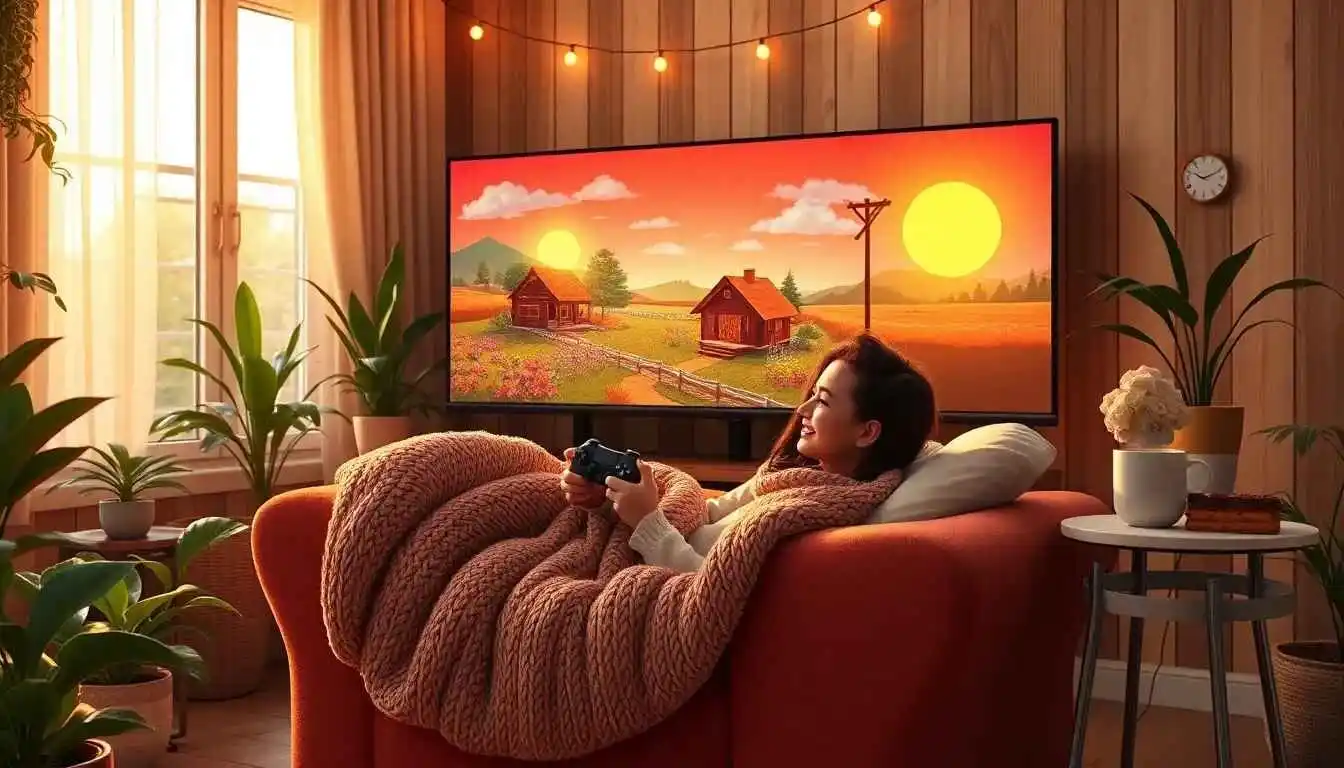
This aesthetic extends to the physical realm of the gamer as well. The “Cozy Gamer” setup has become a status symbol. It isn’t about the most expensive RGB lighting or the fastest refresh rate monitor. It is about the environment. Gamers in 2026 curate their physical play spaces with weighted blankets, warm-toned lamps, plushies representing their in-game companions, and snack trays. The boundary between the game and the player’s comfort has dissolved. The game is an extension of the physical sanctuary.
Social Connection Without the Toxicity
One of the most profound aspects of the 2026 cozy gaming trend is the redefinition of multiplayer. For decades, multiplayer meant competition. It meant voice chat filled with slurs, “git gud” toxicity, and the anxiety of letting the team down.
Cozy gaming introduced the concept of “Parallel Play” to the digital masses. Inspired by the educational philosophy of toddlers playing side-by-side, games like Palia (and its 2026 successors) introduced multiplayer modes where cooperation is optional and low-pressure.
You and a friend can be in the same valley. You might be fishing while they are decorating their house. You can wave, trade a tomato, and go your separate ways. Or you can sit on a bench together and watch the virtual sunset.
This “low-stakes socialization” is a massive breakthrough for mental health, particularly for those with social anxiety or neurodivergence. It provides the warmth of companionship without the demand for performance. In a world where social interactions are fraught with political tension and economic comparison, a digital campfire where friends can simply exist together is a rare commodity. It rebuilds trust in human connection, one pixelated wave at a time.
The Democratization of Gaming Skill
For the longest time, the video game industry was built on a barrier to entry. Complex controllers with twelve buttons, steep learning curves, and twitch-reflex requirements alienated vast swathes of the population.
The mental health trend of 2026 is partially driven by the democratization of the medium. The “Cozy” label has become a signal for accessibility. These games are often playable on low-end laptops, tablets, and even smartphones, breaking the hardware barrier. More importantly, they break the skill barrier.
Games like Unpacking (a zen puzzle game about arranging items in boxes) or PowerWash Simulator (satisfyingly cleaning dirt) require no traditional “gaming skills.” This inclusivity has invited millions of new players—seniors, recovering burnout victims, and those who previously felt “not good enough” for games—to pick up a controller.
When a person who has internalized a lifetime of “I’m not good at tech” or “I’m clumsy” successfully builds a digital village, it produces a quiet but profound sense of competence. It is a therapeutic victory. It challenges the internal narrative of inadequacy. In 2026, gaming isn’t about being the best; it’s about being present.
The Economy of Kindness
The industry economics have shifted to support this mental health trend. In the past, game monetization was predatory. Loot boxes, pay-to-win mechanics, and fear-of-missing-out (FOMO) limited-time events were designed to trigger anxiety and compel spending.
The cozy gaming boom of 2026 has forced a market correction. Players are rejecting the anxiety economy. They are flocking to titles with transparent monetization or, increasingly, titles that operate on a “buy once, relax forever” model.
Developers have realized that the “Cozy” demographic is loyal. If a game respects their time and mental peace, they will support it. We see the rise of “tip jar” economics in indie development and DLC that is purely cosmetic and wholesome (new sweater patterns for your cat, new furniture sets).
Furthermore, the merchandise economy around cozy gaming is booming. It’s no longer just game sales; it’s about the lifestyle. Brands are partnering with cozy games to sell tea blends, journals, and loungewear. The economy is built on comfort, not combat. This reinforces the mental health benefits—players aren’t being exploited by the games; they are being cared for by them.
A Case Study in 2026 – The Virtual Sanctuary
Let’s visualize a typical evening in November 2026. Sarah, a 28-year-old data analyst, comes home. Her brain is fried from spreadsheets and Zoom calls. She doesn’t turn on the news. She doesn’t open a social media app where everyone’s life looks perfect.
Instead, she powers on her console. She enters Haven’s Glen, a fictionalized representation of the 2026 cozy hit archetype. The screen fades in to a warm, amber-lit cabin. It’s raining outside in the game—a soothing sound effect of pattering drops.
In the game, she isn’t saving the world from destruction. She is helping a neighbor find a lost locket. She is deciding whether to plant blue hydrangeas or red roses by her mailbox. The stakes are non-existent. If she turns off the console mid-task, nothing bad happens.
As she plays, her heart rate slows. The digital environment provides a sense of order that her chaotic physical office lacks. In the game, if you put in the seeds and water them, flowers grow. It is a fair system. It restores her sense of justice and predictability.
After an hour, she saves (though the game autosaves gently, reminding her she doesn’t have to) and closes her eyes. She feels refreshed, not drained. She has engaged in “active recovery.” This is the essence of the 2026 trend: gaming as a deliberate act of self-soothing.
Criticism and the Defense of “Not Real Games”
It would be remiss not to address the backlash. As cozy games dominate the charts, there is a vocal minority of “traditional” gamers who decry the genre. “Walking simulators,” “digital chores,” and “not real games” are common insults hurled at titles that lack combat.
This criticism, however, misses the point of play. Play is not inherently about conflict; it is about engagement. A child playing house is playing. A person solving a Sudoku puzzle is playing.
The resistance to cozy gaming often stems from a fragile definition of masculinity and skill. For decades, gaming was a fortress of competitive skill. The rise of cozy gaming breaches that fortress, suggesting that “hard” does not equal “good,” and that “easy” does not equal “boring.”
In 2026, the industry has largely moved past this debate. The sales numbers speak for themselves. But the existence of this critique highlights why the cozy gaming trend is so vital for mental health—it teaches us to disengage from the need for external validation. The cozy gamer plays for themselves, not for the accolades of a competitive lobby. Learning to enjoy something “uncool” or “easy” is, in itself, a radical act of mental self-care.
The Future – VR, AR, and the Blurring of Reality
Looking ahead to the latter half of the decade, the integration of cozy gaming with emerging technologies promises even deeper mental health applications.
Virtual Reality (VR) in 2026 is no longer the clunky, nausea-inducing tech of the past. Lightweight, high-resolution headsets allow for “immersive coziness.” Imagine sitting in your tiny apartment in a crowded city, but putting on a headset to find yourself in a sprawling, digital library with a fireplace. The sense of presence is profound. VR meditation apps are blending with gaming, creating spaces where you can physically interact with a calming environment.
Augmented Reality (AR) is also playing a role. Following the footsteps of Pokémon GO (but stripping away the competitive gym battles), new AR games encourage “Cozy Walks.” They overlay serene visuals onto the real world or guide players to real-world “safe spots” like parks or quiet cafes, gamifying the act of taking a mental health break.
The line between a game and a wellness app is vanishing. Your mental health tracker might recommend a specific level in a cozy game to help you wind down for sleep, syncing the game’s lighting with your circadian rhythm. Technology, once the enemy of sleep and peace, is being weaponized for relaxation.
The Legacy of the Cozy Gamer
The rise of the cozy gamer in 2026 is not a bubble; it is a paradigm shift. It signals a permanent change in how we view leisure. We are moving away from the “Boyhood fantasy” of constant conflict and conquest and toward a “Human fantasy” of connection, stewardship, and peace.
This trend has validated the need for rest. It has told a generation of burned-out adults that it is okay to play. It is okay to spend three hours arranging digital furniture. It is okay to find solace in a pixelated sunset.
In a high-stakes world, low-stakes gaming is the rebellion we needed. It is the soft revolution. It reminds us that while we cannot control the economy, the climate, or the chaos of the news cycle, we can control the layout of our digital farm. We can plant the seeds. We can watch them grow. And sometimes, that is enough to keep us going.
As we power down our consoles in 2026, we don’t feel the hollow echo of a victory won at the expense of our nerves. We feel the quiet hum of a spirit restored. The Cozy Gamer isn’t just playing a game; they are healing, one click at a time.
In-Depth Analysis: Why “Low-Stakes” is the New High-Risk Reward
To fully flesh out the magnitude of this trend, we must look deeper into the psychological concept of “Agency.” In psychological research, agency is the sense of control we feel over our lives. A lack of agency is a primary predictor of depression and anxiety. In the mid-2020s, the average person’s agency is under constant siege. Algorithms decide what we see. Employers decide when we work. Economic forces decide if we can buy a home.
High-stakes competitive gaming actually reduces agency in a specific way. You are at the mercy of the matchmaker, the teammates, and the meta. If you play perfectly but lose because of a bad team, you are reminded of your powerlessness.
Low-stakes gaming restores total agency. In Stardew Valley or Animal Crossing, you are the master of your domain. The game refuses to punish you. If you want to chop wood, you chop wood. If you want to fish, you fish. This absolute control in a safe environment allows the brain to “recalibrate” its sense of self-efficacy.
It’s akin to the concept of “micro-mastery.” When we are overwhelmed by macro-problems (world peace, climate change), we retreat to micro-problems (organizing the inventory in Resident Evil 4 or decorating a room in The Sims). Completing these micro-tasks releases dopamine and serotonin. It provides a tangible, completed loop in a world of open-ended, unresolved problems.
The Role of Nostalgia in the 2026 Trend
Another pillar of the cozy gaming boom is nostalgia. The gamers of 2026 are largely Millennials and Gen Z. We grew up in a time that, retrospectively, feels safer. Cozy games often lean heavily into nostalgic aesthetics—pixel art, chiptune music, and storylines that echo the simplicity of 90s childhoods.
However, 2026’s cozy games are iterating on this. We are seeing “Sophisticated Nostalgia.” It looks like the past, but it plays with modern convenience. This appeals to the mental health trend of “anchoring.” In times of rapid change (AI, political shifts), nostalgic visuals act as an anchor, grounding the player in familiar, safe imagery.
Games like Coral Island or Haiku the Robot use this visual language to lull the player into a state of safety before engaging them with deeper, sometimes surprisingly poignant narratives about nature or loss. This allows players to process difficult emotions in a safe container. You can cry over a digital character’s loss or the restoration of a ruined environment, processing your own grief about the real world, but in a setting where the music is soft and the lighting is warm.
The Community Aspect: Digital Third Places
Sociologist Ray Oldenburg coined the term “Third Place” for spaces that aren’t work or home—cafes, pubs, parks—where community happens. In 2026, these places are expensive or unsafe for many. Cozy games have become the “Digital Third Place.”
Discord servers dedicated to cozy games are notably different from those for competitive games. The culture is one of sharing—sharing farm layouts, outfit codes, and screenshots of a particularly nice sunset. It is a culture of “show and tell” rather than “dominate and humiliate.”
This community support is a vital mental health component. For individuals suffering from loneliness, the cozy gaming community offers a low-barrier entry to socialization. You don’t need to be funny, smart, or rich to participate. You just need to share a screenshot of your cat in a game. The ensuing flood of positive reinforcement (“Omg so cute!”) provides the social validation humans crave, without the toxicity that usually accompanies it.
Economic Implications for Developers
The “Cozy Gamer” rise is also reshaping the industry’s workforce. Game development is notorious for “crunch culture”—insane overtime to ship a game. But the ethos of cozy gaming rejects crunch. Developers of cozy games often tout their own healthy work-life balance as a selling point. “This game was made without crunch” is a sticker on the virtual box of 2026 indie hits.
This alignment of product and production values resonates with the mental health-conscious consumer. They are not just buying a game; they are buying a product that aligns with their values. They are voting with their wallets for a kinder, slower world.
Conclusion: The End of the Grind
To summarize, the rise of the Cozy Gamer in 2026 is not a fad. It is a necessary evolutionary step in our relationship with technology. We spent two decades digitizing the rat race. We built leaderboards, rankings, and status updates that turned us into competitive beasts.
Now, we are digitizing the spa. We are building digital gardens where we can rest.
For the global population’s mental health, this trend offers a beacon of hope. It proves that we can use the immense power of modern computing to soothe rather than enrage. It validates the need for rest. It democratizes play. It heals the fractured spirit of the burned-out worker.
So, if you find yourself in 2026, feeling the weight of the world on your shoulders, consider picking up a controller. Don’t go to war. Go to a farm. Go to a valley. Go to a world where the sun always sets in golden hues, and the only thing you have to do is… nothing at all. That is the power of the Cozy Gamer. That is the revolution of low-stakes.
This article was generated to explore the intersection of digital trends and psychological well-being, envisioning a future where technology serves the human need for peace.
Final Thoughts: The “Cozy Gamer” trend reminds us that in a world that screams “Go, Go, Go,” the most radical thing you can do is stop and smell the digital roses. As we navigate the complexities of the mid-21st century, perhaps our high scores will matter less than our high vibes. Welcome to the Soft Revolution.
Disclaimer: The content on this blog is for informational purposes only. The author’s opinions are personal and not endorsed.
Efforts are made to provide accurate information, but completeness, accuracy, or reliability are not guaranteed. The author is not liable for any loss or damage resulting from the use of this blog. It is recommended to use the information on this blog at your own discretion.
