
Table of Contents
🎵 Your Brain Is Lying to You — And Your Playlist Is the Proof
Why Old Songs Feel Better Than New Ones: The Science of Musical Nostalgia & The Hidden Language of Music That Hijacks Your Mood Without Warning
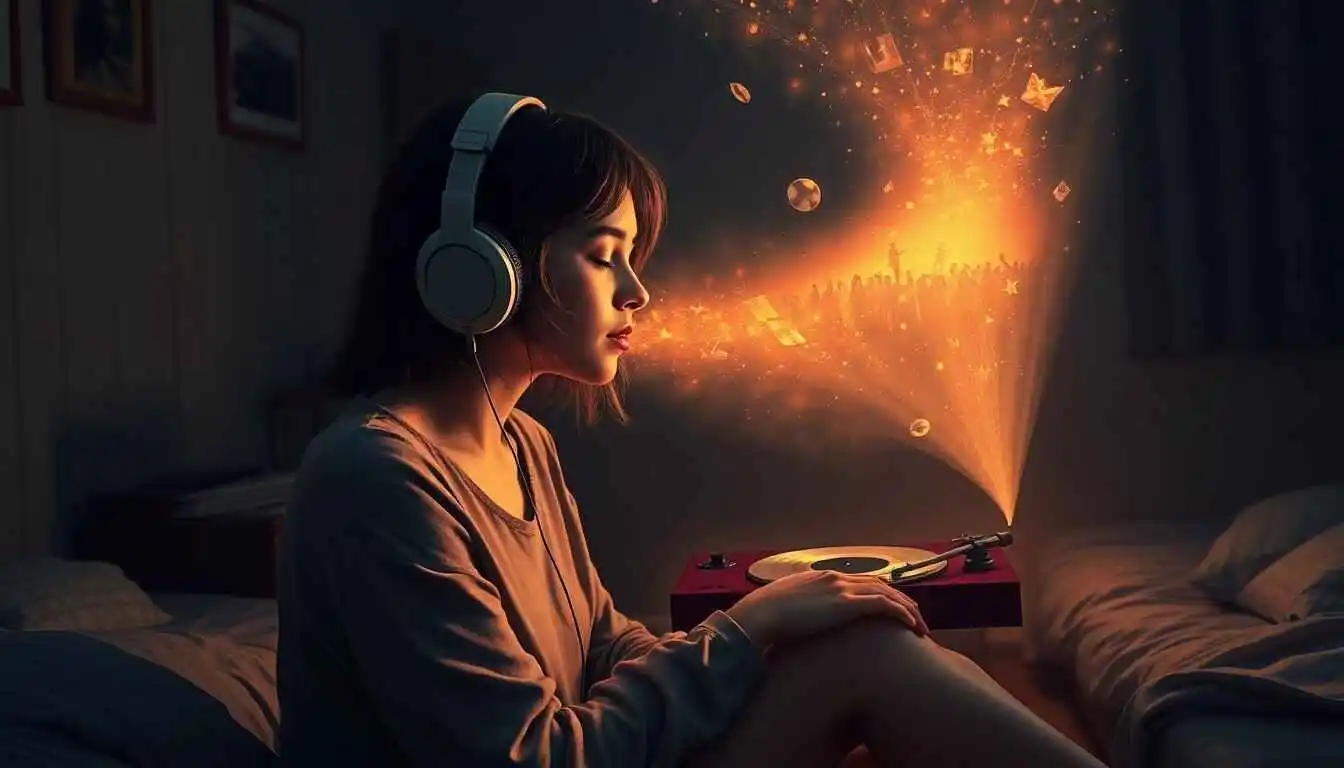
There’s a moment everyone knows. You’re driving, scrolling through the radio, half-distracted — and then it happens. Four seconds into a song you haven’t heard in a decade, your chest tightens. You’re not just hearing music. You’re inside a memory — the backseat of your dad’s car, your first heartbreak, a summer that felt infinite. You feel everything at once: joy, ache, warmth, and a grief you can’t name.
You’re not imagining it. And you’re definitely not alone.
Every generation has stood in the same emotional wreckage and asked the same question: Why does old music feel so much more powerful than anything new? Why do the songs from your teenage years hit differently than the ones topping the charts today? And more importantly, is the music actually better, or is your brain playing an elaborate, beautiful trick on you?
The answer is both. And it goes deeper than you think.

The Memory Machine in Your Skull
To understand why old music feels so potent, you need to understand one of neuroscience’s most underappreciated discoveries: the reminiscence bump.
Research in cognitive psychology has consistently shown that people recall memories from their adolescence and early adulthood — roughly ages 12 to 25 — with far greater emotional intensity and frequency than memories from any other period in their lives. This isn’t nostalgia as a feeling. This is nostalgia as a neurological event.
During those formative years, your brain is undergoing its most dramatic period of development since infancy. The prefrontal cortex is still wiring itself. The limbic system — your emotional processing center — is firing at peak sensitivity. Hormones are flooding your body. Everything feels urgent, raw, and indelible. The brain, in its wisdom, encodes these experiences with extraordinary depth. They become anchor memories, reference points for your entire emotional identity.
And music? Music was there for all of it.
The songs playing during your first love, your worst loss, your wildest night, your loneliest hour — those songs didn’t just provide a soundtrack. They became fused with the memory itself. Neuroscientists call this state-dependent memory encoding: when an emotional state and a sensory stimulus occur simultaneously, they become biochemically linked. The stimulus — in this case, a melody, a chord progression, a specific vocal timbre — later acts as a direct key to the original emotional state.
This is why four seconds of an old song can drop you back into 1998 without warning. You’re not remembering the song. The song is remembering you.
Dopamine, Chills, and the Chemistry of “That Feeling”
Not all music creates chills. But the music that does — that sends a shiver down your spine, raises your arm hair, and makes your eyes sting — is doing something extraordinary in your brain.
Dr. Robert Zatorre’s landmark research at McGill University identified that music capable of inducing frisson (the scientific term for those spine-tingling chills) triggers a measurable release of dopamine — the same neurotransmitter involved in anticipation, reward, and pleasure. What’s striking is when the dopamine peaks: not during the most intense moment of the song, but just before it. During the buildup. The anticipatory pause before the chorus drops.
Your brain is predicting the music. And when the prediction is correct, it rewards itself.
Here’s the critical insight: familiarity amplifies this reward loop. The more your brain knows a song, the more precisely it can anticipate what comes next — and the more powerfully it rewards itself when those expectations are met. Old songs you’ve heard hundreds of times aren’t boring because of familiarity. They’re richer because your nervous system has had years to build complex predictive models around them.
New songs, by contrast, are neurological strangers. Your brain has no predictive framework for them. There’s no dopamine anticipation loop. There’s no embedded emotional memory. There’s just… sound.
This doesn’t mean new music can’t move you. It absolutely can. But it hasn’t had time yet. Every song you’ll cry over in 2035 is probably playing on a playlist somewhere right now, unnoticed. Time is the ingredient the music charts can’t bottle.
The Hidden Language of Music — Frequencies That Feel Like Feelings
Here is where it gets more mysterious — and more manipulative.
Music doesn’t just remind you of emotions. Music manufactures them, even in the absence of any memory at all. This happens through a set of acoustic properties so deeply embedded in human neurology that they operate beneath conscious awareness. You don’t decide to feel something when you hear music. You’re programmed to.
Tempo is the most obvious lever. Tempos above 120 BPM (beats per minute) synchronize with elevated heart rates and trigger physiological arousal. Your body begins to mirror the music’s urgency. Slower tempos — below 70 BPM — entrain your heartbeat downward, activating the parasympathetic nervous system. You’re slow. You open. You become vulnerable to feeling.
Mode — whether a piece is written in a major or minor key — operates on a more primal level. Major keys activate associations with brightness, resolution, and forward momentum in virtually every culture studied. Minor keys signal unresolved tension, inwardness, and longing. But — and this is crucial — the most emotionally devastating music plays both against each other. A song in a major key with a descending bass line. A minor key melody with an upbeat rhythm. The emotional contradiction creates complexity that the brain struggles to categorize, and that struggle is what we call being moved.
Vocal timbre — the texture and overtone structure of a human voice — triggers the most ancient response of all. The human voice is processed by a dedicated neural pathway that evolved long before music existed, because reading the emotional content of a voice was a survival skill. When a singer’s voice breaks, wavers, or roughens under emotional weight, your mirror neurons fire as if you are the one breaking. You aren’t hearing sadness. Your nervous system is performing sadness in miniature.
This is the hidden language of music: a vocabulary of frequency, rhythm, and timbre that speaks directly to your body before your mind has a chance to evaluate it. By the time you think “this song is sad,” you’re already crying.
Why Every Generation Thinks the Old Music Was Better
Let’s address the generational mythology head-on.
Ask a Baby Boomer, and they’ll tell you The Beatles, The Rolling Stones, and Motown were the apex of music. Ask a Gen Xer, and they’ll defend the emotional authenticity of grunge and new wave. Ask a Millennial, and they’ll cite the lyrical sophistication of 90s hip-hop and the golden age of pop-punk. Ask Gen Z and — well, they’re starting to figure out their own nostalgia is coming.
Everyone is right. And everyone is wrong.
The music isn’t objectively better. The brain experiencing the music was better — more open, more impressionable, more drenched in first-time experiences. The reminiscence bump applies universally across cultures, generations, and musical genres. The mechanism doesn’t care what music you heard during those peak-encoding years. It just encodes whatever was there with extraordinary fidelity.
Research published in Psychological Science confirms that people consistently rate the music of their youth as superior to contemporary music — and this bias is consistent across every age group studied. Sixty-year-olds prefer music from the 1970s. Forty-year-olds prefer music from the 1990s. Thirty-year-olds prefer music from the 2000s. The pattern doesn’t lie.
There is also, however, a legitimate acoustic argument. Music from past decades was produced under different technological and commercial constraints. Analog recording equipment introduced harmonic warmth that digital formats struggle to replicate. Songs were written to be played by humans in physical rooms, and the acoustic bleed — the way instruments breathe and bleed into each other’s microphones — created an organic complexity that modern production tools have largely eliminated in the pursuit of sonic perfection.
Modern music is, in many ways, technically flawless. And that’s part of the problem. Flawlessness is emotionally sterile. The wobble in a vinyl record. The breath before a note. The moment a guitarist slightly misses the beat. These imperfections are not errors — they are proof of human presence. And human presence is what the brain is actually listening for.
The Nostalgia Paradox — Why We Ache for What We Can Never Return To
Nostalgia was once classified as a medical disorder. In 1688, a Swiss physician named Johannes Hofer coined the term from the Greek nostos (homecoming) and algos (pain) to describe the debilitating homesickness observed in Swiss mercenaries fighting far from home. For centuries, it was considered a form of neurological illness.
We now understand nostalgia as something far more complex and, remarkably, far more beneficial.
Contemporary research by Dr. Constantine Sedikides at the University of Southampton has documented that nostalgia is a psychological resource. People who engage in nostalgic reflection report higher levels of social connectedness, a greater sense of meaning, increased self-continuity (the feeling that your past and present selves are coherently linked), and even reduced anxiety about death. Nostalgia, in measurable terms, makes life feel more worth living.
Music is nostalgia’s most efficient delivery mechanism. It’s portable. It’s immediate. It’s precise. A song can deliver a complete emotional time capsule in three minutes. It requires no photographs, no journals, no other people. It needs only you and a speaker.
But here is the paradox: nostalgia always aches because it contains an irreducible loss. You can return to the song, but you cannot return to the version of yourself who heard it for the first time. That person is gone. The song remains, and the song is now a monument to something you can never touch again. The bittersweet quality of musical nostalgia — the way it’s never pure joy but always joy mixed with longing — is precisely because you are mourning a self who no longer exists.
This is not a reason to stop listening. It’s a reason to listen more carefully.
What Happens in Your Brain When Your Favorite Song Plays
For people with Alzheimer’s disease, something remarkable happens when familiar music is played. Patients who have lost the ability to recognize family members, who cannot recall their own names, who have retreated into a silence that seems absolute — these patients respond to music from their youth. They begin to sing. They smile. For the duration of the song, something that was inaccessible becomes reachable.
This happens because musical memory is stored differently from other forms of memory. Autobiographical memories — who you are, where you’ve been, what happened to you — are stored in the hippocampus and highly vulnerable to neurodegeneration. But the implicit memory of music — the melody, the rhythm, the emotional charge — is distributed across multiple brain regions, including the cerebellum, basal ganglia, and motor cortex. These regions are among the last to be damaged by Alzheimer’s. Music survives in the brain longer than almost anything else.
In neurologically healthy people, a favorite song activates an astonishing breadth of brain real estate simultaneously. The auditory cortex processes the sound. The motor cortex lights up — you want to move. The limbic system floods with emotion. The default mode network — the seat of self-reflection and autobiographical memory — comes alive. You are, in a meaningful sense, more fully yourself when your favorite song is playing than at almost any other moment in your day.
This is the hidden language of music made visible: a neurological conversation between sound and self that bypasses language, logic, and resistance. Music speaks to the part of you that existed before you knew who you were. And when it does, you feel — even briefly, even painfully — like you’ve come home.
Conclusion: The Song Doesn’t Change. You Do.
The question “why does old music feel better?” has a scientific answer: neuroplasticity, dopamine anticipation loops, state-dependent memory encoding, the reminiscence bump, and the acoustic signatures of imperfect human performance. These are real, measurable, replicable phenomena.
But the deeper answer is this: the music you love most is the music that was present when you were becoming yourself. It was there in the room when the neural architecture of your identity was being assembled. It encoded itself not just into memory but into the structure of who you are. To hear it again is not nostalgia. It’s recognition.
The hidden language of music is not a metaphor. It is a biological fact. Tempo speaks to your heartbeat. Mode speaks to your nervous system. Timbre speaks to your evolutionary history. And the particular songs that lived inside the years when you were most alive speak to something that may not have a clinical name — something that feels, when you’re sitting in a car with a song from twenty years ago filling every corner of the air, remarkably like a soul.
So the next time an old song makes you pull over because you suddenly can’t see through your eyes — don’t be embarrassed. You’re not being sentimental. You’re being human.
And that, neuroscience is starting to understand, is one of the most sophisticated things a brain can do.
FAQs
- Why do old songs make me emotional?
Old songs are linked to emotionally intense memories from your formative years. When you hear them, your brain retrieves both the memory and its associated emotion simultaneously, often causing powerful emotional responses.
- Is musical nostalgia the same for everyone?
The mechanism is universal, but the specific songs and memories differ for each person based on their individual experiences during their reminiscence bump years (ages 12–25).
- What is the “reminiscence bump”?
The reminiscence bump is a cognitive phenomenon where people recall memories from adolescence and early adulthood more vividly and frequently than memories from other life stages.
- Can new music ever feel as powerful as old music?
Yes — over time. Music heard during emotionally significant moments will gain nostalgic power as years pass. Today’s unnoticed songs may become tomorrow’s treasured memories.
- Why do I get chills from certain songs?
Chills, or “frisson,” occur when music triggers a dopamine release in anticipation of an expected musical moment. Familiarity and emotional resonance make this more likely.
- What is dopamine’s role in music listening?
Dopamine is released during pleasurable anticipation and reward. Music that creates suspense and resolution — particularly familiar music — activates this system powerfully.
- Does everyone experience musical nostalgia the same way?
While the neurological mechanism is consistent, emotional sensitivity to music varies. People with higher “openness to experience” tend to feel music more intensely.
- Why does music feel more emotional than other memories?
Music bypasses the analytical brain and activates emotional centers directly. It also synchronizes with physiological processes like heart rate and breathing, deepening its impact.
- Is old music objectively better than new music?
No — but the brain’s preference for music from one’s youth is a documented, consistent cognitive bias. The music isn’t better; the brain was more impressionable.
- What does “state-dependent memory encoding” mean in music?
It means that when you hear music during an emotionally charged moment, the music and the emotion become neurologically linked. The music can later trigger that emotional state directly.
- Why does music from my teenage years feel so important?
Adolescence is a period of peak neuroplasticity and hormonal intensity. Everything experienced during this time — including music — is encoded with exceptional depth and emotional weight.
- Can music actually change my mood?
Yes. Music alters brainwave activity, heart rate, cortisol levels, and dopamine production. These physiological changes directly produce mood shifts.
- Why does minor key music feel sad?
Minor scales contain intervals that the human auditory system associates with unresolved tension. This is partly learned and partly rooted in the acoustic similarity to distress vocalizations.
- What is “musical frisson”?
Frisson is the technical term for the physiological chill or goosebump response to music. It’s associated with dopamine release and occurs in approximately 55–86% of people.
- Why does music help people with Alzheimer’s remember?
Musical memory is stored across multiple brain regions beyond the hippocampus, many of which are more resistant to neurodegeneration. This makes music accessible even when other memories are lost.
- Does tempo actually affect how I feel?
Absolutely. Fast tempos physiologically elevate arousal; slow tempos activate the parasympathetic (calming) system. Your body literally adjusts to match the rhythm.
- Why do I like songs that make me sad?
Sad music triggers emotions in a safe context, allowing emotional processing without real-world consequences. It also releases prolactin, a hormone associated with comfort and bonding.
- What is the default mode network’s role in music?
The default mode network handles self-reflection and autobiographical memory. It activates during music listening, linking the music to your sense of identity and personal history.
- Can music reduce anxiety?
Yes. Music at approximately 60 BPM can synchronize with alpha brainwave patterns associated with relaxed alertness. Certain types of music also reduce cortisol, a key stress hormone.
- Why does vinyl sound “warmer” to many people?
Analog recordings capture continuous waveforms, including harmonic overtones that digital formats sample discretely. This creates a richer, more complex sound that many find more emotionally resonant.
- Is musical preference genetic?
Partially. Studies of twins suggest that some aspects of musical preference have heritable components, though environment and experience are stronger determinants.
- Why do certain songs become “ours” in relationships?
Music heard during emotionally significant bonding moments becomes encoded with the relationship itself. The song becomes a shorthand for the entire emotional architecture of that connection.
- What makes a song “timeless”?
Timeless songs typically contain melodic simplicity, harmonic resolution, relatable lyrical themes, and tempo ranges that align with natural human physiological rhythms.
- Does nostalgia have health benefits?
Research shows nostalgia increases feelings of social connectedness, life meaning, and self-continuity, and may reduce anxiety and existential distress.
- Why does music sound better with eyes closed?
Closing your eyes reduces cognitive load on the visual cortex, freeing neural resources for auditory and emotional processing, intensifying the subjective experience.
- Can music be used therapeutically?
Yes. Music therapy is an evidence-based clinical discipline used for pain management, depression, autism support, stroke rehabilitation, and dementia care, among other applications.
- Why does a song I hated become likeable over time?
Repeated exposure increases familiarity, and familiarity itself produces a mild positive feeling (the mere exposure effect). Positive associations formed over time can transform an initial dislike.
- Why do songs I heard during heartbreak still hurt years later?
The emotional encoding during intense pain is exceptionally deep. The song remains neurologically linked to the full emotional experience, which can be reactivated decades later.
- Does music preference change with age?
Yes. Research shows people’s active music exploration typically peaks in their early twenties and gradually narrows with age, though deep emotional responses to familiar music persist throughout life.
- Why do I sometimes feel like a song “understands” me?
Because music encodes and expresses emotional states that language often cannot. When music mirrors an emotion you haven’t been able to articulate, the recognition feels profound — because it is.
Disclaimer: The content on this blog is for informational purposes only. The author’s opinions are personal and not endorsed. Efforts are made to provide accurate information, but completeness, accuracy, or reliability are not guaranteed. The author is not liable for any loss or damage resulting from the use of this blog. It is recommended to use the information on this blog at your own discretion.
