
Table of Contents
The 3-Minute Limit: How TikTok and Streaming Quietly Shrank the Modern Pop Song
No more intros, no more solos, no more slow build — inside the algorithm-driven economics reshaping how hit songs are written, structured, and released
The Song That Ends Before You Notice It Started
Put on almost anything near the top of a streaming chart right now and count the seconds before the hook arrives. There is a good chance you will not get past ten. No four-bar drum build, no atmospheric guitar swell, no slow-motion fade-in borrowed from a film score. The chorus, or something close to it, is often already happening. Then, somewhere around the two-minute-thirty mark, the whole thing is over, credits rolling before you have fully settled into the groove.
This is not an accident, and it is not simply changing taste. It is the visible result of an invisible negotiation happening behind almost every major pop release today, one conducted not between artist and audience but between artist and algorithm. Streaming royalty structures and short-form video platforms have quietly rewritten the economic incentives of songwriting, and the modern pop song, in both its length and its internal architecture, is the artifact of that rewrite.
This piece traces how that shift happened: the mechanics of streaming payouts that made length itself a financial variable, the arrival of TikTok and the fifteen-second attention economy, what specifically gets cut from a song under this pressure, the data behind the shrinking runtime, the pushback from artists and critics who see something being lost, and where this arms race between art and engagement metrics might be heading next.

How Streaming Turned Song Length Into a Financial Variable
To understand why songs are shrinking, it helps to understand how streaming platforms actually pay artists, because the mechanism is fundamentally different from how radio or physical sales ever worked. Radio paid based on airplay counts and advertising reach. Album sales paid a fixed amount per unit regardless of how long any individual track ran. Streaming, by contrast, generally pays out from a royalty pool divided based on the number of streams a track accumulates, and a stream is typically counted once a listener has played a track past a minimum threshold, historically around thirty seconds on several major platforms.
That single design choice has an outsized consequence. A three-minute song and a five-minute song can both count as one stream once that threshold is crossed, but the shorter song lets a listener cycle through more total tracks in the same amount of listening time, generating more individual streaming events across an album, playlist, or looping session. For an artist or label thinking in aggregate terms across millions of plays, shaving a minute off a song is not a stylistic footnote. It is a structural decision with a direct line to revenue.
This dynamic compounds with how algorithmic playlists and recommendation engines behave. These systems track engagement signals like completion rate and skip rate closely, using them to decide whether to keep pushing a track to new listeners. A song with a slow build risks losing a chunk of its audience in the first fifteen seconds, before the hook ever arrives, and a high early skip rate can quietly suppress a song’s algorithmic reach before it ever gets the chance to find its audience organically.
“A three-minute song and a five-minute song can both count as one stream — but the shorter one lets a listener, and the royalty pool, cycle through more of them.”
Enter TikTok: The Fifteen-Second Audition
If streaming economics quietly nudged songs shorter, short-form video platforms applied direct, almost violent pressure to the front of the track. TikTok did not just change how music gets discovered; it changed what portion of a song matters most. On a platform where videos historically ran fifteen to sixty seconds, a song’s usefulness is often determined entirely by whether a short clip of it works as background audio for dance trends, comedic timing, transitions, or emotional moments in a video.
This has given rise to an entire pre-release strategy inside major labels and independent artist camps alike: testing song snippets on short-form platforms before a full single ever drops, sometimes months in advance, to see which fifteen-second segment resonates before finalizing the structure of the eventual release. In some documented cases, the section of a song that catches on as a TikTok sound is not even the traditional chorus, prompting writers and producers to restructure the full track around that unexpected hook rather than the other way around.
The effect on songwriting is direct: if a song needs to work as a loopable, instantly graspable fifteen-second clip, then everything that used to buy a song time to build a mood — the slow intro, the instrumental breakdown, the modulation before a final chorus — becomes structurally expendable. Some producers now describe writing toward what one might call the ‘TikTok fifteen’ the way earlier generations wrote toward a radio-friendly single edit, treating that short, extractable segment as close to the primary creative deliverable rather than a byproduct of the full song.
What Actually Gets Cut: Anatomy of a Shrinking Song
The parts of a song under the most pressure are remarkably consistent across genres. Long instrumental intros are frequently the first casualty, since they delay the hook without adding replay value in a fifteen-second clip economy. Where a 1970s rock song might spend thirty or forty seconds building atmosphere before a single lyric is sung, a contemporary pop or hip-hop single is far more likely to open on or near the vocal hook itself, sometimes within the first five seconds.
Bridges, the structural section traditionally used to introduce contrast or emotional development before a final chorus, have also shrunk or disappeared in many mainstream hits, replaced by a quick pivot straight back to the hook that already proved itself earlier in the track. Extended instrumental solos, once a showcase moment in rock, R&B, and pop alike, have become rarer in mainstream chart hits, partly a casualty of length pressure and partly a reflection of broader genre shifts toward vocal-forward, hook-dense arrangements that leave less room for a purely instrumental passage. Even key changes and tempo shifts, once common devices for signaling a song’s climactic final stretch, appear less frequently in mainstream structures today, since they typically require the kind of extended runway a tightly compressed single no longer has room to spare.
Even within sections that remain, the pacing has tightened. Producers increasingly favor arrangements that reach a song’s most memorable or energetic moment earlier, sometimes restructuring a traditional verse-chorus-verse-chorus-bridge-chorus format into something closer to hook-verse-hook-hook, front-loading the payoff rather than making a listener wait for it. The overall effect is a song engineered less like a narrative arc with a beginning, middle, and end, and more like a repeating loop optimized to be entered at nearly any point without losing the listener.
“The modern hit is engineered less like a narrative arc with a beginning, middle, and end, and more like a loop built to be entered at almost any point.”
The Numbers Behind the Trend
This shift is not merely anecdotal; multiple industry data analyses tracking chart-topping songs over recent decades have documented a measurable decline in average track length. Songs that regularly ran close to four minutes or longer in earlier decades have, in aggregate, given way to hits more commonly landing in the three-minute range or slightly under, with some individual chart-topping singles running closer to two and a half minutes, a runtime that would have been considered unusually brief for a mainstream single a generation earlier.
It is worth noting this is not the first time an external distribution technology has shaped song length. Mid-twentieth-century radio formatting favored songs around the three-minute mark partly for programming efficiency and partly due to the physical constraints of early single formats, meaning artists have navigated length pressure from distribution technology before. What distinguishes the current moment is the mechanism: rather than a fixed physical or programming limit, today’s pressure comes from continuously adapting algorithmic engagement metrics that respond in near real time to listener behavior, creating a more dynamic and arguably more pervasive influence on structure than earlier format constraints ever could. A radio programmer in 1965 set a rough target and moved on; a streaming algorithm in 2026 re-evaluates a song’s performance against millions of listener sessions continuously, adjusting its distribution and reach on a rolling basis, which means the pressure on a songwriter never really switches off the way a fixed industry norm once did.
The trend is also uneven across genres, which itself supports the economic explanation over a purely aesthetic one. Genres more insulated from single-driven streaming and short-form virality, including certain strains of jazz, progressive rock, and extended electronic or dance music built for continuous club play, have not shown the same runtime compression, suggesting the shrinkage is concentrated precisely where streaming and short-form video exposure carry the most commercial weight. Mainstream pop, hip-hop, and radio-adjacent genres, which depend most heavily on algorithmic playlist placement and viral short-form exposure for commercial reach, show the clearest and most consistent compression, reinforcing that this is a market-driven pattern tied to specific distribution channels rather than a universal shift in how all music is now made.
Not Everyone Is on Board: Artists and Critics Push Back
The shift has not gone unnoticed or uncontested within the industry itself. Songwriters, producers, and music journalists have increasingly discussed, in interviews and industry commentary, how streaming and short-form video considerations now factor directly into arrangement decisions during the writing process, sometimes described with a mix of pragmatic acceptance and genuine frustration at having commercial mechanics dictate creative structure.
Critics of the trend argue it risks flattening musical diversity, narrowing the range of structures and pacing choices that reach a mainstream audience, and discouraging the kind of patient, exploratory arrangement that produced many beloved songs of earlier eras. The concern is less about any individual short song, many of which are considered genuinely strong artistic work, and more about the aggregate effect of an entire commercial ecosystem consistently rewarding one narrow structural template over any other.
At the same time, plenty of artists and producers describe the constraint as creatively energizing rather than purely limiting, framing the challenge of hooking a listener within seconds as its own legitimate craft discipline, not unlike the way earlier songwriters treated the three-minute radio single as a creative constraint to master rather than resent. Some point out that certain celebrated shorter tracks throughout music history, even well before streaming existed, achieved impact precisely because of their economy and lack of filler, suggesting brevity itself is not inherently an artistic compromise. Under this reading, the current environment simply raises the stakes on an old songwriting virtue, rewarding writers who can say something memorable quickly rather than punishing depth for its own sake, even if the commercial mechanism forcing that discipline feels newly explicit and unforgiving.
There are also artists who deliberately push against the trend, particularly those with established fanbases less reliant on algorithmic discovery, choosing to include longer intros, extended bridges, or instrumental passages on album tracks not intended as lead singles, treating those songs as spaces insulated from the commercial pressure shaping the rest of the release.
The Loop Economy: Songs Built to Be Entered Anywhere
Perhaps the most striking structural consequence of this shift is not just that songs are shorter, but that they are increasingly designed to function less like a linear story and more like a loop. A song built for a fifteen-second video clip, a skip-averse streaming algorithm, and a looping playlist environment benefits from being enjoyable to enter at almost any point, rather than requiring a listener to sit through a deliberate build toward a payoff.
This has real implications for how hooks themselves are written. Where a traditional pop structure might reserve its most memorable melodic or lyrical moment for the chorus after establishing contrast in the verse, hook-first writing increasingly blurs that distinction, embedding catchy, quotable, or rhythmically distinct elements throughout the entire track rather than concentrating them in a single dedicated section. The goal shifts from building toward one great moment to ensuring there is rarely a weak moment for a listener, or an algorithm, to exit on.
This looping quality also interacts with how songs get used culturally once released. A track engineered around a strong, extractable, replayable segment is inherently better suited to becoming a meme, a dance trend, or a recurring audio backdrop across thousands of user-generated videos, extending its cultural life in a way a slower-building, more narratively structured song may not achieve as easily, regardless of its overall artistic merit.
Is This Reversible, or Is It the New Default?
Whether this trend represents a permanent shift or a passing phase tied to the current dominance of specific platforms remains an open question. Music history shows that distribution technology and songwriting structure have influenced each other before, and shifts in dominant platforms, algorithms, or monetization models have previously changed what commercial success required from a song’s structure, suggesting today’s constraints are not necessarily permanent physical laws of the medium.
Some industry observers point to the continued commercial viability of longer, more structurally traditional songs, particularly from established artists with dedicated fanbases less dependent on cold algorithmic discovery, as evidence that the shrinking trend reflects a dominant commercial strategy for breaking new music rather than an absolute requirement for any song to succeed. Streaming platforms themselves have also periodically adjusted playback thresholds, payout structures, and discovery algorithms, meaning the specific incentives driving today’s short, hook-first songs could evolve as these systems continue to change.
For now, though, the incentive structure remains firmly in place, and its influence on how a new generation of songwriters approaches the blank page is difficult to overstate. Whether that produces a genuinely new, economically shaped musical aesthetic worth taking seriously on its own terms, or a temporary distortion future listeners will look back on as a curious artifact of the algorithm era, is likely to be argued over for years, much the way earlier generations debated the artistic merits of the three-minute radio single before eventually absorbing it into the accepted vocabulary of popular music.
A Tale of Two Choruses: Comparing Then and Now
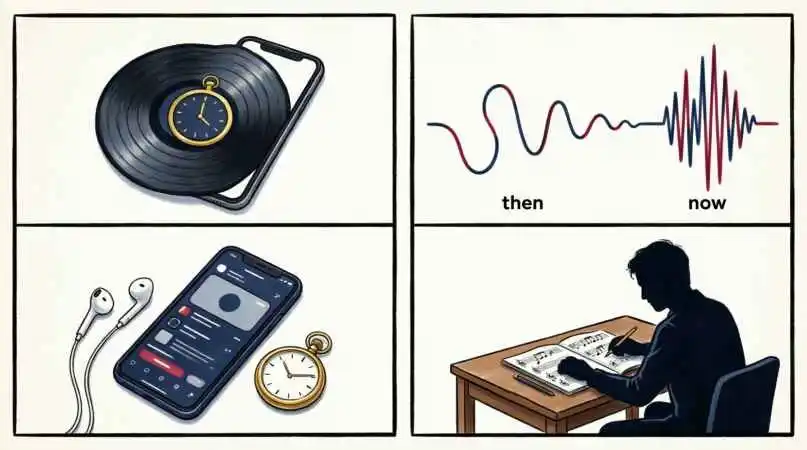
A useful way to see this shift concretely is to imagine two hypothetical but representative singles, one built on the structural conventions common a generation ago and one built on today’s conventions, both aiming for the same emotional payoff. The older-style track might open with a full instrumental bar establishing mood, ease into a first verse that sets a scene, hold the hook back until roughly the forty-five-second mark to make its arrival feel earned, include a bridge that shifts key or tempo to create contrast, and close with a longer outro that lets the arrangement resolve. Total runtime: somewhere around four minutes.
A contemporary equivalent aiming for maximum streaming and short-form performance is far more likely to open directly on a vocal hook or a heavily processed instrumental riff within the first five seconds, compress the first verse to a handful of lines before returning to that same hook, skip or drastically shorten any bridge, and end abruptly rather than fade, often just under three minutes or even closer to two and a half. Neither structure is inherently superior as a piece of songwriting craft, but only one of them is optimized for the specific mechanics of today’s dominant distribution channels, and that difference in optimization, multiplied across an entire release calendar of major-label singles, is what produces the aggregate runtime decline visible in industry-wide data.
This comparison also illustrates why the shift can feel invisible from the inside even to listeners who sense something has changed. No single song announces the trend; it emerges only in aggregate, across thousands of individual structural choices made independently by writers and producers responding to a shared set of incentives, each one a small, individually reasonable decision that collectively reshapes what a hit song sounds like on a cultural scale.
The Song as a Product of Its Distribution System
Strip away the technology and the underlying story is an old one: the format that carries music has always shaped the music itself, from the physical limits of a 78-rpm record to the programming logic of commercial radio to the algorithmic engagement metrics of a streaming platform. What has changed is the speed and precision of that influence. Where earlier format pressures shifted gradually over years or decades, today’s algorithmic feedback loops respond to listener behavior in near real time, giving songwriters and producers a far more immediate, granular, and financially explicit signal about exactly which seconds of a song are earning their place.
The modern pop song, tight, hook-forward, often gone before three minutes have passed, is not simply a matter of shrinking attention spans or declining artistic ambition, as it is sometimes casually dismissed. It is a rational response to a specific, well-documented set of financial and algorithmic incentives that reward exactly this shape. Understanding that does not settle the debate over whether something valuable is being lost in the process, but it does clarify what is actually driving the change: not a mystery of shifting taste, but a traceable, structural negotiation between art and the economics of attention, playing out three minutes, or less, at a time.
| FREQUENTLY ASKED QUESTIONS |
| Q1. Are pop songs actually shorter today than in the past?
Yes, multiple industry analyses show the average length of chart-topping songs has declined over the past decade, with many hits now landing under three minutes compared to closer to four minutes in earlier decades. |
| Q2. What is the main reason songs are getting shorter?
The leading driver is streaming economics combined with short-form video platforms, both of which financially reward songs that hook listeners immediately and loop or replay easily. |
| Q3. How does Spotify’s payment model influence song length?
Streaming platforms typically count a stream and pay royalties once a listener passes a short playback threshold, so a shorter song can accumulate a completed stream faster and more often than a longer one. |
| Q4. What is a ‘skip rate’ and why does it matter to artists?
Skip rate measures how often listeners skip a song before it finishes, and streaming algorithms often deprioritize tracks with high skip rates, pushing artists to front-load the most engaging parts of a song. |
| Q5. How has TikTok specifically changed songwriting habits?
TikTok rewards short, highly memorable, loopable audio clips, so many artists and labels now write or restructure songs around a punchy 15-to-30-second hook designed to work as a standalone video soundtrack. |
| Q6. What part of a song is most likely to get cut today?
Long instrumental intros, extended bridges, and guitar or instrumental solos are the sections most frequently shortened or removed in modern hit songwriting. |
| Q7. Did earlier eras of music have length pressures too?
Yes, mid-20th-century radio formatting favored songs around three minutes for airplay efficiency, showing that external distribution technology has shaped song length before, though the current pressure operates differently through algorithms. |
| Q8. Is there a specific point in a song streaming platforms consider a ‘played’ track?
Practices vary by platform and have evolved over time, but historically many major streaming services have counted a stream once a certain playback duration, often around 30 seconds, has been reached. |
| Q9. Do all music genres feel this pressure equally?
No, genres built around club play, extended arrangements, or album-oriented listening, such as certain strains of electronic, jazz, or progressive rock, feel less pressure than mainstream pop, hip-hop, and radio-driven genres. |
| Q10. Are guitar solos disappearing from popular music?
Extended instrumental solos have become less common in mainstream chart hits, partly due to length pressures and partly due to shifting genre trends favoring vocal-forward, hook-dense arrangements. |
| Q11. What is ‘hook-first’ songwriting?
Hook-first songwriting places the most memorable, catchy part of a song at or near the very beginning, rather than building toward a chorus after a slower verse or intro. |
| Q12. How do record labels use TikTok data before releasing a single?
Some labels test song snippets or hooks on short-form platforms ahead of a full release to gauge audience reaction and sometimes adjust the final single based on which portion resonates most. |
| Q13. Has the loudness or energy of songs changed alongside length?
Many analyses note modern hits tend to reach their most energetic or catchy moment earlier in the track, reflecting the same pressure to capture attention within the first few seconds. |
| Q14. Do older, longer songs still perform well on streaming platforms?
Yes, some longer or slower-building songs still find success, particularly through strong artist fanbases, nostalgia, or viral moments unrelated to length, showing length is an influence rather than an absolute rule. |
| Q15. What role does the attention economy play in this trend?
The broader attention economy, where countless media forms compete for a listener’s limited time and focus, incentivizes any content format, including songs, to front-load engagement to avoid being skipped or scrolled past. |
| Q16. Are songwriters and producers publicly discussing this shift?
Yes, numerous songwriters, producers, and music executives have discussed in interviews and industry panels how streaming and short-form video considerations now factor into arrangement and structural decisions during the writing process. |
| Q17. Is song length data tracked and published by researchers?
Yes, several music data and analytics researchers and outlets have published studies and articles tracking average chart song duration over multi-decade periods, generally showing a downward trend in recent years. |
| Q18. Does a shorter song necessarily mean lower artistic quality?
Not necessarily; song length is a structural choice, and many acclaimed shorter tracks are considered artistically strong, though critics debate whether external commercial pressure narrows creative range in aggregate. |
| Q19. How do playlists factor into the pressure for shorter songs?
Curated and algorithmic playlists often favor tracks that maintain listener engagement without long lulls, and a shorter, tighter song can fit more easily into playlist flow without risking a skip. |
| Q20. What is ‘song sniping’ in a TikTok context?
Song sniping refers to a trend or video using only a specific short segment of a song, often the hook, which can drive massive streaming interest in that segment even if the rest of the song is rarely heard in full. |
| Q21. Can a song go viral on TikTok without ever charting traditionally?
Yes, a song clip can circulate widely on short-form video platforms and drive real cultural visibility even if the full track underperforms on traditional sales or radio metrics. |
| Q22. Are intros making a comeback in any part of the industry?
Some artists, particularly in album-oriented or established-fanbase contexts, continue to use longer intros deliberately as an artistic choice, especially on non-single album tracks not intended for algorithmic discovery. |
| Q23. How has average song length changed numerically over recent decades?
Various industry analyses report average hit song lengths declining from roughly four minutes or more in earlier decades to closer to three minutes or slightly under in more recent years, though exact figures vary by study and dataset. |
| Q24. Do vinyl or CD-era format constraints still influence song length today?
Physical format constraints like vinyl side length or radio-friendly single lengths mattered heavily in earlier eras, but today’s constraints are driven far more by digital platform engagement metrics than physical media limits. |
| Q25. What is the financial incentive difference between a 2-minute and 4-minute song on streaming?
A shorter song can potentially accumulate more completed streams within the same listening session length, which under a per-stream royalty model can translate into more counted plays over time, though total revenue depends on many additional factors. |
| Q26. Are there criticisms of the shift toward hook-first, shorter songs?
Yes, some critics and musicians argue this trend can flatten musical diversity, discourage experimental structure, and prioritize algorithmic performance over long-form artistic expression. |
| Q27. Do music award shows or critics factor in this trend when evaluating songs?
Some music critics and commentators have referenced streaming and short-form video influence when discussing contemporary songwriting trends, though formal award criteria generally remain focused on broader artistic and commercial merit. |
| Q28. Is this trend unique to a specific country or global?
The trend has been observed and discussed across multiple major music markets globally, since major streaming platforms and short-form video apps operate internationally with similar underlying engagement mechanics. |
| Q29. Could future technology reverse this trend toward shorter songs?
It is possible; shifts in platform algorithms, monetization models, or listener behavior could change these incentives over time, much as radio formatting pressures have evolved across different eras of the music industry. |
| Q30. What should an independent artist know about this trend when releasing music?
Independent artists are often advised to understand how streaming and short-form platforms measure engagement so they can make informed, intentional choices about song structure rather than following trends by default. |
Disclaimer: The content on this blog is for informational purposes only. The author’s opinions are personal and not endorsed. Efforts are made to provide accurate information, but completeness, accuracy, or reliability are not guaranteed. The author is not liable for any loss or damage resulting from the use of this blog. It is recommended to use the information on this blog at your own discretion.
