
Table of Contents
The Hidden Gem of the Balkans: Why Montenegro Should Be Your Next Epic Adventure
There is a place in Europe where towering, jagged mountains plunge dramatically into the impossibly blue waters of the Adriatic Sea. A land where medieval stone villages cling to sheer cliffsides, where emerald rivers cut through ancient canyons, and where the pace of life slows down just enough for you to savor a perfectly poured cup of coffee. Welcome to Montenegro.
For years, this small Balkan nation played the role of the wallflower at the European travel dance, overshadowed by its glamorous neighbor, Croatia, and its historically heavyweight cousin, Italy. But the secret is out. Travelers seeking authentic experiences, breathtaking natural landscapes, and a fraction of the crowds found elsewhere in the Mediterranean are now setting their compasses toward this captivating country. Whether you are a history buff, an adrenaline junkie, a foodie, or a beach bum, Montenegro offers a kaleidoscope of experiences that will leave you absolutely spellbound.
In this comprehensive guide, we are going to dive deep into everything you need to know about traveling to Montenegro. From its exact geographical location and the jaw-dropping sightseeing places that grace its landscape, to the intricacies of local transportation, the best places to lay your head, and essential travel tips—consider this your ultimate blueprint for the Balkan adventure of a lifetime.
Location and Geography: Where in the World is Montenegro?
Montenegro is a small, sovereign state located in the southeastern region of Europe, squarely within the heart of the Balkan Peninsula. To understand its geographical significance is to understand its soul. It is bordered by Croatia to the west, Bosnia and Herzegovina to the northwest, Serbia to the northeast, Kosovo to the east, and Albania to the southeast. To the southwest, it boasts a stunning coastline along the Adriatic Sea.

Despite its modest size—covering roughly 13,800 square kilometers—Montenegro packs an almost comical amount of geographical diversity into its borders. The country is broadly divided into three distinct climatic and geographical zones: the coastal region, the central highlands, and the mountainous northern region.
The coastal zone, which stretches for about 295 kilometers, is characterized by a classic Mediterranean climate. Here, you will find long, hot summers and mild, wet winters, making it a haven for beachgoers from June through September. As you move inland, the terrain changes rapidly. The central region, where the capital city of Podgorica sits, features a more continental climate with hotter summers and significantly colder winters.
But it is the northern region that will truly blow your mind. This is where the Dinaric Alps dominate the landscape, creating a rugged, alpine environment that receives heavy snowfall in the winter. Because of this dramatic topography, it is entirely possible to swim in the Adriatic Sea in the morning and go skiing in the mountains in the afternoon—a feat very few countries in the world can boast. The name itself, “Montenegro,” translates to “Black Mountain,” a moniker likely derived from the dense, dark forests that historically cloaked the Mount Lovćen area, looking almost black when viewed from the sea.
Sightseeing Places: The Jewels in Montenegro’s Crown
To visit Montenegro is to embark on a continuous journey of visual discovery. The sightseeing opportunities are vast, ranging from UNESCO World Heritage sites to untouched national parks. Here are the absolute must-visit destinations that you cannot miss.
The Bay of Kotor (Boka Kotorska)
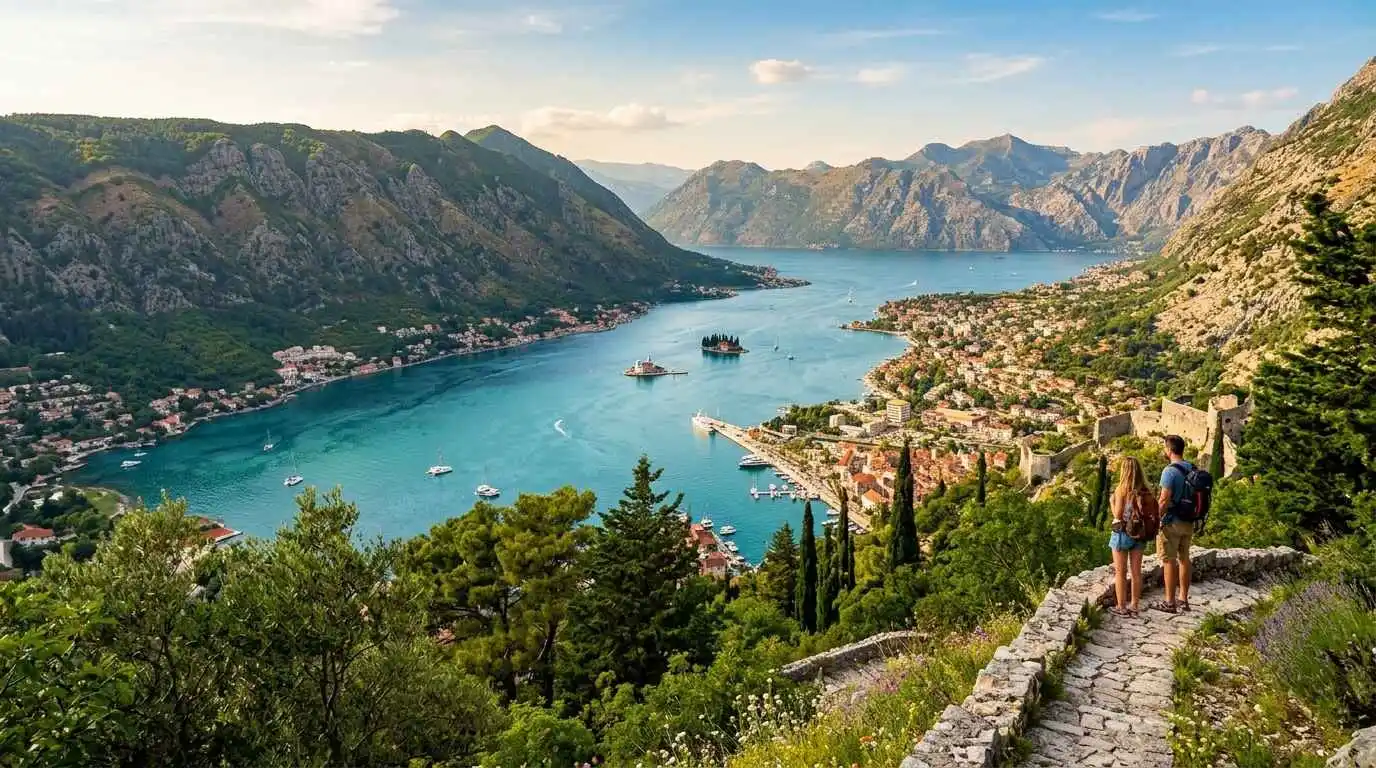
Often mistakenly referred to as Europe’s southernmost fjord (it is actually a submerged river canyon), the Bay of Kotor is the undisputed crown jewel of the Montenegrin coast. The bay is surrounded by steep mountains that rise dramatically from the water’s edge, creating a surreal, cinematic backdrop.
At the heart of the bay lies Kotor Old Town, a UNESCO World Heritage site. Losing yourself in the labyrinthine alleyways of Kotor is a mandatory experience. The town is enclosed by imposing Venetian walls built between the 15th and 17th centuries to protect against Ottoman invasions. Inside, you will find a treasure trove of Romanesque, Gothic, Renaissance, and Baroque architecture. Don’t miss the Cathedral of Saint Tryphon, which dates back to 1166.
For the physically ambitious, you must climb the 1,350 steps to the Fortress of San Giovanni, perched high on the cliff above the town. The climb is strenuous, especially in the midday heat, but the panoramic view of the entire bay, the red-roofed houses, and the azure water below is a reward that will be etched into your memory forever.
Sveti Stefan
If you have seen a postcard of Montenegro, chances are it featured Sveti Stefan. This iconic islet, located just a few kilometers south of Budva, is connected to the mainland by a narrow isthmus. Originally a fortified fishing village dating back to the 15th century, the island fell into disrepair before being completely transformed into an ultra-luxurious resort in the 1960s. Today, it operates under the Aman brand and is a playground for the ultra-rich.
While you cannot access the island itself unless you are a guest or have a dining reservation, the mainland opposite the island offers pristine beaches and the absolute best vantage points for photography. The contrast of the terracotta-roofed stone buildings against the deep blue Adriatic is simply mesmerizing, particularly at sunset when the island takes on a golden hue.
Budva and the Riviera
If Kotor is for history lovers, Budva is for those seeking sun, sea, and vibrant nightlife. Known as the “Montenegrin Miami,” Budva boasts a 35-kilometer coastline known as the Budva Riviera, dotted with numerous beaches, coves, and luxury resorts.
Within Budva itself lies another magnificent Old Town, surrounded by ancient defensive walls. While smaller than Kotor’s, it buzzes with a different energy, packed with boutique shops, seafood restaurants, and lively bars. At night, the town transforms. The beaches host massive open-air clubs that attract world-renowned DJs, making it the epicenter of entertainment in the Balkans during the summer months.
Durmitor National Park and the Tara River Canyon
Leaving the coast behind and heading north into the mountains, you will discover why Montenegro is a paradise for nature lovers and adventure seekers. Durmitor National Park, another UNESCO World Heritage site, is a geological marvel.
The centerpiece of the park is the Tara River Canyon, the deepest river canyon in Europe and the second deepest in the world, plunging to a depth of 1,300 meters. The canyon is spanned by the Đurđevića Tara Bridge, an elegant concrete arch bridge built in 1940, which offers vertigo-inducing views of the roaring river below. Whitewater rafting on the Tara River is a quintessential Montenegrin experience, taking you through rapids flanked by dense pine forests and sheer rock faces.
Also within the park is the Black Lake (Crno Jezero), a stunning glacial lake surrounded by dense, dark forests and towering peaks. A paved walking path circumnavigates the lake, offering a serene, easy walk that reflects the majestic mountains in its still, dark waters. In winter, the nearby town of Žabljak transforms into a ski resort.
Ostrog Monastery
Carved almost miraculously into the vertical face of a massive rock cliff, the Ostrog Monastery is one of the most important sites of Orthodox Christianity in the world. Located high in the mountains above the Zeta valley, the monastery was founded in the 17th century by Saint Basil of Ostrog.
The upper monastery, situated at an elevation of around 900 meters, houses the relics of St. Basil and features frescoes painted directly onto the cave walls. The atmosphere here is palpably spiritual, regardless of your personal religious beliefs. Pilgrims and tourists alike make the journey up the winding, mountainous roads to witness this architectural and human feat of devotion. The views of the surrounding valleys from the monastery balconies are staggering.
Lovćen National Park and the Mausoleum of Petar II Petrović-Njegoš
To truly understand the Montenegrin spirit, you must visit Lovćen. This mountain is considered the sacred heart of the country, deeply tied to its identity and poetry. At the very top of the Jezerski vrh peak sits the Mausoleum of Petar II Petrović-Njegoš, a celebrated prince-bishop, poet, and philosopher.
Reaching the mausoleum requires climbing a formidable 461 steps from the parking lot, but once inside, you are greeted by a stunning mosaic containing 200,000 gold tiles. Outside, standing on the balcony of the mausoleum, you are rewarded with what is arguably the best view in the entire Balkans. On a clear day, you can see the entirety of the Bay of Kotor, the Skadar Lake, and even the mountains of Albania.
Skadar Lake (Lake Skadar)
Straddling the border between Montenegro and Albania, Skadar Lake is the largest lake in Southern Europe. It is a paradise for birdwatchers, as it is home to over 270 bird species, including the rare and endangered Dalmatian pelican.
The Montenegrin side of the lake is characterized by tranquil waters, floating water lilies, and quaint fishing villages like Virpazar. Taking a traditional wooden boat tour through the lush wetlands is an incredibly peaceful experience. Furthermore, the area surrounding Skadar Lake is Montenegro’s premier wine-growing region. The local vintners produce exceptional wines, particularly the robust, dark red Vranac, which pairs perfectly with the freshly caught carp from the lake.
Local Transportation: Navigating the Terrain
Getting around Montenegro is an adventure in itself, thanks to the country’s dramatic topography. While the infrastructure has improved significantly in recent years, the mountainous terrain means that travel times can be longer than expected, and the roads can be winding and narrow. Here is a breakdown of your options.
Renting a Car
For the ultimate freedom to explore, renting a car is highly recommended, particularly if you plan to venture into the northern mountains. Driving in Montenegro gives you the flexibility to stop at remote viewpoints, explore hidden villages, and travel at your own pace.
However, be prepared for the roads. The coastal highway is generally in good condition, but can be heavily congested in the summer. The inland routes, such as the famous road from Kotor to Cetinje, are engineering marvels featuring endless hairpin bends (serpentines) with sheer drop-offs. A reliable GPS (Google Maps works well, though offline maps are advisable in areas with poor signal) and a confident driver are essential. An SUV or a car with good engine power is preferable for mountain passes. Always keep an eye out for local wildlife and livestock, which frequently wander onto the roads in rural areas.
Buses
The backbone of Montenegrin public transportation is its network of intercity buses. The system is surprisingly efficient, extensive, and very affordable. The main bus stations in Podgorica, Kotor, Budva, and Nikšić serve as hubs where you can catch buses to virtually any corner of the country.
The buses themselves are usually modern, comfortable coaches equipped with air conditioning. Ticket prices are incredibly budget-friendly; a trip from Kotor to Podgorica might cost you less than a cup of coffee at home. You generally buy tickets directly from the driver or at a booth at the station. The main downside to buses is the lack of strict schedules; they often leave when full rather than at the exact printed departure time. Furthermore, buses to remote mountain villages might only run once or twice a day, so careful planning is required.
Taxis and Ridesharing
Taxis are plentiful in the cities and along the coast. They are relatively cheap compared to Western Europe, but it is crucial to ensure the driver uses a meter or to agree on a price before getting in the car to avoid being overcharged. Ridesharing apps like Uber or Bolt are operational in the capital, Podgorica, and are becoming more prevalent in coastal towns, offering a safer and more transparent pricing alternative.
Ferries
A unique and highly recommended mode of transport is the ferry that crosses the Bay of Kotor. The Kamenari-Lepetane ferry connects the western and eastern sides of the bay, saving travelers from having to drive all the way around the perimeter. It takes about 15 minutes, operates continuously throughout the day, and costs just a few euros. It is not only a practical shortcut but also a lovely mini-cruise offering beautiful views of the bay.
Accommodation: Where to Rest Your Head
Montenegro offers a wide spectrum of accommodation options, catering to everyone from backpackers counting their pennies to billionaires seeking absolute privacy.
Ultra-Luxury
As mentioned, the Aman Resort on Sveti Stefan is the pinnacle of Montenegrin luxury, offering unparalleled exclusivity. Beyond that, the Regent Porto Montenegro in Tivat has transformed the area into a superyacht hub, offering five-star service, high-end dining, and a glamorous marina lifestyle. In the mountains, boutique eco-resorts are beginning to pop up, offering luxury in a rustic, secluded setting.
Boutique Hotels and Guesthouses
The most charming way to experience the coastal towns is by staying in a small, family-run boutique hotel or a guesthouse within the old town walls. In Kotor and Budva, many ancient stone buildings have been lovingly restored and converted into elegant accommodations. Staying here means you wake up stepping directly onto cobblestone streets, surrounded by history. These places often feature interior courtyards, terracotta tiles, and stunning views of the bell towers or the sea.
Apartments and Villas
Along the Budva Riviera and in towns like Herceg Novi, private apartment rentals are incredibly popular. Many locals own second homes or purpose-built apartments that they rent out to tourists. Platforms like Booking.com and Airbnb are flooded with options. This is an ideal choice for couples or families who want their own kitchen facilities, a private balcony, and perhaps a pool. For larger groups, renting a private villa with a view of the Adriatic can be surprisingly affordable compared to similar properties in Italy or France.
Budget and Hostels
For the budget-conscious traveler, Montenegro is exceptionally friendly. Hostels in Kotor and Budva are vibrant, social hubs where backpackers from around the world converge. Dormitory beds can be found for very low prices, and many hostels organize communal dinners, pub crawls, and boat tours. If hostels aren’t your style, basic private rooms (often within a local family’s home) can be found for a fraction of the cost of a hotel, particularly if you venture slightly inland from the immediate coastline.
Eco-Lodges and Mountain Huts
In the north, around Durmitor National Park, the accommodation shifts to reflect the alpine environment. You will find cozy, wooden chalets, eco-lodges, and traditional mountain huts (katuns). Staying in a katun offers a truly authentic experience. These are traditional stone or wooden shepherd huts where you can sleep under the stars, eat homemade cheese and prosciutto, and wake up to the sound of cowbells in the pristine mountain air.
Other Essential Information: The Nuts and Bolts
To ensure your trip goes smoothly, there are several practical details you should be aware of before packing your bags.
Currency and Money
Despite not being a member of the European Union, Montenegro unilaterally adopted the Euro (€) as its official currency in 2002. This is a massive convenience for travelers coming from Europe, as there is no need to deal with confusing exchange rates or foreign transaction fees for currency exchange. ATMs are widely available in all cities and towns, and credit cards (Visa and Mastercard) are accepted in almost all hotels, restaurants, and larger shops. However, it is always wise to carry a stash of cash, as smaller vendors at street markets, rural guesthouses, or local bus drivers may only accept bills.
Language and Communication
The official language is Montenegrin, which is mutually intelligible with Serbian, Croatian, and Bosnian. English is spoken fluently by the younger generations and by anyone working in the tourism, hospitality, or transportation sectors. You will have absolutely no problem ordering food, asking for directions, or navigating your hotel check-in in English. Learning a few basic words in the local language—like “Hvala” (Thank you) or “Molim” (Please)—will be met with huge smiles and appreciative nods.
For internet access, purchasing a local SIM card is incredibly cheap and easy. Providers like Crnogorski Telekom or One offer prepaid SIM cards with generous data allowances for just a few euros, ensuring you can use your GPS and stay connected without incurring roaming charges.
Food and Drink: A Culinary Crossroads
Montenegrin cuisine is a delicious reflection of its history and geography, sitting at the crossroads of the Mediterranean, the Ottoman Empire, and the Slavic heartland.
On the coast, the diet is heavily Mediterranean. You will feast on freshly caught fish, octopus salads, black risotto (made with cuttlefish ink), and mussels Buzara style (cooked in a white wine, garlic, and parsley broth). Olive oil, garlic, and fresh herbs dominate the flavor profiles.
As you move inland, the cuisine becomes heartier and more influenced by Ottoman traditions. Meat is king here. You must try Ćevapi (small, skinless sausages made of minced meat, usually beef or lamb, served with flatbread and sour cream), Pljeskavica (a large, spiced meat patty), and Burek (a flaky pastry filled with meat, cheese, or spinach).
No culinary exploration is complete without trying Njeguški pršut, a dry-cured ham specific to the Njeguši village near Lovćen, and Kačamak, a traditional peasant dish made from potatoes, cornmeal, and cheese, heavily prevalent in the northern mountains.
Wine lovers should actively seek out Vranac, a robust, full-bodied red wine that is the pride of the country. For white wine enthusiasts, Krstač is a crisp, indigenous white grape variety. And for something truly local, try Rakija, a strong fruit brandy (often plum or grape) that is traditionally offered to guests as a sign of welcome. Sip it slowly; it packs a punch!
Best Time to Visit
The best time to visit Montenegro heavily depends on what you want to do.
For a classic beach holiday, the peak season is July and August. During these months, the coastal towns are buzzing, the sea is perfectly warm for swimming, and all the beach clubs and restaurants are in full swing. The trade-off is intense heat, high prices, and massive crowds, particularly in Budva and Kotor.
If you prefer a more temperate climate and fewer tourists, the “shoulder seasons” of May, June, and September are magical. The weather is still warm enough to swim, but the crowds thin out, and accommodation prices drop significantly. This is the absolute best time for hiking and sightseeing.
If your primary goal is to explore the northern mountains, go white-water rafting, or see the Ostrog Monastery without the summer heat, spring (April to early June) and early autumn (September to October) are ideal. Winter (December to March) transforms the mountainous regions into a snowy wonderland, perfect for skiing in Žabljak and Kolašin, while the coastal towns take on a quiet, ghostly, yet romantic atmosphere.
Safety and Etiquette
Montenegro is an incredibly safe country for travelers. Violent crime is exceptionally rare, and the primary threat you face is petty theft, such as pickpocketing in crowded tourist areas or on busy buses—standard precautions apply: keep your valuables secure and be aware of your surroundings.
The locals are known for their warmth, hospitality, and a slightly relaxed attitude toward time. “Polako” is a word you will hear often; it translates roughly to “take it easy,” “slow down,” or “no worries.” Embrace this mindset. If your bus is ten minutes late, or your coffee takes a little longer to arrive, don’t stress. You are on Balkan time now.
Dress codes are generally casual and European-style. When visiting religious sites like monasteries or churches, however, it is mandatory to dress modestly. Women should have their shoulders and knees covered, and men should not wear shorts. It is a good idea to carry a light scarf or shawl in your day bag just for this purpose.
Final Thoughts: Answering the Call of the Black Mountain
Montenegro is a destination that defies expectations. It is a place where you can stand in a 12th-century stone square, look up, and see snow-capped peaks, and look down to see luxury yachts bobbing on crystal-clear water. It is a country that has endured a tumultuous history, yet its people welcome strangers with open arms, generous pours of Rakija, and tables laden with incredible food.
Whether you are navigating the serpentine roads of the Bay of Kotor, feeling the mist of the Tara River on your face during a rafting expedition, or simply watching the sunset paint the walls of Sveti Stefan in shades of gold and pink, Montenegro creates moments that resonate deeply. It is raw, it is authentic, and it is breathtakingly beautiful.
As the rest of the world rushes to discover this European hidden gem, there has never been a better time to visit. Pack your bags, lace up your hiking boots, polish your sunglasses, and set off on a Balkans adventure. The majestic Black Mountain is waiting for you.
FAQ’s
Geography & General Information
- Where is Montenegro located?
Montenegro is located in southeastern Europe, in the heart of the Balkan Peninsula, bordered by Croatia, Bosnia and Herzegovina, Serbia, Kosovo, and Albania, with a coastline along the Adriatic Sea.
- What does the name “Montenegro” mean?
The name translates to “Black Mountain,” likely derived from the dense, dark forests that historically covered the Mount Lovćen area, which looked black when viewed from the sea.
- How large is Montenegro?
Montenegro is a modestly sized country, covering roughly 13,800 square kilometers.
- Is it really possible to swim in the sea and ski on the same day in Montenegro?
Yes, because of its dramatic topography, you can swim in the Mediterranean waters of the coast in the morning and drive to the northern Dinaric Alps to ski in the afternoon.
- What are the three main geographical and climatic zones of Montenegro?
The country is divided into the coastal region (Mediterranean climate), the central highlands (continental climate), and the mountainous northern region (alpine climate).
Sightseeing & Attractions
- Is the Bay of Kotor actually a fjord?
No, while often mistakenly called Europe’s southernmost fjord, it is actually a submerged river canyon.
- How many steps does it take to climb to the Fortress of San Giovanni in Kotor?
It takes 1,350 steps to reach the fortress, which offers panoramic views of the entire bay.
- Can anyone visit the island of Sveti Stefan?
No, the island is an ultra-luxurious Aman resort. Access is restricted to hotel guests or those with a dining reservation, but mainland viewing spots provide incredible photo opportunities.
- Why is Budva referred to as the “Montenegrin Miami”?
Budva earned this nickname because of its vibrant nightlife, numerous beach clubs that host world-renowned DJs, and glamorous summer atmosphere.
- What makes the Tara River Canyon significant?
It is the deepest river canyon in Europe and the second deepest in the world, plunging to a depth of 1,300 meters.
- What is the name of the famous bridge that spans the Tara River Canyon?
The Đurđevića Tara Bridge, an elegant concrete arch bridge built in 1940, spans the canyon.
- What is Black Lake (Crno Jezero)?
It is a stunning, easily accessible glacial lake surrounded by dark pine forests and towering peaks, located within Durmitor National Park.
- How was the Ostrog Monastery built?
It is carved almost miraculously into the vertical face of a massive rock cliff high in the mountains.
- Who is buried at the top of Lovćen National Park?
Petar II Petrović-Njegoš, a celebrated Montenegrin prince-bishop, poet, and philosopher, is buried in the mausoleum at Jezerski vrh peak.
- How many steps must you climb to reach the Njegoš Mausoleum on Lovćen?
You must climb 461 steps from the parking lot to reach the mausoleum.
- What is Skadar Lake known for?
It is the largest lake in Southern Europe, famous for being home to over 270 bird species (including the rare Dalmatian pelican) and being Montenegro’s premier wine-growing region.
Transportation
- Is renting a car recommended in Montenegro?
Yes, it is highly recommended for ultimate freedom, especially if you plan to explore the remote northern mountains, though drivers must be prepared for winding, narrow roads with hairpin bends.
- What should you watch out for when driving in rural Montenegro?
You should keep an eye out for local wildlife and livestock, which frequently wander onto the roads.
- How does the intercity bus system work in Montenegro?
Buses are the backbone of public transport. They are modern, affordable, and you generally buy tickets directly from the driver or at a station booth.
- Do Montenegrin buses leave exactly on time?
Not always. Buses often leave when they are full rather than strictly adhering to the printed departure time.
- Are ridesharing apps available in Montenegro?
Yes, apps like Uber and Bolt are operational, particularly in the capital city of Podgorica.
- Why should tourists take the Kamenari-Lepetane ferry?
It crosses the Bay of Kotor, acting as a practical 15-minute shortcut that saves travelers from having to drive all the way around the perimeter of the bay.
Accommodation
- What is a “katun” in terms of Montenegrin accommodation?
A katun is a traditional stone or wooden shepherd’s hut in the northern mountains that has been adapted to host tourists looking for an authentic, rustic, and secluded nature experience.
- Where is the superyacht hub of Montenegro located?
It is located in Tivat, centered around the luxury Regent Porto Montenegro resort.
- What type of accommodation is best for experiencing the history of Kotor or Budva?
Staying in a small, family-run boutique hotel or guesthouse located within the ancient stone walls of the Old Towns is highly recommended.
Food, Currency & Culture
- What currency is used in Montenegro?
Montenegro uses the Euro (€), despite not being a member of the European Union.
- What is the difference between coastal and inland Montenegrin cuisine?
Coastal cuisine is Mediterranean-focused (fresh fish, olive oil, garlic), while inland cuisine is heartier and Ottoman-influenced (meat-heavy dishes like Ćevapi and Burek).
- What is “Njeguški pršut”?
It is a famous, traditional dry-cured ham specific to the Njeguši village near Lovćen mountain.
- What does the local word “Polako” mean?
It roughly translates to “take it easy,” “slow down,” or “no worries.” It reflects the relaxed local attitude toward time.
- Is there a dress code for visiting religious sites in Montenegro?
Yes, when visiting monasteries or churches, you must dress modestly: women should have shoulders and knees covered, and men should not wear shorts.
Disclaimer: The content on this blog is for informational purposes only. The author’s opinions are personal and not endorsed. Efforts are made to provide accurate information, but completeness, accuracy, or reliability are not guaranteed. The author is not liable for any loss or damage resulting from the use of this blog. It is recommended to use the information on this blog at your own discretion.
