
Table of Contents
Santorini Unfiltered: The Greek Island Where Every Sunset Feels Like a Secret
A practical, honest guide to the caldera views, volcanic beaches, and hillside villages behind the world’s most photographed island
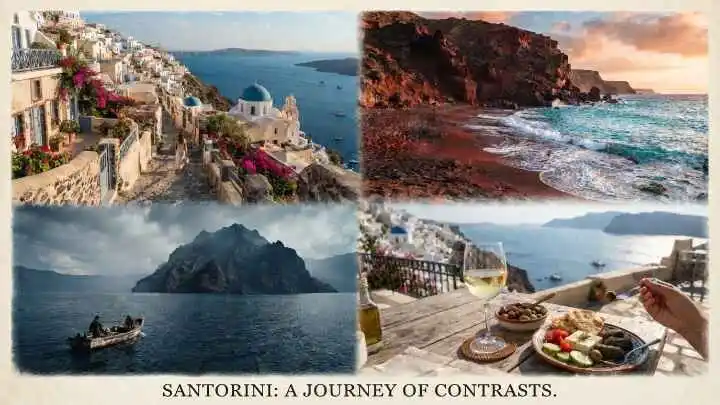
Santorini exists because of a catastrophe. Roughly 3,600 years ago, one of the largest volcanic eruptions in recorded history tore the center out of what had been a single round island, collapsing it into the sea and leaving behind the dramatic crescent-shaped caldera that now defines the island’s entire identity. Every postcard image associated with Santorini — the whitewashed villages perched on cliff edges, the impossibly blue domes of Oia, the sunset crowds gathering along the caldera rim — exists directly because of that ancient act of geological violence. Few places on Earth wear their disaster history quite so beautifully.
That history is easy to forget amid the crowds, the wine bars, and the relentless photography, but it explains almost everything distinctive about the island: the black and red volcanic sand beaches, the mineral-rich soil that produces some of Greece’s most distinctive wines, and the sheer cliff-face geography that forces every village into the same striking vertical architecture. Santorini rewards visitors who look past the famous sunset photo spot and spend time understanding why the island looks and tastes the way it does.
This guide covers what actually makes Santorini worth visiting, the villages and sights that deserve real time, the best season to go, where to stay depending on what kind of trip you want, the food and wine scene, and the practical details that make the difference between a smooth trip and a frustrating one on an island that gets more crowded every year.

Why Santorini Looks the Way It Does
Santorini, known locally as Thira, is technically the largest island in a small volcanic archipelago in the Aegean Sea, part of Greece’s Cyclades island group. The caldera — the flooded crater left behind by the Bronze Age eruption — forms a dramatic bay roughly seven miles across, ringed by cliffs that rise several hundred feet straight up from the water. Every major town on the island’s western side sits directly on top of these cliffs, which is why so many photographs of Santorini seem to show buildings suspended impossibly above the sea.
The eruption that created this landscape, sometimes called the Minoan eruption, is considered one of the largest volcanic events in human history, and many archaeologists connect it to the decline of the Minoan civilization on nearby Crete and to enduring myths, including some theories linking it to the legend of Atlantis. The volcano beneath the caldera, Nea Kameni, remains active today, forming a small island visible in the center of the bay that visitors can actually hike and explore on a boat tour.
This volcanic origin is not just a geological curiosity — it shapes the island’s entire character. The soil is mineral-rich and unusually well-suited to certain grape varieties, the beaches are colored black and red from volcanic rock rather than typical golden sand, and the dramatic cliffside geography that makes the island so photogenic also makes it genuinely difficult to navigate without understanding the layout in advance.
Every postcard image of Santorini exists because of an ancient act of geological violence — few places wear their disaster history quite so beautifully.
Villages and Sights Worth Your Time
Seven places that go beyond the famous sunset photo
1. Oia — The Sunset Village
Oia sits at the northern tip of the island and is responsible for the vast majority of Santorini’s iconic imagery: blue-domed churches, whitewashed cave houses cascading down the cliffside, and the famous sunset viewing spot near the old castle ruins. Oia is genuinely beautiful, but it is also the most crowded village on the island by a wide margin, particularly in the hour before sunset, when narrow pathways fill shoulder to shoulder with visitors angling for the same photo. Visiting Oia earlier in the day, or staying overnight to experience it after the day-trip crowds leave, meaningfully changes the experience, and wandering its quieter side streets away from the main pedestrian thoroughfare reveals a noticeably calmer version of the same village.
2. Fira — The Island’s Capital
Fira is Santorini’s main town and transportation hub, built along the caldera rim with a lively mix of shops, restaurants, and bars alongside genuinely spectacular views that rival Oia’s without quite the same crowd intensity. Fira is also where most cruise ship passengers arrive via cable car or the winding donkey path from the old port, making it considerably busier during midday cruise ship hours than in the early morning or evening.
3. Imerovigli — The Quiet Alternative
Sitting just north of Fira along the same caldera cliff, Imerovigli offers arguably the best caldera views on the entire island from a noticeably quieter, more residential setting. Known locally as the ‘balcony to the Aegean,’ it makes an excellent base for visitors who want easy access to Fira’s amenities without contending with its crowds, and the sunset views here rival Oia’s without requiring the same battle for a good vantage point.
4. Akrotiri — The Buried Bronze Age City
Long before the volcanic eruption that reshaped the island, Akrotiri was a thriving Bronze Age settlement, remarkably preserved under volcanic ash in a manner often compared to Pompeii, though considerably older. Unlike Pompeii, no human remains have been found at the site, suggesting the population evacuated before the final eruption. The excavated ruins, protected under a large covered structure, offer a genuinely fascinating look at sophisticated multi-story buildings, plumbing systems, and artwork from a civilization that predates classical Greece by roughly a thousand years. Many of the site’s most striking frescoes have since been relocated to museums in Fira and Athens, so pairing a visit to the ruins with the nearby Museum of Prehistoric Thira rounds out the picture considerably.
5. The Red Beach and Black Sand Beaches
Santorini’s volcanic origin gives it some of the most distinctive beaches in Greece. Red Beach, near Akrotiri, gets its striking color from the iron-rich red and black volcanic cliffs surrounding it, though the beach itself is relatively small and can get crowded. Perissa and Kamari, on the island’s southeastern coast, offer longer stretches of black volcanic sand with a more developed range of beach clubs, tavernas, and water sports.
6. Santo Wines and the Island’s Wine Country
Santorini’s volcanic soil, combined with a unique low-growing, basket-shaped vine training method developed to protect grapes from strong island winds, produces genuinely distinctive wines found nowhere else, particularly the crisp, mineral-driven white wine Assyrtiko. Several wineries across the island, many with sweeping caldera views from their tasting terraces, offer tastings that pair local wine with the island’s volcanic terroir in a way that makes the wine country a legitimate highlight rather than a secondary activity.
7. Nea Kameni and the Hot Springs Boat Tour
A short boat trip from Fira or Oia’s old port leads to Nea Kameni, the small, still-active volcanic island sitting in the middle of the caldera. Visitors can hike to the crater rim, and many tours continue on to nearby hot springs where a natural sulfur spring warms a patch of seawater near the neighboring island of Palea Kameni, offering a genuinely unusual swimming experience unlike anything found on the beaches themselves.
When to Visit Santorini
Santorini’s peak season runs from June through early September, when the weather is reliably warm and dry but the island is also at its most crowded and expensive, with popular viewpoints in Oia becoming genuinely difficult to enjoy during the sunset hour. Late April through May and September through October, generally considered shoulder season, offer a meaningfully better balance: warm, pleasant weather, thinner crowds, and noticeably lower prices on accommodation, without sacrificing much in terms of open restaurants, tours, or beach weather.
Winter, from November through March, sees a significant portion of the island’s hotels, restaurants, and tour operators close entirely, since Santorini’s economy depends heavily on tourist season. Visitors who do come during this period find a genuinely different, quieter island experience with dramatically lower prices, but should expect a limited range of open businesses and cooler, wetter, windier weather that is far less conducive to the caldera views and outdoor dining the island is known for.
Getting to Santorini
Santorini is served by its own airport, with frequent flights from Athens taking around 45 minutes, along with seasonal direct connections from various other European cities during peak summer months. This makes flying the fastest option for visitors coming from outside Greece or those short on time, though flights during peak season can be considerably more expensive and should be booked well in advance.
Ferries offer a more scenic, budget-friendly alternative, particularly for travelers already island-hopping through the Cyclades. High-speed ferries from Athens’s port of Piraeus typically take around five to eight hours depending on the vessel and route, while slower conventional ferries can take longer but often cost less. Santorini also connects well by ferry to nearby islands like Mykonos, Naxos, and Paros, making it easy to combine with a broader Cyclades itinerary rather than visiting in isolation.
Once on the island, the choice between the New Port (Athinios), where most ferries dock, and the Old Port beneath Fira, used primarily by cruise ships and local boat tours, matters for planning airport or hotel transfers, since the two ports sit in different locations along the caldera coastline.
Where to Stay Depending on What You Want
Santorini’s accommodation options vary enormously by village, and choosing the right base matters more here than on most islands, given how distinctly different each village’s character is.
For the Classic Postcard Experience
Oia offers the most iconic setting, with cave-house hotels built directly into the cliffside and private caldera-view plunge pools, though it comes at the highest price point and requires navigating the village’s steep, crowded pathways with luggage.
For Nightlife and Convenience
Fira provides the easiest access to restaurants, bars, shops, and transportation connections, making it a practical base for visitors who plan to explore the island widely rather than stay centered in one village.
For Caldera Views Without the Crowds
Imerovigli and nearby Firostefani offer caldera views comparable to Oia’s from quieter, more residential settings, ideal for visitors who want the classic Santorini panorama without competing for space at sunset.
For Beaches and a More Relaxed Pace
Perissa, Kamari, and Perivolos on the southeastern coast offer a beach-town atmosphere with easier access to the black sand beaches, generally at a lower price point than the caldera-view villages, at the cost of the dramatic clifftop scenery.
What to Eat and Drink
Santorini’s cuisine draws heavily on its volcanic soil and unique agricultural products. Fava, a puree made from the island’s distinctive yellow split peas, is a signature dish found on nearly every taverna menu, typically served with olive oil, capers, and caramelized onions. Tomatokeftedes, tomato fritters made from the island’s small, intensely flavored cherry tomatoes, showcase another crop that thrives in the mineral-rich volcanic soil despite minimal rainfall.
White eggplants, another Santorini specialty, appear in various preparations across the island’s restaurants, and the local cheese, chloro, offers a soft, tangy counterpoint to the richer dishes. On the wine side, Assyrtiko remains the signature white wine of the island, but Vinsanto, a sweet dessert wine made from sun-dried grapes, offers a distinctly different, honeyed profile worth trying at least once, ideally paired with the local almond-based desserts many wineries serve alongside their tastings.
Seafood also plays a significant role in the island’s cuisine, with grilled octopus, often visible drying on lines outside seaside tavernas, standing out as a particularly common and reliably excellent choice. For a genuinely local experience away from the more tourist-oriented caldera-view restaurants, the inland village of Pyrgos and the town of Megalochori offer traditional tavernas serving many of these same dishes at noticeably lower prices, often frequented as much by locals as by visitors.
Worthwhile Day Trips and Add-Ons
Beyond the main island, a handful of add-on experiences round out a Santorini trip well. The full-day catamaran or sailing tour around the caldera, stopping at the hot springs, Nea Kameni’s volcanic crater, and the neighboring island of Thirasia, is one of the most consistently recommended experiences on the island, offering caldera views from the water that no clifftop vantage point can replicate.
Thirasia itself, a small, sparsely populated island directly across the caldera from Oia, offers a genuinely quiet, undeveloped alternative for visitors curious what Santorini might have looked like before mass tourism reshaped the main island’s villages. A short ferry connects the two, making it an easy half-day escape from the main island’s crowds.
Practical Tips for a Smoother Trip
- Book accommodation with caldera views well in advance, particularly for travel during peak season, since the limited supply of cliffside rooms sells out months ahead in the most popular villages.
- Rent an ATV, small car, or arrange private transportation rather than relying solely on public buses, since the island’s spread-out villages and limited bus schedule can make relying entirely on public transport frustrating.
- Visit Oia for sunset at least once, but consider watching from a quieter nearby spot along the caldera path rather than the main castle viewpoint, where the crowds can genuinely detract from the experience.
- Wear sturdy, closed-toe shoes for exploring the villages, since the cobblestone paths, uneven steps, and steep inclines throughout Oia and Fira are not especially forgiving in sandals.
- Visit Akrotiri and the wineries earlier in your trip when energy levels are higher, since the archaeological site and wine tastings both reward unhurried time that is easy to shortchange later in a busy itinerary.
Final Thoughts
Santorini earns its reputation honestly, even if the crowds and the price tags occasionally make that harder to appreciate in the moment. The caldera views really are as striking as the photographs suggest, the volcanic wine really is distinctive enough to justify a dedicated afternoon, and Akrotiri’s buried Bronze Age city offers a genuinely different kind of experience than the clifftop sunset scene most visitors come specifically to chase. The island rewards travelers who plan around the crowds rather than through them — visiting Oia outside peak sunset hour, choosing a quieter village as a base, and building in unhurried time for the wineries and archaeological sites that get overshadowed by the more famous photo opportunities.
What makes Santorini worth the trip, ultimately, is not just the view from any single balcony or sunset point, but the layered history beneath it: a Bronze Age city buried by the same eruption that carved out the caldera everyone comes to photograph, a wine region shaped by volcanic soil found almost nowhere else on Earth, and villages built directly into cliffs formed by one of history’s largest natural disasters. Seeing all of that, rather than just the sunset, is what turns a crowded, expensive island into something genuinely worth the trip.
For first-time visitors weighing whether the hype is justified, the honest answer is that it depends almost entirely on how the trip is planned. Arrive expecting to fight crowds at a single viewpoint for a single photograph, and the island can feel like a disappointment relative to its reputation. Arrive with a loose plan that spreads time across villages, includes at least one meal or tasting away from the caldera-view restaurants, and leaves room for the archaeological site and a boat tour, and Santorini tends to deliver considerably more than its most famous image ever promises.
FAQs
| # | Question | Answer |
| 1 | Why is Santorini shaped like a crescent? | A massive volcanic eruption roughly 3,600 years ago collapsed the center of the original island, forming the flooded caldera that gives Santorini its crescent shape. |
| 2 | What is the best time to visit Santorini? | Late April through May and September through October offer warm weather with fewer crowds and lower prices than peak summer season. |
| 3 | Is Oia or Fira better to stay in? | Oia offers the most iconic caldera views and cave-house hotels, while Fira offers more convenience, nightlife, and easier transportation access. |
| 4 | Why are Santorini’s beaches black and red? | The island’s volcanic origin gives its beaches distinctive black and red sand and pebbles from surrounding volcanic rock. |
| 5 | What is Akrotiri? | A remarkably preserved Bronze Age settlement buried by volcanic ash, offering a look at a sophisticated civilization that predates classical Greece. |
| 6 | Is Santorini part of an active volcano? | Yes, Nea Kameni, a small island in the center of the caldera, remains an active volcano that visitors can hike. |
| 7 | What wine is Santorini known for? | Assyrtiko, a crisp, mineral-driven white wine grown in the island’s distinctive volcanic soil using a unique basket-shaped vine training method. |
| 8 | How crowded does Oia get for sunset? | Very crowded during peak season, with popular viewpoints filling shoulder to shoulder in the hour before sunset. |
| 9 | Can you swim near the volcano? | Yes, boat tours to Nea Kameni often continue to nearby hot springs where a natural sulfur spring warms a patch of seawater near Palea Kameni. |
| 10 | What food is Santorini known for? | Fava, a yellow split pea puree, tomatokeftedes tomato fritters, white eggplants, and the local cheese chloro are all signature dishes. |
| 11 | Do I need a car to get around Santorini? | Renting an ATV, car, or arranging private transportation is recommended, since public buses have limited schedules across the island’s spread-out villages. |
| 12 | What is Imerovigli known for? | It offers caldera views comparable to Oia’s from a quieter, more residential village setting. |
| 13 | Is Santorini expensive to visit? | Yes, particularly during peak summer season and in caldera-view accommodation, though shoulder season and inland villages offer more affordable options. |
| 14 | What is the legend connecting Santorini to Atlantis? | Some theories link the island’s Bronze Age eruption and the decline of Minoan civilization to the enduring legend of Atlantis. |
| 15 | How do I get from the cruise ship port to Fira? | Visitors typically take a cable car or the winding donkey path from the old port up to Fira. |
| 16 | What is Thirasia? | A small, sparsely populated island across the caldera from Oia, reachable by a short ferry, offering a quieter alternative to the main island. |
| 17 | Are there ancient ruins on Santorini besides Akrotiri? | Akrotiri is the most significant archaeological site, though ancient Thira, a separate classical-era settlement, is also open to visitors. |
| 18 | What is the best beach in Santorini? | Red Beach is the most famous for its striking volcanic color, while Perissa and Kamari offer longer black sand beaches with more amenities. |
| 19 | How many days should I spend in Santorini? | Three to five days allows enough time to see the main villages, Akrotiri, a winery, and a boat tour without feeling rushed. |
| 20 | Is Santorini good for a honeymoon? | Yes, its caldera views, cave-house hotels, and sunset scenery make it a popular honeymoon and romantic getaway destination. |
| 21 | What is Vinsanto? | A sweet dessert wine made from sun-dried grapes, offering a distinctly honeyed flavor compared to the island’s dry white wines. |
| 22 | Can you visit Santorini in winter? | Yes, though many hotels, restaurants, and tour operators close, and the weather is cooler, wetter, and windier than peak season. |
| 23 | What is the donkey path in Fira? | A traditional, winding path with steps leading from the old port up the cliffside to Fira, historically used by donkeys to transport visitors and goods. |
| 24 | Is Santorini walkable? | The main villages are walkable, but paths are often steep, cobblestoned, and uneven, making sturdy footwear important. |
| 25 | What is the significance of the Minoan eruption? | It is considered one of the largest volcanic events in human history and is linked by many archaeologists to the decline of Minoan civilization. |
| 26 | Are there hiking trails on Santorini? | Yes, a popular trail runs along the caldera rim from Fira to Oia, offering continuous views of the volcanic bay. |
| 27 | What makes Santorini’s wine unique? | Its volcanic soil and a unique low, basket-shaped vine training method developed to protect grapes from strong island winds. |
| 28 | Is Red Beach easy to access? | It requires a short walk from a nearby parking area near Akrotiri, and the beach itself is relatively small and can get crowded. |
| 29 | What language is spoken in Santorini? | Greek is the official language, though English is widely spoken in tourist areas, hotels, and restaurants. |
| 30 | Is Santorini suitable for a day trip from a cruise? | Yes, though a single day only allows time for the highlights, such as Fira or Oia, rather than a fuller exploration of the island’s villages and sites. |
Disclaimer: The content on this blog is for informational purposes only. The author’s opinions are personal and not endorsed. Efforts are made to provide accurate information, but completeness, accuracy, or reliability are not guaranteed. The author is not liable for any loss or damage resulting from the use of this blog. It is recommended to use the information on this blog at your own discretion.
