
Table of Contents
The Body’s Secret Architecture: Everything You Need to Know About Collagen and Why It Holds You Together
Introduction: The Invisible Scaffold Holding You Together
Close your eyes and picture the architecture of your body—not the muscles that flex or the skin you can see, but the invisible scaffolding beneath all of it. That scaffold has a name: collagen. It is the most abundant protein in the human body, accounting for roughly 30 percent of total protein mass, and yet most people only encounter the word when someone mentions wrinkles or a supplement advertisement. That invisibility is, in a sense, the highest compliment nature could pay to a structural masterpiece. You do not notice a building’s steel frame when the building is standing strong. You only notice its absence when the cracks appear.
Collagen is not merely a beauty ingredient. It is the molecular thread woven through your skin, your bones, your tendons, your cartilage, your blood vessels, and even your gut lining. Every time you bend a knee, grip a handrail, or simply breathe, collagen is the silent engineer making it possible. Its story is one of biology, biochemistry, aging, nutrition, and modern medicine converging at a single extraordinary protein.
This article takes you deep into the world of collagen—what it is, how it works, why it breaks down, and what you can do to protect and rebuild it. Whether you are navigating the early signs of aging, managing joint discomfort, or simply trying to understand your own biology more deeply, what follows is the most complete picture of collagen you will find anywhere.
What Is Collagen? The Molecular Architecture of Strength
Collagen belongs to a family of fibrous structural proteins. The word itself derives from the Greek ‘kolla,’ meaning glue, which captures something essential about its role: collagen is the substance that holds the body’s tissues together. Unlike many proteins that perform chemical reactions or carry signals, collagen’s primary job is mechanical. It provides tensile strength, flexibility, and structural integrity to nearly every tissue in the body.

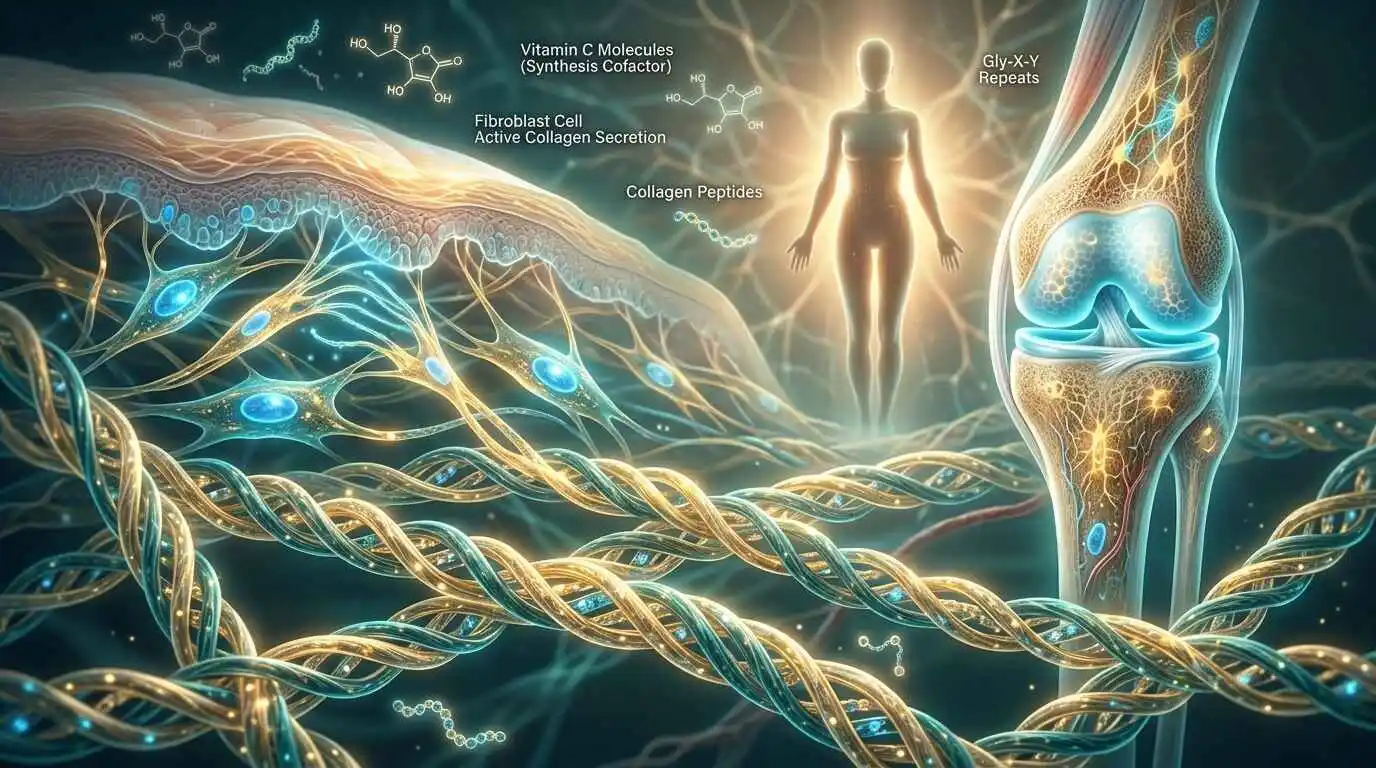
At the molecular level, collagen is built from three polypeptide chains twisted together into a distinctive triple helix structure—a coiled coil that is extraordinarily strong and resistant to stretching. Each chain is composed primarily of a repeating sequence of three amino acids: glycine, proline, and hydroxyproline. Glycine’s small size is not incidental; it fits neatly into the center of the helix where there is little room for a larger molecule. Without glycine at every third position, the triple helix cannot form at all.
These triple helices then assemble into larger structures called fibrils, which bundle into collagen fibers visible even under a light microscope. The result is a material that, pound for pound, has a tensile strength comparable to steel wire. It is no exaggeration to say that collagen is one of nature’s finest engineering achievements.
The 28 Types of Collagen
Scientists have identified at least 28 distinct types of collagen, each with slightly different molecular structures and tissue distributions. However, three types dominate human biology. Type I collagen is the most abundant of all, found in skin, tendons, ligaments, bones, teeth, and the connective tissue capsules that surround organs. It is the workhorse, providing dense mechanical support. Type II collagen is the principal constituent of cartilage, the rubbery tissue that cushions joints and gives the nose and ears their shape. Type III collagen, often found alongside Type I, contributes to the elasticity of skin, the walls of blood vessels, and the structure of organs like the liver and uterus.
Other types—IV, V, VI, and beyond—perform specialized roles such as forming the basement membranes of cells, linking other matrix components together, or anchoring structures within specific tissues. The diversity of collagen types reflects the extraordinary versatility of this protein family across the body’s many functional demands.
How the Body Makes Collagen: The Biosynthesis Pathway
Collagen synthesis is a complex, multi-step process that begins inside cells and finishes in the extracellular space. The primary manufacturers of collagen are fibroblasts, specialized cells scattered throughout connective tissue. In bone, osteoblasts take on this role. In cartilage, chondrocytes are responsible.
The journey begins in the cell nucleus, where genes encoding collagen are transcribed into messenger RNA. Ribosomes translate this RNA into long protein chains called procollagen alpha chains. Within the endoplasmic reticulum—the cell’s internal assembly line—vitamin C earns its indispensable role. Enzymes called prolyl hydroxylases and lysyl hydroxylases, both of which require vitamin C as a cofactor, modify proline and lysine residues. Without these modifications, the three alpha chains cannot wind into a stable triple helix. Three such chains twist together to form procollagen, a precursor molecule with extra peptide extensions at both ends that prevent premature fiber formation inside the cell.
Procollagen is packaged into vesicles and secreted outside the cell, where enzymes called procollagen peptidases cleave the terminal extensions. The resulting tropocollagen molecules spontaneously assemble into fibrils. Finally, enzymes called lysyl oxidases crosslink adjacent fibrils, dramatically increasing tensile strength. This entire cascade—from gene to mature fiber—illustrates why collagen synthesis depends on so many nutritional and enzymatic factors. Disruption at any stage compromises the final product.
Collagen and Skin: The Science of Youth and Aging
The skin is the body’s largest organ and, for most people, the place where collagen’s presence—or absence—is most immediately visible. In young, healthy skin, the dermis (the layer beneath the surface epidermis) is densely packed with Type I and Type III collagen fibers arranged in a loose, basketweave pattern that allows the skin to stretch and recoil. Elastin fibers run alongside collagen, contributing springiness. Together, they give young skin its characteristic plumpness, firmness, and ability to snap back after stretching.
Beginning in the mid-20s, collagen production begins its slow decline. The rate of synthesis falls by roughly one percent per year, while the rate of degradation—driven by enzymes called matrix metalloproteinases—remains steady or increases. The net result is a gradual depletion of the dermal collagen network. The fibers that remain become disorganized and fragmented. Crosslinks accumulate in dysfunctional patterns, making the remaining collagen stiffer and less functional. The skin grows thinner, loses volume, and develops fine lines that deepen into wrinkles.
Ultraviolet radiation from the sun dramatically accelerates this process. UV light activates matrix metalloproteinases, suppresses new collagen synthesis, and creates reactive oxygen species that directly damage collagen fibers. This is why dermatologists rank sun protection as the single most evidence-based intervention for skin aging—it addresses the primary environmental cause of collagen degradation.
Nutrition’s Role in Skin Collagen
What you eat is inseparable from the quality of your skin’s collagen. Vitamin C deficiency causes scurvy precisely because collagen cannot be properly stabilized without it—the triple helices unravel, wounds fail to heal, and blood vessels rupture. At adequate levels, vitamin C not only enables hydroxylation reactions but also acts as an antioxidant that protects existing collagen fibers from oxidative damage.
Zinc and copper are cofactors for enzymes involved in collagen crosslinking. Deficiencies in either mineral impair the maturation of collagen fibers. Foods rich in these minerals—shellfish, seeds, legumes, nuts—are therefore indirectly collagen-supportive. Amino acids from dietary protein—particularly glycine and proline—provide the raw materials for new collagen chains. Bone broth is exceptionally rich in these amino acids precisely because it is made by simmering collagen-rich connective tissue for hours.
Perhaps less appreciated is the role of excess sugar. In a process called glycation, sugar molecules bind to collagen fibers and form abnormal crosslinks known as advanced glycation end-products (AGEs). Glycated collagen is stiffer, more fragile, and more prone to degradation. It also loses its transparency, contributing to the yellowish discoloration that characterizes aged skin. Reducing dietary sugar is therefore not merely a metabolic health measure—it is a strategy for protecting the integrity of your collagen network.
Collagen in Joints, Bones, and Beyond
Cartilage and Joint Health
Cartilage has no blood supply. It is entirely dependent on the diffusion of nutrients from surrounding synovial fluid, which makes it slow to repair and easy to damage. Type II collagen forms the structural backbone of this avascular tissue, providing compressive strength and shock absorption. In healthy joints, cartilage acts as a nearly frictionless surface that cushions bones during movement. When collagen in cartilage degrades—whether through aging, injury, or inflammatory conditions like osteoarthritis—bones lose this cushion and begin to grind against each other, producing the pain and stiffness that characterize the disease.
Clinical research on Type II collagen supplementation has shown promising results. Studies suggest that hydrolyzed Type II collagen peptides can reduce joint pain, improve mobility, and decrease markers of cartilage degradation in people with osteoarthritis. The proposed mechanism involves collagen peptides acting as signaling molecules that stimulate chondrocytes to produce more cartilage matrix, though research is ongoing.
Bone: More Than Calcium
Most people think of bone as a calcium structure. In reality, bone is a composite material in which a mineral phase (calcium phosphate crystals) is embedded within an organic matrix that is approximately 90 percent Type I collagen. The collagen provides the scaffold on which minerals crystallize, and it gives bone the crucial property of flexibility—the ability to absorb impact without fracturing. A bone stripped of its collagen would be brittle; a bone stripped of its minerals would be rubbery. Together, they create a material that is both rigid and resilient.
As collagen production declines with age—and especially after menopause, when estrogen’s collagen-supportive effects are lost—bone matrix quality deteriorates even in the presence of adequate calcium. This contributes to osteoporosis, where bones become fragile not only because of mineral loss but because the collagen scaffold itself is compromised.
Blood Vessels and the Heart
The walls of arteries and veins contain abundant Type I and Type III collagen that provides the mechanical strength to withstand blood pressure. Collagen keeps vessel walls from rupturing under the force of each heartbeat. When vascular collagen degrades—as it does with aging, high blood pressure, smoking, and inflammation—arteries become stiffer. This arterial stiffness is a major driver of cardiovascular risk, forcing the heart to work harder with every beat.
Gut and Organ Integrity
The gut lining is reinforced with collagen, particularly in the lamina propria beneath the intestinal epithelium. Glycine and proline from collagen support the integrity of tight junctions—the cellular gatekeepers that prevent undigested particles and bacteria from crossing into the bloodstream. Disruption of the gut’s collagen matrix is associated with increased intestinal permeability, commonly called leaky gut, which may contribute to systemic inflammation and autoimmune conditions.
Collagen is the vital structural protein responsible for keeping your skin firm, your hair strong, and your joints highly flexible. As we naturally age, our body’s collagen production gradually slows down, but you can effectively boost it through targeted, natural remedies and daily dietary adjustments.
Natural ways to Enhance Collagen
Eat Collagen-Rich Foods
- Bone Broth: The ultimate natural source, packed with easily absorbable collagen extracted from slowly simmered animal bones, cartilage, and connective tissues.
- Fish and Shellfish: Marine collagen is highly bioavailable and easily utilized by the body, particularly found in the skin and scales of fish.
- Egg Whites: While they lack connective tissue, egg whites contain high amounts of proline, an amino acid strictly necessary for collagen production.
Consume Essential Cofactors
Your body requires specific vitamins and minerals to successfully synthesize new collagen naturally:
- Vitamin C: Absolutely crucial for collagen formation. Load up on citrus fruits, bell peppers, strawberries, and acerola cherries.
- Zinc & Copper: Essential trace minerals for protein synthesis. Find them in pumpkin seeds, cashews, lentils, and dark chocolate.
- Sulfur: A trace mineral that aids synthesis and prevents collagen breakdown. Consume garlic, onions, and cruciferous vegetables regularly.
Protect Existing Collagen
- Limit Refined Sugar: Excess sugar causes glycation, a process that actively damages and weakens collagen fibers, leading to premature wrinkles and joint stiffness.
- Natural Sun Protection: UV rays rapidly break down skin collagen. Wear protective clothing, wide-brimmed hats, and utilize natural shade.
- Antioxidant-Rich Foods: Combat collagen-destroying free radicals with natural remedies like green tea, aloe vera, and dark leafy greens.
By combining these collagen-boosting foods with protective lifestyle habits, you can naturally support your body’s internal architecture, promoting lasting joint health and beautifully youthful skin.
Collagen Supplements: Separating Science from Marketing
The global collagen supplement market is enormous and growing, driven by consumer demand for anti-aging solutions and joint support. Walking through any health food store, you will encounter collagen powders, capsules, drinks, and bars claiming to transform skin, repair joints, and strengthen bones. What does the science actually say?
The key to understanding collagen supplements lies in bioavailability. When you consume intact collagen—whether from bone broth or a whole supplement—your digestive system breaks it down into individual amino acids and short peptide chains. These fragments are then absorbed and circulate in the bloodstream. For years, skeptics argued that this meant collagen supplements were no different from any other protein source. However, research over the past decade has complicated that picture.
Studies using isotopic tracing have shown that specific dipeptides and tripeptides derived from collagen hydrolysis—particularly Pro-Hyp (proline-hydroxyproline) and Hyp-Gly—survive digestion partially intact and can be detected in the bloodstream after oral consumption. These peptides appear to act as signaling molecules, stimulating fibroblasts to increase collagen synthesis. Multiple randomized controlled trials have found that daily supplementation with 2.5 to 10 grams of hydrolyzed collagen peptides over 8 to 24 weeks significantly improves skin hydration, elasticity, and the appearance of fine lines compared to placebo. Joint pain studies show similar promise, particularly for active adults and those with early osteoarthritis.
The caveats are real. Collagen supplements are not regulated as drugs, quality varies enormously between products, and not all health claims are supported by robust evidence. Consumers should look for products from reputable manufacturers, third-party tested for purity, and preferably featuring specific peptide types (like VERISOL for skin or UC-II for joints) that have been studied in clinical trials.
Lifestyle Habits That Protect and Rebuild Collagen
Understanding collagen biology leads naturally to a set of evidence-based lifestyle practices that can meaningfully preserve and even rebuild your body’s collagen reserves. These are not exotic interventions—they are decisions that compound quietly over years and decades.
Sun protection is arguably the highest-leverage habit you can adopt for dermal collagen. Daily broad-spectrum sunscreen with SPF 30 or higher, worn consistently even on cloudy days, prevents the UV-driven activation of matrix metalloproteinases and the generation of reactive oxygen species that break down collagen fibers. This single habit, adopted early enough, can meaningfully delay the visible signs of skin aging.
Smoking is one of the most destructive forces collagen encounters. Tobacco smoke contains thousands of chemical compounds that generate oxidative stress, impair blood flow to the skin, and directly inhibit collagen-producing enzymes. Studies consistently show that smokers have thinner, less elastic skin than age-matched non-smokers, and their wounds heal more slowly because their collagen synthesis machinery is compromised.
Exercise—particularly resistance training and weight-bearing activities—is one of the few lifestyle interventions that actively stimulates collagen production. Mechanical loading signals fibroblasts to synthesize new collagen in tendons, ligaments, and bone. Emerging research on exercise timing suggests that consuming collagen supplements alongside vitamin C approximately 30 to 60 minutes before exercise may maximally direct collagen precursors to tissues under mechanical stress.
Sleep deserves emphasis that it rarely receives in collagen discussions. Growth hormone, secreted predominantly during slow-wave deep sleep, is a potent stimulator of collagen synthesis. Chronically poor sleep not only suppresses growth hormone secretion but elevates cortisol, which actively degrades collagen. Prioritizing seven to nine hours of quality sleep is therefore one of the most underrated collagen-protective habits available.
Stress management follows logically. Chronic psychological stress maintains elevated cortisol, which suppresses fibroblast activity and accelerates collagen degradation throughout the body. Mind-body practices—meditation, yoga, deep breathing, time in nature—that reduce cortisol load are therefore indirectly protective of collagen.
The Future of Collagen Science
Collagen research is accelerating rapidly. Biomedical engineers are developing collagen-based scaffolds for tissue engineering—growing replacement skin, cartilage, tendons, and even heart valves in laboratory settings. These scaffolds mimic the native extracellular matrix and can be seeded with the patient’s own cells to reduce rejection risk. The promise for reconstructive surgery, organ repair, and the treatment of chronic wounds is immense.
In dermatology, advanced delivery systems are being developed to carry collagen-stimulating agents—including retinoids, growth factors, and even collagen peptides themselves—deeper into the skin where fibroblasts reside. Laser therapies, microneedling, and radiofrequency treatments all work, at least in part, by creating controlled micro-injury that triggers a repair response involving new collagen synthesis.
The gut microbiome’s relationship with collagen is another frontier. Emerging evidence suggests that certain probiotic strains influence collagen metabolism by modifying inflammation and nutrient absorption. The connection between gut health, systemic inflammation, and collagen turnover may prove to be one of the most clinically significant discoveries of the coming decade.
Conclusion: Honor the Architecture
Collagen is not a trend. It is not a marketing invention. It is the structural reality of your body—present in every organ, every joint, every vessel wall, and every inch of skin. Its abundance in youth gives you resilience. Its gradual loss is one of the defining processes of aging. Understanding collagen is, in a deep sense, understanding what it means to have a living, breathing human body that changes over time.
The good news embedded in all of this science is that collagen is not simply a passive victim of time. The choices you make—what you eat, how you move, whether you sleep deeply, how you manage stress, whether you protect your skin from the sun—all influence the rate at which your collagen network is built, maintained, and dismantled. You may not be able to stop the clock, but you can meaningfully slow it.
The secret architecture of your body is more extraordinary than anything a building could achieve. It is worth understanding, worth protecting, and worth investing in—one meal, one night of sleep, one sunscreen application at a time.
FAQs
| # | Question | Answer |
| 1 | What is collagen? | Collagen is the most abundant protein in the human body, making up about 30% of total protein mass and forming the structural scaffold of skin, bones, tendons, and connective tissues. |
| 2 | How many types of collagen exist? | Scientists have identified at least 28 types of collagen, but Types I, II, and III account for roughly 80–90% of the collagen found in the human body. |
| 3 | Where is Type I collagen found? | Type I collagen is the most common and is found in skin, tendons, ligaments, bones, and teeth. It provides tensile strength to these structures. |
| 4 | What is the role of Type II collagen? | Type II collagen is the primary component of cartilage and plays a key role in joint health, cushioning bones and enabling smooth movement. |
| 5 | What does Type III collagen do? | Type III collagen is found in skin, muscles, and blood vessels. It works alongside Type I to keep skin elastic and support organ structure. |
| 6 | How is collagen produced in the body? | Collagen is synthesized by fibroblast cells. Amino acids like glycine, proline, and hydroxyproline are assembled into procollagen chains, which are then modified and crosslinked outside the cell to form mature collagen fibers. |
| 7 | What vitamins are essential for collagen production? | Vitamin C is absolutely essential—it acts as a cofactor for enzymes that stabilize collagen chains. Without it, collagen synthesis breaks down, leading to scurvy. |
| 8 | Does collagen production decline with age? | Yes. Starting in the mid-20s, the body produces roughly 1% less collagen per year. By the 50s and 60s, this decline significantly affects skin elasticity, joint flexibility, and bone density. |
| 9 | Can diet boost collagen levels? | Yes. Eating foods rich in collagen precursors—bone broth, fish, eggs, leafy greens, citrus fruits, and berries—can support the body’s natural collagen synthesis. |
| 10 | Do collagen supplements work? | Research suggests hydrolyzed collagen peptide supplements can improve skin hydration and elasticity and may support joint health, though results vary between individuals. |
| 11 | What destroys collagen in the body? | UV radiation, smoking, excess sugar (glycation), chronic stress (cortisol), poor sleep, and environmental pollutants are the leading destroyers of collagen. |
| 12 | Is collagen a complete protein? | No. Collagen lacks tryptophan, one of the essential amino acids, making it an incomplete protein. It should complement rather than replace other protein sources. |
| 13 | Can the body absorb collagen directly from food? | Collagen from food is broken down into amino acids during digestion. The body then uses these amino acids to build its own collagen. |
| 14 | What is hydrolyzed collagen? | Hydrolyzed collagen (collagen peptides) is collagen that has been broken down into smaller fragments, making it easier for the body to absorb through the gut wall. |
| 15 | Does collagen help with joint pain? | Clinical studies suggest that Type II collagen supplements may reduce joint pain and stiffness in people with osteoarthritis by supporting cartilage regeneration. |
| 16 | How does collagen affect skin aging? | Collagen provides skin with firmness and elasticity. As collagen degrades with age, skin loses volume and resilience, leading to wrinkles, sagging, and thinning. |
| 17 | Can collagen improve gut health? | Collagen contains glutamine and glycine, amino acids that may help maintain the gut lining and support repair in conditions like leaky gut syndrome. |
| 18 | Does exercise boost collagen production? | Yes. Weight-bearing exercise and resistance training stimulate fibroblast activity, increasing collagen synthesis in muscles, tendons, and bones. |
| 19 | What is the difference between collagen and elastin? | Collagen provides structural strength and rigidity, while elastin gives tissues the ability to stretch and return to their original shape. Both are critical for youthful skin. |
| 20 | Is marine collagen better than bovine collagen? | Marine collagen (from fish) is Type I, highly bioavailable, and absorbed quickly. Bovine collagen (from cows) provides both Types I and III. Choice depends on health goals. |
| 21 | Can collagen help with hair and nail growth? | Collagen provides amino acids that are building blocks for keratin, the protein in hair and nails. Supplementation may improve growth rate and strength. |
| 22 | Does collagen affect bone health? | About 90% of bone’s organic matrix is collagen. It gives bones flexibility to resist fractures, working alongside calcium and phosphate minerals. |
| 23 | What is collagen crosslinking? | Crosslinking is the process where collagen fibers bond together to form a stable network. Abnormal crosslinking, caused by sugar glycation or aging, makes tissues stiff and fragile. |
| 24 | Can vegan diets support collagen production? | Vegans cannot consume animal-derived collagen, but plant-based diets rich in Vitamin C, zinc, copper, and amino acid precursors (legumes, nuts, seeds) can support the body’s own synthesis. |
| 25 | What is collagen’s role in wound healing? | Collagen is essential for wound healing. It attracts fibroblasts to injury sites, promotes new tissue formation, and provides structural scaffolding for skin repair. |
| 26 | Can too much collagen supplementation be harmful? | Collagen supplements are generally safe, but excessive intake may cause digestive discomfort, and some marine collagen products may contain heavy metals if sourced poorly. |
| 27 | What is the glycine-to-proline ratio in collagen? | Collagen is roughly one-third glycine by amino acid content, with proline and hydroxyproline making up another 20–25%, giving the triple helix structure its unique stability. |
| 28 | Does sleep affect collagen production? | Yes. Deep sleep triggers the release of growth hormone, which stimulates collagen synthesis. Poor sleep accelerates collagen breakdown and visible skin aging. |
| 29 | Can red light therapy boost collagen? | Emerging research supports red and near-infrared light therapy as a method to stimulate fibroblast activity and increase collagen production in skin tissue. |
| 30 | What is collagen’s role in the cardiovascular system? | Collagen forms the structural matrix of blood vessel walls, providing strength and flexibility. Degradation of vascular collagen is linked to arterial stiffness and cardiovascular risk. |
⚕️Medical Disclaimer:
The information provided on this website is for general educational and informational purposes only and is not intended as a substitute for professional medical advice, diagnosis, or treatment. Always seek the advice of your physician or other qualified health provider with any questions you may have regarding a medical condition. Never disregard professional medical advice or delay in seeking it because of something you have read on this website.
