
Table of Contents
TECHNOLOGY & CURIOSITIES : The Hole Truth
Pick up almost any utility knife, a good number of folding pocket knives, several butcher’s cleavers, and more than a few kitchen knives, and you will likely find the same odd detail: a hole, sometimes round, sometimes teardrop-shaped, sometimes an entire row of them, punched directly through the one part of the tool that seems least suited to having material removed from it — the blade itself.
At first glance it looks almost like a design accident, or worse, a manufacturing shortcut that somehow made it to market. A blade’s entire job is to be a solid, continuous edge. Why would anyone deliberately weaken it with a hole? And yet these holes are not accidents, oversights, or gimmicks. They show up again and again across wildly different categories of blades — construction tools, chef’s knives, folding pocket knives, military bayonets, butcher’s cleavers — and in nearly every case, the hole is doing real, deliberate work.
The truth is that ‘the hole in the blade’ is not actually one design feature. It is several completely different engineering solutions that happen to look similar, invented decades or even centuries apart, by people solving unrelated problems. A hole punched near the handle of a box-cutter blade exists for an entirely different reason than a hole drilled through a cheese knife, which in turn has nothing to do with the large hole in a butcher’s cleaver or the signature circular cutout near the spine of a folding pocket knife.
This piece walks through each of those reasons in turn — mechanical retention, one-handed deployment, food release, weight and balance, manufacturing economics, retail display, and even ancient agricultural tool ergonomics — and shows how a single small circle of missing steel can quietly represent generations of accumulated design thinking. By the end, that ‘strange hole’ will look a lot less strange, and a lot more like one of the more elegant examples of form following function in everyday tool design.

1. The Utility Knife Hole: A Locking Mechanism in Disguise
The most commonly encountered blade hole belongs to the humble utility knife, sometimes called a box cutter or Stanley knife. Almost every disposable trapezoidal utility blade on the market has one or two small round or oval holes punched near its blunt edge, and this hole is doing genuinely important structural work: it functions as a positive locking and keying feature that mates with a corresponding pin, stud, or protrusion inside the knife handle.
When a blade is loaded into the handle, that internal pin passes through the hole, physically locking the blade against forward or backward movement. Without this mechanical connection, a thin blade under lateral cutting pressure would simply slip or retract back into the handle at the worst possible moment. The hole essentially transforms a loose, replaceable blade into a rigid extension of the handle itself, which is precisely what allows a disposable, dollar-a-dozen blade to cut with the confidence of a fixed, permanently mounted one.
This same hole also explains why utility blades from wildly different manufacturers are so often interchangeable. Because the hole’s position, shape, and size have become an unofficial industry standard, a generic replacement blade purchased at a hardware store will typically drop into handles from several different brands. In modern quick-change utility knives, the same hole is used by a spring-loaded button or lever that drives a retaining pin in and out, allowing tool-free blade swaps in seconds — a feature professional tradespeople rely on constantly throughout a workday.
It is worth pointing out that this hole is doing its job under real mechanical stress. Utility blades cut through cardboard, drywall, carpet, and rope, and the cutting force generated during those tasks is transmitted directly back through the blade toward the handle. Without a solid mechanical interlock at that hole, repeated use would gradually work the blade loose, turning a reliable tool into an unpredictable and genuinely dangerous one.
“The hole in the blade is not one design feature. It is several completely different engineering solutions that happen to look similar, invented decades or even centuries apart.”
2. The Spyderco Story: How One Company’s Hole Became an Industry Icon
If the utility knife hole is functional but anonymous, the folding pocket knife hole has an origin story with a name attached to it. In 1981, Spyderco founder Sal Glesser introduced a distinctive round cutout near the spine of the blade, positioned so a user’s thumb could catch it and flick the blade open with one hand, without needing a second hand to hold the handle steady or pry at a nail nick.
The design was original enough, and effective enough, that it earned Spyderco a United States utility patent, and for years the round hole became the company’s single most recognizable visual signature — instantly identifying a Spyderco knife from across a room, long before a person could read the logo stamped on the blade. Because the mechanism was ambidextrous and did not require any moving parts beyond the pivot itself, it also sidestepped a major limitation of earlier one-handed opening designs, which often favored right-handed users.
Once Spyderco’s patent protections eventually expired on certain aspects of the design, the concept proliferated across the knife industry, and today countless brands incorporate some variation of a blade-opening hole, sometimes reshaped into an oval, a teardrop, or an asymmetric cutout specifically to differentiate their version from the original while preserving the same one-handed function.
What makes this particular hole worth studying is how thoroughly it reshaped an entire product category almost by accident. Before its introduction, one-handed opening on folding knives typically relied on a small nail nick or thumb stud, both of which favored a particular hand orientation and required a fingernail or fingertip to catch a comparatively small purchase point. The hole solved that limitation so completely that it effectively became the default expectation for an entire generation of folding knife design that followed it.
3. The Butcher’s Cleaver Hole: One of the Oldest Reasons of All
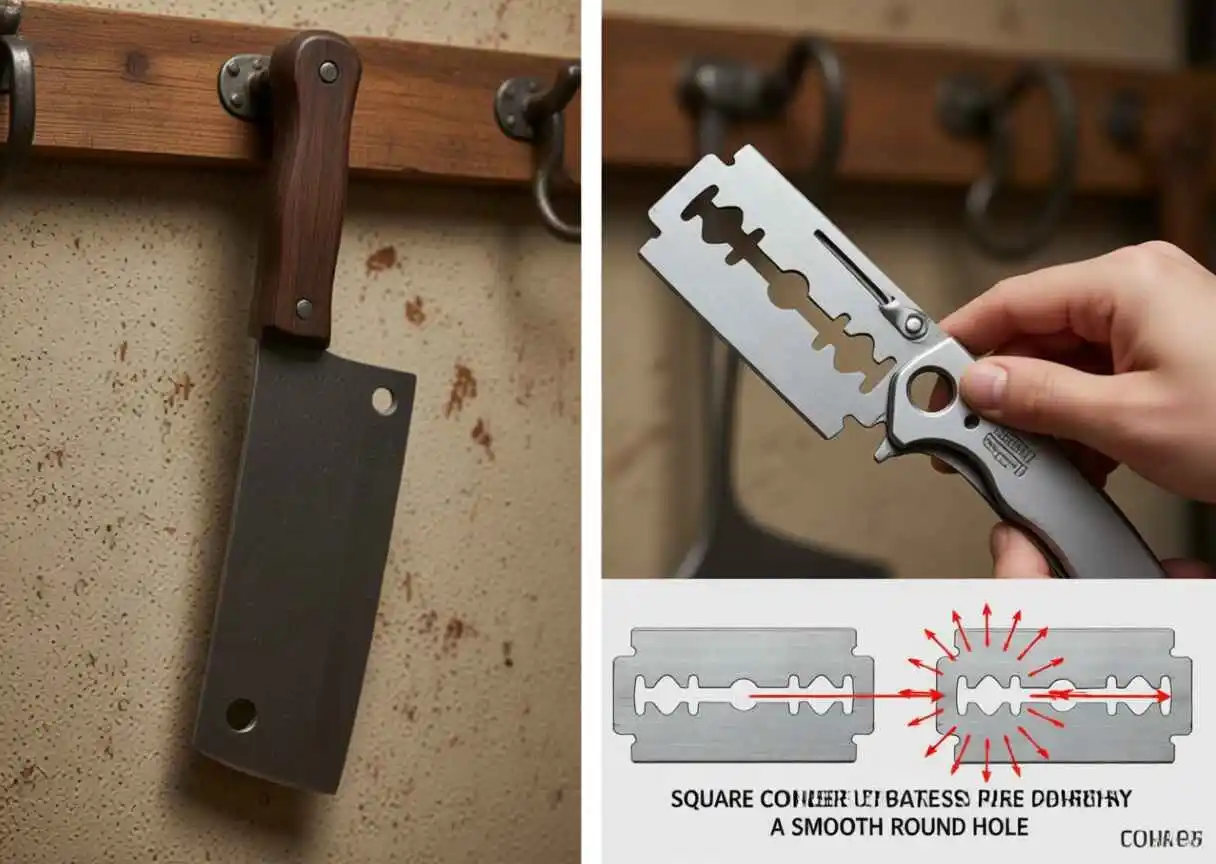
Long before quick-change utility knives or patented pocket-knife mechanisms existed, cooks and butchers were already punching holes into their heaviest blades for a much simpler reason: storage. A traditional butcher’s cleaver is large, heavy, and dangerous to leave lying around a busy kitchen counter, so many cleavers feature a substantial hole near the spine specifically designed to let the tool hang safely from a hook, nail, or magnetic rail.
This solution predates modern knife blocks and drawer organizers by centuries, and it solved two problems simultaneously: it kept a genuinely hazardous blade elevated and out of the way of hands, elbows, and children in a working kitchen, while also keeping the cleaver visible and instantly accessible at eye level rather than buried in a drawer among smaller tools. Several premium kitchen knife brands, including some well-known Japanese and European manufacturers, still include small hanging holes near the tip or spine of their blades today, carrying this same centuries-old logic forward into thoroughly modern kitchens.
It is a useful reminder that not every hole in a blade is a recent engineering innovation. Some of them are simply a very old, very practical answer to the question of where a dangerous object should live when it is not being used.
There is also a quieter safety benefit to this arrangement that is easy to overlook. A cleaver hanging visibly on a rail signals its presence to everyone moving through the kitchen, reducing the chance of an accidental collision with a blade buried edge-up in a cluttered drawer. In professional kitchens especially, where speed and close quarters are constant realities, that visibility is not a minor convenience — it is a genuine safety feature built directly into the tool’s design.
4. Fighting Suction: Why Cheese Knives and Chef’s Knives Get Holes Too
Anyone who has ever sliced a block of soft cheese, a raw potato, or a ripe cucumber has experienced a specific, mildly infuriating phenomenon: the slice sticks stubbornly to the flat side of the blade instead of falling cleanly away. This happens because a thin layer of moisture on the food creates a temporary vacuum-like seal against the wide, flat surface of the blade as it passes through, and that suction is strong enough to drag slices out of position or clump them together.
Holes, along with the closely related dimpled ‘Granton edge’ found on many chef’s knives, exist specifically to break that suction. As the blade moves through the food, air is drawn into the gaps created by the holes or dimples, interrupting the vacuum seal and letting each slice release cleanly rather than clinging to the metal. This is why cheese knives in particular are almost never solid-bladed; the sticky, dense nature of cheese makes the suction problem worse than with almost any other food, and a hole-punched or fluted blade solves it directly.
It is worth noting that this is a genuinely different engineering goal from the utility knife’s locking hole or the pocket knife’s opening hole. Here, the missing material is not about mechanical retention or thumb access at all — it is purely about interrupting a physics problem that occurs at the microscopic boundary between wet food and polished steel.
Chefs and food scientists sometimes describe this as an adhesion problem rather than a friction problem, and the distinction matters. Friction resists sliding motion along a surface, while adhesion is the force holding two surfaces together once they are already in contact. A hole-punched blade does little to change friction during the actual cutting stroke, but it dramatically reduces the adhesion that would otherwise keep a finished slice stuck to the blade after the cut is complete.
5. Shedding Weight Without Losing Strength
A third, entirely separate motivation for punching holes into a blade is simple physics: removing material reduces weight. On larger fixed-blade knives, machetes, and some tactical folding knives, rows of holes or scalloped cutouts along the spine are specifically engineered to shave grams off the finished tool without meaningfully compromising the structural integrity of the cutting edge itself.
This matters more than it might initially seem. A lighter blade is easier to carry for long stretches, whether that means a hiking or hunting trip, a professional kitchen shift, or a soldier’s field kit, and it also shifts the knife’s center of balance. By removing material from the spine rather than the edge, manufacturers can pull the balance point of the knife back toward the handle, which many users find makes the tool feel more controllable and less front-heavy during precise cutting tasks.
The engineering trick that makes this possible is placement. Cutting forces on a blade are concentrated along the sharpened edge, not the spine, so removing material from the thicker, unsharpened back of the blade has a comparatively small effect on cutting performance while still delivering a meaningful reduction in overall weight.
This same balance-shifting principle explains why some large kitchen knives and machetes concentrate their holes closer to the handle rather than spreading them evenly along the entire spine. Removing weight nearer the pivot point of a swing has a proportionally larger effect on how the tool feels in motion than removing the same amount of material near the tip, which is part of why hole placement, not just hole presence, is a deliberate design decision rather than an arbitrary one.
6. The Business Case: Manufacturing Costs and Retail Display
Not every reason for a blade hole is purely mechanical or culinary — some of it is straightforwardly economic. Every hole punched or drilled into a blade removes a small amount of raw steel from the manufacturing process, and at the scale of mass production, that small material saving compounds into a genuine cost reduction across a production run of tens of thousands of blades.
There is also a retail logic at play that has nothing to do with the knife’s performance once it leaves the store. Many blades, particularly folding pocket knives and utility blades sold in hardware stores, are packaged and hung on pegboard display hooks, and a hole positioned in the right spot on the blade or handle provides a convenient, secure point from which to hang the packaged product for customers to browse. What began as a purely functional feature has, in some product lines, been quietly repurposed as a retail convenience as well.
Some manufacturers have leaned into this dual-purpose logic even further, using distinctively shaped holes as a form of brand recognition. A uniquely cut hole can differentiate a company’s blades on a crowded store shelf at a glance, functioning almost like a visual trademark stamped directly into the steel rather than printed on packaging that will eventually be discarded.
“Round holes distribute stress evenly around their circumference and avoid the sharp internal corners that act as crack-initiation points during heat treatment.”
7. The Karambit’s Ring: An Agricultural Tool’s Fighting Legacy
One of the more unusual blade-hole stories belongs to the karambit, a small curved blade with a distinctive ring built into the handle or blade base, historically associated with parts of Southeast Asia. According to knife historians, the ring’s original purpose was agricultural rather than tactical: farmers working with cane or other crops would slip a finger, often the pinky, through the ring so the tool could hang securely from the hand while both hands were needed for other harvesting tasks, then be swung back into a cutting grip in a single fluid motion.
That same ring later proved useful for an entirely different purpose in self-defense and military contexts, where it provides retention, meaning the blade is far harder to knock or strip out of a user’s grip during a struggle compared to a knife held only by a smooth handle. This dual heritage, equal parts farm tool and close-quarters weapon, is part of why modern karambit-style knives remain popular in both utility and tactical knife markets today.
Knife makers who design modern ring-hole knives note that sizing the aperture correctly is a genuine engineering challenge in its own right: too large and the retention benefit weakens, too small and a user’s finger can become dangerously trapped in a fall or impact, a design consideration with real safety implications rather than a purely aesthetic one.
The karambit’s story is a particularly clear illustration of how a single design detail can migrate entirely across purposes over time, from agricultural convenience to combat ergonomics to, in recent years, a recognizable silhouette in mainstream pop culture and collector knife markets, all while the ring itself has changed remarkably little in basic shape and function.
8. Why the Blade Doesn’t Just Snap in Half: The Engineering Behind the Cutout
It is a fair question to ask whether punching a hole through a piece of hardened steel designed to withstand repeated cutting force is structurally risky, and the honest answer is: somewhat, but manageably so. Any hole introduces what engineers call a stress concentration point, a localized area where force applied to the material is distributed less evenly than in a continuous, unbroken sheet of steel.
This is precisely why blade holes are so consistently round, or at least gently curved, rather than square or sharply angular. Round holes distribute stress evenly around their circumference and avoid the sharp internal corners that act as crack-initiation points during the intense heating and rapid cooling of the heat-treatment process that hardens a blade. A square or star-shaped hole would be significantly more likely to develop hairline cracks at its corners under the same manufacturing and use conditions.
Manufacturers manage this stress concentration through careful placement and material selection: holes are positioned away from the primary cutting edge, surrounded by enough ‘web’ of steel to maintain strength, and the surrounding blade is made from hardened, high-carbon or stainless steel tough enough to absorb ordinary cutting loads without concentrating dangerous stress at the hole’s edge. In practice, a well-engineered hole costs a blade very little functional strength for the mechanical, ergonomic, or economic benefit it delivers in return.
This is also why reputable knife manufacturers rarely allow hole placement to be an afterthought added late in a design process. The hole’s size, position, and edge treatment are typically factored in from the earliest stages of a blade’s engineering, alongside decisions about steel type, heat-treatment schedule, and edge geometry, precisely because retrofitting a hole into an already-finalized blade design is far more likely to introduce the kind of structural weakness that careful upfront planning avoids entirely.
Final Thoughts: Small Changes, Real Resilience
Look closely enough at almost any everyday tool and you will usually find that its strangest-looking details are rarely accidents. The hole in a blade is a particularly good example, precisely because it looks, at first glance, like the one place a designer should never remove material from. And yet across utility knives, folding pocket knives, cleavers, cheese knives, machetes, and karambits, that missing circle of steel is doing real work — locking a blade in place, enabling a one-handed flick, breaking a suction seal, shaving grams, cutting manufacturing costs, hanging safely from a hook, or securing a grip during a struggle.
What makes this particular design detail so satisfying to understand is that no single explanation covers every case. A cheese knife’s holes exist for a completely different reason than a utility blade’s, which in turn has nothing to do with why a karambit has a ring, or why a Spyderco folder has become instantly recognizable from across a room. Each hole represents its own small, self-contained engineering story, solved independently by people working in kitchens, hardware factories, pocket-knife workshops, and rice paddies, often with no awareness that similar-looking holes were being cut for entirely different reasons elsewhere in the world.
The next time you notice a hole punched through a blade, it is worth pausing for a second before reaching for it out of habit. That small circle of missing steel is very likely the compressed result of decades of trial, error, and refinement — proof that even the most overlooked feature of the most ordinary tool in a drawer can carry a surprisingly rich design history, if you take a moment to actually ask why it is there.
Frequently Asked Questions
| Question | Answer |
| Why do utility knife blades have a hole near the blunt end? | The hole acts as a locking and keying feature that mates with a pin or stud inside the knife handle, preventing the blade from slipping or retracting under cutting pressure. |
| Are utility knife blades from different brands interchangeable because of this hole? | Yes, because the hole’s position and size have become an informal industry standard, generic replacement blades often fit handles from multiple manufacturers. |
| What is the round hole on Spyderco pocket knives for? | It allows a user to flick the blade open with one thumb, without needing a second hand to steady the handle, a feature introduced by Spyderco founder Sal Glesser in 1981. |
| Was the Spyderco hole ever patented? | Yes, the design was original and effective enough to earn Spyderco a United States utility patent, and it became the brand’s signature visual feature. |
| Why do some butcher cleavers have a large hole near the spine? | The hole allows the heavy cleaver to be hung safely from a hook or rail, keeping a dangerous, heavy tool elevated and accessible rather than left loose on a counter. |
| Why do cheese knives often have holes in the blade? | The holes break the vacuum-like suction that forms between moist, sticky food like cheese and the flat surface of the blade, allowing slices to release cleanly. |
| What is a Granton edge and how does it relate to blade holes? | A Granton edge uses dimples rather than full holes along the blade to achieve a similar effect, letting air into the gaps to reduce food sticking during slicing. |
| Do holes in a blade actually reduce its weight in a meaningful way? | Yes, on larger blades and machetes, rows of holes or scalloped cutouts can noticeably reduce overall weight without significantly compromising cutting-edge strength. |
| How do blade holes affect a knife’s balance? | Removing material from the spine rather than the edge shifts the knife’s center of balance back toward the handle, which many users find improves control. |
| Do holes in blades save manufacturers money? | Yes, removing material during production reduces raw steel usage, and at large manufacturing scales this creates a genuine cost saving across a production run. |
| Why are some blades hung on pegboard displays using a hole? | A hole positioned in the right spot provides a convenient, secure point for hanging packaged knives on retail pegboard hooks for display. |
| What is a karambit and why does it have a ring or hole? | A karambit is a small curved blade historically used in Southeast Asia; its ring originally let farmers hang the tool from a finger while both hands worked with crops. |
| Does the karambit’s ring have any modern tactical purpose? | Yes, the ring provides retention, making the blade harder to knock or strip from a user’s grip during a struggle, which is why it remains popular in tactical designs. |
| Is it risky to sizing the ring hole on a karambit too small or too large? | Yes, too large weakens the retention benefit, while too small risks a user’s finger becoming dangerously trapped during a fall or impact. |
| Does punching a hole in a blade weaken it structurally? | It introduces a localized stress concentration point, but careful placement, sizing, and material selection generally keep the structural trade-off small for normal use. |
| Why are blade holes usually round instead of square? | Round holes distribute stress evenly around their circumference and avoid sharp internal corners, which act as crack-initiation points during heat treatment and use. |
| What is a stress concentration point? | It is a localized area in a material where applied force is distributed less evenly than in a continuous, unbroken section, increasing the risk of cracking or failure. |
| Can a hole in a blade cause it to snap during normal use? | Well-engineered blade holes are positioned away from the primary cutting edge and surrounded by enough surrounding steel that normal cutting use rarely poses a significant risk. |
| Do all utility knife blades have exactly the same hole shape? | While shapes vary slightly, many utility blades share a similar round or oval hole positioned near the blunt end to fit common industry-standard handle designs. |
| Why do some folding knives use oval or teardrop-shaped opening holes instead of round ones? | Some brands reshape the opening cutout into an oval, teardrop, or asymmetric shape specifically to differentiate their design from the original round Spyderco hole. |
| Are decorative holes in blades purely aesthetic? | Some manufacturers do use uniquely shaped holes partly for brand recognition, though many decorative-looking holes also retain a functional role in weight or friction reduction. |
| Do all chef’s knives with holes actually work better for slicing sticky food? | Many users report noticeably reduced sticking with hole-punched or Granton-edge blades, particularly on dense, moist foods like potatoes and cheese. |
| What is the difference between a functional hole and a purely decorative one? | A functional hole is engineered around a specific mechanical, ergonomic, or culinary purpose, while a purely decorative hole is added mainly for visual branding without a targeted performance goal. |
| Why do some tactical knives have multiple small holes along the spine? | Multiple small holes are typically used for weight reduction and balance adjustment rather than any single locking, opening, or food-release function. |
| Do quick-change utility knife systems use the same hole as older manual designs? | Yes, modern quick-change handles typically use the same standardized hole, but pair it with a spring-loaded pin mechanism for faster, tool-free blade replacement. |
| Is the hole in a bayonet blade functional? | Some military bayonets include a tool hole near the tip that, combined with the sheath, can function as a makeshift wire cutter in the field. |
| Why don’t all knives have holes if the benefits are real? | Many knife designs prioritize maximum blade strength, simplicity, or a traditional aesthetic over the specific mechanical, ergonomic, or economic benefits a hole provides. |
| Does removing material from a blade always make it lighter without trade-offs? | Weight reduction is real, but designers must balance it carefully against maintaining sufficient strength and rigidity for the knife’s intended cutting tasks. |
| How old is the practice of putting holes in blades for hanging purposes? | Hanging holes in large blades like cleavers predate modern kitchen storage solutions by centuries, reflecting a very old, practical answer to safe blade storage. |
| What is the single biggest misconception about holes in knife blades? | The most common misconception is that all blade holes serve the same purpose, when in reality they represent several distinct engineering solutions developed independently for different problems. |
Disclaimer: The content on this blog is for informational purposes only. The author’s opinions are personal and not endorsed. Efforts are made to provide accurate information, but completeness, accuracy, or reliability are not guaranteed. The author is not liable for any loss or damage resulting from the use of this blog. It is recommended to use the information on this blog at your own discretion.
