
Table of Contents
8 Everyday Habits That Are Quietly Damaging Your Brain (And How to Reverse Them)
Your brain never clocks out. While you scroll, snack, binge-watch, and bounce between browser tabs, roughly 86 billion neurons are firing away, keeping your heart beating, your thoughts organized, and your memories intact. It is the single most energy-hungry organ in your body, consuming around twenty percent of your daily calories despite making up only about two percent of your body weight. And yet, it is also the organ we neglect the most.
We obsess over our skin, our waistlines, our step counts. We take supplements for our joints and serums for our faces. But the command center running the entire show — the organ responsible for every decision, every emotion, every memory you will ever make — usually gets attention only after something goes wrong. A foggy afternoon. A forgotten name. A headache that will not quit.
Here is the uncomfortable truth: brain damage is rarely the result of one dramatic event. For most people, it is not a car accident or a stroke that quietly erodes cognitive sharpness. It is the slow accumulation of small, repeated, forgettable choices — the habits woven so tightly into daily life that they no longer feel like choices at all. Staying up too late. Scrolling one more reel. Reaching for another sugary drink. Isolating instead of reaching out.
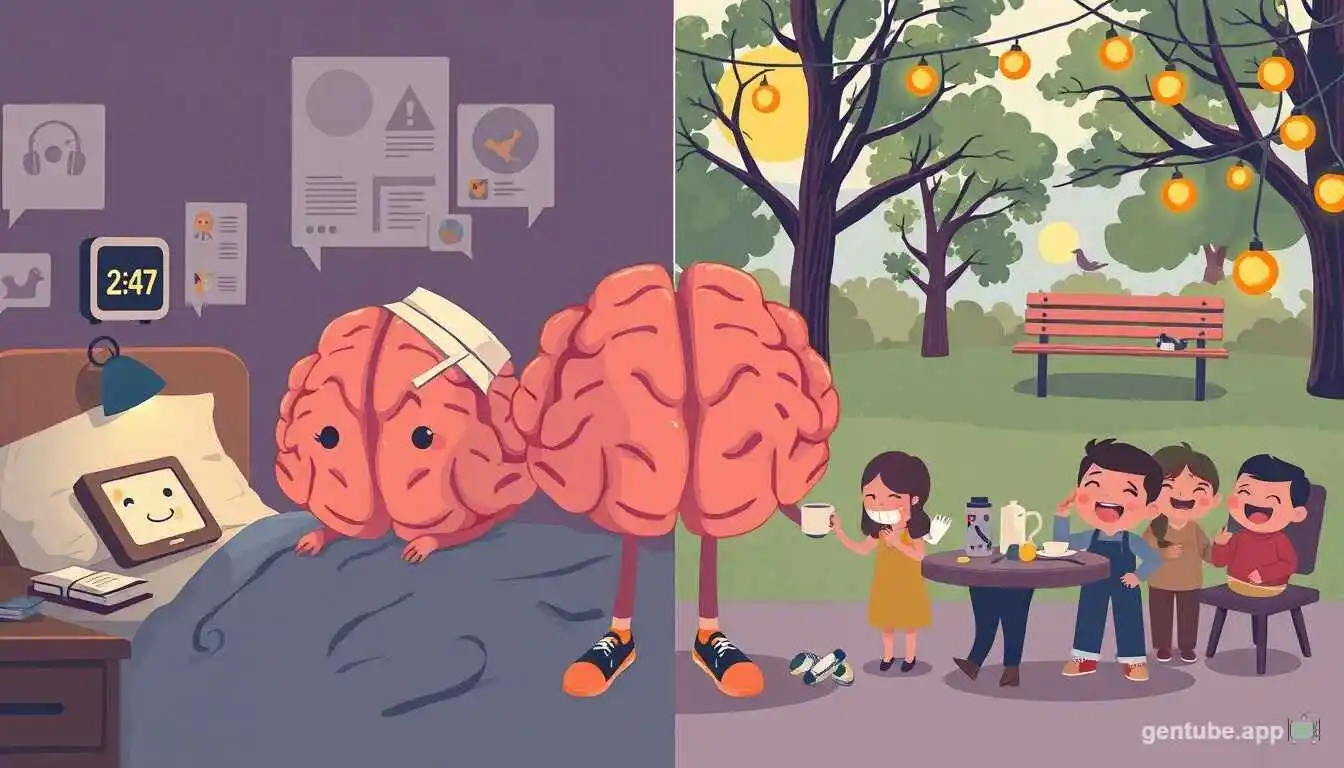
A widely shared health graphic recently put a name to eight of the most common of these habits, illustrating them with a hunched, bandaged cartoon brain looking exhausted and overwhelmed. The image struck a nerve online, racking up hundreds of shares, because it put a face — quite literally — on something millions of people recognized in themselves. This article unpacks the science behind each of those eight habits, explains exactly how they chip away at cognitive health, and — more importantly — gives you practical, doable steps to reverse the damage before it becomes permanent.

What makes this list so relatable is that none of the habits sound dangerous in isolation. Staying up an extra hour to finish a show, scrolling through a feed on the couch, reaching for something sweet during a stressful afternoon — none of these feel like the kind of decisions that show up on a health chart. But the brain does not evaluate choices individually. It responds to patterns, repeated day after day, and patterns are exactly what quietly reshape neural pathways, hormone regulation, and long-term cognitive resilience.
None of this requires a radical life overhaul. Neuroscience is increasingly clear that the brain is remarkably plastic, meaning it can rewire, repair, and strengthen itself in response to better habits, often within weeks. The goal here is not perfection. It is awareness, followed by small, consistent course corrections.
1. Poor Sleeping Habits: The Nightly Cleanup Crew You Are Skipping
Sleep is not downtime for the brain. It is arguably the most metabolically active brain-maintenance window you have. During deep sleep, the glymphatic system — a network of channels discovered only in the last decade — flushes out metabolic waste products, including beta-amyloid, a protein linked to Alzheimer’s disease when it accumulates in excess. Skip sleep, and that nightly cleanup gets cut short, night after night, leaving residue behind.
Chronic sleep deprivation, defined as consistently getting fewer than six to seven hours a night, has been associated with measurable shrinkage in the hippocampus, the brain’s memory-formation center. It also impairs the prefrontal cortex, the region responsible for judgment, impulse control, and emotional regulation, which is why everything feels harder and more irritating after a bad night’s sleep.
The fix is less about willpower and more about structure. Keeping a consistent sleep and wake time, even on weekends, is one of the single most powerful levers for cognitive protection. Dimming lights an hour before bed, keeping the bedroom cool and dark, and avoiding caffeine after early afternoon all help the body’s natural melatonin production do its job. Seven to nine hours is not a luxury; for your brain, it is basic maintenance.
It also helps to think of sleep quality as separate from sleep quantity. Lying in bed for eight hours while checking a phone intermittently is not the same as eight consolidated hours of uninterrupted rest. Wearable trackers can offer a rough estimate of deep-sleep stages, but a simpler gauge is how alert and clear-headed you feel by mid-morning without relying on caffeine. If grogginess persists despite adequate hours in bed, it may be worth discussing sleep quality, rather than just duration, with a healthcare provider.
2. Too Much Screen Time: Death by a Thousand Notifications
The average person now spends several hours a day looking at screens outside of work, and the brain pays a quiet toll for it. Constant notifications and rapid content switching train the brain toward shallow, reactive attention rather than sustained, deep focus. Researchers describe this as attention fragmentation, and studies suggest it can take over twenty minutes to fully regain focus after a single interruption.
Excessive screen exposure, particularly blue-light-heavy devices used late into the evening, also suppresses melatonin production, compounding the sleep problem described above. Add to that the dopamine-driven design of most apps — built specifically to keep you scrolling — and you have a recipe for a brain that is simultaneously overstimulated and undernourished.
This does not mean throwing your phone in a drawer. It means building intentional friction: turning off non-essential notifications, scheduling specific windows for email and social media rather than checking reflexively, and using grayscale mode or app timers to reduce the pull. Even short, regular screen breaks — the classic rule of looking at something twenty feet away for twenty seconds every twenty minutes — give overstimulated visual and attention circuits a chance to reset.
It is worth distinguishing between passive and active screen time as well. Passively scrolling short-form video content tends to be more cognitively draining and less rewarding than active screen use, such as video-calling a friend or working through an online course. If eliminating screens entirely is unrealistic, shifting the balance toward more active, intentional use is a meaningful middle step that still protects attention span over time.
3. Consuming Too Much Sugar: Feeding Inflammation, Starving Focus
Sugar delivers a fast hit of energy and an equally fast crash, and your brain feels both ends of that rollercoaster acutely. Diets high in added sugar and refined carbohydrates have been linked in research to increased neuroinflammation, insulin resistance in brain tissue, and impaired formation of new memories. Some researchers now refer to insulin-resistant, sugar-heavy dietary patterns as contributing to what has informally been called ‘type 3 diabetes’ in the context of cognitive decline, though this remains an area of active study rather than settled consensus.
Beyond the long-term risks, the short-term effects are familiar to almost everyone: the sluggish, foggy feeling that follows a sugar spike and subsequent crash, the difficulty concentrating an hour after a sweet breakfast, the irritability that creeps in mid-afternoon. Over time, a diet dominated by processed sugar can also disrupt the gut microbiome, which communicates directly with the brain through the gut-brain axis and plays a surprisingly large role in mood regulation.
Reducing sugar does not mean eliminating all pleasure from eating. Swapping refined sugar for whole fruit, prioritizing protein and fiber at each meal to blunt blood sugar spikes, and reading labels for hidden sugars in sauces and packaged foods are all manageable, sustainable steps. Omega-3-rich foods like fatty fish, walnuts, and flaxseed, along with antioxidant-rich berries and leafy greens, actively support the same brain tissue that sugar tends to inflame.
Hidden sugars are often the biggest culprit, tucked into condiments, flavored yogurts, granola bars, and beverages marketed as healthy. Building the habit of checking ingredient lists, rather than relying on front-of-package marketing claims, can reveal surprising sugar loads in everyday staples. Gradually reducing sweetness thresholds, rather than cutting sugar abruptly, tends to be a more sustainable path, since taste preferences genuinely recalibrate over a few consistent weeks.
“Brain damage is rarely the result of one dramatic event. For most people, it is the slow accumulation of small, repeated, forgettable choices.”
4. Blasting Your Headphones on Full Volume: Trading Hearing for Convenience
This one might seem like it belongs on an ear-health list rather than a brain-health list, but hearing loss and cognitive decline are more tightly linked than most people realize. Listening to music or podcasts at high volume through headphones, especially for extended periods, damages the delicate hair cells in the inner ear that cannot regenerate once destroyed.
Beyond hearing loss itself, several long-term studies have found associations between untreated hearing impairment and an increased risk of cognitive decline later in life. One proposed explanation is that the brain has to work significantly harder to process degraded auditory signals, diverting cognitive resources away from memory and reasoning. Another is that hearing loss tends to reduce social engagement, and social isolation, as the next section explains, is itself a major risk factor for cognitive decline.
The general safety guideline many audiologists recommend is the 60/60 rule: listening at no more than sixty percent of maximum volume for no more than sixty minutes at a stretch. Noise-canceling headphones can help because they let you hear content clearly at a lower volume by blocking out competing background noise, rather than forcing you to compete with it.
Over-ear headphones generally place less pressure on the ear canal compared to earbuds and can be a gentler option for long listening sessions. It is also worth paying attention to environmental noise exposure beyond headphones, such as loud commutes, concerts, or power tools, since cumulative lifetime noise exposure — not any single source — is what ultimately determines long-term hearing health.
5. Consuming Too Much Negative News: Doomscrolling and the Stressed-Out Brain
There is a specific term for the compulsive consumption of distressing news: doomscrolling. And it does something measurable to the brain. Constant exposure to alarming headlines keeps the amygdala, the brain’s threat-detection center, in a persistent state of high alert, which in turn keeps cortisol, the primary stress hormone, elevated for longer than is healthy.
Chronically elevated cortisol has been linked to impaired memory consolidation, reduced volume in the hippocampus over time, and a weakened ability to regulate emotional responses. In simple terms, a brain that is constantly bracing for bad news has a harder time learning, remembering, and staying calm under pressure — even when the news itself is not a direct threat to the person reading it.
Staying informed does not require staying plugged in around the clock. Choosing one or two set times a day to check the news, rather than leaving notifications on, and deliberately balancing distressing stories with something neutral or restorative — a walk, a conversation, a few minutes of quiet — helps keep the nervous system from living in a permanent state of alarm.
It can also help to curate sources deliberately rather than letting an algorithm decide what appears first. Following a small number of trusted, measured outlets tends to produce a calmer, more accurate picture of the world than an endless, algorithmically amplified feed optimized for engagement rather than clarity. Being informed and being anxious are not the same thing, even though modern news consumption often conflates the two.
6. Staying in the Dark Too Much: Your Brain Runs on Light
Sunlight does far more than help you see. Exposure to natural light, particularly in the morning, helps regulate the circadian rhythm, the internal clock that governs sleep, hormone release, and even mood-related neurotransmitter production. People who spend most of their day indoors, away from natural light, often experience disrupted circadian signaling, which cascades into poor sleep, low energy, and in some cases symptoms resembling seasonal affective disorder.
Light exposure also plays a role in serotonin production. Lower serotonin levels are associated with low mood, and mood disorders themselves carry documented cognitive costs, including slower processing speed and difficulty concentrating during depressive episodes. In this sense, staying in dim, artificially lit spaces for extended stretches is not just a mood issue; it is a cognitive one.
A short walk outside within the first hour of waking, positioning workspaces near windows, and simply opening the blinds during the day are low-effort ways to give the brain the light signal it depends on. Even on cloudy days, outdoor light is dramatically brighter than typical indoor lighting.
For people working night shifts or living in regions with limited seasonal daylight, light therapy lamps designed to mimic natural sunlight can offer a partial substitute, though they work best under guidance from a healthcare provider rather than as a casual purchase. The underlying principle remains the same regardless of the tool used: consistent, sufficiently bright light exposure during waking hours helps anchor the circadian rhythm that so much of brain function depends on.
7. Social Isolation: The Brain Is a Social Organ
Human brains evolved in social groups, and meaningful connection is not a soft, optional nicety for cognitive health — it is a structural requirement. Longitudinal research has repeatedly found that chronic loneliness and social isolation are associated with a significantly elevated risk of cognitive decline and dementia in older adults, independent of other risk factors like diet or exercise.
Social interaction is cognitively demanding in a good way. Following a conversation, reading facial expressions, remembering shared history, and navigating group dynamics all activate multiple brain regions simultaneously, functioning almost like a full-body workout for cognitive circuitry. Isolation removes that regular stimulation, and over time, the brain systems involved in social processing can weaken from disuse, much like an unused muscle.
Rebuilding connection does not require an active social calendar. Regular, low-pressure contact — a weekly call with a friend, a standing coffee with a neighbor, joining a class or a community group — provides meaningful protective benefit. Quality and consistency of connection tend to matter more than sheer quantity of social contacts.
It is also worth noting that isolation and loneliness are not always the same thing. Some people live alone by choice and feel deeply connected through occasional, high-quality interactions, while others surrounded by people daily can feel profoundly isolated. The protective factor appears to be the subjective sense of genuine connection, rather than any specific number of social contacts logged in a week.
“The brain is remarkably plastic — it can rewire, repair, and strengthen itself in response to better habits, often within weeks.”
8. Chronic Multitasking and Mental Overload: The Hidden Eighth Habit
Alongside the seven habits highlighted in the original graphic, brain-health researchers frequently flag one more silent contributor to cognitive strain: chronic multitasking. Juggling multiple demanding tasks at once — replying to messages while on a call, switching between browser tabs while writing — feels productive, but the brain does not actually process tasks in parallel. Instead, it rapidly toggles attention back and forth, and each switch carries a measurable cognitive cost.
Over time, habitual multitasking has been associated with reduced gray matter density in regions of the anterior cingulate cortex involved in cognitive and emotional control, according to neuroimaging research. It also increases the release of stress hormones, since the brain effectively treats constant task-switching as a low-grade emergency requiring continuous vigilance.
Single-tasking, by contrast, allows the brain to enter a state of deeper, more efficient processing. Techniques like time-blocking, closing unrelated tabs and apps before starting focused work, and batching similar tasks together rather than interleaving unrelated ones can meaningfully reduce the cognitive tax of constant context-switching.
Even brief, deliberate single-tasking sessions can help retrain attention over time. Setting a timer for twenty-five or thirty minutes of fully focused work on one task, free of competing tabs or notifications, is a simple, low-cost way to practice sustained concentration. Over weeks, this kind of practice tends to make deep focus feel less effortful and more accessible, even outside of dedicated focus sessions.
Final Thoughts: Small Changes, Real Resilience
None of the eight habits above are exotic or hard to recognize. Poor sleep, too much screen time, too much sugar, blasting headphones, doomscrolling, staying indoors, isolating from others, and chronic multitasking — these are not rare failures of discipline. They are the default settings of modern life, built into the design of our devices, our diets, and our daily routines. That is precisely why they are so easy to overlook and so important to name.
The encouraging news, backed by a growing body of neuroscience, is that the brain is not a fixed, fragile object slowly wearing down beyond your control. It is an adaptive, living system that responds — often quickly — to better inputs. Consistent sleep, moderated screen use, a lower-sugar diet, protected hearing, a healthier information diet, more daylight, real social connection, and focused single-tasking are not abstract wellness ideals. They are concrete, evidence-backed levers you can start pulling today.
Start with one. Pick the habit from this list that felt the most uncomfortably familiar while reading, and commit to a single small change this week — an earlier bedtime, a walk without your phone, one fewer sugary drink. Small, consistent changes compound, and unlike many organs in the body, the brain rewards that consistency with genuine, measurable resilience. Your brain has been running the show for your entire life without asking for much in return. Giving it a little more care back is one of the highest-leverage investments you can make in yourself.
It also helps to track progress loosely rather than obsessively. A simple weekly check-in — how did sleep feel this week, how many screen-free evenings did I manage, did I get outside most mornings — turns abstract intentions into something concrete and reviewable. You do not need a perfect scorecard. You need a general upward trend over months, not flawless execution over days. Brains, much like habits, are built gradually, and the same is true of undoing the damage that gradual, repeated choices can cause.
FAQs
| Question | Answer |
| What are the most common habits that damage the brain? | The most frequently cited habits include poor sleep, excessive screen time, high sugar intake, listening to loud music through headphones, consuming too much negative news, spending too little time in natural light, social isolation, and chronic multitasking. |
| Can bad habits actually cause permanent brain damage? | Most everyday habits cause gradual functional decline rather than sudden permanent damage, but sustained patterns over years can contribute to measurable changes in brain structure and increased risk of cognitive decline if left unaddressed. |
| How much sleep does the brain actually need to repair itself? | Most adults need seven to nine hours of quality sleep per night for the glymphatic system to adequately clear metabolic waste and support memory consolidation. |
| What is the glymphatic system and why does it matter? | The glymphatic system is a network of channels that becomes active mainly during deep sleep, flushing out metabolic waste products, including proteins linked to neurodegenerative disease, from brain tissue. |
| Does too much screen time really affect memory and focus? | Yes, frequent screen switching and constant notifications fragment attention, and research shows it can take over twenty minutes to fully refocus after a single interruption, which cumulatively affects memory encoding and deep focus. |
| How does sugar affect brain function? | High sugar intake is associated with increased neuroinflammation, insulin resistance in brain tissue, energy crashes, and impaired formation of new memories over time. |
| Is there a safe volume level for headphone use? | Many audiologists recommend the 60/60 rule: listening at no more than sixty percent of maximum volume for no more than sixty minutes continuously. |
| Can hearing loss really contribute to cognitive decline? | Multiple long-term studies have found associations between untreated hearing loss and increased risk of cognitive decline, possibly because the brain must work harder to process degraded sound and because hearing loss often reduces social engagement. |
| What is doomscrolling and why is it harmful? | Doomscrolling refers to the compulsive consumption of distressing news, which keeps the brain’s stress-response system activated for extended periods, elevating cortisol and impairing memory and emotional regulation over time. |
| How does sunlight exposure affect brain health? | Natural light, especially in the morning, helps regulate the circadian rhythm and supports serotonin production, both of which influence mood, sleep quality, and cognitive performance. |
| Why is social isolation considered a brain health risk? | Meaningful social interaction activates multiple brain regions simultaneously and provides ongoing cognitive stimulation; chronic isolation removes that stimulation and has been linked in research to a higher risk of cognitive decline. |
| Is multitasking really bad for the brain? | Yes, the brain does not truly process tasks in parallel; frequent task-switching carries a measurable cognitive cost and has been associated with reduced density in brain regions tied to cognitive and emotional control. |
| What foods support brain health? | Omega-3-rich foods like fatty fish, walnuts, and flaxseed, along with antioxidant-rich berries and leafy greens, are commonly associated with supporting cognitive function and reducing inflammation. |
| Can these brain-damaging habits be reversed? | The brain has significant plasticity, meaning it can adapt and strengthen in response to healthier habits, and many people notice improvements in focus, mood, and memory within weeks of consistent change. |
| What is the single most impactful habit to fix first? | There is no universal answer, but sleep is frequently cited by researchers as a foundational habit because it affects memory, mood, appetite regulation, and nearly every other habit on this list. |
| How does stress relate to these brain-damaging habits? | Several of these habits, including doomscrolling and chronic multitasking, keep cortisol levels elevated, and sustained high cortisol has been linked to impaired memory consolidation and reduced hippocampal volume over time. |
| Does staying indoors too much cause depression? | Reduced light exposure can disrupt circadian rhythm and lower serotonin-related mood regulation, and while it is not the sole cause of depression, it is considered a contributing risk factor. |
| How quickly can better habits improve brain function? | Some improvements, such as better sleep quality and reduced brain fog from lower sugar intake, can appear within days to weeks, while structural changes typically require more sustained, long-term habit change. |
| Are noise-canceling headphones better for brain and ear health? | Noise-canceling headphones can help by allowing clear audio at a lower volume, since they reduce the need to compete with background noise, which supports the safe-listening guidelines like the 60/60 rule. |
| What is the gut-brain connection mentioned in relation to sugar? | The gut-brain axis refers to the communication pathway between the gut microbiome and the brain; high-sugar diets can disrupt this microbiome, which has been linked to mood and cognitive effects. |
| Is it bad to check the news first thing in the morning? | Checking distressing news immediately upon waking can elevate stress hormones early in the day; many experts suggest choosing set times to check news rather than reflexively checking it throughout the day. |
| How does poor sleep affect the hippocampus specifically? | Chronic sleep deprivation has been associated with measurable shrinkage in the hippocampus, the brain region primarily responsible for forming new memories. |
| What is attention fragmentation? | Attention fragmentation describes a pattern of shallow, reactive focus caused by frequent interruptions and rapid task-switching, which reduces the brain’s capacity for sustained, deep concentration. |
| Can rebuilding social connections really help brain health at any age? | Yes, research suggests that increasing meaningful social contact, even later in life, is associated with better cognitive outcomes, and quality of connection tends to matter more than the number of contacts. |
| Does blue light from screens affect sleep as well as vision? | Yes, blue light exposure in the evening can suppress melatonin production, delaying sleep onset and reducing the depth of restorative sleep. |
| How much daily light exposure is recommended for brain health? | While exact figures vary by individual, many experts suggest at least twenty to thirty minutes of outdoor natural light exposure, ideally in the morning, to support circadian rhythm regulation. |
| What is the 20-20-20 rule for screen breaks? | The 20-20-20 rule suggests looking at something roughly twenty feet away for twenty seconds every twenty minutes of screen use, which helps reduce eye strain and gives attention circuits a brief reset. |
| Are these eight habits equally harmful, or do some matter more? | Impact varies by individual and by how chronic and severe each habit is; sleep and chronic stress-related habits are frequently highlighted by researchers as having especially broad downstream effects on other areas. |
| Can children and teenagers be affected by these same habits? | Yes, developing brains can be particularly sensitive to poor sleep, excessive screen time, and high sugar intake, since these years involve significant ongoing neural development. |
| When should someone see a doctor about cognitive concerns? | Anyone experiencing persistent memory problems, sudden cognitive changes, or symptoms that interfere with daily functioning should consult a qualified healthcare professional for proper evaluation rather than relying solely on lifestyle changes. |
Disclaimer: The content on this blog is for informational purposes only. The author’s opinions are personal and not endorsed. Efforts are made to provide accurate information, but completeness, accuracy, or reliability are not guaranteed. The author is not liable for any loss or damage resulting from the use of this blog. It is recommended to use the information on this blog at your own discretion.
