
Table of Contents
The Five Minutes That Matter Most: How to Recognize a Venomous Snakebite and Respond Before It’s Too Late
Somewhere between 7,000 and 8,000 people are bitten by venomous snakes in the United States every year, and worldwide the number climbs into the millions, with tens of thousands of resulting deaths, according to the World Health Organization and the Centers for Disease Control and Prevention. Most bites happen quickly, unexpectedly, and far from a hospital — a hand reaching into brush, a foot placed on a trail without looking, a startled reaction near a woodpile. In that first confused, adrenaline-soaked minute, the decisions a person makes can meaningfully affect how the following hours unfold.
The good news buried inside those statistics is this: in the United States, fatalities from venomous snakebites are rare, and the overwhelming majority of people who receive prompt medical care recover fully. The danger is almost never the bite itself in isolation. It is delay, panic-driven mistakes, and outdated home remedies that continue to circulate despite decades of medical evidence showing they do more harm than good.
This guide is built around two goals: helping you recognize the signs that a bite is likely venomous and genuinely dangerous, and walking through exactly what to do, and just as importantly, what not to do, in the minutes immediately following a bite. None of this replaces professional medical care, and nothing here should delay a call to emergency services. Its purpose is to make sure that if you, or someone near you, is ever bitten, you are acting from clear knowledge rather than fear, folklore, or guesswork.
1. The First Rule: Treat Every Snakebite as a Medical Emergency
Before covering how to distinguish a venomous bite from a harmless one, it is worth stating the single most important principle in this entire guide plainly: medical professionals, including Johns Hopkins Medicine and the American Red Cross, consistently advise treating every snakebite as though it were venomous until a healthcare provider determines otherwise. This is not overcaution for its own sake. It reflects a genuine diagnostic difficulty even for trained observers.

Several factors make snake identification unreliable in the moment. Bites often happen too fast to get a clear look at the snake. Juvenile and adult snakes of the same species can look different. Regional coloration varies widely even within a single species. And even a bite from a venomous snake does not always inject venom — a phenomenon called a dry bite, which occurs in a meaningful percentage of venomous snake encounters, further complicating any attempt to judge severity purely by which snake was involved.
The practical implication is straightforward: your job in the first few minutes is not to correctly identify the species. It is to get the person to emergency medical care as quickly as possible while avoiding a short list of specific, well-documented mistakes. Identification, where genuinely safe and easy, is a helpful bonus for the medical team, not a prerequisite for taking the bite seriously.
This principle also protects against a specific, common failure mode: the temptation to wait and see. Because some bites, particularly dry bites or early-stage coral snake envenomation, can look deceptively mild in the first several minutes, waiting for symptoms to worsen before seeking help sacrifices exactly the window of time when treatment tends to be most effective. Acting immediately, before there is certainty about severity, is the approach every major health authority consistently recommends.
“Your job in the first few minutes is not to correctly identify the species. It is to get the person to emergency medical care as quickly as possible while avoiding a short list of specific, well-documented mistakes.”
2. Physical Clues Worth Noticing, Without Getting Close
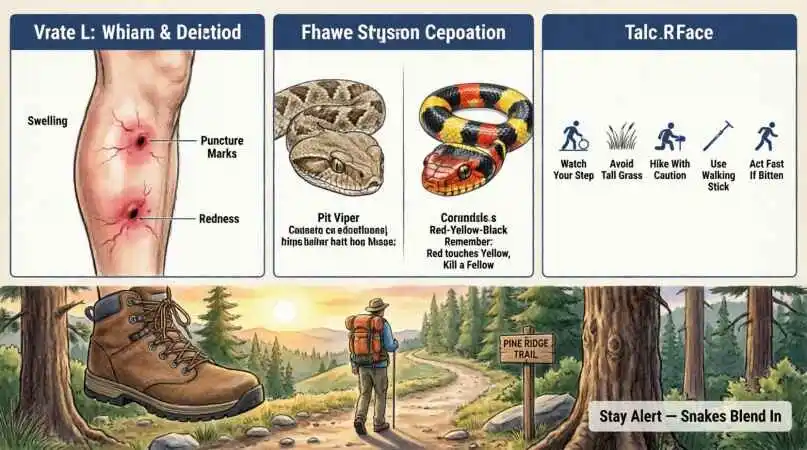
While identification should never come at the cost of safety, there are some general visual clues that can help distinguish a likely venomous bite from a non-venomous one, based on the wound itself rather than the snake. Venomous bites, particularly from pit vipers such as rattlesnakes, copperheads, and cottonmouths, often leave one or two larger puncture marks from fangs, sometimes accompanied by smaller marks from other teeth. Non-venomous bites more commonly leave a semicircular row of small, even tooth marks without deep punctures.
In North America, most venomous snakes fall into two broad categories with different features. Pit vipers generally have triangular, arrow-shaped heads, vertical slit-like pupils, and a heat-sensing pit between the eye and nostril on each side of the face. Coral snakes are the major exception, with a more rounded head, round pupils, and no heat-sensing pit, identified instead by their distinctive banded red, yellow, and black coloration, though several harmless snakes have evolved similar-looking bands as mimicry, making color pattern alone an unreliable identifier without close, careful comparison.
If it is genuinely safe to do so, from a distance well outside striking range, a photograph can be useful for the medical team, since the CDC notes this can help responders anticipate the type of venom involved and prepare appropriate treatment. But no photograph, description, or identification attempt should ever delay a call for emergency help or come at the risk of a second bite. When in doubt, or when there is no time to look, proceed directly to emergency response.
3. Symptoms That Signal a Venomous Bite
The clearest signs that a bite is venomous typically appear at the wound itself first. Immediate, severe, burning pain that is disproportionate to what a simple scratch or puncture would cause is one of the most consistent early indicators, according to MedlinePlus. This is usually followed within minutes by swelling, redness, warmth, and bruising that spreads outward from the bite site, sometimes tracking a significant distance up an affected arm or leg over the following hours.
Beyond the local wound, systemic symptoms often follow as venom moves through the lymphatic system and eventually into general circulation. These can include nausea and vomiting, an unusual metallic or rubbery taste in the mouth, sweating, weakness, rapid heartbeat, and in more severe cases, difficulty breathing or signs of shock such as pale, clammy skin and dizziness. Swollen or tender lymph nodes near the groin or underarm on the affected side can also appear as venom spreads through the lymphatic system.
Coral snake bites deserve special mention because their symptom pattern can be dangerously deceptive. Their neurotoxic venom often produces a bite that is initially painless or only mildly uncomfortable, with major symptoms sometimes delayed for several hours. Warning signs specific to this type of venom include drooping of the upper eyelid, tingling in the fingers or toes, difficulty swallowing, slurred speech, and progressive muscle weakness. Because symptoms can take time to appear, medical experts stress that a person should never assume they are safe simply because a bite from a snake resembling a coral snake looks unremarkable in the first hour.
It is also worth noting that venom effects are broadly categorized into several overlapping types depending on the snake involved: hemotoxic venom, common in pit vipers, primarily damages blood and tissue and can interfere with normal clotting; neurotoxic venom, characteristic of coral snakes, targets the nervous system and can impair muscle control and breathing; and cytotoxic venom causes direct damage to cells at and around the bite site. Many bites involve some combination of these effects rather than a single, isolated mechanism.
4. What to Do in the First Critical Minutes
The very first step is scene safety: move at least twenty feet away from the snake, since it can strike again, and even a recently killed snake can retain a bite reflex for some time afterward, according to wilderness medicine guidance. Do not attempt to catch, trap, or kill the snake. Identification, if attempted at all, should come from a safe distance using only a photograph or a brief visual description.
Call 911 or your local emergency number immediately. This is the single highest-priority action in the entire response, and medical experts are unanimous that it should not be delayed for any other step. If cell service is unavailable, activate any other emergency communication method available, or send someone to reach help while you begin first aid.
While waiting for emergency responders, keep the person as calm and still as possible, since physical movement and an elevated heart rate can speed the spread of venom through the lymphatic system. Remove rings, watches, and any tight clothing near the bite before swelling makes this difficult or impossible. Gently wash the bite with soap and water if available, and cover it with a clean, dry dressing. Create a loose splint to restrict movement of the affected limb, and position the bite at heart level for pit viper bites, or below heart level specifically for coral snake, cobra, or other exotic elapid bites, following current guidance from MedlinePlus. If signs of shock appear, such as pale or clammy skin, lay the person flat, raise the legs slightly, and keep them warm while continuing to wait for emergency responders.
It is also helpful, if you have a marker or pen available, to trace the leading edge of any swelling or redness on the skin and note the time next to the mark. This simple step gives arriving medical responders an immediate, objective way to see how quickly the reaction is progressing, which can meaningfully inform treatment decisions once the person reaches a hospital.
5. What You Should Never Do
Decades of medical research have systematically discredited a long list of traditional snakebite remedies, and current guidance from the CDC, the American Red Cross, and the American College of Medical Toxicology is unambiguous in warning against each of them. Do not apply a tourniquet. Restricting blood flow this aggressively does not stop venom from spreading through the lymphatic system, and it significantly increases the risk of severe tissue damage or loss of the limb.
Do not cut into the wound, and do not attempt to suck out the venom, whether by mouth or with a suction device. Research, including a widely cited study on mock venom extraction, has found that these methods remove a negligible amount of venom while introducing infection risk and additional tissue trauma. Do not apply ice or immerse the wound in water, and do not use electric shock, a folk remedy with no supporting evidence that has occasionally caused additional injury.
Avoid alcohol, and do not take aspirin, ibuprofen, or other over-the-counter pain relievers, since these can worsen bleeding risk depending on the type of venom involved. Do not give the person anything to eat or drink. Finally, never raise the bite site above heart level, and never drive yourself to the hospital if you are the one bitten, since venom effects such as dizziness or fainting can make driving dangerous; wait for emergency transport or have someone else drive.
It is worth understanding why these particular myths persist despite being discredited: many of them originated decades or even centuries ago, before modern understanding of how venom actually moves through the body, and some were even taught in early first-aid manuals before controlled research disproved their effectiveness. They tend to survive in popular culture, television, and film long after medical guidance has moved on, which is part of why explicitly naming and correcting them remains genuinely necessary rather than redundant.
6. Special Considerations for Children, Elderly Individuals, and Allergic Reactions
Children face a disproportionately higher risk from snakebites, largely because a given amount of venom represents a much larger dose relative to their smaller body size, according to MedlinePlus. Symptoms in children can progress more rapidly, and any bite to a child should be treated with heightened urgency, with emergency services contacted immediately regardless of how the wound initially appears.
Older adults and individuals with underlying heart, kidney, or other chronic health conditions also face elevated risk of complications, since their bodies may be less able to compensate for the systemic effects of venom, including changes in blood pressure and clotting function. Any pre-existing medical conditions should be reported to emergency responders and hospital staff as early as possible.
Separately from the venom’s direct toxic effects, some individuals experience a severe allergic reaction, including anaphylaxis, in response to a snakebite. Warning signs include rapid swelling of the face, lips, or throat, difficulty breathing, hives, and a sudden drop in blood pressure. This is a distinct medical emergency requiring immediate treatment, and anyone with a known severe allergy history who carries emergency epinephrine should have it available and inform responders of its use if administered.
“Decades of medical research have systematically discredited a long list of traditional snakebite remedies — tourniquets, cutting, suction, and ice all do more harm than good.”
7. What Happens at the Hospital
Once a patient reaches emergency care, treatment typically begins with a standard airway, breathing, and circulation assessment, followed by close monitoring of the wound’s progression and laboratory testing, including coagulation studies and kidney function, since certain venoms can interfere with normal blood clotting and organ function. Antivenom is the central treatment for confirmed or suspected venomous bites, working by neutralizing venom proteins circulating in the bloodstream.
In the United States, pit viper bites are commonly treated with antivenom products such as CroFab or Anavip, while coral snake envenomation requires a different antivenom formulated specifically for its neurotoxic venom. Most patients require a minimum observation period of twenty-four to forty-eight hours, and some require multiple antivenom doses depending on the severity and progression of symptoms. A tetanus booster may also be given depending on when the patient last received one.
Even bites that ultimately turn out to have been dry, meaning no venom was actually injected, generally still warrant a period of medical observation, since it is not always possible to confirm this immediately, and symptoms from some venoms, particularly neurotoxic types, can take hours to become apparent.
8. Reducing Your Risk Before It Ever Happens
Prevention remains the most reliable protection against snakebites, and most recommended precautions are simple. Avoid tall grass, leaf piles, and areas of dense brush when possible, and be especially cautious around rocks, woodpiles, and other locations where snakes commonly shelter. Wear sturdy boots and long pants in areas known to have snake activity, and use leather gloves when handling brush, firewood, or debris in areas where snakes might be hiding.
Never handle, tease, or attempt to kill any snake, including one that appears dead, since bite reflexes can persist briefly even after death. A striking distance of roughly one-third to one-half of a snake’s body length is a reasonable safety margin to maintain, and many bites occur specifically because someone underestimated how far a snake could reach. Statistical reviews have also found that a meaningful proportion of snakebites in the United States occur among people who had been drinking alcohol, underscoring the value of staying alert and sober in snake habitat.
Being aware that snakes are typically most active at dawn, dusk, and during warm weather can also help inform when extra caution is warranted. None of these precautions guarantee a bite will never happen, but together they meaningfully reduce the odds, and combined with the emergency knowledge in this guide, they represent the two halves of genuinely responsible outdoor safety: reducing the chance of a bite, and knowing exactly what to do if one happens anyway.
For anyone who regularly works or spends recreational time in snake habitat, it is also worth learning which venomous species are actually present in your specific region, since guidance can vary meaningfully by geography. A first-aid approach appropriate for pit vipers in North America is not identical to the recommended response for elapid or sea snake bites common in parts of Australia and Asia, which makes region-specific knowledge a genuinely useful addition to the general principles covered here.
Final Thoughts: Small Changes, Real Resilience
The single most important takeaway from everything above is almost disarmingly simple: call for emergency help immediately, keep the person calm and still, avoid the well-documented list of harmful home remedies, and get to a hospital that stocks antivenom as quickly as possible. Everything else — the visual identification clues, the symptom timelines, the positioning guidance for different snake families — exists to support that core response, not to replace it or slow it down while you try to work out exactly what happened.
Snakebites remain frightening in large part because they feel unpredictable, and in the moment, they often are. But the medical response to them is not unpredictable at all. It is well studied, consistently documented across major health authorities, and, when followed promptly, associated with genuinely good outcomes for the overwhelming majority of people bitten in the United States each year. Panic and outdated folk remedies are consistently more dangerous than the waiting itself, once professional help is truly on the way.
If you spend meaningful time hiking, camping, gardening, or working outdoors in snake habitat, it is worth taking a few minutes to mentally rehearse this response before you ever need it — because in the actual moment, adrenaline narrows thinking, and having a clear, memorized sequence of steps is worth far more than trying to reconstruct the right approach from scratch under pressure. This article is intended for general educational purposes and is not a substitute for professional medical training or care; if you or someone near you is ever bitten by a snake, seek emergency medical attention immediately.
FAQs
| Question | Answer |
| How can I tell if a snakebite is venomous? | Look for signs like severe, disproportionate pain, rapid swelling, redness, and bruising spreading from the bite, along with one or two larger puncture marks, though these signs are not always reliable, so all snakebites should be treated as potentially venomous. |
| What is the very first thing I should do after a snakebite? | Move at least twenty feet away from the snake to avoid another bite, then call 911 or your local emergency number immediately, since this is the single highest-priority action. |
| Should I try to identify the snake before seeking help? | No, identification should never delay emergency care; if it is genuinely safe, a photo from a safe distance can help responders, but calling for help always comes first. |
| Is it true that all snakebites should be treated as venomous? | Yes, major health authorities including Johns Hopkins Medicine recommend treating every snakebite as venomous until a healthcare provider determines otherwise, since identification in the moment is often unreliable. |
| What does a ‘dry bite’ mean? | A dry bite occurs when a venomous snake bites without injecting venom; it still requires medical evaluation, since this cannot be confirmed with certainty outside a clinical setting. |
| Should I apply a tourniquet to a snakebite? | No, tourniquets are strongly discouraged because they do not stop venom from spreading through the lymphatic system and can significantly increase the risk of tissue damage or limb loss. |
| Can I cut the wound and suck out the venom? | No, research has shown that cutting or suction removes a negligible amount of venom while increasing the risk of infection and additional tissue damage. |
| Should I apply ice to a snakebite? | No, applying ice or immersing the wound in water is not recommended and can worsen tissue injury without reducing venom spread. |
| Can I take ibuprofen or aspirin for the pain? | No, over-the-counter pain relievers like aspirin and ibuprofen are discouraged because they can increase bleeding risk depending on the type of venom involved. |
| Should the bite be positioned above or below the heart? | For pit viper bites such as rattlesnakes, copperheads, or cottonmouths, keep the area at heart level; for coral snakes or other elapid bites, keep the area below heart level. |
| What are the main types of venomous snakes in North America? | The main groups are pit vipers, which include rattlesnakes, copperheads, and cottonmouths, and coral snakes, which have a different, neurotoxic type of venom. |
| How do pit vipers physically differ from coral snakes? | Pit vipers typically have triangular heads, vertical slit pupils, and a heat-sensing pit near each eye, while coral snakes have rounded heads, round pupils, and no heat-sensing pit. |
| Is it safe to identify a snake by its color pattern alone? | Not reliably, since several harmless snakes have evolved coloring that closely mimics venomous species, making color pattern alone an unreliable identification method. |
| Why are coral snake bites considered especially dangerous to recognize? | Their neurotoxic venom often causes an initially painless bite with symptoms delayed for hours, which can lead people to mistakenly assume the bite was not serious. |
| What symptoms suggest a coral snake bite specifically? | Warning signs include drooping of the upper eyelid, tingling in the fingers or toes, difficulty swallowing, slurred speech, and progressive muscle weakness. |
| How quickly do venomous snakebite symptoms usually appear? | Pit viper bite symptoms typically begin very quickly, often within minutes, while coral snake symptoms may be delayed for several hours despite an initially mild-seeming bite. |
| Are children at higher risk from snakebites? | Yes, children face higher risk because a given amount of venom represents a larger relative dose for their smaller body size, and symptoms can progress more rapidly. |
| What should I do if the person shows signs of shock? | Lay the person flat, raise their legs slightly, keep them warm, and continue monitoring their condition while waiting for emergency medical responders. |
| Can a snakebite cause a severe allergic reaction separate from the venom itself? | Yes, some individuals experience anaphylaxis in response to a snakebite, with symptoms including facial or throat swelling, difficulty breathing, and a sudden drop in blood pressure, requiring immediate emergency treatment. |
| Should I remove jewelry near the bite site? | Yes, remove rings, watches, and tight clothing near the bite as early as possible, since swelling can make this difficult or unsafe to do later. |
| Is it safe to drive myself to the hospital after being bitten? | No, it is not recommended, since venom effects such as dizziness or fainting can make driving dangerous; wait for emergency transport or have someone else drive. |
| What treatment do hospitals use for venomous snakebites? | Hospitals primarily use antivenom, such as CroFab or Anavip for pit viper bites, along with monitoring of vital signs, wound progression, and laboratory tests including coagulation studies. |
| How long do patients typically stay under observation after a venomous snakebite? | Most patients require a minimum of twenty-four to forty-eight hours of observation, and some require multiple doses of antivenom depending on symptom severity. |
| Does a snakebite always require antivenom? | Not always; treatment depends on whether venom was injected and how severe the resulting symptoms are, which is determined through clinical evaluation and observation. |
| What should I do if I can’t reach cell service after a snakebite in a remote area? | Use any available emergency communication device, such as a satellite messenger or personal locator beacon, or send someone to find help while beginning basic first aid steps. |
| Can a dead snake still bite me? | Yes, a recently killed snake can retain a bite reflex for some time afterward, so it should never be handled, even if it appears dead. |
| How can I reduce my risk of being bitten outdoors? | Wear sturdy boots and long pants, avoid tall grass and leaf piles, use gloves when handling brush or firewood, and never attempt to touch, handle, or tease any snake. |
| Does alcohol consumption increase snakebite risk? | Statistical reviews have found that a meaningful proportion of snakebites occur among people who had been drinking, likely related to reduced caution and awareness. |
| What time of day are snakes most active? | Snakes tend to be most active at dawn, dusk, and during warm weather, so extra caution is warranted in snake habitat during these times. |
| Is this article a substitute for professional medical training? | No, this article is intended for general educational purposes only; anyone bitten by a snake should seek immediate professional emergency medical care. |
⚕️Medical Disclaimer:
The information provided on this website is for general educational and informational purposes only and is not intended as a substitute for professional medical advice, diagnosis, or treatment. Always seek the advice of your physician or other qualified health provider with any questions you may have regarding a medical condition. Never disregard professional medical advice or delay in seeking it because of something you have read on this website.
