
Table of Contents
The Fever Breaks, Then the Rash Appears: What That Exact Pattern Usually Means
A widespread rash on the trunk and upper limbs, appearing right as a several-day fever resolves, is one of the most recognizable diagnostic patterns in pediatric medicine. Here is the full clinical picture, from diagnosis to treatment.
The Case: A 5-Year-Old With Fever Followed by a Widespread Rash
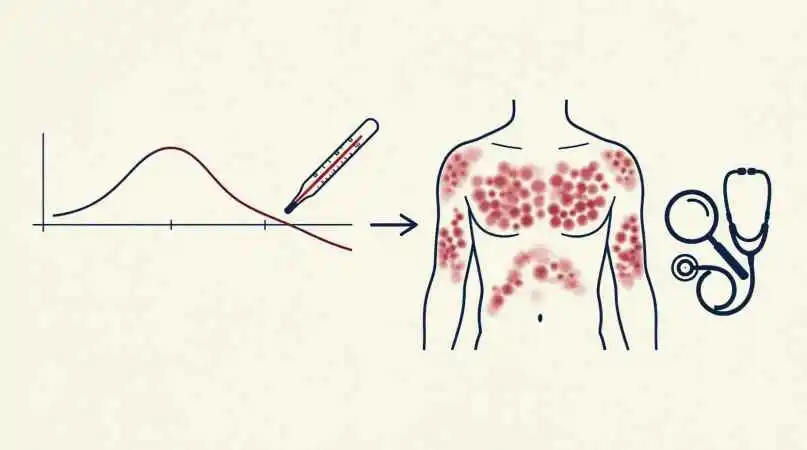
A 5-year-old child presents with a widespread erythematous maculopapular rash concentrated primarily on the trunk and upper extremities. The parents report a high-grade fever that began three days before the rash appeared, and by the time the rash developed, the fever had largely resolved. This sequence, several days of high fever followed by rash onset as the fever breaks, is one of the most diagnostically informative patterns in pediatric medicine, since the timing itself narrows the likely diagnosis considerably before the rash’s specific appearance is even closely examined.
Understanding why this exact sequence points so strongly toward one particular diagnosis, what else needs to be ruled out, and how the condition is actually managed requires walking through the full clinical reasoning a pediatrician would apply to this presentation, not just naming a single answer.
Why the Order of Symptoms Matters So Much
In pediatric medicine, the specific sequence and timing of fever relative to rash onset is one of the single most useful pieces of diagnostic information available, often more informative than the rash’s exact visual appearance alone. A rash that appears while a fever is still climbing points toward a different set of likely causes than a rash that appears only after several days of fever have already resolved, since different viral and bacterial illnesses follow characteristically different timelines.

This is precisely why a presentation of several days of fever followed by a rash coinciding with fever resolution carries such strong diagnostic weight: that specific pattern is the textbook presentation most strongly associated with one particular common childhood viral illness, discussed in detail below, though it is far from the only possibility a thorough evaluation needs to consider.
The Leading Diagnosis: Roseola Infantum
The presentation described here, three to four days of high fever in a young child followed by the appearance of a rash as the fever subsides, is the textbook description of roseola infantum, also called exanthem subitum, one of the most common viral illnesses in early childhood, typically affecting children between six months and three years of age, though it can occur somewhat later, as in this five-year-old case. Roseola is caused most commonly by human herpesvirus 6, and less frequently by human herpesvirus 7.
The rash itself typically presents as small, pink or reddish, slightly raised spots, often described as blanching, meaning the redness temporarily disappears when gently pressed, primarily distributed across the trunk before sometimes spreading to the neck, face, and limbs, matching the trunk-and-upper-extremity distribution described in this case. A defining and genuinely distinctive feature of roseola is that the child often appears notably improved once the rash appears, in contrast to many other childhood rash illnesses where the rash coincides with the child feeling their sickest.
In roseola, the rash often shows up right as the child starts feeling better, which is the opposite pattern of most other childhood fever-rash illnesses.
Why This Pattern Is Considered Reassuring
From a clinical standpoint, the specific fever-then-rash sequence characteristic of roseola is generally considered reassuring precisely because it distinguishes the illness from several other conditions that follow a notably different, and sometimes more concerning, timeline. Roseola is typically a self-limited illness, meaning it resolves on its own without specific antiviral treatment, and most children recover fully within a week to ten days of initial symptom onset without complications.
The main clinical concern during the illness itself is usually not the rash, which requires no specific treatment, but rather the high fever preceding it, since roseola is a well-documented cause of febrile seizures in young children, a genuinely frightening but generally not dangerous event caused by a rapid rise in body temperature rather than any direct effect of the virus on brain function, and one that resolves without lasting harm in the significant majority of cases.
The Full Differential Diagnosis Worth Ruling Out
Responsible clinical reasoning always considers a broader differential diagnosis rather than settling on a single possibility based on timing alone. Measles produces a fever that typically continues alongside, rather than resolving before, rash onset, accompanied by other distinctive features including cough, red watery eyes, and small white spots inside the mouth called Koplik spots, and represents a more serious illness with meaningful potential complications, deserving careful diagnostic consideration given measles’ return in various outbreak clusters in recent years.
Rubella similarly presents with a rash appearing alongside a generally milder fever rather than one clearly following its resolution, along with characteristic swollen lymph nodes, particularly behind the ears. Scarlet fever presents with a distinctive rough, sandpaper-textured rash, typically accompanied by a sore throat and a notably red, bumpy tongue often described as strawberry tongue, and requires antibiotic treatment given its bacterial, strep-related cause. Fifth disease produces a distinctive “slapped cheek” facial redness before a lacier body rash develops. A thorough evaluation also considers non-infectious causes, including a drug reaction to a recently started medication, which can produce a widespread rash without following the same characteristic fever timeline at all.
How a Clinician Distinguishes Between These Possibilities
Distinguishing between these possibilities in an actual clinical evaluation relies on more than the rash’s appearance alone. The rash’s specific texture, whether it blanches under gentle pressure, its exact distribution pattern, and its progression over the following days all provide diagnostic information that a rash cannot fully convey when considered in isolation, particularly when the goal is separating a self-limited viral illness from something requiring more active treatment.
Equally important, a rash cannot be properly evaluated apart from the rest of the clinical picture: the child’s vaccination history, exposure to other sick children or specific illnesses circulating locally, and associated symptoms like sore throat, cough, red eyes, or joint pain all meaningfully narrow the diagnosis. In this specific case, the absence of mentioned respiratory symptoms, eye redness, or mouth lesions, combined with the classic fever-then-rash sequence, further supports roseola as the leading diagnosis over measles or rubella.
Red Flags That Always Warrant Urgent Evaluation
Regardless of the specific suspected diagnosis, certain features accompanying a childhood fever and rash warrant urgent medical evaluation rather than a wait-and-see approach at home. These include a rash that does not blanch, does not lighten temporarily under gentle pressure, since a non-blanching rash can indicate a serious bacterial infection or a bleeding-related process requiring immediate medical attention.
Additional warning signs include a fever in a very young infant, generally under three months old, difficulty breathing, unusual lethargy or difficulty waking the child, a stiff neck, persistent vomiting, signs of dehydration such as notably reduced urination, or a rash rapidly spreading alongside worsening overall appearance, all of which should prompt immediate medical evaluation rather than observation at home, since these features can indicate a more serious underlying process requiring prompt treatment.
Treatment: What Roseola Actually Requires
Roseola, as a viral illness, has no specific antiviral treatment and does not respond to antibiotics, since antibiotics target bacteria and have no effect on viral infections. Management centers entirely on supportive care: ensuring adequate fluid intake to prevent dehydration, keeping the child comfortable with light clothing, and using appropriately dosed acetaminophen or ibuprofen, based on the child’s specific weight and a pediatrician or pharmacist’s guidance, primarily to manage fever-related discomfort rather than aggressively normalizing body temperature at all costs.
The rash itself requires no treatment and resolves on its own, typically within one to two days of appearing, without leaving any lasting marks or scarring. Parents can generally expect a full recovery within a week to ten days of the initial fever onset, with the child able to return to normal activities and, once fever-free for the period their school or daycare requires, back to a regular routine without special precautions beyond standard hygiene practices.
When a Rash Illness Requires Antibiotics Instead
Not every childhood fever-and-rash illness is viral, and this distinction matters both for appropriate individual patient care and for broader efforts to limit unnecessary antibiotic use. Scarlet fever represents the clearest exception among the conditions discussed here, since it is caused by a bacterial infection, specifically group A streptococcus, and requires antibiotic treatment both to resolve the acute illness more quickly and, importantly, to prevent rare but serious potential complications like rheumatic fever.
This is precisely why an accurate diagnosis distinguishing viral from bacterial causes matters considerably more than simply identifying that a rash and fever are present together, and why a sore throat, strawberry tongue, or the distinctive sandpaper-textured rash of scarlet fever should prompt a different treatment path than the supportive-care-only approach appropriate for roseola.
Why Vaccination History Changes the Diagnostic Picture
A child’s vaccination status meaningfully shapes how a clinician approaches this presentation, since measles and rubella are both preventable through routine childhood vaccination, and their likelihood as a diagnosis shifts considerably based on whether a child has received the relevant vaccine doses on schedule. In regions or communities experiencing a measles outbreak specifically, clinicians maintain a notably heightened index of suspicion for measles in an unvaccinated or incompletely vaccinated child presenting with fever and rash, given both the illness’s seriousness and its high contagiousness.
For a fully vaccinated five-year-old with no known measles or rubella exposure, this history further tips the balance of probability toward roseola or another common, self-limited viral exanthem, reinforcing why a complete history, not the rash alone, plays such a central role in reaching an accurate diagnosis.
Is Roseola Contagious, and What Should Parents Expect Next
Roseola spreads through respiratory secretions, similar to a common cold, and is considered contagious primarily during the initial febrile period before the rash appears, which means many children have already passed through the most contagious phase by the time the rash, the feature that typically prompts parents to seek an evaluation, actually develops. Most healthcare guidance considers a child safe to return to daycare or school once they have been fever-free for twenty-four hours without the use of fever-reducing medication, regardless of whether the rash has fully faded.
Reinfection with the same strain is uncommon after a first roseola infection, since the illness typically confers lasting immunity to that specific virus, though a child could still theoretically contract a different, unrelated viral illness with a similar fever-and-rash presentation later on.
How Fever Height and Duration Factor Into the Diagnosis
The specific pattern of high, sustained fever over three to four days, rather than a lower-grade or briefer fever, is itself a meaningful diagnostic clue in this presentation. Roseola is well known for producing fevers that can climb quite high, frequently reaching 103°F or higher, while the child otherwise appears less severely ill than the temperature alone might suggest, a mismatch between fever height and overall clinical appearance that experienced clinicians often note as a subtle but useful supporting clue alongside the classic fever-then-rash sequence.
This pattern also explains why febrile seizures are disproportionately associated with roseola compared to some other childhood illnesses: the speed and height of the temperature rise, rather than the fever’s duration alone, appears to be the more significant seizure-triggering factor, which is part of why parents are often counseled that a rapid temperature spike, even if the peak number itself is not extreme, deserves attention and appropriate fever management regardless of the underlying cause.
What Diagnostic Testing, If Any, Is Typically Needed
In most cases matching this classic presentation, roseola is diagnosed clinically, based on the characteristic history and physical exam findings, without requiring specific laboratory testing, since the fever-then-rash pattern combined with the rash’s typical appearance is usually sufficiently distinctive on its own. Blood tests or viral studies are generally reserved for atypical presentations, children who appear more significantly ill than expected, or cases where the diagnosis remains genuinely uncertain after a full clinical evaluation.
This reliance on clinical diagnosis rather than routine testing is part of why the detailed history, exact fever timeline, associated symptoms, vaccination status, and recent exposures, carries so much diagnostic weight in this specific presentation, reinforcing why a thorough conversation with a healthcare provider, not just a visual rash check, remains central to reaching a confident diagnosis in a case like this one.
The Broader Clinical Takeaway
This case illustrates why accurate pediatric diagnosis depends on considering timing, associated symptoms, exposure history, and vaccination status together, rather than evaluating a rash’s appearance in isolation. The specific sequence described here, several days of high fever resolving right as a trunk-predominant rash appears in an otherwise improving child, points strongly toward roseola infantum as the most likely diagnosis, a self-limited illness requiring supportive care alone.
At the same time, the differential diagnoses outlined above, particularly measles, rubella, and scarlet fever, underscore why any actual case should be evaluated by a healthcare provider rather than diagnosed from a description alone, since distinguishing a benign, self-resolving illness from one requiring antibiotics or closer monitoring depends on a full clinical assessment that only a direct evaluation can reliably provide.
Frequently Asked Questions
| Question | Answer |
| What is the most likely diagnosis for fever followed by a trunk rash in a young child? | Roseola infantum is the classic diagnosis for this specific fever-then-rash pattern. |
| What causes roseola? | It is most commonly caused by human herpesvirus 6, and sometimes human herpesvirus 7. |
| At what age does roseola typically occur? | It most commonly affects children between six months and three years old, though older children can be affected. |
| What does a roseola rash look like? | It typically appears as small, pink or reddish, slightly raised, blanching spots mainly on the trunk. |
| Does a child with roseola feel worse when the rash appears? | No, children often appear improved once the rash develops, unlike many other rash illnesses. |
| Can roseola cause seizures? | Yes, the high fever associated with roseola can trigger febrile seizures in young children. |
| Are febrile seizures dangerous long-term? | Generally no, most resolve without lasting harm, though they can be frightening to witness. |
| Does roseola require antibiotics? | No, it is a viral illness and does not respond to antibiotics. |
| What is the treatment for roseola? | Supportive care, including fluids, comfort measures, and appropriately dosed fever reducers, is all that is needed. |
| How long does roseola typically last? | Most children recover fully within about a week to ten days from initial fever onset. |
| Is roseola contagious? | Yes, primarily during the fever phase before the rash appears, spreading through respiratory secretions. |
| When can a child with roseola return to daycare or school? | Generally once fever-free for twenty-four hours without fever-reducing medication. |
| What other illnesses can cause fever and rash in children? | Measles, rubella, scarlet fever, fifth disease, and drug reactions are all possibilities. |
| How is measles rash timing different from roseola? | In measles, fever typically continues alongside the rash rather than resolving beforehand. |
| What are Koplik spots? | They are small white spots inside the mouth associated with measles infection. |
| What does a scarlet fever rash feel like? | It has a distinctive rough, sandpaper-like texture. |
| Does scarlet fever require antibiotics? | Yes, since it is caused by a bacterial infection requiring antibiotic treatment. |
| What is fifth disease? | It is a viral illness causing a “slapped cheek” facial rash followed by a lacier body rash. |
| What does a blanching rash mean? | It means the redness temporarily fades when gently pressed, generally a reassuring sign. |
| What does a non-blanching rash indicate? | It can indicate a more serious condition and requires urgent medical evaluation. |
| What red flag symptoms require urgent care? | Non-blanching rash, difficulty breathing, lethargy, stiff neck, or signs of dehydration all warrant urgent care. |
| How should fever be managed at home? | Ensure fluids, light clothing, and appropriately dosed fever-reducing medication as needed for comfort. |
| Is a high fever always dangerous? | Not necessarily; fever itself is often a normal immune response, though certain symptoms warrant evaluation. |
| Why does vaccination history matter for diagnosis? | It affects the likelihood of illnesses like measles and rubella, which are vaccine-preventable. |
| Should unvaccinated children with fever and rash be evaluated urgently? | Yes, especially during known outbreaks, given increased risk of serious vaccine-preventable illness. |
| What information helps a doctor diagnose a fever and rash presentation? | Timing of symptoms, associated symptoms, exposure history, and vaccination status all help significantly. |
| Can drug reactions cause a rash similar to viral illnesses? | Yes, a new medication can cause a rash that mimics infectious causes without the same fever pattern. |
| Can a child get roseola more than once? | Reinfection with the same strain is uncommon due to lasting immunity after the first infection. |
| Should parents wait to see a doctor if their child has fever and a rash? | A healthcare provider evaluation is recommended to confirm the diagnosis and rule out other causes. |
| What is the most important overall takeaway from this case? | The fever-then-rash timing strongly suggests roseola, but a full clinical evaluation is needed to confirm it. |
:
The information provided on this website is for general educational and informational purposes only and is not intended as a substitute for professional medical advice, diagnosis, or treatment. Always seek the advice of your physician or other qualified health provider with any questions you may have regarding a medical condition. Never disregard professional medical advice or delay in seeking it because of something you have read on this website.
SEO Keywords:
