
Table of Contents
The Hidden Power of Micro-Investing: What Changed?
The story of how spare change, a $5 weekly habit, and a phone in your pocket rewrote the rules of who gets to invest.
A Coffee Habit That Quietly Built a Portfolio
Three years ago, my friend Jake told me he was waiting. He was 24, working a decent job, and he had decided not to invest until he had $5,000 saved up. That felt like the responsible move. The kind of thing his dad would have said. So he kept his cash in a savings account earning close to nothing and told himself he would start soon. The truth was, the $5,000 number kept getting pushed back every time something came up, and a year passed without a single dollar in the market.
Around the same time, his younger sister Lena, who was 21 and making less than him, downloaded a micro-investing app. She linked her debit card, turned on round-ups, and set a $25 weekly transfer. Every time she bought a $3.85 coffee, the app rounded the purchase up to $4.00 and parked the $0.15 difference into a basket of index funds. She did not feel the money leaving. She did not study balance sheets. She just lived her normal life.
Fast forward to today. Jake is still waiting. His $5,000 goal keeps slipping because life keeps happening, and he has watched from the sideline as the market moved on without him. Lena, on the other hand, has roughly $4,800 invested across mostly ETFs, and she has watched the balance climb through two good market years. She is not rich. But she started, and starting is the part most people never get to. That small gap between Jake and Lena is the whole story of how micro-investing apps quietly changed retail investing. This post breaks down what these apps actually do, the real benefits, the quiet risks, and the simple tips that decide whether your $5 a week becomes $50,000 or just disappears into monthly fees.

What Are Micro-Investing Apps, Really?
Micro-investing apps are smartphone-first platforms that let you put very small amounts of money to work in the market. We are talking $5, $1, even spare change from a sandwich. The big idea is to remove the old excuse that you need a fat paycheck or a finance degree before you can own a slice of the stock market.
Most of these apps work in two layers. The first layer is round-ups. When you buy a $9.40 sandwich, the app rounds the charge up to $10.00 and invests the $0.60. The second layer is recurring transfers. You tell the app to move $10 a week or $50 a month from your checking account into a portfolio, and it just happens. You can also do one-time lump sums when you have extra cash.
A Quick Note on Names You Will See
Apps like Acorns, Stash, Fidelity Spire, Robinhood, SoFi Invest, and a handful of others sit in this space. Some lean harder on round-ups and curated ETF baskets, while others focus on fractional shares of individual stocks. I am not here to sell you on any one of them. The point is the model. The model is what changed retail investing.
Why This Quietly Matters
Before these apps, retail investing had a gatekeeper problem. You needed a brokerage account. You needed to understand ticker symbols. You needed at least enough money to buy a full share of an ETF, which could be $200 or more. And you needed the confidence to actually click the buy button. Each of those steps quietly filtered people out. By the time someone got through all of them, years had passed, and many never got through them at all.
Micro-investing apps quietly changed retail investing by deleting almost every step in that chain. You do not need a lump sum. You do not need to pick a stock. You do not need to time the market. You link a card, set a number, and the app does the rest. The result is a whole generation of people who now own pieces of the market who, ten years ago, would have owned none of it. That shift is not loud. It is not a meme stock rally. But it is one of the biggest structural changes in personal finance in the last decade. It rewrote who the market is for, and it did so without asking permission from anyone who used to control the gates.
How Micro-Investing Apps Actually Work
Under the hood, these apps are not doing anything magical. They are doing something simple, repeatedly, and removing you from the equation. Here is the real mechanics in plain money English.
Round-Ups
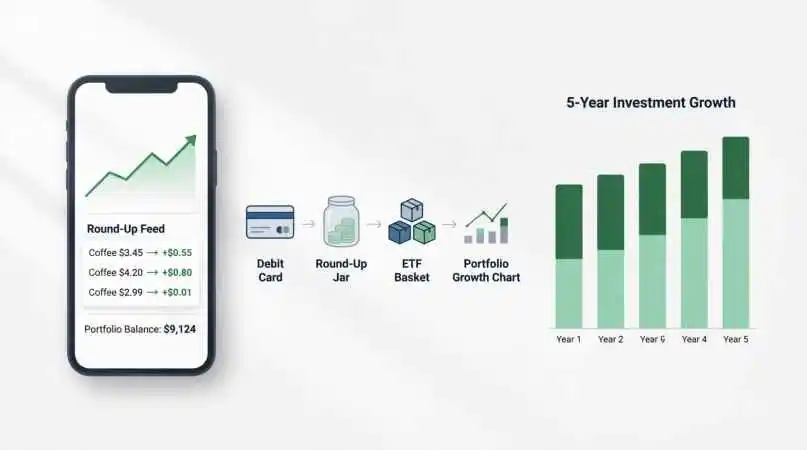
When you swipe your linked debit or credit card, the app reads the transaction amount. It rounds the purchase up to the nearest dollar and stores the spare change in a virtual jar. Once that jar hits a threshold, usually $5, it gets swept into your investment account. From there, the app buys fractional shares of ETFs based on the portfolio you picked.
Recurring Transfers
Round-ups alone are slow. They might add up to $30 or $50 a month. The real engine is the recurring transfer. You choose an amount, say $25 a week, and the app pulls that money on a schedule. This is the part that does the heavy lifting on growth, because consistent contributions matter more than picking the perfect stock.
Portfolio Baskets
Most apps do not ask you to pick stocks. They ask you to pick a risk level: conservative, moderate, or aggressive. Each level maps to a basket of ETFs, usually a mix of stocks and bonds. The aggressive basket might be 90% stocks and 10% bonds. The conservative one flips that. Some apps let you build your own, but most beginners just pick a level and walk away.
Fees
This is the part to watch. Most micro-investing apps charge a flat monthly fee of $1 to $6 depending on the tier. On a $500 balance, a $3 monthly fee equals 7.2% a year, which is brutal. On a $20,000 balance, the same $3 is 0.18%, which is fine. The fee only makes sense once your balance is big enough to dwarf it. We will come back to this in the risks section.
Benefits of Micro-Investing
There is a reason these apps caught on. They solve real problems that traditional investing never bothered to solve. Here are the benefits that actually move the needle.
1. A Tiny Starting Point
You do not need $1,000 to begin. You need $5. For someone who lives paycheck to paycheck, that is the difference between being in the market and being on the sidelines forever. The psychological barrier of needing a big pile of cash kept millions of people out of investing for decades. Removing it is the single biggest benefit of the model.
2. Automatic Habits
Behavior is the hardest part of money. Most people know they should invest. They just forget, or they wait for the perfect moment, or they spend the money instead. Micro-investing apps turn investing into something that happens in the background, like a subscription you actually want. Once it is set up, inertia works in your favor instead of against you.
3. Fractional Shares
A single share of a broad US market ETF can cost over $400. A share of a popular tech stock can cost over $300. Fractional shares let you buy a slice of that share for $5. You own the same proportional return, just in a smaller piece. This means even tiny deposits can buy real, diversified exposure instead of being stuck waiting to afford one full share.
4. A Learning Onramp
People learn by doing. Reading about compounding is fine. Watching $60 of round-ups grow into $84 over a year is the moment it clicks. Micro-investing apps give beginners a sandbox where mistakes are cheap and the feedback loop is short. Many users start with these apps and graduate to a full brokerage once they understand what they are doing.
5. Lower Fear, Less Procrastination
Because the amounts are small, the emotional stakes are small. You are not going to panic-sell a $200 portfolio during a market dip the way you might with a $50,000 one. That low fear is a feature, not a bug. It lets beginners sit through volatility long enough to actually see compounding work.
Risks and Downsides You Should Know
Micro-investing is not a free lunch. The same model that makes it easy also creates new ways to lose money quietly. Here are the risks that get glossed over in the marketing.
1. Monthly Fees Eat Small Balances
A $3 monthly fee sounds tiny. On a $100 balance, that is 36% a year. On a $300 balance, it is 12% a year. Until your balance crosses roughly $5,000, the flat fee can easily exceed the growth you get from the market. If you only round up $30 a month and pay a $3 fee, you start every month in the hole. This is the single most important risk to understand.
2. Market Volatility on Tiny Accounts
When the market drops 20%, your $400 portfolio becomes $320. In dollar terms, that is only $80, which feels survivable. But beginners often react by stopping contributions, which is the worst possible move. They sell low, or they freeze, and they miss the recovery. Small accounts do not protect you from bad behaviour. They just make the numbers smaller.
3. Tax Complexity
Every sale inside the app can trigger a taxable event. Round-ups, rebalancing, dividend reinvesting, all of these can generate small capital gains or losses. At tax time you may get a 1099 with dozens of tiny line items. It is not catastrophic, but it is annoying, and it can surprise first-time filers who thought investing was supposed to be set-and-forget.
4. Behavioural Overconfidence
Once someone sees their first $50 of growth, they sometimes start thinking they are a genius. That leads to bigger riskier bets, jumping into individual stocks, chasing hot sectors, or opening options trades on a different app. The training wheels come off too early, and the lesson that should have been patience becomes a lesson in chasing returns.
Real Case Study: Maria, 26, Barista in Austin
Let me show you how the numbers actually look. Maria is 26, works as a barista in Austin, and makes about $34,000 a year. She has never invested before. She downloads a micro-investing app in January of Year 1, links her debit card, turns on round-ups, and sets a $25 weekly recurring transfer. Her portfolio is set to moderate, which is roughly 70% stocks and 30% bonds.
Her round-ups average about $0.80 a day, because she makes 3 to 5 small purchases daily on coffee, groceries, and transit. That works out to roughly $24 a month in spare-change investments. Add the $25 weekly transfer, which is about $108 a month, and her total contributions run around $132 a month, or about $1,580 a year. The app charges her $3 a month, or $36 a year.
Below is a 5-year projection assuming a 7% average annual return, which is close to the long-run average for a balanced ETF portfolio. Fees are deducted from the balance. Numbers are rounded.
Table: Maria’s 5-Year Micro-Investing Projection
| Year | Contributed | Round-ups | Fees Paid | Ending Balance (7% return) |
| Year 1 | $1,300 | $420 | $36 | $1,309 |
| Year 2 | $2,600 | $840 | $72 | $2,801 |
| Year 3 | $3,900 | $1,260 | $108 | $4,572 |
| Year 4 | $5,200 | $1,680 | $144 | $6,663 |
| Year 5 | $6,500 | $2,100 | $180 | $9,124 |
By the end of Year 5, Maria has put in $8,600 of her own money ($6,500 from recurring transfers and $2,100 from round-ups) and paid $180 in fees. Her ending balance is $9,124, meaning she has earned roughly $524 above her contributions even after fees. More importantly, she now has a habit. She has five years of muscle memory of moving money into the market every single week. That habit, not the $524, is the real return on investment.
Maria’s next move is the part most people skip. In Year 6, she transfers the $9,124 to a low-cost brokerage charging 0.25% a year, keeps the $25 weekly contribution, and adds an extra $50 a month from a small raise. The flat $3 monthly fee disappears, replaced by about $23 a year in percentage fees. Over the following decade, assuming the same 7% return, her balance crosses $40,000 without her ever making a single dramatic decision. That is how someone earning a barista wage ends up with a real portfolio.
This is exactly how micro-investing apps quietly changed retail investing. Not by making anyone rich overnight, but by turning people like Maria into lifelong investors before they even noticed it was happening.
Micro-Investing Apps vs Traditional Brokerage
Here is a side-by-side to make the choice simple. Use this as a starting point, not a verdict. The right answer depends on your balance, your experience, and how much hand-holding you want.
Table: Feature Comparison
| Dimension | Micro-Investing App | Traditional Brokerage |
| Minimum to start | $5 or less | $0 to $1,000 |
| Monthly fees | $1 to $6 flat | $0 to 0.5% of assets |
| Automation built in | Yes (round-ups, sweeps) | Often optional or manual |
| Fractional shares | Yes, default | Varies by broker |
| Learning curve | Gentle, app-first | Steeper, platform-heavy |
| Best for | Beginners under $10k | Investors with $10k+ |
The takeaway is simple. If your balance is under $10,000 and you are still learning, micro-investing apps win on ease and habit. Once your balance crosses $10,000, the flat monthly fee becomes worse than a percentage-based fee at a traditional brokerage, and you should graduate. The right answer is not a brand name, it is the tool that fits the size of your portfolio today. A micro-investing app for $500, a low-cost broker for $50,000, and a financial advisor for $500,000. Each tool has a job, and the trick is matching the tool to where you actually are right now.
5 Actionable Investment and Saving Tips
Tip 1: Start With $5 a Week, Not $500
The biggest mistake beginners make is waiting until they feel ready. Readiness is a feeling that never arrives. Pick $5 a week, link the card, and let it run for 90 days. Once you see the balance growing, increasing to $25 or $50 a week feels easy. Starting small is not a compromise. It is the strategy.
Tip 2: Keep Fees Under 1% of Your Balance
Do the math every quarter. Take the monthly fee, multiply by 12, divide by your current balance. If that number is over 1%, you are paying too much. A $3 monthly fee is fine above $3,600. Below that, you are losing ground. Either bump your contributions to grow the balance faster, or move to a no-fee broker.
Tip 3: Do Not Micro-Invest Your Emergency Fund
Emergency money does not belong in the stock market, even in small amounts. Markets drop, and they drop at the worst possible moment, which is usually the same moment you lose a job or get a medical bill. Keep 3 to 6 months of expenses in a high-yield savings account first. Then micro-invest the spare change on top of that.
Tip 4: Rebalance Once a Year, Not Once a Week
When stocks have a good year, your 70/30 portfolio might drift to 80/20. That is fine. Once a year, usually in January, log in and rebalance back to your target mix. Most apps do this automatically. If yours does, leave it alone. Tweaking every week is how beginners lose to their own impatience.
Tip 5: Graduate to a Full Broker at $10,000
Once your balance crosses $10,000, the math flips. Flat monthly fees start looking expensive compared to a 0.25% annual fee at a robo-advisor or a commission-free broker. At $10,000, a $3 monthly fee is $36 a year, or 0.36%. A 0.25% alternative charges $25. The gap widens as your balance grows. Move the money, keep the habit.
Conclusion
Micro-investing apps are not a get-rich scheme. They are training wheels. They work because they lower the emotional cost of starting, and starting is the part that almost everyone gets stuck on. The actual returns on small balances are modest. The behavioural returns are enormous. Once you have built the habit of moving money into the market every single week, you have won the hard half of personal finance. The rest is just optimising fees and increasing contributions as your income grows.
If you take one thing from this, take the Jake and Lena story. Waiting for the perfect moment is the most expensive mistake in personal finance. Five dollars invested today, repeated weekly, will quietly do more for you over twenty years than $5,000 invested in a single burst ten years from now. That is the quiet, unsexy, life-changing reality of how micro-investing apps quietly changed retail investing.
The apps themselves are not the point. Some will thrive, some will get acquired, some will fade. What stays is the behaviour they taught a generation of beginners: that investing does not require a windfall, that small deposits compound into something real, and that the best time to start was years ago and the second best time is this week. Use the apps as the onramp they are, ride them until your balance is big enough to leave, and then keep the habit. That is the whole game.
FAQs
Q: What is micro-investing?
A: Micro-investing means putting very small amounts of money, often spare change or $5 a week, into the stock market through a smartphone app.
Q: How do round-ups work?
A: The app rounds your card purchase up to the nearest dollar and invests the difference. Buy something for $4.20, and $0.80 goes into your portfolio.
Q: Are micro-investing apps safe?
A: They are as safe as any regulated brokerage. Your assets are held by a custodian and usually covered by SIPC insurance up to $500,000. Safety of the app is different from market risk, which always exists.
Q: What is the best micro-investing app for beginners?
A: It depends on your goal. Acorns is the most automated for round-ups. Stash adds educational content. Fidelity Spire is good if you already use Fidelity. Compare fees before choosing.
Q: How much money do I need to start?
A: Usually $5 or less. Some apps let you open an account with $0 and fund it with the first round-up.
Q: Do micro-investing apps charge fees?
A: Most charge a flat monthly fee between $1 and $6. A few are free with limited features. Always calculate the fee as a percentage of your balance.
Q: Are the fees worth it for small balances?
A: On balances under $3,600, a $3 monthly fee is over 1% a year, which is high. Bump contributions to grow the balance fast or use a no-fee broker.
Q: Can I lose money with micro-investing?
A: Yes. Anything invested in stocks can lose value. Bonds and cash portions buffer risk, but no investment is fully safe from market drops.
Q: What is a fractional share?
A: A fractional share is a slice of a full share. You buy $5 worth of a $400 stock and own 1/80 of a share, with proportional gains and dividends.
Q: Are micro-investing apps SIPC insured?
A: Yes, most are. SIPC protects up to $500,000 if the brokerage fails, but it does not protect against market losses.
Q: Do I pay taxes on micro-investing gains?
A: Yes. Dividends and capital gains from sales are taxable. You will usually receive a 1099 form at the end of the year.
Q: What happens if I sell my investments?
A: The sale settles in a few days, cash lands in the linked bank account, and you may owe capital gains tax on any profit.
Q: What is the difference between micro-investing and robo-advisors?
A: Micro-investing focuses on small round-ups and a simple app. Robo-advisors usually manage larger portfolios with algorithmic rebalancing and tax-loss harvesting.
Q: Can I withdraw my money anytime?
A: Yes, but settlement takes a few business days. Selling during a market dip locks in the loss, so withdrawals should be planned.
Q: Is micro-investing good for retirement?
A: It can be a starting point. Once your balance grows, move the money into an IRA or 401(k) for better tax treatment and lower fees.
Q: What is the average return on micro-investing?
A: Returns match your underlying portfolio. A balanced ETF portfolio has historically averaged around 6 to 8% a year over long periods, with no guarantees.
Q: What is the minimum age to use a micro-investing app?
A: You must be 18 in most countries. Minors can invest through custodial accounts opened by a parent or guardian.
Q: Do micro-investing apps affect my credit score?
A: No. Investing does not show up on your credit report. Late payments on linked credit cards can, but the app itself does not.
Q: Can I use multiple micro-investing apps at once?
A: Yes, but it gets messy. Pick one for round-ups, use a separate broker for larger balances to keep fees low and life simple.
Q: Are dividend reinvestments automatic?
A: Most apps reinvest dividends automatically into your chosen portfolio. Check the settings to confirm.
Q: What happens if the app shuts down?
A: Your investments are held by a custodian, not the app. You can transfer your assets to another brokerage if the app closes.
Q: Should I invest in individual stocks through these apps?
A: Beginners should stick to ETF baskets. Individual stocks carry more risk and require research. Build a base first.
Q: Is micro-investing the same as day trading?
A: No. Day trading is high-frequency stock buying. Micro-investing is slow, automated, and long-term.
Q: How often should I check my micro-investing app?
A: Once a month is plenty. Checking daily leads to emotional decisions, which are the enemy of long-term returns.
Q: Can I lose more money than I deposited?
A: No, not in a standard ETF portfolio. You can lose value, but you cannot go negative. Leverage and margin are not part of micro-investing.
Q: Are ETFs safer than individual stocks?
A: Yes, generally. ETFs hold many stocks or bonds, which spreads risk. A single stock can go to zero. An ETF rarely does.
Q: What is rebalancing?
A: Rebalancing means resetting your portfolio back to your target mix of stocks and bonds. If stocks grew to 80% of your portfolio, rebalancing brings them back to 70%.
Q: Do I need a financial advisor if I use a micro-investing app?
A: Not for small balances. Once your portfolio crosses $50,000 or your situation gets complex, talking to a fee-only advisor is worth it.
Q: Can micro-investing make me rich?
A: No, not on its own. Small amounts grow slowly. Wealth comes from raising your contributions as your income grows. The app is a starting line, not a finish line.
Q: When should I switch from a micro-investing app to a full brokerage?
A: When your balance crosses $10,000, the flat fee becomes more expensive than percentage-based alternatives. That is the natural graduation point.
Financial Disclaimer
This blog post is for educational purposes only. It is not financial, investment, tax, or legal advice. I am not a licensed financial advisor, and the case study figures are illustrative projections, not guaranteed outcomes. Past market performance does not predict future results. All investing carries risk, including the possible loss of principal. Before opening any account or moving any money, do your own research and consider speaking with a qualified, licensed financial professional who knows your specific situation, your full financial picture, your time horizon, and your personal risk tolerance. Read the fine print on any app before you sign up.
