
Table of Contents
Black Stools, Dizzy Spells, and the Kitchen Cabinet: What Natural Remedies Can and Can’t Do for a GI Bleed
A practical, evidence-aware guide to gastrointestinal bleeding natural remedies: what helps healing, what to skip, and when to stop reading and go to the hospital.
Picture a man we’ll call Raghu. For three weeks he blames a bad curry. The stomach ache comes and goes, he’s wrung out by mid-afternoon, and his wife keeps saying he looks pale. Then one morning his stool is black, sticky, and smells unlike anything he has dealt with before. When he stands up, the room tilts and the edges go white.
His family’s first reflex is a glass of cold milk and some ginger tea. Their second, thankfully, is the hospital.
That order of operations is what this guide is really about. Search for gastrointestinal bleeding natural remedies and you’ll find plenty of confident lists: cabbage juice, aloe, turmeric, honey. A few of those things do have a genuine place in recovering from a bleeding ulcer or an irritated gut lining. None of them can stop an active bleed. And some popular “natural” picks can quietly make bleeding worse.

So, here’s the plan. We’ll sort out what a GI bleed actually is and how to recognize GI bleed symptoms and the signs of internal bleeding. We’ll be clear about when to see a doctor for GI bleeding, because that part isn’t negotiable. Then we’ll get to the useful stuff: a healing diet for peptic ulcer recovery, natural remedies for stomach ulcers that have some evidence behind them, the herbs that increase bleeding risk, how to rebuild with iron-rich foods for anemia, and the daily habits that keep this from happening twice.
Think of natural care as the rebuilding crew. It arrives after the paramedics. It never replaces them.
| READ THIS FIRST
This article is educational and is not a substitute for medical care. If you are vomiting blood, passing black tarry stools, feeling faint, or your heart is racing, treat it as an emergency and get to a hospital now. Do not drive yourself, and do not wait to see whether a home remedy works. |
What a GI Bleed Actually Is (and What It Feels Like)
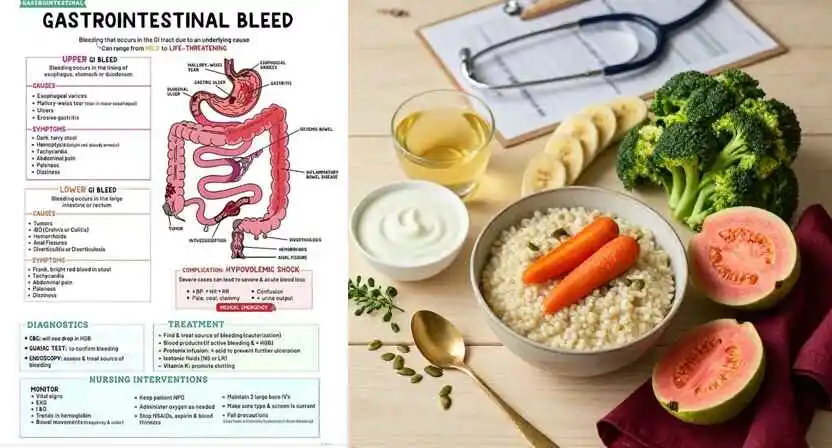
Your digestive tract is a long, wet tube running from your mouth to your anus, lined with delicate tissue and a generous blood supply. A GI bleed is bleeding anywhere along that tube. It isn’t a disease by itself. It’s a sign that something has damaged the wall: an ulcer, inflamed lining, a swollen vein, a small tear, a polyp, or a growth.
Sometimes the bleed is a slow trickle that you never see. Sometimes it’s brisk enough to drop your blood pressure within an hour. The tricky part is that you can’t tell which one you have from the outside.
Upper versus lower: where the blood comes from
Doctors split the tract at a landmark near the start of the small intestine. Above it is the upper GI tract (esophagus, stomach, first part of the small intestine). Below it is the lower tract (the rest of the small intestine, colon, rectum, and anus). The source changes what you see in the toilet, and it changes the treatment.
| Source | Common causes | What you typically notice |
| Upper GI | Peptic (stomach or duodenal) ulcers, gastritis, esophageal varices, Mallory-Weiss tears, erosive esophagitis | Black, tarry stools (melena); vomit that is red or looks like coffee grounds |
| Lower GI | Diverticular disease, hemorrhoids, anal fissures, colitis, polyps, colon cancer, angiodysplasia | Bright red or maroon blood in the stool, on the paper, or in the bowl |
| Hidden (occult) | Slow ulcer bleeding, polyps, early tumors | Nothing visible at all; fatigue, pallor, breathlessness, iron-deficiency anemia |
GI bleed symptoms worth knowing
- Black, tarry, sticky stool with an unusually foul smell. Blood that has been digested on its way down turns black, which usually points to the upper tract.
- Vomit that is bright red or looks like coffee grounds.
- Maroon or bright red blood in the toilet or on the tissue.
- Dizziness when you stand up, fainting, or nearly fainting.
- A fast heartbeat, shortness of breath, cold and clammy skin.
- Deep tiredness, pale skin, headaches, which are the slow-bleed and anemia version.
- Abdominal pain, burning, or bloating. Plenty of bleeds are painless, so don’t wait for pain before taking black stools seriously.
Signs of internal bleeding that mean “go now”
Think about what the body is doing when it bleeds. Blood volume drops, so the heart speeds up to push the remaining blood around, and blood pressure sags. That’s why the early warning signs of internal bleeding look like a mix of panic and exhaustion: racing pulse, dizziness, sweaty skin, a strange sense of doom, sudden weakness. If you’re seeing blood plus any of those, you’re past the point of home care.
Who is most at risk
Anyone can bleed, but some groups are far more likely to.
- People who take NSAIDs regularly, including daily low-dose aspirin.
- People on anticoagulant or antiplatelet drugs, especially those combining more than one.
- Adults over 60, whose stomach lining and blood vessels are more fragile.
- Anyone with an untreated H. pylori infection, which many people carry for decades without symptoms.
- Heavy drinkers and people with cirrhosis, where swollen veins (varices) can bleed massively.
- Smokers, and anyone who has had an ulcer or a GI bleed before.
- People who are critically ill or recovering from major surgery.
If more than one of those applies to you, don’t wait for dramatic symptoms before raising it with a doctor. A short conversation about protecting your stomach can prevent a hospital stay.
The black stool trap: harmless look-alikes
Not every dark stool is a bleed, and knowing the black tarry stools causes that aren’t dangerous will spare you some panic. Iron tablets, bismuth subsalicylate (the pink stomach remedy), black licorice, blueberries, and even some dark supplements can all darken stool.
The difference is in the texture. True melena is glossy, sticky, tar-like, and has a smell people describe as unmistakable. Stool darkened by iron or bismuth is usually dark green-black but formed and less sticky. If you aren’t sure, assume it’s a bleed and get checked, especially if you also feel dizzy, have stomach pain, or take blood thinners. One more point: bismuth subsalicylate contains a salicylate, a cousin of aspirin, so it’s a poor choice when bleeding is even a possibility.
“Natural care is the rebuilding crew. It arrives after the paramedics, never instead of them.”
Why Home Remedies Can’t Come First: When to See a Doctor for GI Bleeding
Bleeding is a plumbing problem. Healing is a construction problem. You can’t mop your way out of a burst pipe, and no cup of tea will close an open vessel in your stomach wall. A bleeding ulcer may need to be treated directly through an endoscope, with clips, cautery, or an injection, and that requires someone to look inside you.
The reason these matters so much is that ulcers that have bled once are prone to bleeding again, often within the first few days. Waiting at home to see if its “settles” is exactly the window in which a rebleed does the most harm.
Go to the emergency room or call an ambulance if you have:
- Vomited blood, or vomit that looks like coffee grounds.
- Black, tarry stools along with weakness, dizziness, or a racing heart.
- Fainted or nearly fainted, or you feel confused or unusually sleepy.
- Heavy red or maroon bleeding from the rectum, or a large clot.
- Chest pain, severe abdominal pain, or a rigid, painful belly.
- Any visible bleeding while taking blood thinners such as warfarin, apixaban, rivaroxaban, clopidogrel, or daily aspirin.
Book a doctor’s visit within days if you notice:
- Occasional dark stools that come and go.
- Unexplained tiredness, paleness, or breathlessness on stairs, especially if a blood test has shown low iron.
- Persistent burning in the upper abdomen, early fullness after meals, or nausea that won’t quit.
- Regular use of painkillers like ibuprofen, diclofenac, or naproxen with any stomach symptoms.
- Small amounts of bright red blood with bowel movements that last more than a week or two.
What doctors actually do (so it feels less scary)
For a suspected bleed, the team first checks that you’re stable: blood pressure, pulse, oxygen. Blood tests look at your hemoglobin and clotting. You may get IV fluids, and a transfusion if you’ve lost a lot. For upper bleeds, an endoscopy (a thin camera passed through the mouth) is usually done within about 24 hours so the bleeding point can be treated on the spot. Strong acid-suppressing medicines called proton pump inhibitors are standard. Lower bleeds are usually investigated with a colonoscopy.
After the immediate crisis, the cause gets treated for real: H. pylori eradication, stopping the offending painkiller, banding of swollen veins, treating colitis, removing polyps. This is the point where the natural side of care starts to matter, because the lining has to heal and the body has to rebuild its blood. One caution before we get there: don’t use antacids, herbal powders, or “gut-coating” remedies to mask suspected bleeding while you wait. Relief of discomfort is not the same thing as the bleeding stopping.
Questions worth bringing to your appointment
- What caused my bleed, and has that cause actually been treated?
- Do I need an H. pylori test, and when should it be repeated?
- Which of my current medicines or supplements raise bleeding risk?
- How long should I stay on acid-suppressing medicine?
- Which warning signs should send me straight back to the hospital?
- When can I return to normal food, exercise, and work?
Write these down before you go. Stress shrinks memory, and a list is the difference between leaving with answers and leaving with a vague “it’s fine.”
The Healing Diet for Peptic Ulcer and an Irritated Gut Lining
Once the bleed is controlled and your doctor says you can eat normally, food becomes a real tool. Let’s be honest about what that means, though. There’s no single proven “ulcer diet.” The old advice of living on milk and white bread has been dropped, and spicy food doesn’t cause ulcers; H. pylori infection and painkillers do. What we have is a decent body of evidence, much of it observational, that certain patterns of eating support the gut lining, and that certain irritants are worth avoiding while it heals.
Foods that tend to help
- Fiber-rich whole foods. Oats, barley, lentils, apples, pears, and vegetables. Large observational studies have linked higher fiber intake with fewer duodenal ulcers. Introduce it gradually if your gut is sore.
- Flavonoid-rich fruits and vegetables. Apples, berries, onions, celery, and cabbage. A well-known observational study found that men with higher flavonoid intake had fewer ulcers. It shows association, not proof, but the foods are good for you anyway.
- Cruciferous vegetables. Broccoli, broccoli sprouts, and cabbage contain sulforaphane, which we’ll come back to in the H. pylori section.
- Fermented foods. Curd, buttermilk, kefir, and (if you tolerate it) kimchi. They’re a gentle way to add live bacteria to the diet.
- Lean protein. Fish, eggs, tofu, chicken, lentils, and paneer. Your body needs amino acids to rebuild tissue, and protein is also essential for making new blood.
- Zinc and vitamin A foods. Pumpkin seeds, chickpeas, sweet potato, carrots, and eggs. These nutrients support the repair of mucous membranes, though evidence for megadose supplements is thin. Food first.
- Ripe bananas and cooked plantain. Traditional ulcer foods in many cultures. The evidence is mostly from animal studies, but they are soft, low-acid, and easy on the stomach.
- Warm, soft, cooked meals during early recovery. Rice porridge (kanji), khichdi, oatmeal, soups, steamed vegetables, mashed sweet potato.
Foods to avoid with GI bleeding (or limit hard while healing)
The list of foods to avoid with GI bleeding isn’t long, and it isn’t about punishment. It’s about not poking a wound while it’s closing.
| Avoid or limit | Why it matters | Gentler swap |
| Alcohol | Irritates and erodes the stomach lining and raises bleeding risk, and in people with liver disease it is especially dangerous | Skip it entirely while healing; herbal teas, infused water, buttermilk |
| NSAID painkillers (ibuprofen, aspirin, diclofenac, naproxen) | They suppress the compounds that protect the stomach lining; the biggest preventable cause of ulcer bleeds | Ask your doctor about alternatives such as paracetamol (acetaminophen) at safe doses |
| Strong coffee, especially on an empty stomach | Stimulates acid and irritates many people during recovery | A smaller cup with food, or an herbal tea, if your doctor allows caffeine |
| Very spicy, chilly-heavy dishes | Not a cause of ulcers, but they can aggravate symptoms during healing | Cumin, coriander, fennel, and mild herbs for flavor |
| Deep-fried and very fatty foods | Slow stomach emptying and worsen reflux and fullness | Steamed, baked, grilled, or pressure-cooked versions |
| Carbonated drinks | Bloating and pressure, and often triggers discomfort | Plain water, coconut water, diluted fresh juice |
| Tobacco in any form | Slows ulcer healing and increases the chance of recurrence | Talk to your doctor about quitting support |
A word on milk, since almost every family reaches for it. It can feel soothing for a few minutes, but milk also stimulates acid production afterwards, and it does not heal ulcers. A little in a meal is fine. Using it as a treatment isn’t.
A sample recovery day (once your doctor says you can eat freely)
This is an example, not a prescription. Adjust it to your culture, your appetite, and whatever your medical team has told you.
- Morning: Oatmeal cooked in water or low-fat milk, topped with a sliced ripe banana and a teaspoon of ground flaxseed.
- Mid-morning: A small bowl of curd or a glass of buttermilk.
- Lunch: Soft rice or millet khichdi with moong dal, steamed carrots and cabbage, and a spoon of ghee or olive oil.
- Afternoon: A peeled, grated or stewed apple, plus a small handful of pumpkin seeds.
- Dinner: Baked or steamed fish (or an egg scramble, or tofu) with steamed broccoli and a small portion of rice or roti. Finish at least two to three hours before lying down.
- All day: Plain water, with chamomile or fennel tea if you like. If big meals trigger discomfort, split the same food into smaller portions. The evidence for “six small meals” is thin, but plenty of people feel better that way.
Natural Support with Real Evidence, and What’s Mostly Hype
Natural doesn’t mean useless, and it definitely doesn’t mean harmless. The most honest way to sort the options is by how much evidence stands behind them. I’ll group them into three tiers.
Tier one: reasonable add-ons to medical treatment
Start with the elephant in the room. H. pylori is the single biggest treatable cause of stomach and duodenal ulcers worldwide, and no herb has been shown to replace antibiotic-based eradication therapy. So, any honest discussion of H. pylori natural treatment has to be framed as support, not substitution. With that said, here’s what has some research behind it:
- Probiotics (particularly Saccharomyces boulardii and certain Lactobacillus strains). Reviews of clinical trials suggest they can modestly improve eradication rates and reduce antibiotic side effects like diarrhea and nausea. Ask your doctor about timing relative to antibiotics, and be cautious if your immune system is weakened.
- Broccoli sprouts and sulforaphane. Small human studies found that regular broccoli sprout intake reduced markers of H. pylori colonization. The effect looks modest and tends to fade when you stop, but sprouts are food, they’re cheap, and they’re a sensible daily habit.
- Zinc carnosine. A supplement used in Japan to support mucosal healing, with some clinical data in ulcer and gastritis care. Worth a conversation with your doctor rather than a self-started experiment.
- Deglycyrrhizinated licorice (DGL). Regular licorice can raise blood pressure and lower potassium, which is why the DGL version, with the problem compound removed, is the one people use for stomach support. The evidence is modest. Chew-tablet forms are the common format.
Tier two: traditional, plausible, thin evidence
- Cabbage juice. Stanford studies from the 1940s reported faster ulcer healing with fresh cabbage juice. They were small and wouldn’t meet today’s standards. Eating cooked or lightly steamed cabbage is harmless and nutritious, though the juice tends to cause gas.
- Mastic gum. A tree resin from the Mediterranean with some lab and small human data against H. pylori. Results have been inconsistent, so it’s an “interesting, not proven” option.
- Manuka and other honeys show antibacterial activity against H. pylori in the lab, but there is no solid clinical proof that eating honey treats an ulcer. A teaspoon in tea is fine; a cure it is not.
- Aloe vera gel. Sometimes promoted for gut healing. Evidence is limited, and whole-leaf aloe products contain a laxative latex that can cause cramping. If you try aloe at all, stick to products labelled as latex-free and discuss it with your doctor first.
Tier three: popular, but skip them
Baking soda “to neutralize acid,” raw garlic cloves chewed on an empty stomach, huge doses of turmeric milk, apple cider vinegar shots, and chilly-based “cleansing” drinks have all been suggested to people with ulcers. None has good evidence for healing, and several can irritate a lining that’s already raw. If a remedy involves swallowing something strongly acidic, burning, or abrasive in a person with a stomach ulcer, it’s a bad bet.
Herbs and supplements that can increase bleeding risk
| NATURAL DOES NOT MEAN SAFE FOR BLEEDING
Several widely sold herbs and supplements affect platelets or interfere with blood thinners. If you’ve had a GI bleed, or you’re on an anticoagulant, check every supplement with your doctor or pharmacist before you start it. |
| Supplement or herb | Why it matters for bleeding |
| Ginkgo biloba | Affects platelet function; bleeding events have been reported, particularly alongside blood thinners |
| Garlic extract (supplements) | Has antiplatelet activity at supplement doses; culinary amounts are generally fine |
| High-dose ginger supplements | May affect platelet function; ginger tea or cooking amounts are normally not an issue |
| Turmeric or curcumin supplements | Mild antiplatelet effects and possible interaction with anticoagulants; high doses can upset the stomach |
| Fish oil at high doses | May increase bleeding tendency in some people |
| Vitamin E at high doses | Interferes with clotting |
| Willow bark | Contains salicin, converted in the body to an aspirin-like compound |
| Dong quai, danshen, feverfew | Reported interactions with warfarin and other blood thinners |
| Ginseng, St. John’s wort | Can alter how blood thinners and other medicines behave |
| Bismuth subsalicylate | Contains a salicylate and can turn stool black, hiding the real picture |
One more practical point for people on warfarin: don’t cut out leafy greens or green tea. Keep your vitamin K intake steady instead, so your dose stays predictable. And always tell any surgeon, dentist, or endoscopist about the supplements you take, because some need to be paused before procedures.
Rebuilding After Blood Loss: Iron, Vitamin C, and Energy
A bleed takes more than blood. It takes iron, and low iron is what leaves you flat for weeks afterwards: tired, breathless, foggy, cold. The good news is that diet can do a lot to rebuild your stores once the bleeding has been dealt with. The slightly annoying news is that dietary iron works slowly, and you may need medical iron on top.
Iron-rich foods for anemia
Iron comes in two forms. Heme iron (red meat, liver, poultry, fish) is absorbed efficiently. Non-heme iron (plants, eggs, fortified foods) is absorbed less well, but it still counts, especially if you eat a vegetarian diet. Good choices include:
- Lentils, chickpeas, kidney beans, and soy products such as tofu.
- Spinach, amaranth, drumstick leaves, and other dark leafy greens.
- Pumpkin seeds, sesame seeds, and ragi (finger millet).
- Jaggery and dates, as part of the diet rather than as sugar-heavy shortcuts.
- Eggs, fish, chicken, and lean red meat or liver, if you eat them.
- Fortified cereals and breads where available.
Make every milligram count
- Pair iron with vitamin C. A squeeze of lemon over dal, a guava or papaya on the side, bell pepper in the stir-fry. If citrus bothers your stomach, pick gentler vitamin C sources like guava, papaya, and sweet peppers.
- Separate iron from tea, coffee, and calcium. Tannins and calcium reduce iron absorption, so keep them an hour or two away from your main iron-rich meal.
- Cook in cast iron when it’s practical. The bump is modest but real, especially with acidic dishes.
Why you shouldn’t self-prescribe iron tablets
Iron pills can irritate the stomach, cause constipation, and turn stools black, which muddles the one signal you most need to read clearly after a bleed. Your doctor will choose the dose and duration based on blood tests like hemoglobin and ferritin, and may prefer an IV iron infusion if tablets aren’t tolerated. Take iron only as advised, and tell your doctor if your stools stay black for reasons you can’t explain.
The supporting cast: B12, folate, fluids, and rest
Red blood cells also need vitamin B12 (eggs, dairy, fish, fortified foods; vegans may need a supplement) and folate (leafy greens, legumes). Drink enough fluids through the day, rest when your body asks, and go back to exercise gradually. Heavy lifting and straining in the first weeks are poor ideas while your blood count is low and a healing ulcer or vein is still recovering. Walking is usually a safe place to start, but let your team confirm that for your situation.
If your bleed was lower GI
Everything above leans towards ulcers, but lower bleeds have their own food rules. If the cause was hemorrhoids or a fissure, soft stools are the goal: build up to 25 to 30 grams of fiber day slowly, drink plenty of water, and spend a few minutes on the toilet without scrolling or straining. For diverticular disease, a fiber-rich diet helps prevent flare-ups, although during an acute episode doctors sometimes ask for a temporary low-fiber diet. Where inflammatory bowel disease or a polyp is involved, diet is a supporting player at best; medication, colonoscopy, or removal does the heavy lifting. In every case, bright red blood that keeps returning deserves a proper look instead of a daily “it’s probably piles.”
Daily Habits That Keep a GI Bleed from Coming Back
A first bleed is a warning. The goal of everything below is to make sure it stays a one-off.
- Rethink painkillers. NSAIDs are the largest preventable cause of ulcer bleeds. If you need long-term pain relief, ask your doctor for the safest option, and about a stomach-protecting medicine if an NSAID is unavoidable.
- Test for H. pylori and confirm it’s gone. Breath and stool tests are common. Acid-suppressing medicines and recent antibiotics can affect results, so follow your doctor’s instructions about timing. After treatment, a repeat test confirms the infection has really been cleared.
- Cut back on alcohol or stop. For anyone with liver disease, alcohol also raises the risk of bleeding from swollen veins in the esophagus.
- Stop smoking. It slows healing and drives recurrence. This is one of the highest-return changes you can make.
- Take prescribed medicines as directed. Acid-suppressing drugs and H. pylori regimens only work if you finish them. Feeling better at day five is not the same as being cured.
- Be realistic about stress. Everyday stress doesn’t cause ulcers in the way people used to believe, but it can worsen symptoms and push people towards smoking, painkillers, and skipped meals. Walking, breathing exercises, yoga, and protecting your sleep are all fair investments here.
- Keep a steady meal rhythm. Avoid long fasts followed by huge meals, and leave two to three hours between dinner and bed to reduce reflux.
- Know your risk. If you’re older, take blood thinners or daily aspirin, have liver disease, or have had a bleed before, ask whether a stomach-protecting medicine makes sense. Never stop a prescribed aspirin or anticoagulant by yourself; that decision belongs to the person who prescribed it.
- Look after the lower tract too. Fiber, water, and not straining on the toilet help prevent hemorrhoids and reduce diverticular trouble. Ask your doctor when colon cancer screening is due for you; it is typically recommended from the mid-forties to fifty, earlier with family history.
FAQs
1. Can a GI bleed heal on its own with natural remedies?
Some very minor bleeds from irritated lining do stop by themselves, but you can’t know that yours is one of them without evaluation. Ulcers can re bleed days later, and slow bleeding silently drains your iron. Natural remedies can support healing afterwards; they shouldn’t be your only plan.
- What are the first signs of a GI bleed?
Often the first signs are subtle: new tiredness, paleness, breathlessness on exertion, or stools that look darker than usual. More obvious signs include black tarry stools, red or maroon blood, and vomit that resembles coffee grounds. Dizziness when standing is a red flag.
Q3. Is black stool always a GI bleed?
No. Iron supplements, bismuth subsalicylate, black licorice, and some foods can darken stool. True melena is sticky, tar-like, and strongly foul-smelling. If you can’t tell the difference, or you feel unwell, get checked rather than guessing.
- How long does it take a bleeding ulcer to heal?
With proper treatment, most peptic ulcers heal over several weeks, often around four to eight. Healing depends on removing the cause (H. pylori, NSAIDs), taking acid-suppressing medicine as prescribed, and avoiding smoking and alcohol. Your doctor may repeat an endoscopy for some ulcers to confirm healing.
- What foods should I avoid with GI bleeding?
Alcohol, NSAID painkillers (not a food, but the biggest culprit), strong coffee, very spicy dishes, deep-fried and fatty foods, and carbonated drinks are the usual suspects. Focus on soft, cooked, fiber-rich, lower-fat meals while the lining heals.
Q6. Is milk good for a bleeding ulcer?
Not really. Milk soothes briefly and then stimulates acid, and it doesn’t heal ulcers. A little in cooking or with meals is fine, but don’t use it as a treatment or as a stand-in for medical care.
Q7. Can I drink coffee after a GI bleed?
Ask your doctor first. Many people are advised to avoid it early in recovery. If it’s allowed, choose a smaller cup with food rather than a strong one on an empty stomach, and stop if it brings back burning or nausea.
- Does cabbage juice really heal ulcers?
The evidence comes from small, old studies and isn’t strong. Cabbage is a healthy vegetable, so eating it cooked or lightly steamed is a reasonable addition. The juice can cause gas and bloating, and it should never delay medical treatment.
- Does aloe vera help stomach ulcers?
Evidence is limited. Whole-leaf aloe contains a laxative latex that can cause cramps, so if you try it, look for a latex-free product and check with your doctor. It’s not a replacement for acid-suppressing medicine or H. pylori treatment.
Is honey good for ulcers?
- Honey has antibacterial activity in laboratory tests, including against H. pylori, but there’s no clinical proof that it treats ulcers in people. A spoonful in warm tea is a harmless comfort. Treat it as a pleasant extra, not a medicine.
Q11. Can turmeric help or harm a GI bleed?
Turmeric in cooking is fine for most people. High-dose curcumin supplements, though, have mild antiplatelet effects, can interact with blood thinners, and may upset the stomach. After a bleed, check with your doctor before taking them.
- Can probiotics help with stomach ulcers?
They may help as an add-on. Some trials show better H. pylori eradication rates and fewer antibiotic side effects with certain strains. They don’t heal an ulcer alone, and people with weakened immunity should ask a doctor before using them.
- Is ginger safe if I’ve had a GI bleed?
Culinary amounts and a mild cup of ginger tea are generally fine for most people. High-dose ginger supplements may affect platelet function, so avoid them unless your doctor agrees, particularly if you take blood thinners.
Can stress cause a GI bleed?
- Everyday stress isn’t a direct cause of ulcers, but severe physical stress, like critical illness, can cause stress ulcers in hospital patients. Ordinary stress can worsen symptoms and lead to risky habits such as smoking or overusing painkillers.
Q15. Do spicy foods cause ulcers?
No. This is one of the most persistent myths in digestive health. H. pylori infection and NSAID use are the main causes. Spicy food can aggravate symptoms in some people, which is why many ease off while healing.
- Which painkillers are safer for the stomach?
Paracetamol (acetaminophen) is usually gentler on the stomach lining than NSAIDs, though it has its own dose limits and liver considerations. If you truly need an NSAID, your doctor may add a stomach-protecting medicine. Never self-switch if you’re on blood thinners.
Q17. How is a GI bleed diagnosed?
Typically, with a physical exam, blood tests (hemoglobin, clotting, sometimes iron studies), and then an endoscopy for suspected upper bleeds or a colonoscopy for lower ones. Stool tests, imaging, and capsule endoscopy are used in specific situations, such as when the source is hard to find.
- What’s the difference between an upper and lower GI bleed?
It’s about the location. Upper bleeds come from the esophagus, stomach, or first part of the small intestine and often cause black stool or vomiting blood. Lower bleeds come from further down and usually produce red or maroon blood in the stool.
- Can hemorrhoids cause black stool?
Usually not. Hemorrhoid bleeding is typically bright red and shows up on the paper or in the bowl. Black, tarry stool points higher up the tract. But don’t assume a hemorrhoid is the explanation for any new bleeding without a proper check.
- Can GI bleeding cause anemia?
Yes. Both sudden and slow bleeding can lead to anemia, especially iron-deficiency anemia. An unexplained low hemoglobin or low ferritin in an adult, particularly in men or after menopause, should trigger a search for a source of gut bleeding.
- How can I tell if I’m losing blood slowly?
Slow loss produces fatigue, pallor, breathlessness, headaches, and sometimes odd cravings for ice or clay. Stools might look normal. Blood tests and a stool test for hidden blood can pick it up, which is why unexplained anemia deserves attention.
Q22. What should I eat right after a GI bleed?
Follow the hospital’s instructions. Many patients start with clear fluids and progress to soft, bland foods as the team confirms the bleeding has settled. Once cleared, move gradually to the balanced, fiber-rich, lower-irritant diet described above.
- Is curd (yogurt) good for people with ulcers?
Generally, yes. Curd and other fermented dairy are soft, easy to digest, and provide live bacteria. They are a reasonable part of a recovery diet, though they won’t eradicate H. pylori by themselves.
Q24. When can I exercise again after a GI bleed?
Ask your doctor, because it depends on how much blood you lost and how your hemoglobin is recovering. Gentle walking often comes first. Avoid heavy lifting and hard straining early on, and stop if you get dizzy, breathless, or notice any dark stools.
- Are there foods that stop bleeding?
No food can stop active bleeding in the gut. Foods can support healing and rebuild your blood afterwards, but control of the bleed itself needs medical treatment such as endoscopic therapy, medicines, or sometimes surgery.
- Which vitamins help ulcers and recovery?
Vitamin C, vitamin A, zinc, B12, folate, and iron all play roles in tissue repair and blood rebuilding. Get them from food where you can. High-dose supplements need a doctor’s input, since some, like vitamin E, can raise bleeding risk.
- How do I lower my risk if I’m on aspirin or blood thinners?
Ask your doctor about a stomach-protecting medicine, get tested for H. pylori, avoid extra NSAIDs and alcohol, and report black stools quickly. Never stop aspirin or an anticoagulant on your own, since that can cause a stroke or heart attack.
Q28. Can a GI bleed come back?
Yes, particularly if the underlying cause isn’t dealt with. Untreated H. pylori, continued NSAID use, heavy drinking, smoking, and liver disease all increase the chance of recurrence. Follow-up and prevention matter as much as the first treatment.
- When is surgery needed for a GI bleed?
Today it’s relatively rare. Most bleeds are controlled with endoscopic treatment and medication. Surgery or radiological procedures are considered when bleeding can’t be controlled, keeps returning, or when there’s a perforation or tumor.
- Is it safe to take Pepto-Bismol if I might be bleeding?
It isn’t a good idea. Bismuth subsalicylate contains a salicylate, related to aspirin, and it darkens stool, which can hide or mimic bleeding. Ask a pharmacist or doctor for safer options if you have stomach symptoms and bleeding is possible.
Go back to Raghu for a second. The ginger tea didn’t hurt him, and a bowl of khichdi weeks later helped his recovery. But what saved him was the car ride to the hospital, the endoscopy, the medicine, and the treatment of the infection that caused the ulcer in the first place. The kitchen came in afterwards, doing what it’s actually good at: rebuilding.
That’s the honest answer to the question this article started with Natural remedies for a GI bleed are real in the recovery phase and dangerous as a first response. Learn the red flags. Treat black stools as a message, not a nuisance. Then let food, the right supplements, sensible habits, and a good medical team do their separate jobs.
If someone in your family has been brushing off dark stools, constant tiredness, or stomach burning, send them this guide today and nudge them toward a check-up this week. For more practical, no-nonsense health guides, explore the latest posts on cloudtechbull.com and subscribe so you don’t miss the next one.
⚕️Medical Disclaimer:
The information provided on this website is for general educational and informational purposes only and is not intended as a substitute for professional medical advice, diagnosis, or treatment. Always seek the advice of your physician or other qualified health provider with any questions you may have regarding a medical condition. Never disregard professional medical advice or delay in seeking it because of something you have read on this website.
