
Table of Contents
The Truth About a “Cracked” Tongue: What Those Deep Grooves Actually Mean
Imagine you are doing a routine dental checkup on a 35-year-old patient. He’s completely relaxed. No tooth pain, no jaw ache, just a casual mention that his morning coffee or a spicy lunch has started to leave a mild, lingering burn on his tongue.
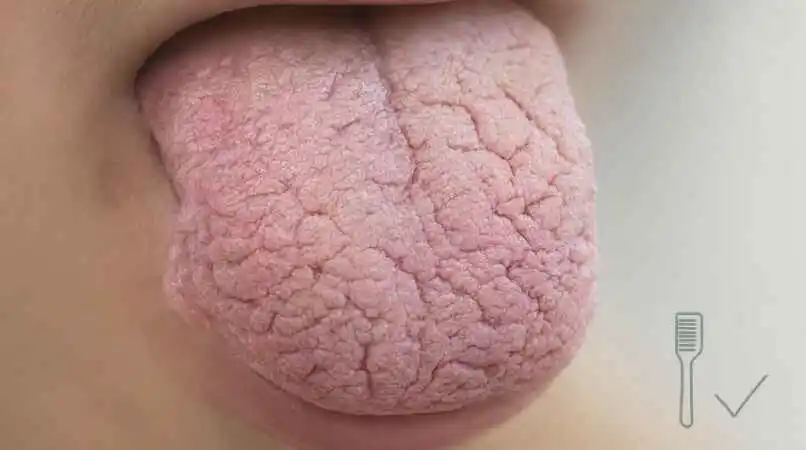
You ask him to stick his tongue out. Instead of a smooth, pink surface, you are looking at a landscape of deep, crisscrossing canyons. The tissue is split into distinct lobes by fissures that look like a dried riverbed.
To a patient looking in the bathroom mirror, this can be terrifying. It looks like the tissue is splitting apart or that something is seriously wrong. But as a clinician, when I see this presentation, I don’t reach for a prescription pad or prepare a referral for a biopsy. I simply see a very common, perfectly benign anatomical variation known as a fissured tongue.
If you or someone you know has a tongue that looks like a topographical map, you need to know the real story. This isn’t a disease, it’s not contagious, and it’s not a sign that your mouth is falling apart. Let’s break down exactly what is happening, why it happens, and how to manage the only symptom that usually brings people into the clinic: that mild burning sensation.

Seeing the Grooves: What Exactly is a Fissured Tongue?
When a patient presents with deep grooves on the dorsal (top) surface of their tongue, the clinical diagnosis is fissured tongue (sometimes referred to as scrotal tongue or plicated tongue).
The hallmark of this condition is the presence of one or more distinct fissures. These can be shallow or deep, single or branching, and they often crisscross to separate the tongue into small, lobule-like segments. In severe cases, the primary central fissure can be quite deep, with smaller secondary fissures radiating outward.
Here is the most important thing to understand: Fissured tongue is considered a normal variant of human anatomy. It is not a pathological disease. It is simply how the tissue formed. Think of it like a person having deep dimples or a widow’s peak—it’s just a structural quirk of their genetic blueprint.
Why Did It Show Up Now?
Patients often ask, “Why is this happening to me now?” The truth is, it’s probably been developing for years.
While some people are born with a slightly grooved tongue, the fissures often become much more pronounced as we age. The tongue tissue loses some of its elasticity over time, and the grooves deepen. It’s entirely possible to be 35, look in the mirror after a spicy meal, and notice for the first time that your tongue is heavily fissured—even if the structural changes started decades ago.
The Burning Question: Why the Spice Sensitivity?
This brings us back to our 35-year-old patient. He has no pain, but he notices a mild burn when he eats spicy food. If the condition is “harmless,” why is his mouth burning?
The answer lies in the anatomy of the grooves. Those deep crevices are essentially traps. They are the perfect environment for food debris, dead epithelial cells, and bacteria to accumulate.
When you eat something spicy or highly acidic (like citrus or tomatoes), you aren’t feeling the fissures themselves burn. You are feeling the exposed nerve endings at the base of the fissures, which have become mildly inflamed or irritated due to the trapped debris and the chemical assault of the spices.
In clinical practice, when patients complain of a burning sensation, it is almost always a secondary issue. The grooves aren’t the problem; the lack of cleaning inside the grooves is the problem.
The Clinical Checklist: What to Look For
When I have a patient in the chair with a fissured tongue, my job is not just to look at the grooves, but to rule out anything else. The vast majority of these cases are isolated and entirely benign, but as a practitioner, you are always scanning for associated conditions.
Common Associations
While a fissured tongue is often a standalone feature, it can travel with a few other genetic or inflammatory conditions. Here is the clinical breakdown:
| Associated Condition | What It Looks Like | Why It Matters |
| Geographic Tongue | Smooth, red, migrating patches on the tongue (often with white borders) where papillae are missing. | Up to 40% of people with a fissured tongue also have geographic tongue. Both are benign inflammatory conditions. |
| Melkersson-Rosenthal Syndrome | A triad: fissured tongue, facial swelling (often the lips), and facial nerve paralysis. | This is rare. Unless the patient has a history of facial swelling or paralysis, this is highly unlikely. |
| Down Syndrome | An extra copy of chromosome 21. | A significant percentage of individuals with Down syndrome exhibit fissured tongues. |
| Psoriasis | Scaly patches on the skin. | There is an established link between severe skin psoriasis and oral manifestations, including tongue fissuring. |
What You Don’t See (Ruling Out Malignancy)
When a patient sees deep grooves, their mind often jumps to oral cancer. When a clinician sees them, we are actively checking to ensure there is no malignancy.
Oral squamous cell carcinoma typically presents as a non-healing ulcer, a firm mass, a white or red patch (leukoplakia or erythroplakia) that cannot be scraped off, or spontaneous bleeding. It does not typically present as symmetrical, bilateral grooves across the entire tongue.
If a patient has symmetrical fissures, a normal mucosal texture in the non-fissured areas, and no hard lumps or non-healing sores, it is overwhelmingly likely to be a benign anatomical variant.
Management and Treatment: What to Actually Do
The word “treatment” can be misleading when it comes to a fissured tongue. There is no medication, surgery, or therapy that “fixes” the grooves. If you try to cut them out or laser them, you are putting the patient through unnecessary pain and risking nerve damage.
The clinical management of fissured tongue is entirely focused on hygiene and symptom control.
The Pro-Tip for Patients: The Tongue Brush
If you are dealing with this condition, the most important step you can take is to establish a robust oral hygiene routine that directly targets the grooves.
A standard soft toothbrush is often too bulky to clean deep into a primary fissure. I recommend using a dedicated tongue scraper or a tongue brush that has a wider, flatter head designed to penetrate the grooves.
Here is the step-by-step protocol I give my patients:
- Brush after meals: This is non-negotiable. The moment food gets trapped, the irritation begins. Brush or scrape the tongue gently after every meal to clear the debris before it sits.
- Use a water flosser: For very deep fissures, a Waterpik or water flosser on the lowest pressure setting can flush out debris that a toothbrush cannot reach.
- Avoid harsh chemicals: Many commercial mouthwashes contain high levels of alcohol or strong essential oils. These can be overly abrasive to the sensitive tissue inside the grooves. Use a gentle, alcohol-free rinse instead.
- Sooth the tissue: If the tongue is actively burning, suggest a plain, non-alcoholic, sugar-free oral gel or simply rinsing with a saltwater solution to soothe the inflamed tissue.
Addressing the Dietary Triggers
The second part of management is dietary. If the patient is complaining about the burning sensation, the tissue is currently inflamed.
Advise them to take a break from the most common irritants for about two weeks:
- Spicy foods (capsaicin is a direct tissue irritant)
- Acidic foods (citrus, vinegar, tomatoes)
- Very hot or very cold beverages
Once the debris is cleared out and the tissue has a chance to heal, the patient will usually find they can reintroduce these foods without the same level of discomfort.
The Bigger Picture: Why It’s a Blessing in Disguise
I know it sounds strange to call a tongue full of deep grooves a “blessing,” but in a way, it is.
Because of those grooves, the 35-year-old patient in our scenario noticed a slight burn with spicy food. That mild discomfort brought him to a dentist’s chair. In the process, we were able to examine his entire oral cavity. We checked his teeth, his gums, and his oral mucosa. We caught a small cavity in its early stages and warned him about early signs of gum recession.
If his tongue had been smooth, he might have ignored that spicy food sensitivity. He might have skipped the checkup entirely.
The grooves are a built-in early warning system. They make you pay attention to your oral hygiene. They force you to be proactive about brushing and flossing because if you don’t, the debris buildup becomes uncomfortable quickly. It is a condition that demands you stay on top of your oral care.
FAQs
Does a fissured tongue mean I am unhygienic?
Absolutely not. Fissured tongue is a genetic anatomical variant, not a sign of poor hygiene. However, the deep grooves require a more diligent cleaning routine than a smooth tongue does to prevent debris buildup.
Is fissured tongue contagious?
No. You cannot catch a fissured tongue from kissing someone, sharing utensils, or drinking from the same glass. It is a structural feature of your own body.
Can I have a fissured tongue and geographic tongue at the same time?
Yes, and it’s actually quite common. The two conditions frequently coexist. Geographic tongue causes red, migrating patches of depapillation, while fissured tongue causes the deep grooves.
What is the difference between a cracked tongue and a fissured tongue?
They are the same thing. “Cracked tongue,” “fissured tongue,” “plicated tongue,” and “scrotal tongue” are all interchangeable medical terms for this benign condition.
Does fissured tongue increase my risk of oral cancer?
No. There is no scientific evidence linking fissured tongue to an increased risk of oral cancer. It is a benign condition.
Can fissured tongue go away on its own?
The grooves will not disappear. They are a permanent anatomical feature. However, the symptoms (like burning or irritation) will resolve with proper hygiene and removal of dietary triggers.
Why is it called scrotal tongue?
The term “scrotal tongue” is an older medical term used to describe the deep, wrinkled appearance of the tongue, which resembles the scrotum. It is not a term used to imply any reproductive or gender-related issue; it simply describes the visual texture.
Should I be worried if my tongue has deep cracks?
Depth alone is not a reason to worry. Some fissures can be as deep as 6 millimeters and remain entirely benign. You only need to worry if you develop a non-healing sore, a lump, or persistent pain.
What causes the burning sensation with spicy food?
The burning is caused by food debris and bacteria trapped in the fissures, which causes mild inflammation. The spicy food then irritates the already inflamed tissue. Cleaning the grooves thoroughly usually resolves the issue.
Can children get fissured tongue?
Yes. It can be present at birth or develop during childhood. The grooves often become more pronounced as the person ages.
Is fissured tongue more common in men or women?
It affects men slightly more frequently than women.
Do I need to take medication for a fissured tongue?
No. There is no medication required. Treatment is entirely focused on good oral hygiene and avoiding irritants until the tissue calms down.
Can stress make my fissured tongue worse?
Stress itself does not deepen the fissures, but it can contribute to dry mouth or teeth grinding, which can make the tongue feel more sensitive.
Should I brush my tongue if I have fissures?
Yes, absolutely. You should brush or scrape your tongue gently twice a day, and ideally after meals, to remove trapped debris. Use a soft brush or a dedicated tongue scraper.
What is the best mouthwash for a fissured tongue?
Avoid alcohol-based mouthwashes, as they can be drying and irritating. Opt for an alcohol-free, gentle rinse, or simply use warm saltwater to soothe the tissue.
Can a fissured tongue affect my ability to taste food?
Not directly. However, if there is significant debris buildup causing inflammation, it can temporarily alter taste perception.
Is fissured tongue a sign of a vitamin B deficiency?
In some rare cases, glossitis (tongue inflammation) can be linked to vitamin B deficiencies, but the anatomical fissures themselves are genetic, not nutritional.
How do I clean deep fissures?
A soft toothbrush can reach shallow grooves, but for deep fissures, a water flosser on a low-pressure setting is highly effective at flushing out trapped food particles.
Does smoking affect a fissured tongue?
Smoking is a general oral irritant. While it doesn’t cause the fissures, it can increase the risk of bacterial buildup and bad breath, worsening the symptoms.
What does a normal tongue look like?
A normal tongue is pink, relatively smooth, and covered in tiny bumps called papillae. It should not have deep, distinct grooves.
Will I always have a fissured tongue?
Yes, the structural grooves are permanent. They may deepen slightly as you age, but they will not vanish.
Can a tongue piercing cause a fissured tongue?
No. Piercings do not cause fissures, but they can introduce bacteria and trauma to the mouth, which can worsen hygiene issues in a person who already has fissures.
Is fissured tongue related to HIV?
No. Fissured tongue is not a hallmark or typical sign of HIV.
Are there any surgical options to fix the grooves?
No. Surgery is not recommended or indicated. It would cause unnecessary pain and risks nerve damage to a perfectly healthy tongue.
Can hormonal changes affect fissured tongue?
Hormonal changes, such as during menopause, can affect saliva flow and tissue sensitivity, which might make the grooves feel more uncomfortable, but they don’t cause the grooves.
Does a fissured tongue cause bad breath?
Yes, it can. The deep grooves are excellent at trapping food and bacteria, which can lead to halitosis if not cleaned thoroughly.
Is a fissured tongue considered a disability?
No. It is a benign anatomical variant and does not affect your physical capabilities or require special accommodation.
Do I need to see an oral surgeon?
No. A general dentist can diagnose and manage this condition. You would only need a specialist if there was a suspicious lesion or an associated syndrome present.
Can I get a fissured tongue from biting my tongue?
No. Trauma from biting can cause a sore or a bruise, but it does not create the structural crisscrossing grooves of a fissured tongue.
Should I tell my doctor about my fissured tongue?
Yes, it is good to mention it during any routine medical or dental checkup so it is documented in your chart as a baseline.
What if my tongue grooves bleed when I brush?
Bleeding is not normal and usually indicates that you are brushing too aggressively or that there is severe inflammation. Use a softer touch and see your dentist if the bleeding persists.
Will my tongue always look like this?
Yes, the grooves are a permanent structural feature. However, with good hygiene, they won’t cause you any problems.
If you have a fissured tongue, you are perfectly healthy. The structural grooves are a natural variation, much like having blue eyes or attached earlobes.
The only caveat is that you have to be more diligent about your oral hygiene than the average person. The grooves are a trap for food and bacteria, so you need to actively clean them out every day. If you do that, the burning sensation will go away, your breath will stay fresh, and your tongue will stop demanding your attention.
Your next step? Go look in the bathroom mirror. Stick out your tongue. If you see grooves, don’t panic. Just pick up a soft toothbrush or a tongue scraper, and give it a gentle clean.
⚕️Medical Disclaimer:
The information provided on this website is for general educational and informational purposes only and is not intended as a substitute for professional medical advice, diagnosis, or treatment. Always seek the advice of your physician or other qualified health provider with any questions you may have regarding a medical condition. Never disregard professional medical advice or delay in seeking it because of something you have read on this website.
