
Table of Contents
The Tiny Puff That Reopens Your Airway: Everything Bronchodilators Are Actually Doing In There
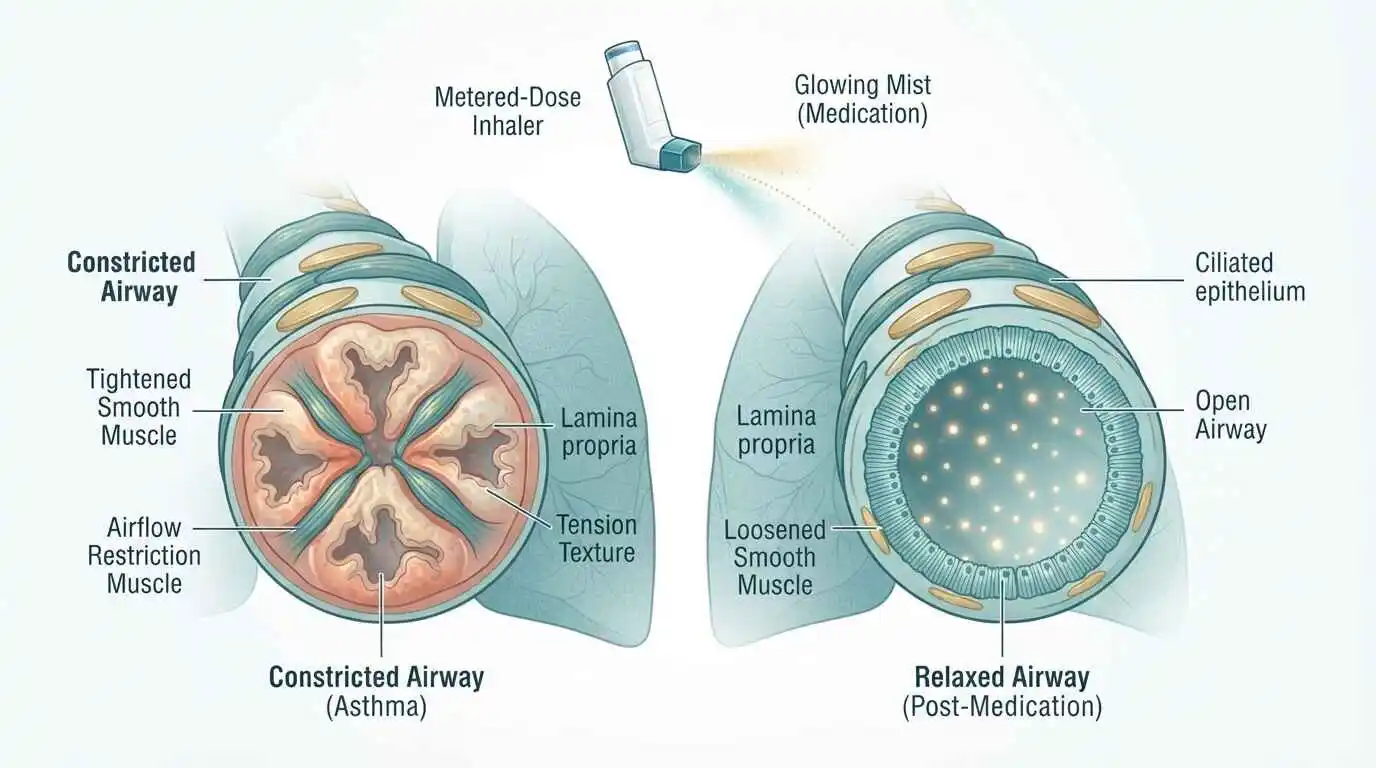
Somewhere in the middle of an asthma flare, a person reaches for a small plastic canister, presses down once, and within minutes can breathe again. It feels almost too simple for what’s actually happening inside the chest. Just moments earlier, rings of smooth muscle wrapped around the bronchial tubes were clenched tight, squeezing already-inflamed airways down to a fraction of their normal width, while the surrounding tissue swelled and extra mucus thickened the passage further. The inhaler didn’t clear any of that swelling or mucus. It did something narrower and, in the moment, more urgent: it told that clenched ring of muscle to let go.
That single mechanism — relaxing airway smooth muscle — is the entire job description of a bronchodilator, and it’s easy to underestimate how much clinical engineering has gone into refining exactly how a drug tells a muscle to relax, how quickly, for how long, and with which unwanted side effects tagging along. Bronchodilators are among the most widely used medications on earth, prescribed to hundreds of millions of people living with asthma and chronic obstructive pulmonary disease, and yet the actual biology behind that familiar puff of mist remains fairly opaque to most of the people relying on it daily. Understanding it changes how the whole category — rescue inhalers, maintenance inhalers, nebulizers, combination therapies — actually fits together.
What’s Actually Happening in a Narrowed Airway
Before understanding how bronchodilators work, it helps to understand what they’re working against. Airways in the lungs are lined with rings of smooth muscle, a type of involuntary muscle tissue that, unlike the muscle in an arm or leg, contracts and relaxes based on chemical signals rather than conscious control. In conditions like asthma and COPD, a combination of factors — allergen exposure, irritants, infection, or in COPD’s case, long-term damage from smoking or pollutant exposure — triggers that smooth muscle to contract, the airway lining to swell with inflammation, and mucus glands to produce more secretions than usual. All three changes shrink the effective diameter of the airway, and because airflow resistance increases dramatically as a tube narrows, even a modest reduction in airway diameter can produce a large, noticeable increase in the effort required to breathe.
Bronchodilators target only one piece of that three-part problem: the muscle contraction. They do nothing directly to reduce inflammation or clear mucus, which is an important and frequently misunderstood limitation. A bronchodilator can rapidly widen an airway that’s narrowed primarily from muscle spasm, providing fast, tangible relief, but if inflammation is the dominant driver of a person’s ongoing symptoms, bronchodilators alone will provide only partial and often temporary relief, which is precisely why they’re so often prescribed alongside anti-inflammatory medication rather than as a standalone solution.

The Three Main Classes, and How Each One Works
Beta-2 agonists are the most widely used bronchodilator class and the active ingredient in most rescue inhalers. They work by binding to beta-2 adrenergic receptors located on the surface of airway smooth muscle cells, triggering an internal chemical cascade that ultimately causes the muscle fibers to relax. Because these receptors respond quickly once triggered, short-acting beta-2 agonists can produce noticeable airway widening within minutes, which is exactly the speed needed during a sudden asthma flare. Beta-2 receptors also exist in other tissues throughout the body, including the heart and skeletal muscle, which explains why beta-2 agonists commonly produce side effects like a fast heartbeat or mild tremor as an unintended consequence of the same receptor-binding mechanism working outside the lungs.
Anticholinergic bronchodilators, also called muscarinic antagonists, work through an entirely different pathway. Under normal conditions, a neurotransmitter called acetylcholine binds to muscarinic receptors on airway smooth muscle, signaling it to contract as part of the nervous system’s baseline regulation of airway tone. Anticholinergic medications block that binding, preventing the contraction signal from reaching the muscle in the first place, which produces a bronchodilating effect through a fundamentally different chemical route than beta-2 agonists. This distinct mechanism is part of why anticholinergics and beta-2 agonists are sometimes combined in a single inhaler, since blocking two separate contraction pathways simultaneously often produces a stronger combined effect than either mechanism alone.
Methylxanthines, the oldest of the three classes and best known through the drug theophylline, relax airway smooth muscle through a less precisely targeted biochemical pathway involving enzyme inhibition inside the muscle cell. Methylxanthines were once a mainstay of asthma and COPD treatment, but their use has declined substantially as beta-2 agonists and anticholinergics, which offer more predictable effects and a considerably wider safety margin, became available; methylxanthines require closer blood-level monitoring and carry a higher risk of interactions and side effects, which has pushed them toward a more limited, specialist-guided role in modern treatment.
A bronchodilator doesn’t treat the disease. It reopens the door the disease keeps trying to close.
Short-Acting Versus Long-Acting: Two Different Jobs
Bronchodilators are further divided by how quickly they act and how long that effect lasts, a distinction that matters enormously for how they’re actually used day to day. Short-acting bronchodilators, most commonly short-acting beta-2 agonists, begin working within minutes and typically last only a few hours, making them well suited for rapid relief during a sudden onset of symptoms but poorly suited for round-the-clock symptom control, since their effect wears off too quickly to prevent recurring narrowing between doses.
Long-acting bronchodilators, by contrast, are engineered to bind more persistently to their target receptors, producing effects that last twelve to twenty-four hours depending on the specific medication. This makes them appropriate for scheduled, ongoing maintenance therapy rather than emergency relief, since their slower onset means they generally shouldn’t be relied upon during an acute flare when fast symptom relief is the priority. This is one of the most clinically important distinctions patients need to understand about their own prescriptions: mixing up a long-acting maintenance inhaler with a short-acting rescue inhaler during a sudden breathing crisis can leave a person waiting for relief that simply won’t arrive quickly enough from the wrong device.
Many patients with persistent asthma or COPD are prescribed both types simultaneously, using the long-acting version on a fixed daily schedule to maintain baseline airway openness, while keeping a short-acting rescue inhaler available for breakthrough symptoms the maintenance medication doesn’t fully prevent. Needing to reach for that rescue inhaler unusually often is itself a clinically meaningful signal, one worth paying attention to rather than simply managing around.
Getting the Medication Where It Needs to Go
A bronchodilator’s chemistry only matters if the medication actually reaches the airway tissue it’s meant to act on, and delivery method turns out to be a surprisingly large factor in real-world effectiveness. Metered-dose inhalers, the small pressurized canisters most people picture, release a fixed burst of medication that requires precise timing between activation and inhalation to deposit efficiently in the lower airways rather than the mouth and throat. Dry powder inhalers work differently, releasing a measured dose of powdered medication activated by the force of the user’s own inhalation, which removes the timing-coordination challenge but requires a reasonably strong, fast inhalation breath that isn’t always practical for very young children, elderly patients, or anyone in the middle of a severe flare.
Nebulizers take a third approach entirely, converting liquid medication into a continuous fine mist inhaled over several minutes through a mask or mouthpiece rather than a single quick puff. This makes nebulizers particularly useful for very young children, patients experiencing a severe flare who can’t reliably coordinate inhaler technique, or anyone who simply finds hand-held inhalers difficult to use correctly, though the trade-off is a considerably longer administration time and less portability compared to a pocket-sized inhaler.
Spacer devices address one of the most common inhaler technique problems directly: without one, a large share of a metered-dose inhaler’s medication mist deposits in the mouth and throat before it ever reaches the lower airway, simply because most people struggle to time a deep, slow inhalation precisely with the inhaler’s quick burst. A spacer holds that released mist briefly in a chamber, giving the user a slightly longer window to inhale it fully, which studies consistently show meaningfully improves how much medication actually reaches the lungs rather than settling in the mouth.
Asthma and COPD Aren’t Treated Identically
Though bronchodilators feature prominently in treatment for both asthma and chronic obstructive pulmonary disease, their role differs meaningfully between the two conditions, reflecting real differences in underlying disease mechanics. Asthma is typically driven substantially by airway inflammation triggered by allergens, irritants, or other specific triggers, with the airway narrowing itself often significantly reversible once inflammation is controlled. Because of this, bronchodilators in asthma treatment are frequently paired closely with inhaled corticosteroids, since addressing the inflammatory driver tends to reduce how often bronchodilation alone is needed in the first place.
COPD, most commonly caused by long-term exposure to cigarette smoke or occupational pollutants, involves a more structurally fixed pattern of airway narrowing and lung tissue damage that inflammation-focused treatment alone cannot fully reverse. For many COPD patients, long-acting bronchodilators serve as a primary, ongoing maintenance therapy rather than a secondary addition to anti-inflammatory treatment, since improving airway muscle tone provides a more direct and substantial functional benefit given the disease’s more fixed structural component. This is part of why COPD treatment guidelines often center long-acting bronchodilator therapy more prominently than asthma guidelines do, even though both conditions share the same basic drug classes.
Why Bronchodilators Are So Often Combined With Other Medications
Because bronchodilators address muscle contraction but not inflammation, mucus production, or, in COPD’s case, structural lung damage, they are frequently paired with other medication classes rather than used in isolation. Inhaled corticosteroids, which reduce airway inflammation directly, are commonly combined with a long-acting bronchodilator in a single combination inhaler, simplifying the daily routine for patients managing a chronic condition that otherwise might require juggling multiple separate devices on different schedules.
Some combination inhalers instead pair two different bronchodilator classes together, most often a long-acting beta-2 agonist with a long-acting anticholinergic, leveraging their two distinct muscle-relaxation pathways for a stronger combined effect than either medication alone typically provides. Choosing between a bronchodilator-corticosteroid combination and a dual-bronchodilator combination, or in some cases a triple therapy combining all three, depends heavily on which underlying disease processes — inflammation, muscle constriction, or both — are driving a specific patient’s symptoms, which is a clinical judgment made individually rather than a one-size-fits-all default.
Side Effects, Overuse, and the Warning Signs Worth Knowing
Every bronchodilator class carries its own characteristic side effect profile, generally traceable back to the same receptors that produce the therapeutic effect also existing elsewhere in the body. Beta-2 agonists commonly cause a faster or occasionally irregular heartbeat, mild hand tremor, or a feeling of nervousness, since beta-2 receptors are present in cardiac and skeletal muscle tissue in addition to the airway. Anticholinergic bronchodilators more commonly produce dry mouth, and less frequently mild constipation or urinary retention, reflecting the broader distribution of muscarinic receptors throughout the body beyond just the airway.
Frequent reliance on a short-acting rescue inhaler — using it considerably more than a few times a week outside of an acute illness — is one of the more important warning signs in respiratory medicine, generally interpreted as a sign that underlying inflammation or overall disease control isn’t adequate, rather than simply a sign that more rescue medication is needed. This distinction matters because the instinct to simply use the rescue inhaler more often, without revisiting the broader treatment plan, can mask worsening disease control rather than actually address it. Some evidence also suggests that certain beta-2 agonists can produce a modest reduction in bronchodilator responsiveness with frequent long-term overuse, adding a further reason clinicians generally discourage treating a rescue inhaler as a routine daily tool rather than an as-needed backup.
Worsening breathlessness despite proper rescue inhaler use is a distinct and more urgent warning sign, since it can indicate that a flare has progressed to a point where inflammation and mucus, rather than muscle constriction alone, are now the dominant obstacle — a scenario bronchodilators alone cannot fully resolve and one that generally warrants prompt medical evaluation rather than repeated inhaler doses.
Special Populations and Practical Considerations
Bronchodilator use in children generally follows the same core drug classes used in adults, though device choice and dosing are adjusted for age, with young children frequently using a spacer or nebulizer to compensate for the coordination challenges a standard metered-dose inhaler demands. Pregnancy introduces its own considerations, though many bronchodilators are generally considered relatively safe for use during pregnancy when properly prescribed and monitored, largely because poorly controlled asthma itself poses a well-documented risk to both maternal and fetal health that typically outweighs the modest risks associated with appropriately managed medication.
Drug interactions are worth taking seriously, particularly for beta-2 agonists, which can interact with certain heart medications, some antidepressants, and other stimulant-type drugs due to overlapping effects on heart rate and the cardiovascular system. This is part of why disclosing a complete medication list to a prescribing physician matters more than patients sometimes realize, especially when multiple specialists are independently managing different aspects of a person’s care without a shared, complete picture of every medication involved.
A Brief History of How We Got Here
The path to today’s precisely engineered inhalers was considerably less refined than the pocket-sized devices in common use now. Early twentieth-century treatments for asthma and related breathing difficulties relied on crude, non-selective stimulant compounds that widened airways as something of a side effect of their broader, less targeted action on the body’s adrenaline-related receptors, producing significant cardiovascular side effects alongside any respiratory benefit. Methylxanthines like theophylline emerged as a somewhat more deliberate option decades later, offering genuine bronchodilation but requiring careful blood-level monitoring due to a narrow margin between an effective dose and a toxic one.
The development of selective beta-2 agonists marked the real turning point for the field, since these compounds were specifically engineered to target the beta-2 receptor subtype concentrated in airway smooth muscle rather than the broader family of related receptors found throughout the cardiovascular system. This selectivity, refined further across successive generations of beta-2 agonist medications, dramatically reduced the cardiovascular side effects that plagued earlier non-selective treatments while improving the speed and reliability of airway relaxation. Anticholinergic bronchodilators followed a similar refinement path, with newer long-acting versions offering more selective muscarinic receptor targeting and a longer duration of action than earlier formulations. The overall trajectory across this history has been consistent: increasingly precise targeting of the specific receptors responsible for airway relaxation, paired with delivery devices engineered to place medication as directly and efficiently as possible into the airway itself, rather than dosing the entire body more broadly to achieve a local effect.
Environmental Triggers and Monitoring Tools
Bronchodilators treat the muscle-constriction symptom, but managing asthma and COPD well typically also involves identifying and reducing exposure to whatever is triggering that constriction in the first place. For asthma, common triggers include airborne allergens like pollen, dust mites, and pet dander, along with irritants such as smoke, strong fragrances, and cold air, with specific trigger profiles varying considerably from one person to another. Identifying a personal trigger pattern, often with the help of an allergist or through careful symptom tracking, allows many patients to reduce how often they need bronchodilator relief in the first place, rather than simply treating each flare reactively as it occurs.
Peak flow meters, small handheld devices that measure how forcefully a person can exhale, give patients a simple, objective way to monitor airway function between medical visits, often catching a gradual decline in lung function before it becomes severe enough to feel dramatically different day to day. Many asthma action plans incorporate peak flow readings directly, using specific threshold values to guide when to increase maintenance medication, when to use a rescue inhaler, and when a reading has dropped low enough to warrant urgent medical attention rather than home management alone. This kind of objective monitoring complements rather than replaces bronchodilator therapy, giving patients and clinicians a clearer, earlier signal of changing airway function than symptoms alone often provide.
Of everything covered here, inhaler technique may be the single most underrated variable in whether bronchodilator therapy actually works as intended. Research consistently finds that a substantial share of patients, across age groups and experience levels, use their inhalers with technique errors significant enough to meaningfully reduce how much medication reaches the lower airway, regardless of how well-chosen the prescribed medication itself is. A perfectly matched drug and dose delivered poorly is, functionally, an underdose, which is why clinicians frequently ask patients to demonstrate their technique in person rather than simply assuming a device that looks straightforward is being used correctly.
None of the science covered in this piece — receptor binding, smooth muscle relaxation, the differences between drug classes — changes the fact that a bronchodilator only works if it physically reaches the tissue it’s designed to act on. The chemistry is, in a real sense, the easy part; delivery is where most of the real-world variability in outcomes actually lives. Understanding that distinction is arguably more useful, day to day, than memorizing which receptor a particular medication targets, and it’s the piece of bronchodilator education most likely to actually change how well a prescribed treatment works. Taken together, the mechanism, the drug class distinctions, the delivery devices, and the discipline of tracking symptoms and triggers form less a single medication and more a small, ongoing system of care — one built around a simple but genuinely elegant piece of biology: telling a clenched ring of muscle, gently and precisely, to let go.
FAQS
| Question | Answer |
| 1. What exactly is a bronchodilator? | A bronchodilator is a type of medication that relaxes the smooth muscle bands surrounding the airways, widening them to make breathing easier during conditions like asthma or COPD. |
| 2. Why do airways narrow in the first place during an asthma attack? | During an asthma flare, the smooth muscle around the airways tightens, the lining becomes inflamed and swollen, and mucus production increases, all of which combine to restrict airflow. |
| 3. What are the three main classes of bronchodilators? | The three main classes are beta-2 agonists, anticholinergics (also called muscarinic antagonists), and methylxanthines, each acting on a different biological pathway to relax airway muscle. |
| 4. How do beta-2 agonists work? | Beta-2 agonists bind to beta-2 receptors on airway smooth muscle cells, triggering a chemical cascade that relaxes the muscle and widens the airway within minutes for short-acting versions. |
| 5. How do anticholinergic bronchodilators work? | Anticholinergics block a signaling molecule called acetylcholine from binding to muscarinic receptors, preventing the nerve signal that would otherwise cause airway muscle to contract. |
| 6. What are methylxanthines and are they still commonly used? | Methylxanthines, such as theophylline, relax airway muscle through a different, less targeted mechanism and are prescribed far less often today due to a narrower safety margin and more frequent side effects compared to newer options. |
| 7. What’s the difference between short-acting and long-acting bronchodilators? | Short-acting bronchodilators work within minutes and last a few hours, making them suited for rapid symptom relief, while long-acting versions take longer to start working but provide effects lasting twelve to twenty-four hours for ongoing symptom control. |
| 8. What is a ‘rescue inhaler’? | A rescue inhaler typically contains a short-acting bronchodilator intended for fast relief during sudden breathing difficulty, rather than for regular daily scheduled use. |
| 9. Can long-acting bronchodilators be used as rescue medication during an attack? | No; long-acting bronchodilators take too long to reach peak effect to help during a sudden flare and are intended for scheduled maintenance use rather than emergency relief. |
| 10. How are bronchodilators typically delivered into the lungs? | Common delivery methods include metered-dose inhalers, dry powder inhalers, and nebulizers, each requiring a slightly different inhalation technique to deposit medication effectively in the airways. |
| 11. What is the most common mistake people make with inhaler technique? | Failing to coordinate the inhaler’s release with a slow, deep breath, or inhaling too quickly, are among the most common errors that reduce how much medication actually reaches the lower airways. |
| 12. Why do some people use a spacer device with their inhaler? | A spacer holds the medication mist in a chamber briefly after release, giving a person more time to inhale it fully and reducing the amount of medication that would otherwise deposit in the mouth and throat. |
| 13. Are bronchodilators used differently for asthma versus COPD? | In asthma, bronchodilators are often paired closely with anti-inflammatory treatment since airway inflammation plays a central role, while in COPD, bronchodilators frequently serve as a primary maintenance therapy given the more fixed nature of the airway narrowing involved. |
| 14. Why are bronchodilators often combined with inhaled corticosteroids? | Bronchodilators relax airway muscle but do not address underlying inflammation, so pairing them with an inhaled corticosteroid targets both the muscle constriction and the inflammatory process driving many respiratory conditions. |
| 15. What are combination inhalers? | Combination inhalers deliver a bronchodilator and an inhaled corticosteroid, or sometimes two different bronchodilator classes, in a single device to simplify dosing for patients managing chronic respiratory conditions. |
| 16. What are the common side effects of beta-2 agonists? | Common side effects include a fast or irregular heartbeat, mild tremor, and nervousness, since beta-2 receptors are also present in other tissues like heart and skeletal muscle beyond the airway. |
| 17. What are the common side effects of anticholinergic bronchodilators? | Common side effects include dry mouth and, less frequently, mild constipation or urinary retention, related to the medication’s effect on other muscarinic receptors throughout the body. |
| 18. Is it dangerous to use a rescue inhaler too often? | Frequent rescue inhaler use, more than a few times a week outside of illness, is generally considered a sign that underlying inflammation or disease control is inadequate and typically warrants a medical reassessment. |
| 19. Can the body build tolerance to bronchodilators over time? | Some reduction in bronchodilator responsiveness can occur with frequent long-term use of certain beta-2 agonists, which is one reason overreliance on rescue medication without proper maintenance therapy is discouraged. |
| 20. Are bronchodilators safe for children? | Bronchodilators are commonly prescribed for children with asthma, though dosing and delivery device choice are adjusted based on age, and young children often use a spacer or nebulizer to improve medication delivery. |
| 21. Can bronchodilators be used safely during pregnancy? | Many bronchodilators are considered relatively safe during pregnancy when properly prescribed, since poorly controlled asthma itself poses a greater risk to both mother and baby than appropriately managed medication. |
| 22. Do bronchodilators interact with other common medications? | Certain heart medications, some antidepressants, and other stimulant-like drugs can interact with bronchodilators, particularly beta-2 agonists, making it important to disclose a full medication list to a prescribing physician. |
| 23. Can someone become dependent on bronchodilators? | Bronchodilators do not cause the kind of psychological dependence associated with addictive substances, though patients can become functionally reliant on frequent rescue inhaler use if underlying disease control is poorly managed. |
| 24. Why do doctors emphasize proper inhaler technique so heavily? | Even an effective medication provides little benefit if it doesn’t reach the lower airways, and studies consistently show a large percentage of patients use inhalers with technique errors significant enough to reduce effectiveness. |
| 25. What is a nebulizer and when is it preferred over an inhaler? | A nebulizer converts liquid medication into a fine mist inhaled over several minutes through a mask or mouthpiece, often preferred for very young children, severe flares, or patients who struggle to coordinate inhaler technique. |
| 26. Can lifestyle changes reduce reliance on bronchodilators? | Identifying and avoiding personal asthma or COPD triggers, maintaining good indoor air quality, and following prescribed maintenance therapy consistently can reduce how often rescue bronchodilators are needed. |
| 27. Is shortness of breath after using a bronchodilator ever a warning sign? | Worsening symptoms despite bronchodilator use can indicate a severe flare requiring urgent medical attention, since it may signal that airway inflammation has progressed beyond what bronchodilation alone can address. |
| 28. Do bronchodilators cure asthma or COPD? | Bronchodilators manage symptoms by relaxing airway muscle but do not cure the underlying disease process in either asthma or COPD, which is why they’re typically part of a broader, ongoing treatment plan. |
| 29. Why does a doctor sometimes prescribe both a short-acting and a long-acting bronchodilator? | A long-acting bronchodilator provides steady background symptom control, while a short-acting version remains available for sudden breakthrough symptoms that the maintenance medication alone doesn’t fully prevent. |
| 30. What should someone do if their prescribed bronchodilator stops feeling effective? | A noticeable drop in bronchodilator effectiveness should prompt a follow-up with a prescribing physician rather than simply increasing use independently, since it may indicate a need to adjust the overall treatment plan. |
⚕️Medical Disclaimer:
The information provided on this website is for general educational and informational purposes only and is not intended as a substitute for professional medical advice, diagnosis, or treatment. Always seek the advice of your physician or other qualified health provider with any questions you may have regarding a medical condition. Never disregard professional medical advice or delay in seeking it because of something you have read on this website.
