
Table of Contents
Your Brain Never Actually Sleeps: The Strange Psychology of What Happens After Lights Out
At around 2 a.m., while the rest of the body lies still, the brain is arguably busier than it was at breakfast. Neurons fire in tight, coordinated waves. Emotional memories from the day get pulled from temporary storage and quietly filed into long-term networks. In one stage of the cycle, the brain becomes so electrically active that a scientist glancing at a monitor might briefly mistake the sleeper for someone wide awake, if not for one detail: the body, for a short window, is essentially paralyzed. Sleep has a reputation as psychology’s off switch. It is closer to the opposite — a separate, highly structured mode of cognitive work that happens to require the eyes to be closed.
The psychology of sleep has moved fast over the last two decades, helped along by cheaper, more precise brain imaging and a research community increasingly willing to take dreaming seriously as data rather than dismiss it as noise. What has emerged is a far stranger and more mechanically specific picture than the folk wisdom most people grew up with. Sleep is not one thing. It is a sequence of distinct psychological states, each doing different cognitive work, and understanding that sequence changes how the more unsettling parts of the night — sleep paralysis, sleepwalking, the eerie sensation of a false awakening — start to look less like glitches and more like the visible seams of a system running exactly as designed.
The Architecture of a Night’s Sleep
A full night of sleep is built from repeating ninety-minute cycles, each moving through progressively deeper non-REM stages before curving back up into REM sleep, the stage most associated with vivid dreaming. Early cycles in the night lean heavily toward deep non-REM sleep, the physically restorative stage where growth hormone release peaks and the body handles most of its physical repair work. As the night goes on, the balance shifts, and REM periods grow longer, which is part of why the most vivid, memorable dreams tend to cluster in the final hours before natural waking rather than right after falling asleep.
This architecture is not incidental to psychological functioning; it is the mechanism. Interrupting a person specifically during REM sleep, repeatedly, across a night — a manipulation sleep researchers can perform with electroencephalogram monitoring — produces measurable next-day deficits in emotional regulation and creative problem-solving, even when total sleep time is held constant. The stage matters as much as the duration, which is one reason two people who each slept seven hours can wake up in noticeably different psychological shape.

Understanding this cycle also reframes what a ‘light sleeper’ actually is. Waking briefly between cycles is normal and happens to nearly everyone several times a night; most people simply don’t remember it because the brief arousal doesn’t reach the threshold required to form a lasting memory. What differs between people is largely how easily they fall back into the cycle, not whether the brief wakings happen at all.
Why the Brain Needs REM Sleep So Badly
REM sleep, named for the rapid eye movements that accompany it, is the stage where the brain’s activity most closely resembles waking cognition, and it is disproportionately important for emotional processing. Neuroimaging studies have found that during REM sleep, the brain appears to reprocess emotionally charged memories from the day while stress-chemical levels associated with the amygdala are unusually low, effectively allowing the brain to revisit difficult material with the emotional intensity partially turned down. Some sleep psychologists describe this as a kind of nightly, built-in exposure therapy, stripping the sharp emotional edge off memories so they can be filed away without the same charge they carried at the time.
This helps explain a pattern many people notice anecdotally: a problem that feels overwhelming at midnight often feels more manageable the next morning, independent of anything actually being resolved. The content of the memory hasn’t changed. Its emotional weighting has, and REM sleep appears to be doing much of that recalibration work. Deprive someone of REM sleep specifically, and next-day measures of emotional reactivity, irritability, and even threat perception in ambiguous situations reliably worsen, even when total sleep hours look normal on paper.
REM sleep also appears disproportionately involved in creative and associative thinking. Multiple studies have found that people perform better on tasks requiring novel connections between unrelated ideas after a period rich in REM sleep, compared to matched periods of non-REM-heavy or fragmented sleep. The folk idea of ‘sleeping on a problem’ and waking with a fresh angle has a plausible mechanistic basis: REM sleep seems to loosen the normal associative constraints that waking, goal-directed thought imposes.
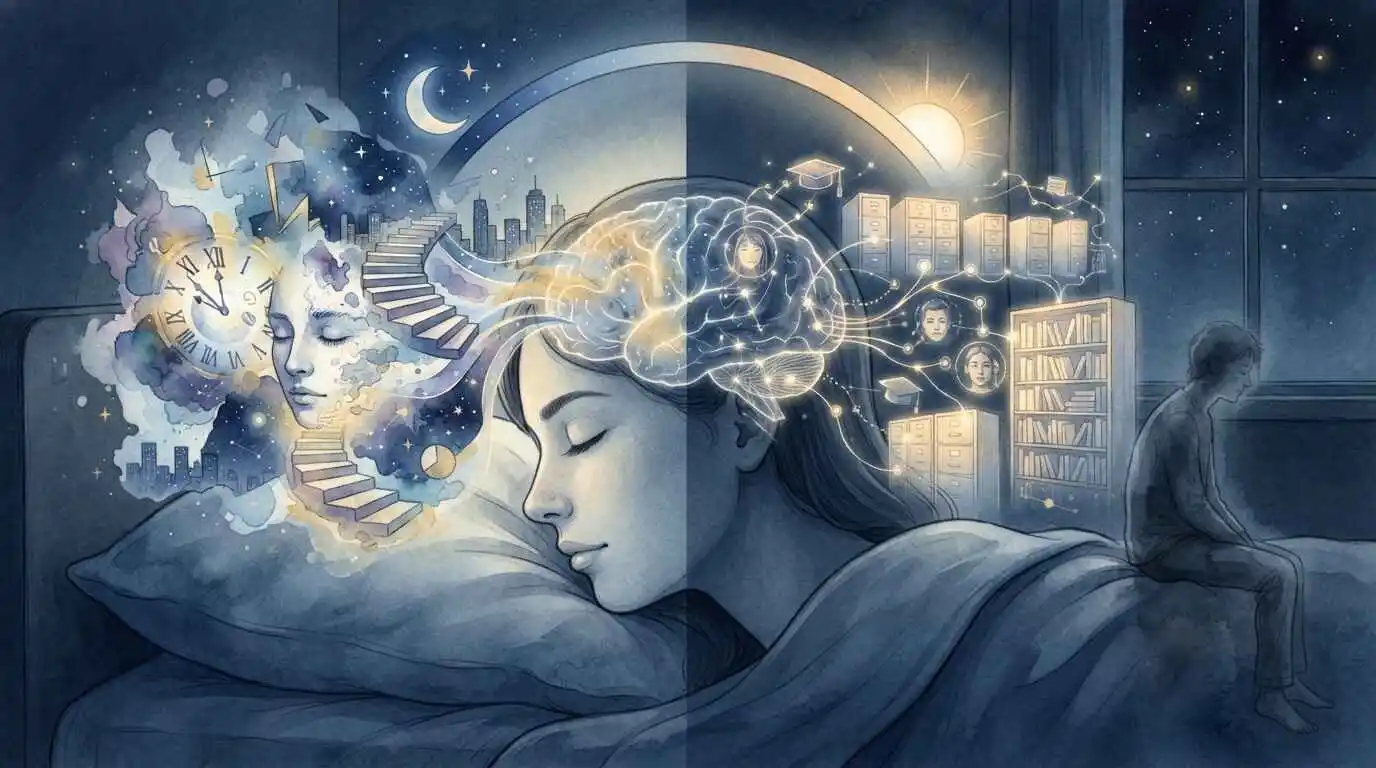
The brain doesn’t switch off at night. It switches jobs — from taking in the world to filing it away.
The Memory Consolidation Machine
Not all memories get the same treatment overnight, and this is one of the more granular findings in sleep psychology over the past twenty years. Declarative memories — facts, names, the content of a conversation — appear to consolidate most efficiently during deep non-REM sleep, when the brain generates slow, synchronized electrical waves that researchers believe support the transfer of information from the hippocampus, a short-term storage hub, into the cortex, where longer-term memory lives. Procedural memories, meanwhile, the kind involved in learning a physical or motor skill, seem to benefit more specifically from a mix of stages, with measurable overnight performance improvements on tasks like sequence-tapping or instrument practice even without additional waking rehearsal.
This selective consolidation isn’t indiscriminate, either. Sleep researchers have found evidence that the brain appears to prioritize emotionally significant or personally relevant material for consolidation over neutral information, which suggests the process is doing something closer to editorial curation than simple mechanical copying. Some studies have even demonstrated that cueing a specific memory during sleep — for instance, replaying a faint sound associated with a learning task while a person sleeps — can measurably strengthen recall of that particular memory the next day, a technique known as targeted memory reactivation.
The practical implication that keeps surfacing across this research is a simple one: cramming information right before a stretch of poor or interrupted sleep undermines the very consolidation process the studying was meant to support. Learning without adequate subsequent sleep is, from this angle, an incomplete transaction — the intake happened, but the filing step that turns exposure into durable memory never got the chance to run.
The Strange Psychology of Dreams
Dream content itself has been one of the more contested areas of sleep psychology, largely because for most of the twentieth century, dream interpretation was dominated by frameworks that treated dreams as coded symbolic messages requiring a trained interpreter to decode. Contemporary sleep science has moved substantially away from that model. The more widely supported current view treats dream content largely as a byproduct of the same memory consolidation and emotional processing happening structurally during REM sleep, with narrative dream imagery emerging from the brain’s attempt to weave reactivated memory fragments and emotional material into something resembling a coherent scene, however loosely.
This reframing doesn’t make dreams meaningless, but it does relocate the meaning. Recurring dream themes, researchers now suggest, more often reflect ongoing emotional preoccupations the brain keeps returning to during its nightly processing work, rather than encrypted messages needing symbolic translation. A recurring dream about being unprepared for an exam, long after school has ended, is less a hidden message and more a sign that some underlying feeling of unpreparedness or evaluation-related anxiety is still active enough to keep surfacing in the brain’s nightly memory-sorting process.
One of the more well-documented and slightly eerie phenomena in this space is dream incorporation, in which real external sensory input — a phone alarm, a partner’s voice, a passing siren — gets woven directly into ongoing dream narrative rather than simply waking the sleeper outright. Sleep labs have reliably reproduced this by introducing controlled stimuli, like a light spray of water or a specific sound, during a sleeping participant’s REM stage and later asking them to describe their dream; a striking percentage of participants report the stimulus appearing in some transformed, narratively logical form within the dream itself, suggesting the sleeping brain doesn’t fully disconnect from the outside world so much as reinterpret it.
Lucid dreaming, the experience of becoming aware within a dream that one is dreaming, sits at an unusually well-verified intersection of subjective experience and objective measurement. Because the eye muscles remain functional during REM sleep even though most other voluntary muscles do not, researchers have had lucid dreamers pre-arrange specific eye-movement signals before sleep, then successfully detected those exact signals via electrooculography once the dreamer reported becoming lucid — a rare case in sleep psychology where a subjective, private experience produced an objectively measurable, replicable signal from inside the dream itself.
Sleep Paralysis and the Night’s Other Anomalies
Sleep paralysis is, from a mechanical standpoint, one of the more elegantly explainable phenomena in sleep psychology, even though the subjective experience of it is often described as one of the most frightening things a person can go through. During REM sleep, the brain actively suppresses signals to most voluntary muscles, a mechanism researchers believe evolved specifically to prevent people from physically acting out dream content. Sleep paralysis occurs when consciousness returns from REM sleep slightly ahead of that muscular suppression switching off, leaving a person mentally awake and aware of their surroundings while still physically unable to move for anywhere from several seconds to a couple of minutes.
What makes sleep paralysis episodes so frequently described in similar, culturally consistent ways — a sensed presence in the room, chest pressure, a shadowy figure — is an area of active research interest. The leading explanation treats these hallucinated experiences as a blending of leftover REM-stage dream imagery with the sleeper’s actual waking perception of their real environment, producing a hybrid state neither fully dream nor fully reality. Because this overlap draws on universal features of human threat perception, similar sleep paralysis narratives — an intruding presence, an inability to call out — recur across cultures with strikingly little variation, despite very different explanatory folklore layered on top of the same underlying mechanism.
Sleepwalking works through a related but distinct malfunction: rather than consciousness arriving too early, as in sleep paralysis, sleepwalking involves the body’s motor systems becoming active while higher-order conscious awareness remains only partially engaged, typically during an incomplete transition out of deep non-REM sleep. This explains why sleepwalking episodes can include surprisingly complex behavior — walking through a familiar house, opening a refrigerator, occasionally holding a brief conversation — despite the person having little to no memory of the episode afterward and no meaningful ability to reason about their situation in the moment.
A closely related and far less discussed phenomenon is the false awakening, in which a person dreams they have woken up and gone through a normal morning routine, only to genuinely wake up later and realize the earlier waking was itself part of the dream. Some individuals report nested false awakenings, waking within a dream of waking, sometimes several layers deep, a phenomenon that has been of particular interest to researchers studying the boundary between dream cognition and waking self-monitoring, since it demonstrates just how convincingly the sleeping brain can simulate the specific mental signature of being awake.
Sleep Deprivation’s Psychological Toll
The psychological consequences of insufficient sleep show up faster and more severely than most people assume, and they show up disproportionately in the brain regions responsible for emotional regulation and impulse control. Functional imaging studies of sleep-deprived participants consistently find heightened amygdala reactivity to negative stimuli, paired with weakened connectivity to the prefrontal cortex, the region that normally exercises a kind of top-down braking function over emotional responses. The practical result is a brain that reacts to minor frustrations with a disproportionate emotional charge, while simultaneously losing some of its normal capacity to talk itself down.
This pattern closely mirrors, in a milder and typically reversible form, some of the neural signatures researchers observe in clinical anxiety, which has fueled a growing body of research into sleep’s bidirectional relationship with mental health conditions more broadly. Chronic sleep disruption is now understood as both a risk factor for, and a common symptom of, depression and anxiety disorders, rather than a simple side effect of either. Sleep-focused interventions have consequently become a more central component of treatment protocols for several mood and anxiety conditions, not merely a supportive afterthought layered onto other therapy.
Cognitively, sleep loss degrades decision-making in a specific, well-studied way: rather than uniformly impairing all thinking, it disproportionately weakens exactly the prefrontal-driven functions responsible for impulse control, risk assessment, and weighing long-term consequences against short-term reward. Sleep-deprived individuals in controlled studies consistently take larger financial risks, respond more impulsively under provocation, and show reduced sensitivity to negative outcomes when making decisions, a combination that has obvious real-world implications well beyond the research setting.
Even brief, involuntary lapses matter. Microsleep episodes — sudden, several-second intrusions of sleep during otherwise wakeful activity, often without the person’s conscious awareness that anything happened at all — become measurably more frequent under sleep debt, and are a significant contributing factor in vehicle accidents specifically because they can occur with the eyes technically still open, undetectable to the person experiencing them until after the fact.
Circadian Rhythms and the Myth of One Sleep Schedule
Underneath the stage-by-stage architecture of a single night sits a slower, twenty-four-hour rhythm — the circadian clock — that governs when a person naturally feels alert or drowsy, largely driven by the timed release of melatonin in response to light and darkness. Individual variation in this rhythm, known as chronotype, is substantially influenced by genetics rather than simple willpower or habit, which is part of why the popular framing of early risers as more disciplined than night owls doesn’t hold up especially well under scrutiny; a genuine night-owl chronotype forced into an early schedule tends to show the same performance and mood deficits as anyone else operating against their natural rhythm.
Adolescents provide one of the clearest illustrations of this. Puberty shifts the circadian clock’s melatonin release later in the evening, meaning teenagers are not being lazy or defiant when they struggle to fall asleep early and wake groggy for an early school start; their biology has genuinely moved their optimal sleep window later, creating a direct and well-documented mismatch with typical school scheduling. Several school districts, informed by this research, have shifted start times later specifically in response to sleep psychology findings, with measurable improvements in student alertness and mood.
One of the more persistent myths this research complicates is the idea of fully ‘catching up’ on lost sleep over a weekend. While extra weekend sleep does provide some real recovery in alertness and mood, most sleep researchers now describe it as a partial correction rather than a full reset, since several metabolic and cognitive markers associated with chronic sleep debt do not appear to fully normalize from a couple of longer nights alone. The related myth that everyone needs precisely eight hours is similarly oversimplified; sleep need genuinely varies by individual and shifts across the lifespan, meaning eight hours functions better as a population average than a personal prescription.
Everyday Sleep Myths, Examined
A handful of widely believed claims about sleep don’t hold up well against the current research, and untangling them matters because they shape real behavior. The belief that alcohol improves sleep is a common example: alcohol does shorten the time it takes to fall asleep, but it substantially suppresses REM sleep in the first half of the night and tends to produce more frequent awakenings in the second half, leaving overall sleep quality worse despite the faster, more convincing onset. People who use alcohol as a sleep aid are often trading the subjective sense of falling asleep quickly for measurably lower-quality sleep once objectively monitored.
Screen use before bed occupies similarly contested territory. The specific mechanism most consistently supported by research is that blue-wavelength light suppresses melatonin production more than warmer light does, delaying the felt onset of sleepiness; separately, and arguably just as significant, the mentally stimulating or emotionally engaging content typical of pre-bed scrolling keeps cognitive arousal elevated in a way that has little to do with light wavelength at all. Both factors appear to contribute, which is part of why simply switching a phone to night mode solves only part of the problem.
Naps have an unfairly mixed reputation, often blamed for grogginess that actually results from timing rather than the nap itself. Short naps under roughly thirty minutes, kept within non-REM light sleep stages, have been shown across multiple studies to measurably improve alertness and reaction time without the disorienting grogginess, known as sleep inertia, that tends to follow longer naps that allow the brain to descend into deep sleep before being interrupted. The practical lesson from this research is less ‘avoid napping’ and more ‘nap briefly and avoid napping late enough in the day to interfere with nighttime sleep pressure.’
What the Research Actually Recommends
Sleep psychology research converges on a smaller, more specific set of practical takeaways than the sprawling wellness industry built around sleep might suggest. Consistency in sleep and wake timing appears to matter nearly as much as total duration, since the circadian system responds strongly to regularity and poorly to frequent schedule shifts, even when total sleep hours stay roughly the same. Protecting the later portion of the night, when REM sleep is most concentrated, matters specifically for emotional regulation and creative thinking, which means an early wake-up that consistently truncates the final sleep cycle carries a distinct cost beyond simple hour-counting.
It’s also worth sitting with the deeper reframe this research keeps pointing toward: sleep is not a passive void the brain falls into when it runs out of things to do. It is an active, highly organized second mode of cognitive operation, doing specific, identifiable work — sorting memory, recalibrating emotion, occasionally producing a paralyzed body with a fully alert mind, or a dream so convincing it fools the dreamer into thinking they’ve already woken up. The stranger corners of sleep psychology, once explained mechanically, tend to lose their mystery without losing their fascination. The brain isn’t switching off each night. It’s switching jobs, and it has been doing that job, largely unnoticed, for as long as anyone has slept at all.
FAQs
| Question | Answer |
| 1. Does the brain actually shut down during sleep? | No; the brain remains highly active throughout the night, cycling through distinct electrical activity patterns, and in some stages it consumes nearly as much energy as it does while awake. |
| 2. What are the main stages of sleep? | Sleep cycles through three non-REM stages of progressively deeper rest followed by REM sleep, and a full cycle repeats roughly every ninety minutes through the night. |
| 3. Why does REM sleep matter so much psychologically? | REM sleep is when most vivid dreaming occurs and is strongly associated with emotional processing and the consolidation of emotionally charged memories. |
| 4. Do we dream during every stage of sleep? | Dreaming can occur in any stage, but REM dreams tend to be vivid and narrative, while non-REM dreams are typically shorter, vaguer, and more thought-like. |
| 5. Why can’t most people remember their dreams? | Dream recall depends heavily on waking directly from REM sleep, since memories formed during dreaming fade rapidly once the brain shifts into non-REM activity or full wakefulness. |
| 6. What is sleep’s role in memory consolidation? | During sleep, the brain replays and reorganizes the day’s experiences, transferring select memories from short-term storage into more stable long-term networks. |
| 7. Does sleep help with procedural skills like playing an instrument? | Research indicates that sleep, particularly certain non-REM stages, helps consolidate motor and procedural learning, which is why practiced skills often improve slightly overnight without additional practice. |
| 8. What happens to mood after even one night of poor sleep? | A single night of significant sleep loss measurably increases irritability, emotional reactivity, and negative mood, largely due to reduced regulatory control between the brain’s emotional and reasoning centers. |
| 9. Is there a real connection between sleep loss and anxiety? | Sleep deprivation heightens activity in the amygdala, the brain’s threat-detection center, while weakening its connection to regulatory prefrontal regions, producing a pattern that closely resembles clinical anxiety responses. |
| 10. Can poor sleep cause depression, or does depression cause poor sleep? | Current research describes the relationship as bidirectional, since chronic sleep disruption can contribute to depressive symptoms while depression itself commonly disrupts normal sleep architecture. |
| 11. What is a chronotype? | A chronotype describes an individual’s natural inclination toward earlier or later sleep and wake times, driven substantially by genetics rather than simple habit or discipline. |
| 12. Why do teenagers naturally want to stay up late? | Adolescent circadian rhythms shift later due to developmental changes in melatonin timing, meaning early school start times often conflict directly with teenagers’ biological sleep windows. |
| 13. Can you actually ‘catch up’ on lost sleep over a weekend? | Weekend catch-up sleep can partially restore some functioning, but researchers generally find it does not fully reverse the cognitive and metabolic effects of accumulated sleep debt. |
| 14. Is the popular ‘eight hours a night’ rule accurate for everyone? | Individual sleep need varies meaningfully by age and genetics, so while eight hours is a reasonable population average, some people function well on less and others genuinely need more. |
| 15. What is sleep paralysis, psychologically speaking? | Sleep paralysis occurs when the brain wakes from REM sleep before the temporary muscle paralysis that prevents dream-acting has fully switched off, producing a frightening but medically benign waking-but-immobile state. |
| 16. Why do people report seeing figures or presences during sleep paralysis? | The transitional brain state often blends leftover dream imagery with waking perception, and researchers believe this overlap accounts for commonly reported hallucinated figures during sleep paralysis episodes. |
| 17. What causes sleepwalking? | Sleepwalking arises from incomplete transitions out of deep non-REM sleep, where the body becomes physically active while the brain’s higher awareness centers remain only partially awake. |
| 18. Can sleepwalkers actually perform complex tasks? | Yes; sleepwalking episodes have documented instances of walking, talking, and even simple tasks like eating, since basic motor circuits can operate somewhat independently of full conscious awareness. |
| 19. What is a false awakening? | A false awakening is a dream in which a person believes they have woken up and resumed normal activity, only to later wake again for real, often producing a disorienting layered sense of unreality. |
| 20. Is lucid dreaming a real, scientifically studied phenomenon? | Lucid dreaming, in which a sleeper becomes aware they are dreaming and sometimes gains some control over the dream, has been verified in sleep labs using pre-agreed eye-movement signals during REM sleep. |
| 21. Does everyone have the capacity to lucid dream? | Most people can experience at least occasional lucidity, and specific reality-testing and dream-journaling techniques have been shown to increase lucid dream frequency for those who practice them. |
| 22. Why do external sounds sometimes get woven into dreams? | This phenomenon, called dream incorporation, happens because the sleeping brain continues processing some sensory input and often weaves it into ongoing dream narratives rather than fully blocking it out. |
| 23. What is ‘exploding head syndrome’? | It is a harmless but startling sleep phenomenon in which a person perceives a sudden loud noise or explosive sensation while falling asleep or waking, believed to result from a brief misfiring during the sleep transition. |
| 24. Does alcohol actually help you sleep better? | Alcohol can shorten the time it takes to fall asleep but disrupts REM sleep and increases nighttime awakenings later on, so overall sleep quality typically declines despite the faster onset. |
| 25. How does sleep loss affect decision-making? | Sleep-deprived individuals show measurably reduced impulse control and riskier decision-making, largely because prefrontal cortex function, which governs judgment and restraint, is disproportionately affected by sleep loss. |
| 26. Can naps meaningfully improve cognitive performance? | Short naps, particularly those under thirty minutes, have been shown to measurably improve alertness and reaction time without producing the grogginess associated with longer naps that enter deep sleep. |
| 27. What is ‘microsleep’ and why is it dangerous? | Microsleep refers to brief, involuntary lapses into sleep lasting a few seconds, often without the person’s awareness, which is particularly hazardous during activities like driving. |
| 28. Does screen light before bed really disrupt sleep psychology? | Blue-wavelength light suppresses melatonin production more than warmer light, and screen use before bed also tends to introduce mentally stimulating content, both of which can delay sleep onset. |
| 29. Why do some people talk in their sleep? | Sleep talking, like sleepwalking, occurs during incomplete transitions between sleep stages and is generally considered harmless, though content is usually fragmented rather than meaningfully coherent. |
| 30. What is the biggest misconception people hold about dreaming? | A common misconception is that dreams carry hidden symbolic messages requiring interpretation, whereas most sleep researchers view dream content as largely a byproduct of memory processing and emotional regulation rather than coded meaning. |
⚕️Medical Disclaimer:
The information provided on this website is for general educational and informational purposes only and is not intended as a substitute for professional medical advice, diagnosis, or treatment. Always seek the advice of your physician or other qualified health provider with any questions you may have regarding a medical condition. Never disregard professional medical advice or delay in seeking it because of something you have read on this website.
