
Table of Contents
Connected Living: A Comprehensive Guide to the Hottest Wearable Tech and Smart Gadgets of the Year
Introduction: The Age of the Quantified Self and Seamless Connectivity
We are living in a golden age of personal technology. Gone are the days when “tech” meant a desktop computer tucked away in a spare room or a bulky laptop that tethered you to a desk. Today, technology is fluid, wearable, and deeply integrated into the fabric of our daily lives. It wraps around our wrists, sits in our ears, rests on our eyes, and even monitors our sleep from our fingers. We have entered the era of the Quantified Self—a phenomenon where individuals engage in self-tracking of biological, physical, and behavioral information—to optimize performance, health, and well-being.
The landscape of consumer electronics has shifted dramatically over the last decade. What began as simple step counters and basic notification mirrors has evolved into a sophisticated ecosystem of medical-grade health monitors, immersive augmented reality headsets, and AI-driven companions. The distinction between a “gadget” and a “lifestyle essential” has blurred. A watch is no longer just a timepiece; it is a guardian of your heart health. A pair of glasses is no longer just for vision correction; it is a portal to a digital overlay of the world.
This year has been particularly pivotal in the world of wearable tech and smart gadgets. We are witnessing a convergence of hardware excellence and software intelligence. Devices are not just getting smaller and faster; they are getting smarter. They are learning our habits, predicting our needs, and offering insights that were previously the domain of clinical labs. From the explosive popularity of smart rings to the dawn of spatial computing, the innovations released this year have redefined what we expect from our gear.
In this extensive guide, we will traverse the cutting edge of the industry. We will dissect the hottest wearable tech and smart gadgets of the year, exploring not just their specs, but their impact on our lives. We will delve into the fierce rivalry between smartwatch giants, explore the niche world of wellness tech, and look toward a future where connectivity is invisible and omnipresent. Whether you are a tech enthusiast, a fitness junkie, or simply a consumer looking to upgrade your digital arsenal, this deep dive covers everything you need to know about the devices shaping our future.

The Smartwatch Renaissance: More Than Just a Second Screen
For many, the smartwatch remains the entry point into the world of wearables. However, the devices released this year prove that the category is far from stagnant. The narrative has shifted from “which phone does it pair with?” to “how much can this device actually do for my health?”
The Apple Watch Series 9 and Ultra 2: The Power of the Ecosystem Apple continues to dominate the conversation, and this year’s releases, while iterative on the surface, represent a significant internal leap. The introduction of the S9 SiP (System in Package) chip has brought a new level of responsiveness to the wrist. The “Double Tap” gesture—a feature that allows users to answer calls, stop timers, or snooze alarms by tapping their thumb and index finger together—is a quintessential Apple feature: simple on the outside, complex in execution. It utilizes advanced algorithms and the new Neural Engine to detect the subtle movements of blood flow in the wrist.
But the real story is the display brightness. The Apple Watch Ultra 2 hits a staggering 3000 nits, making it readable even in the harshest direct sunlight. For outdoor enthusiasts, divers, and athletes, this transforms the device from a convenience into a critical tool. Furthermore, the integration of health sensors—specifically the blood oxygen and ECG apps—has turned the watch into a preventative health device. The focus this year has been on “Siri + Health,” allowing users to ask complex health queries offline, securing data privacy while providing instant insights.
Samsung Galaxy Watch 6 and 6 Classic: The Android Standard. On the other side of the aisle, Samsung has delivered what many consider the definitive Android smartwatch. The return of the rotating bezel on the Classic model is a nod to user feedback, offering a tactile, satisfying way to navigate menus without smudging the screen. But the innovation lies in the health suite. The Galaxy Watch 6 features an enhanced BioActive Sensor that tracks heart rate, blood oxygen, and even offers a new Irregular Heart Rhythm Notification feature.
Samsung has also pushed the envelope in sleep tracking. In partnership with the National Sleep Foundation, they have introduced “Sleep Coaching,” a feature that analyzes sleep patterns and assigns users a “Sleep Animal” symbol to help them understand their sleep habits. This gamification of health data makes the opaque science of sleep hygiene accessible and engaging.
Garmin Fenix 7 Pro and Epix Pro: The Battery Kings. While Apple and Samsung fight for the mainstream, Garmin continues to dominate the hardcore fitness market. The Fenix 7 Pro series, equipped with built-in LED flashlights and solar charging capabilities, represents the pinnacle of multisport GPS watches. The key selling point here is battery life. In an era where nightly charging is the norm, a Garmin can last weeks on a single charge. For ultramarathoners, hikers, and adventurers, this reliability is non-negotiable. The introduction of the MIP (Memory In Pixel) displays ensures readability in all conditions while sipping power, proving that not all innovation is about bright OLED screens.
The Rise of the Smart Ring: The Stealth Revolution
If the smartwatch is the flagship of wearable tech, the smart ring is the stealth submarine. This year, the category exploded, led by the Oura Ring Gen 3 and the highly anticipated Samsung Galaxy Ring.
Oura Ring Gen 3: The Wellness Whisperer. The Oura Ring has transcended “gadget” status to become a lifestyle icon. Unlike a watch, which is screen-centric, the Oura Ring is data-centric. It has no display; it exists purely to gather biometric data—heart rate variability (HRV), respiratory rate, and body temperature—and present it via a smartphone app.
What makes Oura one of the hottest gadgets of the year is its focus on “Readiness.” Instead of just telling you how much you moved, it tells you how prepared your body is to handle stress. By analyzing your sleep quality and recovery, it assigns a Readiness Score. If you wake up with a low score, the ring suggests you take it easy. If the score is high, it encourages you to push your limits. This personalized, bio-feedback loop is revolutionizing how athletes and bio-hackers approach training. The titanium construction and discreet jewelry-like appearance appeal to those who want the benefits of tracking without the “cyborg” aesthetic of a wrist computer.
The Samsung Galaxy Ring: The New Contender. The biggest news in wearables this year was Samsung’s entry into the ring space. The Galaxy Ring is poised to integrate deeply with the Samsung Health ecosystem. Early previews suggest a focus on longevity and comfort, promising up to 7 days of battery life—a significant feat for such a small form factor. What sets the Galaxy Ring apart is its synergy with other devices; for example, it can integrate with Samsung’s smart home ecosystem to adjust lighting or temperature based on your sleep stage. This interoperability signals that smart rings are moving from niche curiosities to central hubs of the smart home.
Hearables: The Transformation of Audio into Intelligence
“Happy ears” have evolved. The hottest audio gadgets this year are not just about noise cancellation; they are about conversation intelligence and seamless switching.
Apple AirPods Pro (2nd Gen) with USB-C and Adaptive Audio. The USB-C transition was inevitable, but the real upgrade was software-based. Apple’s introduction of “Adaptive Audio” is a game-changer for urban living. Instead of manually switching between Transparency Mode (to hear the world) and Active Noise Cancellation (to block it out), the AirPods now do it for you in real-time. If you walk into a coffee shop, they lower the volume of background chatter but keep the announcement sounds audible. If a siren wails, they dampen it. This contextual awareness creates a layer of digital hearing protection and convenience that was previously impossible.
Sonos Ace: The Audiophile’s Dream. While earbuds dominate the daily commute, the over-ear headphone market saw a stunning entry with the Sonos Ace. Known for its speakers, Sonos entered the wearable audio space with a bang. The Ace features a “TV Audio Swap” button that instantly transfers sound from a Sonos Arc soundbar to the headphones, allowing for private, immersive Dolby Atmos movie watching without disturbing the household. The build quality and comfort level set a new standard for premium headphones, proving that the “smart” feature can sometimes just be seamless integration with your home theater.
** Bone Conduction and Open-Ear Tech: Shokz OpenRun Pro** For runners and cyclists, situational awareness is safety. Bone conduction technology, which transmits sound through the cheekbones, has matured significantly. The Shokz OpenRun Pro remains the leader, offering better bass and volume than ever before without blocking the ear canal. This year saw a rise in “open-ear” designs from other brands like Bose and Oladance, utilizing air conduction to deliver quality sound while leaving the ear open. This trend highlights a growing desire for tech that doesn’t isolate the user from their environment.
Spatial Computing and AR Glasses: The Dawn of a New Era
We are standing on the precipice of the next major computing platform. While Virtual Reality (VR) has been with us for a few years, Augmented Reality (AR) and Mixed Reality (MR) are finally hitting their stride.
Apple Vision Pro: The Category Definer. No discussion of this year’s tech is complete without the Apple Vision Pro. Apple calls it a “Spatial Computer,” and they mean it. It is not just a headset; it is a monitor, a cinema, and a workspace all wrapped into one. The innovation lies in “Passthrough”—cameras that show you the real world with such high fidelity that it almost looks like you are looking through glass, not a screen.
The Vision Pro represents the hottest gadget of the year, not because of its sales volume (due to its high price point), but because of its technological ambition. The eye-tracking system is unparalleled; you literally navigate the interface by looking at icons and tapping your fingers. It solves the isolation problem of VR with a feature called “EyeSight,” which projects a digital rendering of your eyes onto the front glass, allowing others to see when you are engaged in a virtual task or available for conversation. It is a bold step toward a future where digital content exists in our physical space.
Meta Quest 3 and Ray-Ban Meta Smart Glasses: The Volume Leader. While Apple aims for the high-end, Meta is aggressively capturing the mass market. The Quest 3 is the first mass-market mixed reality headset that is affordable and genuinely fun. It offers full-color passthrough, allowing users to walk around their homes while wearing the headset, interacting with virtual objects overlaid on their furniture.
However, the “sleeper hit” of the year in this category is the Ray-Ban Meta Smart Glasses. They don’t have a display; instead, they focus on capturing life. With a 12MP camera and open-ear speakers, they allow for hands-free photography and video calling. The integration of a multimodal AI assistant allows you to look at a French menu and ask the glasses to translate it, or look at a landmark and ask for its history. This represents “invisible tech”—gadgets that look like regular fashion accessories but pack the power of a smartphone.
Health and Wellness Gadgets: Bio-Hacking at Home
Beyond the wrist, the “hottest gadgets” this year extend to devices that bring clinical analysis into the home.
Withings U-Scan: The Lab in Your Toilet Perhaps the most surprising innovation of the year is the Withings U-Scan. It is a pebble-shaped sensor that sits inside your toilet bowl and analyzes your urine. It can track hydration levels, vitamin C deficiency, and pH balance. It represents the ultimate in passive health tracking—you don’t have to wear anything or change your routine; the data is gathered automatically. This is the frontier of preventative medicine, monitoring metabolic health in real-time.
The Smart Scale Evolution: Garmin Index S2 and Withings Body Scan Smart scales have moved beyond just weight and BMI. The new generation, like the Withings Body Scan, uses 4 weight sensors and a handle to measure body composition (fat mass, muscle mass), visceral fat, and even perform a 6-lead ECG (electrocardiogram) to detect heart rhythm irregularities like Atrial Fibrillation. This turns a daily weigh-in into a comprehensive check-up, syncing data directly to your phone to track long-term trends.
Muse 2: Meditation Measured Mental wellness is also getting the tech treatment. The Muse 2 is a headband that measures brain activity (EEG), heart rate, and breathing during meditation. It translates your mental state into weather sounds. If your mind is calm, you hear peaceful birds chirping; if your mind wanders, the wind picks up. It gamifies meditation, providing real-time feedback that helps users learn to focus, effectively bridging the gap between ancient mindfulness practices and modern neuroscience.
Smart Home Integration: The Wearable as a Remote Control
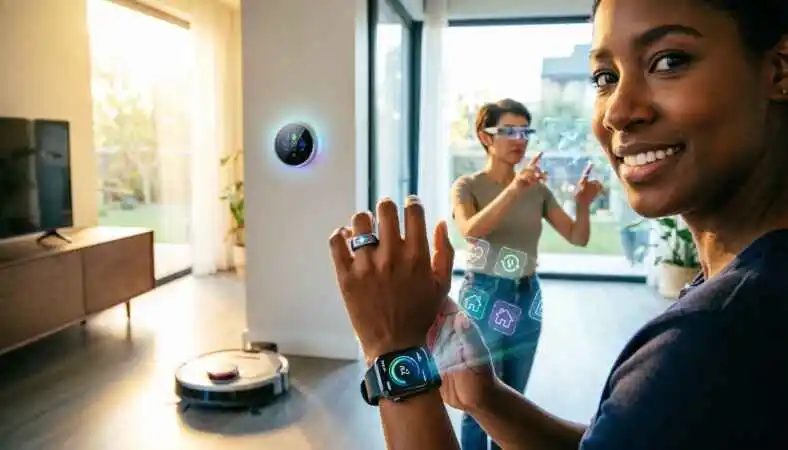
The trend of 2024 is the interconnectivity of devices. The hottest wearable tech is no longer an island; it is the bridge to your environment.
The Wearable as a Key. Smart locks like the August Wi-Fi Smart Lock and the Schlage Encode have made keys obsolete. But the integration this year has deepened. Approaching your door with an Apple Watch or Android phone now triggers “homecoming” scenes—lights turn on, the thermostat adjusts, and music starts playing. The wearable acts as a proximity sensor, creating a seamless transition from the outside world to your sanctuary.
Matter and Thread: The Great Unification. Underlying the gadget boom is the rollout of the “Matter” standard. This new connectivity protocol aims to unify smart home devices, allowing them to work across Apple HomeKit, Google Home, and Amazon Alexa. This matters for wearable tech because it ensures your watch can control any device, regardless of brand. The ease of use has skyrocketed; your watch face might now feature a control to start the coffee machine or check who is at the front door via a video doorbell, all without unlocking a phone.
Fashion Meets Function: The Aesthetics of Tech
A crucial reason for the mass adoption of these gadgets is the improvement in design. Tech companies have finally realized that if people are going to wear something 24/7, it has to look good.
Swappable Straps and Custom Materials. The ability to customize the look of a smartwatch has been a major driver of sales. Bands are now available in every material imaginable, from ocean-bound plastic to premium leather and titanium links. The Oura Ring’s success is largely due to its matte and glossy finishes that mimic wedding bands or fashion rings, allowing it to disappear into a professional outfit.
Heritage Brands Going Smart. Traditional watchmakers are also entering the fray. TAG Heuer and Montblanc have released smartwatches that retain the classic aesthetic of luxury timepieces while packing in GPS, heart rate monitors, and e-ink displays. This fusion of heritage and high-tech appeals to an older demographic who want the benefits of tracking without the “geeky” look of a plastic device.
The Future Outlook: What’s Next?
As we look at the hottest gadgets of the year, we can also glimpse the horizon. The trend lines are clear: miniaturization, AI integration, and battery innovation.
Neural Interfaces: The ultimate goal of wearable tech is to bridge the gap between human intention and digital action. We are seeing early research into brain-computer interfaces (BCIs) that could allow users to control devices with their thoughts. While we aren’t there yet, the gesture control seen in the Vision Pro and the Double Tap feature on the Apple Watch are stepping stones toward that neural future.
Haptic Suits and VR As the Metaverse grows, haptic feedback will become essential. Companies are developing vests and gloves that simulate touch, weight, and temperature, allowing users to “feel” virtual objects. This will revolutionize gaming, remote work, and even social interaction in digital spaces.
Battery Technology: The biggest constraint on wearable tech remains power. The lithium-ion battery is reaching its limits. The next breakthrough will likely come from solid-state batteries or energy harvesting technologies that draw power from body heat or movement, potentially creating devices that never need to be plugged in.
Conclusion: Living Smarter
The hottest wearable tech and smart gadgets of the year share a common thread: they are designed to augment human capability, not replace it. They are tools that offer us a clearer picture of our health, a deeper connection to our entertainment, and a more seamless way to manage our homes and work.
From the wrist to the ears, and from the eyes to the finger, these devices are becoming extensions of ourselves. They act as silent guardians of our health, checking our hearts and monitoring our sleep. They act as intelligent assistants, translating languages and filtering out the noise of the world. They act as portals, opening new dimensions of digital experience.
As we embrace these technologies, the challenge is to remain the masters of our tools rather than their servants. Used wisely, the smart ring, the smartwatch, and the AR headset offer us the ultimate luxury: the gift of time, better health, and a more connected, efficient life. The future isn’t just something we step into; it is something we wear.
FAQs
General Concepts & Ecosystems
- What does “Connected Living” actually mean?
Connected Living refers to a lifestyle where digital devices, appliances, and wearables communicate with each other via the internet (IoT) to automate tasks, improve efficiency, and provide real-time data about your environment and health.
- What are the major smart home ecosystems this year?
The dominant ecosystems remain Amazon Alexa, Google Home, and Apple HomeKit, with the new “Matter” standard gaining traction to allow devices from different brands to work together seamlessly.
- Is it necessary to stick to one brand for a smart home?
While not strictly necessary, sticking to one ecosystem (e.g., all Google or all Apple) usually provides a smoother, more integrated user experience. However, the new Matter protocol is making cross-compatibility easier.
- What is the “Matter” standard I keep hearing about?
Matter is a universal smart home connectivity standard that allows smart home devices to work across different platforms (Alexa, Google, HomeKit) without compatibility issues, reducing fragmentation in the market.
Wearable Tech: Smartwatches & Fitness Trackers
- What is the biggest trend in smartwatches this year?
The shift toward advanced health monitoring is the biggest trend. Modern smartwatches now feature FDA-approved atrial fibrillation (AFib) detection, blood oxygen monitoring, and even electrocardiogram (ECG) capabilities.
- Are smart rings better than smartwatches?
Smart rings (like the Oura Ring or Samsung Galaxy Ring) are gaining popularity because they are discreet and focus specifically on sleep and recovery tracking, but they lack the screen and smart notification features of a watch.
- How accurate are the health sensors on wearables?
While they have improved significantly, consumer wearables are not medical devices. They provide excellent trend data for lifestyle adjustments, but should not replace professional medical diagnosis equipment.
- What is the battery life expectancy for modern wearables?
Standard smartwatches usually last 1–3 days, while fitness trackers and smart rings can last up to 7–14 days on a single charge.
- Can wearables help with stress management?
Yes, many top-tier devices now measure Heart Rate Variability (HRV) and offer guided breathing exercises or “body battery” scores to help users understand their stress and energy levels.
Smart Home Gadgets
- What are the most useful smart gadgets for beginners?
Smart bulbs, smart plugs, and a voice-controlled smart speaker are the best entry points. They are affordable, easy to install, and instantly deliver the “wow” factor of voice control for your home.
- Are smart locks safe to use?
Smart locks are generally very secure, offering features like temporary access codes, auto-locking, and activity logs. However, strong passwords and two-factor authentication are essential to prevent remote hacking.
- Do I need a smart thermostat to save money?
Smart thermostats (like Nest or Ecobee) learn your schedule and adjust heating/cooling automatically. Users typically see a 10-12% savings on heating and 15% on cooling costs annually.
- What makes a kitchen appliance “smart”?
Smart kitchen gadgets (fridges, ovens, coffee makers) connect to your phone or voice assistant, allowing you to preheat your oven remotely, check fridge contents while grocery shopping, or automate brewing schedules.
- Are robot vacuums worth the investment?
Modern robot vacuums with LiDAR navigation and mopping functions have become highly effective, drastically reducing the frequency of manual cleaning.
Audio & Visual Tech
- What is the difference between noise-canceling and transparency mode?
Active Noise Cancellation (ANC) uses microphones to block out external sound, while Transparency mode uses those microphones to amplify ambient sound (like announcements or traffic) so you remain aware of your surroundings.
- Are spatial audio headphones a gimmick?
No, spatial audio provides a theater-like surround sound experience that tracks your head movement. It has become a standard feature in premium headphones and earbuds this year.
- Do I need a soundbar if I have a smart TV?
Most smart TVs have thin bodies that result in poor sound quality. A smart soundbar is highly recommended for a better audio experience and often serves as a hub for voice assistants.
Health & Wellness Gadgets
- What is a smart scale, and how does it work?
Smart scales use bioelectrical impedance to measure not just weight, but also body fat percentage, muscle mass, and water weight, syncing the data automatically to a health app on your phone.
- Are smart water bottles actually useful?
They serve as a reminder system for hydration. They light up or send notifications to your phone to remind you to drink water and track your daily intake.
- What gadgets help with posture?
Smart posture correctors are wearable devices that vibrate gently when they detect slouching, helping retrain your muscles over time.
Privacy & Security
- What are the privacy risks of connected living?
The main risks include data collection by big tech companies and the potential for devices to be hacked via unsecured Wi-Fi networks.
- How can I secure my smart home network?
Always change default passwords on routers and devices, enable two-factor authentication (2FA), keep firmware updated, and consider creating a separate “Guest” Wi-Fi network specifically for your IoT devices.
- Do smart devices listen to my conversations?
Voice assistants listen for “wake words” (e.g., “Hey Siri,” “Alexa”) to activate. You can review and delete voice history in the app settings, and most devices have a physical mute button for privacy.
Future Tech & AR/VR
- What is the current state of Augmented Reality (AR) glasses?
AR glasses are transitioning from niche prototypes to consumer products. Current models offer heads-up displays for navigation, notifications, and live translation, though full immersive AR is still developing.
- Is Virtual Reality (VR) still just for gaming?
No, VR is increasingly used for fitness, virtual meetings, virtual tourism, and educational simulations, making it a broader lifestyle gadget.
- What is “haptic feedback” in wearables?
Haptic feedback uses vibrations to simulate the sense of touch. It is used in VR gloves, smartwatches for silent notifications, and clothing to guide movement during exercise.
Buying & Maintenance
- How long do smart gadgets typically last?
While hardware can last 5-10 years, software support varies. Some brands stop updating apps after 3-5 years, which can render features obsolete—a concept known as “planned obsolescence.”
- Is “Water Resistant” the same as “Waterproof”?
No. “Water Resistant” means a device can handle splashes or rain, but not submersion. Always check the IP rating (e.g., IP68) to know if a wearable can be worn swimming.
- Do I need a strong Wi-Fi connection for all these devices?
Yes, a robust dual-band router is essential. The more devices you add, the more bandwidth you need to prevent lag or disconnections.
- What is the one “must-have” gadget of the year?
While subjective, the Smart Home Hub (or a high-end smart speaker with a display like the Echo Show or Google Nest Hub) is considered the command center essential for any connected living setup.
Disclaimer: The content on this blog is for informational purposes only. The author’s opinions are personal and not endorsed. Efforts are made to provide accurate information, but completeness, accuracy, or reliability are not guaranteed. The author is not liable for any loss or damage resulting from the use of this blog. It is recommended to use the information on this blog at your own discretion.
