
Table of Contents
Raynaud’s Phenomenon: Recognizing the Triphasic Vasospasm and Distinguishing Primary from Secondary Disease
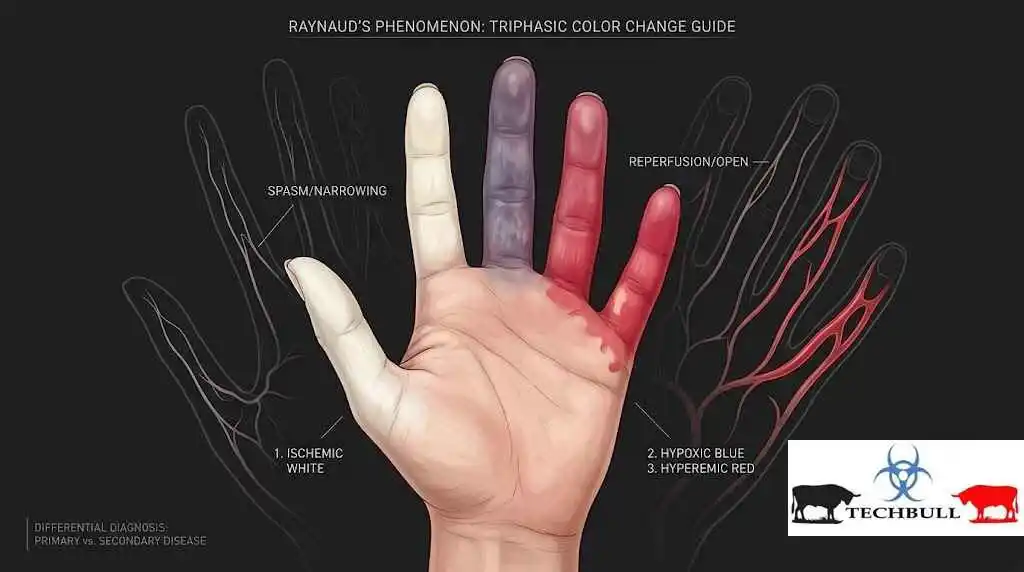
Raynaud’s Phenomenon is among the most visually distinctive presentations in clinical medicine, and one of the most frequently misread by trainees encountering it for the first time. A patient’s fingers turn white, then blue, then a florid red, in a sequence that appears alarming to the untrained eye but is, in the majority of cases, entirely benign. The diagnostic task is rarely to recognize that vasospasm has occurred — the color change is unmistakable — but to determine whether it stands alone or signals an underlying systemic disease.
Consider a 23-year-old medical student who presented to a medicine outpatient department in Delhi on a cold December morning. For two consecutive winters, she had noticed that on cold exposure — most often inside an air-conditioned dissection hall — the fingers of both hands would turn white and go numb. The episodes had grown longer with each season, and as color returned, the fingers throbbed and ached. Convinced she was developing a blood clot or a nerve disorder, she had stopped wearing her stethoscope around her neck, since contact with the cold metal reliably triggered an attack.
Examination revealed normal peripheral pulses and no digital ulceration. Laboratory investigations, including antinuclear antibody (ANA) testing, were unremarkable. The diagnosis was Primary Raynaud’s Phenomenon — a benign, common condition in young women with an excellent prognosis. The case nonetheless illustrates a discipline that should govern every such encounter: no presentation of Raynaud’s phenomenon should be assumed benign until secondary causes have been actively excluded.
What Raynaud’s Phenomenon Is
Raynaud’s Phenomenon is a temporary, episodic reduction in blood flow to the small arteries supplying the fingers and toes, caused by an exaggerated spasm of the smooth muscle within these vessels. When flow stops, the skin loses its color; when flow resumes, the skin reddens. In essence, it represents a hyperactive vascular response to cold exposure or emotional stress.

The Relevant Microvascular Anatomy
The digital arteries run deep within the finger and branch, closer to the skin surface, into arterioles. Immediately beneath the skin lie glomus bodies — specialized clusters of cells that function as thermoregulatory valves. These structures form direct arteriovenous anastomoses, connections that bypass the capillary bed entirely.
Under normal conditions, cold exposure causes the glomus bodies to close, redirecting warm blood away from the periphery to protect core organs. In Raynaud’s Phenomenon, this regulatory mechanism becomes dysfunctional: the smooth muscle of the digital arteries contracts excessively and remains contracted well beyond what thermoregulation requires.
Normal Thermoregulatory Physiology
The body maintains a core temperature near 37°C through a tightly coordinated reflex. Cutaneous thermoreceptors detect a drop in temperature and relay the signal to the hypothalamus, which transmits it down the spinal cord through the sympathetic ganglia to the blood vessels of the fingers.
The sympathetic nervous system releases norepinephrine, which binds alpha-1 and alpha-2 receptors on digital artery smooth muscle, producing contraction and vasoconstriction. This is a normal, protective response to cold.
What Goes Wrong in Raynaud’s Phenomenon
In affected patients, this reflex becomes locally exaggerated. The digital vessels show heightened sensitivity to alpha-receptor stimulation, so that a minor temperature drop — or even the visual cue of something cold — provokes disproportionate vasoconstriction.
A parallel imbalance exists at the endothelial level. Affected vessels overproduce endothelin-1, a potent vasoconstrictor, while underproducing nitric oxide, a vasodilator. The combined effect keeps the digital vessels clamped shut well past the point of physiological need.
The Classic Triphasic Color Change
The sequence of color change is a frequent examination question and a reliable diagnostic clue at the bedside.
- White (Pallor): The ischemic phase. The digital artery is fully clamped shut, no blood reaches the tissue, and the finger becomes cold and numb.
- Blue (Cyanosis): The hypoxic phase. Deoxygenated blood trapped in the capillaries gives the skin a dusky blue or purple color, often accompanied by tingling or aching.
- Red (Rubor): The reperfusion phase. The spasm relaxes and blood rushes back rapidly, producing bright redness and a sharp, throbbing pain.
Classification: Primary Versus Secondary
Raynaud’s Phenomenon is divided into two categories whose management and prognosis differ substantially.
- Primary Raynaud’s (Raynaud’s Disease): The benign form, occurring without underlying disease. Onset typically falls between ages 15 and 30. Attacks are mild and symmetrical, with no tissue loss, no smoking history, and negative autoimmune serology.
- Secondary Raynaud’s Phenomenon: The dangerous form, driven by an underlying systemic illness, most often a connective tissue disease. Onset is typically after age 35–40, and attacks can be severe, asymmetrical, and complicated by digital ulcers, gangrene, and tissue loss.
No presentation of Raynaud’s phenomenon should be assumed benign until secondary causes have been actively excluded.
Case Study: A Presentation of Secondary Disease
The following case, representative of a final-year MBBS long case, illustrates the red flags that distinguish secondary disease from the benign primary form.
| Patient Profile
A 48-year-old male farmer presented to the medicine ward with severe pain in the right index finger of three weeks’ duration. |
| History of Present Illness
For the preceding two years, his fingers had turned white in cold weather. Over the past three weeks, however, the tip of the right index finger had remained black and acutely painful, disrupting sleep. He reported smoking ten bidis daily for twenty years and regular use of vibrating farm machinery. |
| Examination
General examination showed tightening of the skin over the face and fingers (sclerodactyly). The right index fingertip showed a dry, black eschar with surrounding swelling. The radial pulse was feeble, and there was no pitting edema. |
| Investigations
ESR was elevated at 55 mm/hr. ANA was strongly positive with a speckled pattern, and anti-Scl-70 (anti-topoisomerase I) antibody was positive. Nailfold capillaroscopy showed dilated, tortuous capillary loops with areas of drop-out. Hand X-ray showed soft tissue loss at the fingertip without bone involvement. |
| Diagnosis and Management
This is a classic presentation of Secondary Raynaud’s Phenomenon due to Systemic Sclerosis (Scleroderma), complicated by digital gangrene, with occupational vibration exposure likely accelerating the underlying vascular disease. Management requires urgent admission, intravenous prostacyclins, pain control, and surgical consultation. |
The contrast between the two cases is instructive: a young patient with a normal examination, negative serology, and no tissue damage points to primary disease, while an older patient with sclerodactyly, positive antibodies, and frank gangrene points unambiguously to a secondary, systemic process.
Secondary Causes to Exclude
Every patient presenting with Raynaud’s Phenomenon warrants a systematic search for an underlying cause. The principal categories are as follows.
- Connective Tissue Diseases: The most common cause. Systemic Sclerosis (Scleroderma) predominates; Systemic Lupus Erythematosus, Rheumatoid Arthritis, Sjögren’s Syndrome, and Dermatomyositis should also be considered, particularly when Raynaud’s is accompanied by joint pain, rash, or muscle weakness.
- Occupational Exposure: Repeated use of vibrating tools — jackhammers, drills, chainsaws — produces Hand-Arm Vibration Syndrome (Vibration White Finger), in which repeated trauma damages the vascular endothelium.
- Obstructive Arterial Disease: Atherosclerosis, particularly in older smokers, can occlude digital arteries. Thromboangiitis Obliterans (Buerger’s Disease) is a significant cause in young Indian males who smoke bidis or cigarettes.
- Drug-Induced Causes: Beta-blockers such as propranolol block vasodilatory beta receptors and leave alpha-mediated constriction unopposed. Bleomycin and ergotamine-containing migraine medications can produce a similar effect.
- Hematologic Disorders: Conditions that increase blood viscosity — Polycythemia Vera, Cryoglobulinemia, and cold agglutinin disease — can impair flow through the digital capillary bed.
Comparison: Primary Versus Secondary Raynaud’s Phenomenon
| Feature | Primary Raynaud’s (Raynaud’s Disease) | Secondary Raynaud’s Phenomenon |
| Age of onset | Young, usually 15–30 years | Older, usually after 35–40 years |
| Gender | Strong female predominance (~90%) | More balanced between males and females |
| Underlying cause | None (idiopathic) | Always linked to an underlying disease (CTD, etc.) |
| Severity of attacks | Mild, short episodes | Severe, prolonged, painful |
| Symmetry | Symmetrical, both hands affected equally | Often asymmetrical, one hand or specific fingers |
| Tissue damage | Never causes ulcers or gangrene | Frequently causes digital ulcers or gangrene |
| Nailfold capillaroscopy | Normal | Abnormal — dilated, giant loops, hemorrhages |
| ANA | Negative | Usually positive |
| Prognosis | Excellent with lifestyle measures | Depends on the underlying disease; can be poor |
Evidence-Based Management
Regardless of type, lifestyle management forms the foundation of treatment. Five measures are supported by consistent clinical evidence.
1. Aggressive core warming
Gloves alone are insufficient. Because the body restricts flow to the fingers to protect the core, keeping the chest and abdomen warm reduces the trigger for peripheral vasoconstriction. Thermal inner layers, layered clothing, and electrically heated gloves are effective, particularly in severe cases.
2. Strict smoking cessation
Nicotine is a direct and potent vasoconstrictor that stimulates the sympathetic nervous system and damages vascular endothelium. In Secondary Raynaud’s, continued smoking undermines any pharmacologic treatment and materially raises the risk of digital gangrene.
3. Avoidance of vasoconstricting triggers
Direct contact with cold objects — reaching into a freezer, holding a cold drink — should be avoided. Emotional stress triggers the same vasospastic response through adrenaline release, so simple breathing techniques to manage stress are a useful adjunct.
4. Calcium channel blockers
When lifestyle measures are insufficient, Nifedipine, a dihydropyridine calcium channel blocker, is first-line. It blocks calcium entry into vascular smooth muscle, forcing relaxation, and reduces the frequency and severity of attacks by approximately 50%. Amlodipine is a common alternative.
5. Skin protection to prevent ulceration
In Secondary Raynaud’s, skin care is a medical necessity rather than a cosmetic concern. Dry, cracked skin readily progresses to a non-healing ulcer given the underlying poor perfusion. Regular use of thick moisturizing creams, prompt cleaning and dressing of minor cuts, and avoidance of cuticle trimming during manicures are all advisable.
Raynaud’s Phenomenon illustrates, with unusual clarity, the interaction between the sympathetic nervous system and the peripheral microvasculature. The essential clinical task is distinguishing the benign primary form from the dangerous secondary form. Red flags — late age of onset, asymmetry, painful ulceration, and abnormal nailfold capillaroscopy — should prompt an active search for an underlying connective tissue disease. A single white finger, evaluated carefully, can be the first sign of a complex systemic illness.
FAQs
| Question | Answer |
| 1. What is the exact definition of Raynaud’s Phenomenon? | An episodic, reversible vasospasm of the small digital arteries and arterioles, usually triggered by cold or stress. |
| 2. Who first described Raynaud’s Phenomenon? | It was first described by French physician Maurice Raynaud in 1862. |
| 3. Is Raynaud’s Phenomenon a common condition? | Yes; it affects approximately 3–5% of the general population worldwide. |
| 4. Why are women more affected by Primary Raynaud’s? | The precise mechanism is unclear, but female hormones are thought to influence the reactivity of vascular smooth muscle. |
| 5. What is the classic triphasic color sequence? | White (ischemia), followed by blue (deoxygenation), followed by red (reperfusion). |
| 6. Can Raynaud’s Phenomenon affect the toes? | Yes; it commonly affects the toes and can rarely affect the nose, ears, or nipples. |
| 7. What is the most common trigger for an attack? | Cold exposure, such as entering an air-conditioned room or holding a cold drink, is the most common trigger. |
| 8. Can emotional stress cause a Raynaud’s attack? | Yes; stress-induced adrenaline release produces the same vascular spasm as cold exposure. |
| 9. What is the difference between Raynaud’s Disease and Raynaud’s Phenomenon? | Raynaud’s Disease refers specifically to the primary form, while Raynaud’s Phenomenon is the broader term that includes the secondary form. |
| 10. Which connective tissue disease is most strongly linked to Secondary Raynaud’s? | Systemic Sclerosis (Scleroderma) is the most common and most severe underlying cause. |
| 11. What is nailfold capillaroscopy? | A non-invasive test in which a magnifying tool is used to examine the tiny capillaries at the base of the fingernail. |
| 12. What does nailfold capillaroscopy show in Secondary Raynaud’s? | Dilated, giant capillary loops, areas of capillary drop-out, and micro-hemorrhages. |
| 13. Can working with vibrating tools cause Raynaud’s Phenomenon? | Yes; prolonged use of tools such as jackhammers causes Hand-Arm Vibration Syndrome, a form of secondary vascular damage. |
| 14. Which class of drugs is first-line medical treatment for Raynaud’s? | Calcium channel blockers, specifically Nifedipine or Amlodipine. |
| 15. How does Nifedipine help in Raynaud’s Phenomenon? | It blocks calcium entry into vascular smooth muscle cells, forcing the arteries to relax and reducing vasospasm. |
| 16. Can beta-blocker medications worsen Raynaud’s Phenomenon? | Yes; by blocking vasodilatory beta receptors, they leave vasoconstricting alpha receptors unopposed. |
| 17. Does smoking make Raynaud’s Phenomenon worse? | Yes; nicotine is a potent vasoconstrictor that narrows blood vessels and damages the endothelium. |
| 18. Can Raynaud’s Phenomenon cause gangrene? | Primary Raynaud’s does not cause gangrene, but Secondary Raynaud’s, particularly with Scleroderma, can. |
| 19. What blood tests should be ordered for suspected Secondary Raynaud’s? | A complete blood count, ESR, Antinuclear Antibody (ANA), and specific antibodies such as Anti-Scl-70 and Anti-centromere. |
| 20. What is the role of endothelin-1 in Raynaud’s Phenomenon? | It is a vessel-lining chemical that causes vasoconstriction, and its levels are often elevated in affected patients. |
| 21. Why does the finger throb when it turns red during an attack? | Because blood rushes back rapidly under high pressure through arteries that were previously fully clamped shut. |
| 22. Is Raynaud’s Phenomenon curable? | Primary Raynaud’s has no cure but is manageable with lifestyle changes; Secondary Raynaud’s depends on treating the underlying disease. |
| 23. Can children develop Raynaud’s Phenomenon? | Primary Raynaud’s can occasionally begin in the teenage years, though it is rare in young children. |
| 24. What is the best way to manage an acute Raynaud’s attack at home? | Moving to a warm room and running warm, not hot, water over the affected fingers to gently reverse the spasm. |
| 25. Should patients with Raynaud’s use chemical hand warmers? | Yes; keeping chemical hand warmers on hand during winter is a practical preventive measure. |
| 26. Can caffeine trigger a Raynaud’s attack? | Caffeine is a mild vasoconstrictor and may modestly contribute to attacks in highly sensitive individuals. |
| 27. What is the significance of pitting scars on the fingertips? | Pitting scars or ulcers are a major red flag for Secondary Raynaud’s, often pointing to Systemic Sclerosis. |
| 28. Does keeping the chest warm really help prevent finger vasospasm? | Yes; keeping the core warm reduces activation of the sympathetic reflex that diverts blood from the extremities. |
| 29. Are there surgical options for severe Secondary Raynaud’s? | In rare cases where medical therapy fails and gangrene threatens, sympathectomy may be performed to interrupt the spasm. |
| 30. Why is it important to differentiate Primary from Secondary Raynaud’s? | Because Primary Raynaud’s is benign and requires only reassurance, while Secondary Raynaud’s signals a systemic disease requiring urgent, aggressive treatment. |
⚕️Medical Disclaimer:
The information provided on this website is for general educational and informational purposes only and is not intended as a substitute for professional medical advice, diagnosis, or treatment. Always seek the advice of your physician or other qualified health provider with any questions you may have regarding a medical condition. Never disregard professional medical advice or delay in seeking it because of something you have read on this website.
