
Table of Contents
The Wisdom of Detachment: Why the Wise Grieve Neither for the Living Nor the Dead
Introduction: The Paradox of Sorrow
In the landscape of human experience, few forces are as paralyzing as grief. It is the heavy shadow cast by love, the price we pay for attachment. When we lose a loved one, a job, a dream, or a way of life, the natural response is a profound sense of mourning. Society validates this mourning; we are given time off work, we are offered condolences, and we are encouraged to “let it out.” Yet, amidst this universal acceptance of grief as a necessary human process, there stands a provocative and somewhat startling counterpoint found in one of the world’s most revered spiritual texts, the Bhagavad Gita.
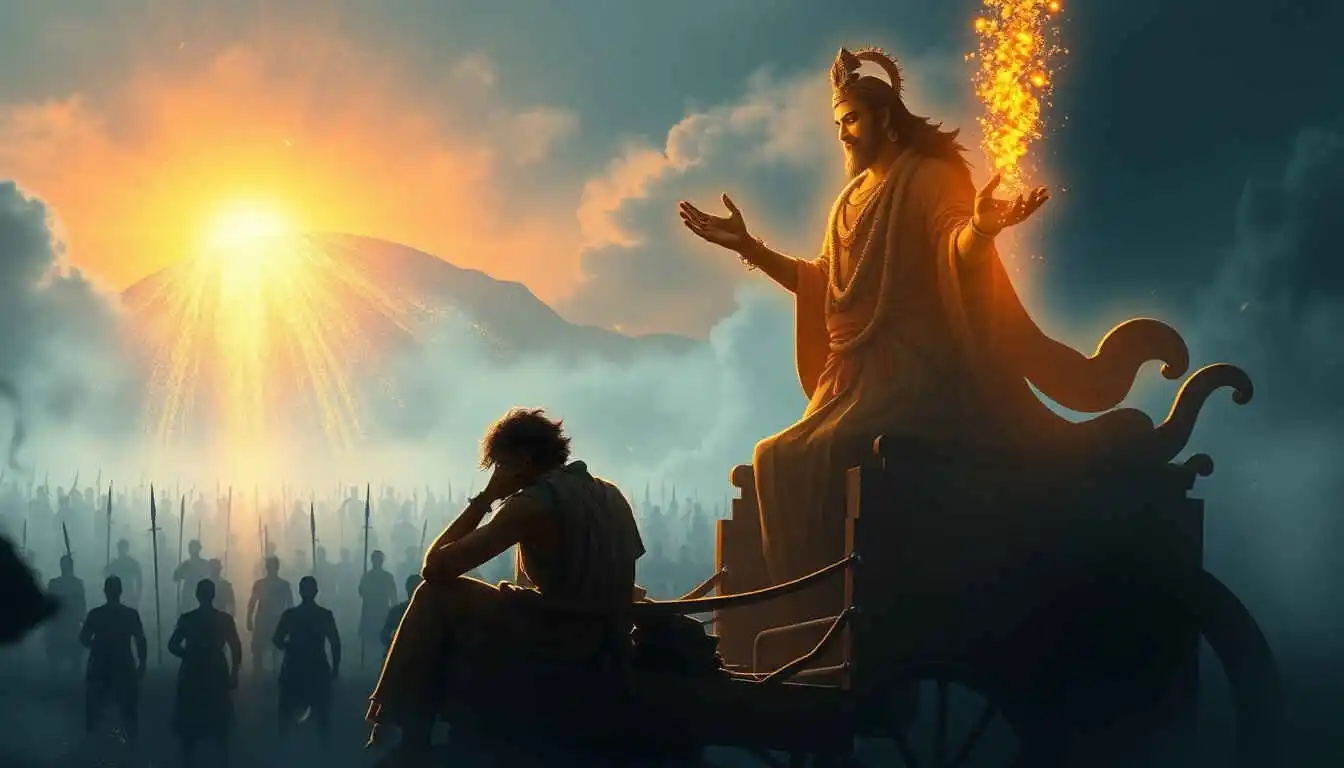
In the second chapter, Verse 11, Lord Krishna addresses the warrior Arjuna, who has collapsed in a chariot, paralyzed by sorrow on the battlefield of Kurukshetra. Krishna says:
“You grieve for those who are not worthy of grief, and yet speak words of wisdom. The wise grieve neither for the living nor for the dead.”
At first glance, this statement can seem cold, detached, or even lacking in empathy. Is Krishna suggesting that we should be heartless? Is he invalidating the pain of losing a parent, a child, or a partner? To the modern mind, conditioned to equate emotional expression with healing, this verse poses a radical challenge. It forces us to confront the very nature of reality, the definition of the “self,” and the mechanics of attachment.

This blog post seeks to unravel the layers of this profound statement. We will explore what it means to grieve for the “unworthy,” the distinction between intellectual knowledge and true wisdom, and the transformative realization that allows the wise to remain steadfast in the face of life’s greatest transitions. This is not a guide to suppressing emotion, but a roadmap to transcending the suffering that stems from a misunderstanding of the eternal.
The Battlefield of the Mind: Contextualizing the Verse
To understand the weight of Krishna’s admonishment, we must first understand the scene. Arjuna is not merely sad; he is undergoing a catastrophic psychological breakdown. He stands before a vast army, composed of his own relatives, teachers, and friends. He is faced with a war he must fight to uphold righteousness (Dharma), but the cost is the annihilation of his kin.
Arjuna’s grief is not abstract; it is visceral. He trembles, his bow slips from his hand, and he predicts the collapse of family values and the corruption of society. He presents a sophisticated argument, essentially saying, “How can it be right to kill for a kingdom? Is victory worth the bodies of my brothers?”
It is here that Krishna intervenes with the verse in question. When Krishna says, “You grieve for those who are not worthy of grief,” he is not insulting Arjuna’s family members. He is not suggesting they are bad people or that their lives had no value. Rather, he is pointing out that Arjuna is grieving for the wrong thing.
Arjuna is grieving for the bodies and the relationships, ignoring the essence that animates them. He is treating the temporary—the physical form—as if it were permanent. Krishna identifies this misidentification as the root of all suffering. The “unworthy” aspect refers to the perishable aspect of existence. To grieve for that which is destined to perish is, in the eyes of spiritual wisdom, a misappropriation of emotional energy.
The Misplaced Grief: Mourning the Temporary
What does it mean to grieve for those “not worthy of grief”? In our daily lives, we often confuse the container with the content. We identify ourselves and others with the physical body, the social status, the job title, and the role played in the family drama. We invest our emotional capital in these fluctuating, fragile vessels.
When we grieve excessively, we are often grieving the loss of our attachment. We grieve the void left in our own lives, the silence in the house, the absence of a familiar voice. This is a self-centric form of grief. While natural, it stems from the assumption that the person we loved has ceased to exist.
Krishna challenges this assumption by introducing the concept of Anitya (impermanence). The body is subject to birth, growth, decay, and death. This is a biological law. To expect the body to remain static or to resent the process of death is to fight against the fundamental nature of the physical world.
Consider the analogy of a river. If one stands by a river and watches the water flow by, they do not grieve for the water that has passed downstream. They understand that the river exists precisely because the water flows. Similarly, to grieve the death of a body is to grieve the changing of the seasons. It is a resistance to the inevitable rhythm of life.
Therefore, “unworthy of grief” signifies that the event of death should not be a source of delusion. It is not a tragedy; it is a transition. The tragedy, according to Krishna, is the ignorance that views this transition as a final annihilation.
The Paradox of the “Wise Words”
Krishna adds a stinging critique in the second half of the verse: “…and yet speak words of wisdom.”
Arjuna, moments before his collapse, was quoting scriptures. He spoke of sin, of family duty, and of the afterlife. He was using intellectual knowledge to justify his emotional paralysis. This highlights a crucial gap that exists in many of us: the gap between knowing and being.
We often use philosophy as a crutch. We know logically that “everything happens for a reason” or “death is a part of life.” We can quote Stoics, Buddhists, and Gurus. Yet, when the phone call comes at 3:00 AM, our philosophy evaporates, and we are left drowning in sorrow.
Krishna points out this hypocrisy. To speak wisdom while acting in ignorance is a sign of a mind that is not yet integrated. True wisdom is not in the quoting of verses, but in the reaction to reality. Arjuna’s words were wise, but his state of mind was foolish. He was trying to use logic to support his fear, rather than using wisdom to conquer it.
This teaches us that spiritual maturity requires more than book knowledge. It requires internalizing the truth until it becomes the lens through which we view the world. When we merely speak words of wisdom without living them, we are engaging in a spiritual performance that protects the ego but fails to heal the soul.
The Eternal Soul: The Logic of Non-Grieving
To support the claim that the wise do not grieve, Krishna presents the metaphysical foundation of the Gita: the distinction between the body and the soul (Deha and Atman).
“The wise grieve neither for the living nor for the dead.”
Why? Because the wise see with the “eye of knowledge.”
- For the Dead: Krishna explains that the soul is eternal. It was never born, and it will never die. It cannot be cut by weapons, burned by fire, moistened by water, or withered by the wind. When a person dies, the body perishes, but the soul merely casts off the worn-out garment and assumes a new one. If the essence of the person—the soul—is indestructible, what is there to grieve?
- For the Living: This part is often overlooked. Why does the wise not grieve for the living? We usually think grief is reserved for the dead. However, Krishna expands the scope. The wise do not grieve for the living because they understand that the living are also in a state of flux. We do not own the people in our lives. Our children, partners, and friends are independent souls on their own journeys. To cling to them, to worry incessantly about their physical safety or their worldly success, is to deny their spiritual autonomy. The wise love the living deeply, but without the anxiety of possession.
This perspective shifts the paradigm of love. It moves from attachment (clinging to the form) to compassion (honoring the soul). When we realize the soul is immortal, death ceases to be a “loss” and becomes a “departure.”
The Stoic Parallel: Accepting the Inevitable
While the Bhagavad Gita roots its argument in the immortality of the soul, Stoic philosophy arrives at a similar conclusion through the logic of nature. The Stoics, like Epictetus and Marcus Aurelius, argued that we should only grieve over things within our control. Since death is a law of nature, outside our control, grieving it excessively is a form of insanity.
Epictetus famously said, “If you wish your children, your wife, or your friends to live forever, you are foolish… You wish to control things which you cannot.”
This aligns with the Gita’s teaching on “unworthy grief.” To grieve over the inevitable is to wish for reality to be something it is not. It is a rejection of the present moment.
- Stoic View: Do not add to the pain of an event by layering it with judgment and resistance. The event (death) is factual; the grief (suffering) is an opinion added by the mind.
- Gita View: Do not mistake the event for an end. The event (death) is a perception; the reality (existence) continues.
Both philosophies converge on the idea that “The Wise” are those who align their internal reality with the external laws of the universe. The wise do not deny the reality of death; they accept it so fully that it loses its power to terrorize.
The Practical Application: How to “Not Grieve”
It is easy to intellectualize these concepts, but how does one apply them when the heart is breaking? It is important to distinguish between Grief as Sorrow and Grief as Suffering.
Krishna is not advocating for sociopathy. He is not saying one should not feel the sting of loss. When a loved one dies, the vacuum they leave is real. The absence is tangible. To deny this sensation is repression, not wisdom.
The distinction lies in the clinging.
- Ordinary Grief: “He is gone forever. I will never be happy again. This is unfair. I have lost everything.” This is grief rooted in the delusion of permanence.
- Wise Grief: “He has transitioned. The body has served its purpose. I miss his presence, but I honor the journey of his soul. My love remains, but my attachment to his physical form must release.”
The “Wise” grieve the passing of the physical form, perhaps with tears and silence, but they do not suffer from the delusion that the person has been annihilated. Their grief is clean; it is a process of release, not a state of endless despair.
Steps to Cultivate “Wise” Grieving:
- Shift Focus to the Essence: When you look at a loved one, practice seeing beyond their physical attributes. Acknowledge the consciousness within them. By recognizing the “soul” in the living, you prepare yourself to accept the continuity of the soul after death.
- Detach from the Form: This does not mean loving less. It means loving without fear. We often grieve because we fear losing the object of our happiness. If we find happiness within, rather than in the other person, the fear of loss dissolves, leaving only love.
- Contemplate Impermanence: The Gita advises us to constantly remember that the body is temporary. This isn’t morbid; it’s realistic. A traveler knows their time in a hotel is short; they enjoy the stay but do not collapse in despair when it is time to check out.
- Serve the Living: Often, our grief is a form of guilt—things left unsaid, deeds left undone. By fulfilling our duties (Dharma) to the living while they are here, we remove the root of regret.
The Burden of “Anticipatory Grief”
One of the most subtle forms of suffering is grieving for the living. Krishna’s phrase—”neither for the living”—strikes at the heart of worry and anxiety. We often torture ourselves with imagined future scenarios. We worry about our children’s safety, our parents’ health, and our partner’s fidelity. This is grieving for the living.
This type of grief stems from a lack of trust in the cosmic order. We feel we must constantly vigilantly hold the universe together to protect our loved ones. The wise understand that every soul is the architect of its own destiny. We have a duty to care for them, but we do not own their fate.
To grieve for the living is to deaden the joy of the present moment. If you are constantly worrying about your child dying, you are not fully present with them while they are alive. You are, in a sense, killing them in your mind over and over again. The wise refuse to pay this emotional tax. They embrace the living fully, completely, and fearlessly, accepting that whatever happens in the future is a part of the grand design.
The “Worthy” Objects of Grief
If there are things “not worthy of grief,” are there things worthy of grief? Perhaps not grief in the sense of weeping, but in the sense of deep concern or lamentation.
The scriptures often suggest that the only thing truly worthy of “grief” is our own ignorance. We should mourn the time we wasted in delusion. We should grieve our lack of self-knowledge. We should grieve the moments we spent in anger and hatred rather than in love.
When we shift our focus from external loss to internal growth, the grieving process becomes a catalyst for awakening. Arjuna’s grief on the battlefield was the friction necessary for the Gita to be spoken. It was the darkness that demanded the light. So, while Krishna admonishes Arjuna for his misplaced grief, he uses that very grief as the starting point for Arjuna’s transformation.
Conclusion: From Despair to Freedom
The verse, “The wise grieve neither for the living nor for the dead,” is an invitation to freedom. It is a call to step out of the small, cramped room of “I, me, and mine” and walk into the vast expanse of the eternal.
It teaches us that our sorrow is often a form of arrogance—a belief that we know how the universe should run, and that it has made a mistake by taking something from us. The wise humbly accept the law of impermanence. They trust in the continuity of consciousness.
This does not mean we become stone statues, unfeeling and cold. On the contrary, the wise are capable of the deepest love because their love is not tainted by the fear of loss. They can give fully, knowing that the source of their joy is internal and imperishable.
Implementing this teaching is a practice. It requires catching ourselves in the moment of despair and asking: What am I grieving? The body? The memory? Or am I honoring the soul?
We are all Arjuna. We all stand on the battlefields of our lives, facing losses and changes that seem unbearable. And the voice of Krishna—the voice of our own higher wisdom—whispers to us: Do not grieve the inevitable. You are eternal. They are eternal. The forms change, but the life within them never dies.
By internalizing this, we do not erase the pain of loss, but we rob it of its power to destroy us. We move from grief to gratitude, from attachment to liberation. This is the mark of the wise: not the absence of tears, but the presence of understanding.
FAQs
Context and Origin
- Which ancient text is the primary source of the quote discussed?
The quote is derived from the Bhagavad Gita, specifically Chapter 2, Verse 11.
- Who speaks the verse, “The wise grieve neither for the living nor for the dead”?
Lord Krishna speaks the verse.
- To whom is this teaching addressed?
It is addressed to the warrior Arjuna, who has collapsed in sorrow on the battlefield of Kurukshetra.
- What was Arjuna’s mental state when Krishna spoke these words?
Arjuna was undergoing a catastrophic psychological breakdown, paralyzed by the prospect of fighting his own relatives and teachers.
The Meaning of Grief
- What does Krishna mean by “grieving for those not worthy of grief”?
He means that Arjuna is grieving for the physical body and temporary relationships, which are perishable, rather than the eternal soul.
- Is Krishna suggesting that we should be cold or heartless?
No, he is not advocating for a lack of empathy. He is pointing out the futility of grieving for that which is inevitable and temporary.
- Why is the physical body considered “unworthy of grief”?
The body is subject to birth, decay, and death. Grieving for the inevitable decay of the body is a resistance to the fundamental laws of nature.
- What is the “root of all suffering” according to the text?
The root of suffering is the misidentification of the self with the temporary physical form rather than the eternal essence.
The Soul and Eternity
- Why do the wise not grieve for the dead?
The wise understand that the soul is eternal and indestructible; death is merely a transition where the soul casts off the body like worn-out clothes.
- According to the Gita, what are the qualities of the soul?
The soul was never born and will never die. It cannot be cut by weapons, burned by fire, moistened by water, or withered by the wind.
- What is the difference between the body and the soul?
The body is temporary and perishable (Anitya), while the soul (Atman) is eternal and immutable.
Grieving for the Living
- Why does Krishna say the wise do not grieve for the living?
The wise do not grieve for the living because they understand that we do not own the people in our lives; they are independent souls on their own journeys.
- How does the text define “grieving for the living”?
It defines this as worry, anxiety, and the fear of loss—essentially, clinging to the physical presence of someone out of attachment.
- What is the danger of “anticipatory grief”?
Anticipatory grief deadens the joy of the present moment because we are constantly worrying about a future loss that has not happened yet.
Wisdom vs. Intellect
- What is the paradox of “speaking words of wisdom”?
It refers to the gap between intellectual knowledge and internalized wisdom. Arjuna quoted scriptures logically, but his emotional state was one of ignorance.
- What is the difference between “knowing” and “being”?
“Knowing” is intellectual understanding (quoting philosophy), while “being” is living that truth in one’s reaction to reality.
Philosophy and Stoicism
- How does Stoicism align with the Gita’s view on grief?
Stoicism argues that death is a law of nature outside our control; therefore, grieving it excessively is irrational and a form of resisting reality.
- What is the Stoic view on control and grief?
Stoics believe we should only concern ourselves with things within our control. Since death is inevitable, grieving it is futile.
Practical Application
- Does the text advocate for suppressing emotions?
No. The text distinguishes between the natural sensation of loss and the prolonged suffering caused by delusion.
- What is the difference between “Ordinary Grief” and “Wise Grief”?
Ordinary grief clings to the delusion of permanence and finality, while wise grief acknowledges the transition and honors the soul without despair.
- How can one practice “shifting focus to the essence”?
By looking beyond the physical attributes of a loved one and acknowledging the consciousness or soul within them while they are alive.
- What is the “traveler analogy” mentioned in the text?
It compares life to a traveler in a hotel. A traveler enjoys the stay but does not collapse in despair when it is time to check out, knowing their stay is temporary.
- How does attachment differ from love in this philosophy?
Attachment is clinging to the form and fearing loss, whereas love is honoring the soul without the anxiety of possession.
- Why is attachment considered “self-centric”?
Attachment often grieves the void left in our own lives, rather than the actual loss of the other person.
- What is the only thing truly “worthy of grief”?
The text suggests that the only thing worthy of lamentation is our own ignorance and lack of self-knowledge.
- How does fulfilling one’s duty (Dharma) help with grief?
By fulfilling our duties to the living while they are here, we remove the root of regret and guilt that often complicates grief.
- What is the “eye of knowledge”?
It is the perspective that sees the distinction between the temporary body and the eternal reality.
- How does the text suggest we view the future?
We should not torture ourselves with imagined future scenarios but trust in the cosmic order and the autonomy of other souls.
- What is the ultimate result of internalizing this teaching?
It leads to freedom from fear, allowing one to love fully and fearlessly without the constant dread of loss.
- What is the final takeaway regarding the “wise”?
The wise are not devoid of tears, but they are devoid of the delusion that death is the end; they possess an understanding that transforms grief into gratitude.
Disclaimer: This article explores philosophical perspectives on grief and should not be considered medical advice. If you are struggling with overwhelming grief or depression, please seek support from a qualified mental health professional.
