
Table of Contents
How Krishna’s Teachings in the Bhagavad Gita Redefine Brotherhood as a Path to Spiritual Awakening
Introduction: The Battlefield of Duality
The Bhagavad Gita, often revered as the “Song of the Lord,” unfolds on a stage that seems far removed from the tranquil settings usually associated with spiritual discourse. It begins not in a serene forest hermitage or a mountaintop, but on the precipice of a cataclysmic war. The field of Kurukshetra is a landscape of tension, where the air is thick with the dust of chariots and the cacophony of conch shells. It is here, amidst the collision of two massive armies, that a profound psychological and spiritual crisis erupts.
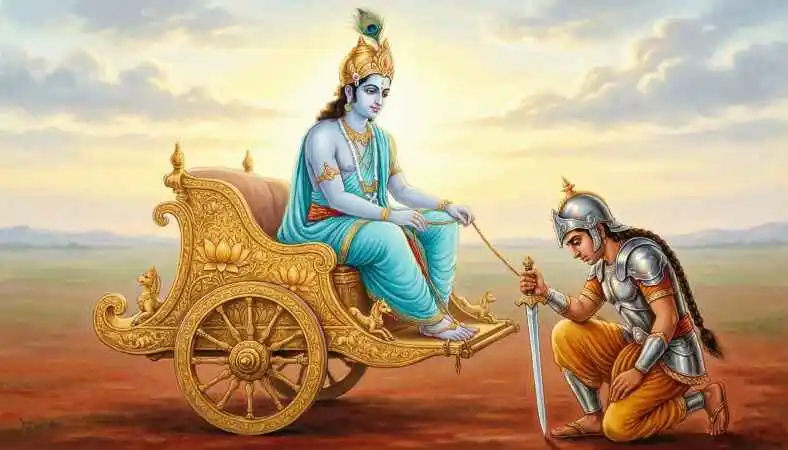
Arjuna, the greatest warrior of his time, is paralyzed. His bow drops from his hand, and he sinks into the chariot, overwhelmed by a sudden, crushing grief. He sees before him not enemies, but kinsmen—uncles, teachers, cousins, and brothers. The impending war is not a battle against strangers, but a civil war against his own blood. In his desperate plea to Krishna, Arjuna articulates the conventional understanding of brotherhood: one based on blood ties, social obligation, and emotional attachment. He asks, “How can I kill my own kin?”
It is in this moment of profound vulnerability that Lord Krishna initiates a transformation that would redefine the very concept of brotherhood. Krishna does not merely offer tactical advice; He deconstructs the warrior’s limited worldview. The Gita’s journey is one of moving from the “brotherhood of blood” to the “brotherhood of being.” This transition is not just a philosophical shift but a necessary prerequisite for spiritual awakening. To awaken to the Divine, one must transcend the egoic identification with the body and recognize the deeper, unifying thread that connects all existence. This essay explores how Krishna’s timeless teachings in the Bhagavad Gita elevate the concept of brotherhood from a social construct to a spiritual reality, paving the way for the ultimate liberation of the soul.
The Crisis of Limited Identity
To understand how Krishna redefines brotherhood, we must first examine the root of Arjuna’s suffering. Arjuna’s despair arises from a fundamental misidentification. He sees himself as a body, a son, a brother, and a student. Consequently, he sees his adversaries through the same lens of physicality and social relation.

The Illusion of the Temporary Arjuna’s argument is rooted in dharma (duty), but a distorted version of it. He argues that killing his kinsmen would destroy family traditions, corrupt the lineage, and lead to the decay of society. While these arguments hold weight in the material world, Krishna perceives a deeper malady. Arjuna is confusing the temporary with the eternal. He is grieving for that which cannot be killed—the body—and ignoring that which is immortal—the soul (Atman).
This attachment to the physical form creates a false sense of separation and exclusivity. It says, “This is my brother because he shares my blood,” implying that one who does not share this blood is “other.” This is the seed of duality. Spiritual awakening, in the Vedic tradition, is the dissolution of this duality. As long as one operates from the platform of the body, true brotherhood—universal and unconditional—is impossible.
The Ego’s Barrier The “I” and “Mine” consciousness (Mamata) is the barrier. Arjuna claims, “They are my relatives.” This possessiveness creates a cage. It limits his love and compassion to a specific circle, leaving the rest of the world outside. Krishna’s mission is to shatter this cage. He does not ask Arjuna to stop loving his cousins; rather, He asks Arjuna to expand his love until it encompasses all beings. The first step toward this spiritual brotherhood is the realization that the physical body is merely a garment worn by the soul.
The Brotherhood of the Eternal Soul (Atman)
In the second chapter of the Gita, Krishna delivers the seminal teaching on the nature of the soul (Sankhya Yoga). This is the philosophical bedrock upon which spiritual brotherhood is built.
The Indestructible Self Krishna declares, “The soul is never born, nor does it die; nor having once existed, does it ever cease to be. The soul is without birth, eternal, immortal, and ageless. It is not destroyed when the body is destroyed.” (Gita 2.20).
This verse radically alters the definition of “brother.” If the body is perishable, then the physical relationship between Arjuna and Duryodhana is temporary. However, if the soul within Arjuna and the soul within Duryodhana are both eternal fragments of the Divine (Amshas), then their relationship is not merely biological; it is ontological.
Equality in Essence Krishna further explains in later chapters that the soul is part of His energy. By recognizing the Atman within all living entities, Arjuna is forced to acknowledge a fundamental equality. The distinction between “cousin” and “enemy” dissolves when viewed through the lens of the soul. The soul is not Hindu or Muslim, Indian or Western, kinsman or stranger. It is pure consciousness.
This realization establishes the first tier of Krishna’s redefined brotherhood: The Brotherhood of Essence. It is the understanding that we are all travelers on the same cosmic journey, wearing different uniforms (bodies) but sharing the same origin. This perspective shifts the focus from the external differences to the internal unity. Spiritual awakening begins the moment one sees the soul within the body of a friend, a foe, a dog, or an elephant—an ability Krishna attributes to the wise (Panditah).
Sama-Darshinam – The Vision of Equality
The Gita introduces a Sanskrit term that perfectly encapsulates the attitude of a realized soul: Sama-Darshinam, or “equal vision.”
Transcending the Modes of Nature In Chapter 5, Verse 18, Krishna states: “The humble sages, by virtue of true knowledge, see with equal vision a learned and gentle Brahmin, a cow, an elephant, a dog, and a dog-eater [or outcast].”
This verse is revolutionary. It challenges every hierarchy and prejudice ingrained in human society. To see a “brother” in a blood relative is easy; it is an instinct programmed by evolution. To see a brother in a stranger requires effort. To see a brother in a dog or an outcast requires spiritual vision.
This Sama-Darshinam is the practical application of spiritual brotherhood. It means that one does not judge the value of a being by their species, caste, economic status, or physical appearance. One judges them by the presence of the Divine spark within. When Arjuna can look at Duryodhana, not as a villain to be killed, but as a soul entrapped in ignorance and greed, his engagement in war changes from an act of vengeance to an act of duty (Karma Yoga).
The Antidote to Hatred Brotherhood is not merely the absence of enmity; it is the presence of active identification with the other. Krishna teaches that when we see the Supreme Lord seated in the hearts of all beings, we cannot hate anyone. Hatred is born of ignorance, of seeing others as separate from ourselves. By redefining the “other” as “another aspect of the same Divine reality,” Krishna removes the very fuel for conflict. This does not mean one passively accepts injustice; rather, one acts to correct injustice without developing a hateful heart. Arjuna is to fight the evil in Duryodhana, not the soul of Duryodhana.
Vasudeva Kutumbakam – The Supreme Connection
While the concept of the soul establishes equality, the concept of God (Bhagavan) establishes a relationship. Krishna introduces a second, deeper tier of brotherhood: The Brotherhood of Divine Relation.
Children of the Same Father In Chapter 9, Verse 17, Krishna declares, “I am the father of this universe, the mother, the support, and the grandsire.” In Chapter 14, Verse 4, He states, “It should be understood that all species of life, O son of Kunti, are made possible by birth in this material nature, and that I am the seed-giving father.”
If Krishna (the Supreme Consciousness) is the Father, and Material Nature is the Mother, then every living entity—from the microscopic bacteria to the celestial demigods—is a sibling. This brings the ancient Vedic aphorism Vasudhaiva Kutumbakam (“The world is one family”) to life.
This spiritual genealogy transcends DNA. If we are all children of the same Divine Source, then the brotherhood we share is not just a social contract but a cosmic fact. Our disagreements are merely squabbles between children in the playground of the material world. This perspective fosters a sense of responsibility. Just as an elder brother cares for a younger sibling who has lost their way, a spiritual aspirant views humanity with compassion. The “sinner” is not an outcast to be condemned, but a sick brother to be healed or a confused sibling in need of guidance.
The Indwelling Guide Krishna emphasizes that He resides as the Paramatman (Supersoul) within the heart of every living entity. This means that the closest person to you is not the one standing next to you, but the One residing within you—and within them. Recognizing this presence means realizing that you are never alone, and neither is anyone else. The Divine is the witness and guide in every heart. To serve another being is to serve God; to hurt another being is to hurt God. This realization is the pinnacle of spiritual awakening.
Brotherhood Through Action (Karma Yoga)
Theory without practice is incomplete in the Gita. Krishna does not ask Arjuna to retreat to a cave to meditate on brotherhood; He asks him to practice it on the battlefield.
Yajna: The Spirit of Cooperation In Chapter 3, Krishna explains the concept of Yajna (sacrifice) and the cycle of creation. He describes how humanity was created along with sacrifice, and through cooperation, humans prosper. “Devotees perform sacrifices for the gods (demigods), and the gods provide rain for the earth, and the earth provides grains for the living beings.” (Gita 3.14).
This illustrates a pragmatic brotherhood based on interdependence. We do not exist in isolation. The food we eat, the clothes we wear, and the air we breathe are the results of a cooperative effort involving nature, animals, and other humans. Acknowledging this debt, the wise work for the welfare of all beings (Lokasangraha).
Acting for the Collective Good Krishna instructs Arjuna: “Work for the welfare of the world; whatever a great man does, that others follow.” (Gita 3.25). Here, brotherhood is defined as social responsibility. A true spiritualist does not retreat from society but engages with it selflessly. Arjuna’s fight is no longer for his kingdom or his pride; it is to establish Dharma (righteousness) for the benefit of the collective. He fights to relieve society of oppression. This is “tough love” in brotherhood—correcting a sibling when they cause harm to the family.
By offering the fruits of his actions to Krishna (Karma-phala-tyaga), Arjuna breaks the chains of selfishness. Selfishness is the antithesis of brotherhood. When one acts without desire for personal gain, purely out of duty to the whole, that action becomes a spiritual offering.
Bhakti Yoga – Brotherhood Cemented in Love
The final and most profound definition of brotherhood in the Gita emerges in the chapters on Bhakti Yoga (The Yoga of Devotion).
The Friend of All Beings Krishna reveals, “There is no servant in this world more dear to Me than he, nor will there ever be one more dear.” (Gita 18.69, paraphrased regarding the devotee). But the most striking revelation regarding brotherhood comes in Chapter 7, Verse 18, where Krishna says of the devotee who sees Him in everything: “Such a devotee is very dear to Me.”
And in Chapter 12, Verse 13-14, Krishna describes the ideal devotee: “One who is not envious but is a kind friend to all living entities… such a devotee is very dear to Me.”
Here, the definition is complete. To be a devotee of God is to be a friend to all. One cannot claim to love the Father while hating His children. Bhakti (devotion) naturally blossoms into universal brotherhood. This is not a sentimental, emotional indulgence, but a profound state of being.
The Divine Friendship The Gita itself is a testament to divine friendship. The relationship between Krishna and Arjuna is the model. It oscillates between Master and servant, Teacher and student, and ultimately, Friend and Friend. Krishna says, “I am the same to all beings.” (Gita 9.29). He does not favor the pious over the sinner; He is equally present for both. By cultivating this divine friendship, the aspirant transcends the dualities of love and hate, liking and disliking.
The Awakening
How does this redefinition lead to Spiritual Awakening?
From Fragmentation to Wholeness The spiritual journey is a process of moving from fragmentation (seeing oneself as separate) to wholeness (seeing oneself as part of the whole). The conventional view of brotherhood is fragmentary—it includes some and excludes others. Krishna’s redefinition is inclusive. It is holistic.
When Arjuna finally accepts Krishna’s instruction with the words “Karishye vachanam tava” (I shall act according to Your word), he has awakened. He is no longer fighting his brothers; he is acting as an instrument of the Divine will to restore balance. He has awakened to the truth that he is not the body, and neither are his enemies. He has awakened to the duty of protecting the world order. He has awakened to the love of God, which naturally extends to all of God’s creation.
The Peace of the Wise Krishna concludes the Gita by promising that those who follow this path attain peace (Shanti). Brotherhood is not just a moral virtue; it is a state of consciousness. A mind that sees enemies everywhere cannot be peaceful. A mind that sees brothers everywhere—souls on a similar journey, children of the same Father—finds rest. This peace is the hallmark of spiritual awakening.
Conclusion
The Bhagavad Gita takes the concept of brotherhood out of the realm of sociology and places it into the realm of metaphysics. Lord Krishna teaches that true brotherhood is not a contract between bodies, but a reality of the spirit. It is an inherent state of being, obscured only by the dust of ignorance and ego.
By urging Arjuna to see beyond the physical forms of his kinsmen to the eternal souls within, and by revealing His presence in the heart of every living entity, Krishna dissolves the barriers that separate “me” from “you.” He establishes a universal brotherhood based on the shared essence of the Atman and the shared relationship with the Divine.
To walk this path is to undergo a profound spiritual awakening. It is to realize that the “other” is none other than the “Self.” It is to act in the world not for selfish gain, but for the welfare of the cosmic family. In a world often fractured by division, the Gita’s message remains a beacon of light: we are not many; we are one in the Divine. To embrace this brotherhood is not just to become a better citizen, but to become a truly awakened soul.
FAQs
General Context & The Crisis
- Where does the conversation in the Bhagavad Gita take place?
The conversation takes place on the battlefield of Kurukshetra, just before the start of a massive cataclysmic war.
- Why was Arjuna paralyzed with grief before the battle?
He was overcome by a psychological crisis because he saw his enemies as kinsmen—uncles, teachers, cousins, and brothers—and could not bear the thought of killing his own blood.
- How does Arjuna initially view the concept of brotherhood?
Arjuna views brotherhood conventionally, based on blood ties, social obligation, and emotional attachment to the physical body.
- What is the “misidentification” that causes Arjuna’s suffering?
Arjuna misidentifies himself and others with the temporary physical body rather than the eternal soul, leading to false attachments and the “I” and “Mine” consciousness.
The Nature of the Soul (Atman)
- How does Krishna redefine the definition of a “brother”?
Krishna redefines a brother not as someone who shares blood, but as a fellow spiritual being who shares the same divine essence (Atman).
- What is the “Brotherhood of Essence”?
It is the realization that all living entities are equal in their spiritual nature, transcending the labels of friend, foe, or stranger.
- What does Krishna teach about the nature of the soul in Chapter 2?
Krishna teaches that the soul is eternal, indestructible, unborn, and immutable; it is not killed when the body is killed.
- How does the concept of Atman dissolve duality?
By recognizing that the same spiritual spark exists in all beings, the distinction between “me” and “you” fades, removing the sense of separation.
The Vision of Equality (Sama-Darshinam)
- What is Sama-Darshinam?
Sama-Darshinam means “equal vision”—the ability to see the same divine truth in all living beings regardless of their external form.
- Which beings does Krishna mention in the example of equal vision?
Krishna mentions that the wise see no difference between a learned Brahmin, a cow, an elephant, a dog, and a dog-eater (outcast).
- How does equal vision affect one’s judgment of others?
It prevents one from judging others based on species, caste, economic status, or physical appearance, focusing instead on the divine spark within.
- Does seeing a “brother” in an enemy mean one must tolerate their injustice?
No, Krishna teaches that one must correct injustice (fight the evil) without hating the soul of the person, acting out of duty rather than vengeance.
Divine Relation & Universal Family
