
Table of Contents
The Sacred Code: A Comprehensive Guide to Hindu Temple Rituals and Their Deep Meanings
Introduction
The Hindu temple, or Mandir, is not merely a place of congregational worship; it is a profound architectural and spiritual marvel designed to bridge the gap between the finite human experience and the infinite cosmic reality. Unlike a church or a mosque, which are primarily halls for prayer, a Hindu temple is conceptualized as the body of the Divine on earth—a physical vessel that houses the pulsating energy of the deity. Every stone, every carving, and every ritual performed within its precincts is part of a grand, intricate science of spirituality aimed at elevating the human consciousness.
The rituals performed in Hindu temples are not arbitrary acts of superstition. They are rooted in the Agamas and Vedas, ancient scriptures that detail the science of metaphysics, sound, light, and energy. These rituals, known as Upacharas (services), are designed to honor the deity as a living, breathing sovereign—a royal guest in the house of the devotee. This comprehensive guide unpacks the myriad rituals performed in Hindu temples, exploring the symbolism, the procedure, and the deep philosophical meanings behind each sacred act.
Entering the Temple: The Threshold of Divinity
The journey of worship begins before one even enters the sanctum. The temple structure itself is a map of the human body, with the sanctum sanctorum (Garbhagriha) representing the head, the hall (Mandapa) the torso, and the gateway (Gopuram) the feet. Entering the temple is akin to entering a higher state of consciousness.
a. Removing Footwear: Shedding the World. The first act upon entering a temple compound is the removal of footwear. While this is often viewed as a hygiene measure, its spiritual significance runs deeper. Shoes carry the dust and dirt of the outside world—the noise, the stress, and the negativity of daily life. By removing them, the devotee symbolically sheds their ego and worldly attachments, signaling a readiness to step onto sacred ground with humility and purity.

b. The Gopuram and the Threshold :The towering entrance tower, the Gopuram, is usually covered in hundreds of colorful sculptures depicting gods, demons, and celestial beings. This serves as a visual reminder of the complexity of the universe. As the devotee crosses the threshold, they are often advised to step in with the right foot first. The right side represents the Pingala Nadi (solar energy channel) in yogic philosophy, associated with activity and positivity. Stepping in with the right foot invokes auspiciousness and strength.
c. Dhwaja Stambha: The Flagstaff. In the courtyard stands the Dhwaja Stambha, a tall pillar usually made of brass or wood, wrapped in silk. It acts as a cosmic antenna, connecting the earth to the heavens. It marks the transition point between the worldly and the divine. Devotees often prostrate before it (Namaskara), offering their physical body in surrender to the divine will.
The Science of Purification
Before approaching the deity, purification of the physical and subtle body is essential. The human body is seen as a vessel that accumulates impurities through thoughts, words, and actions.
- Washing Hands and Feet Most temples have a tank or a tap near the entrance. Washing the extremities symbolizes the cleansing of Karma (action) performed through the limbs. It prepares the physical body to receive the high-frequency energy present inside the sanctum.
- Sattvic State Devotees are encouraged to maintain a Sattvic state—purity of mind and body. This often involves fasting or eating lightly before visiting the temple. An empty stomach keeps the body light, preventing lethargy (Tamas) and allowing for alertness during worship.
- The Sound of the Divine: Ghanta (The Bell) Upon entering the main hall, the first action of a devotee is to ring the bell hanging at the entrance of the sanctum. This is not merely a signal of arrival. The Ghanta is a potent spiritual instrument.
- The Sound: The bell is crafted from an alloy of five metals (Panchaloha) to produce a distinct, resonating sound that lasts for at least 7 seconds. This duration is significant; the echo is believed to match the frequency of Om, the primordial sound of creation.
- The Meaning: The bell serves two purposes. First, it drowns out the noise of the outside world—both physical noise and mental chatter—allowing the devotee to focus entirely on the deity. Second, it is an invitation to the divine. The Agamas state that the ringing of the bell awakens the deity from their cosmic slumber (though God never sleeps, it symbolizes awakening the devotee’s awareness of God). It scares away negative energies and invites auspiciousness.
Darshan: The Meeting of Eyes
The central act of Hindu temple worship is Darshan, which translates to “sight” or “vision.” However, it is a two-way process. The devotee sees the deity, and the deity sees the devotee.
- The Vigraha (Idol) as a Battery The deity’s idol is not a stone statue; it is a Vigraha (embodiment). Through a complex ritual called Prana Pratishtha (infusion of life), priests have invoked the cosmic energy of the deity into the idol. Thus, the stone becomes a repository of immense energy.
- The Eyes The eyes of the deity are often large and prominent. Looking into the eyes of the deity is believed to transfer grace (Kripa). It is a moment of silent communication, where the devotee unburdens their heart and receives a silent blessing of strength and peace.
The Shodashopachara: The Sixteen Steps of Worship
While personal worship involves a simple prayer, the formal temple ritual follows the Shodashopachara, a standardized sequence of 16 services offered to the deity as if they were a visiting king. This elaborate ritual is usually performed by the Archaka (priest), but understanding it enriches the devotee’s experience.
- Avahana (Invitation): The priest invokes the deity, inviting them to grace the temple.
- Asana (Seat): A seat is offered for the deity to rest upon.
- Padya (Washing Feet): Water is poured to wash the deity’s feet, symbolizing hospitality.
- Arghya (Washing Hands): Water is offered to wash the hands.
- Achamana (Sipping Water): Water is offered for sipping, a purification rite.
- Snana (Bath): The deity is bathed with water, milk, yogurt, ghee, honey, and sugar (Panchamrita).
- Vastra (Clothing): Fresh clothes or silk are draped over the deity.
- Yajnopavita (Sacred Thread): The sacred thread is offered.
- Gandha (Sandalwood): Sandalwood paste is applied to the deity. Sandalwood has cooling properties and represents the cooling of the devotee’s ego.
- Pushpa (Flowers): Flowers are offered. Each flower represents the senses; offering them to God means surrendering one’s senses to the divine.
- Dhoopa (Incense): Incense is waved. The fragrance represents the purified atmosphere and the spread of virtue.
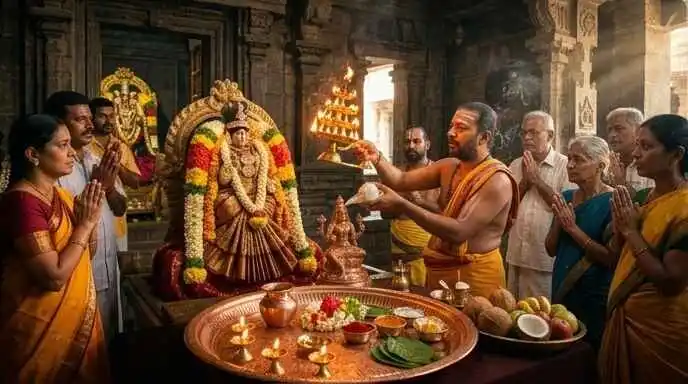
- Deepa (Light): An oil lamp is waved. Light represents knowledge and the removal of ignorance (Tamas).
- Naivedya (Food): Food offerings (Prasad) are placed before the deity.
- Tamboola (Betel Leaves): Betel leaves and nuts are offered for digestion and freshness.
- Nirajana (Aarti): The final waving of the light.
- Mantra Pushpa (Prayers): Recitation of Vedic hymns and asking for forgiveness for any mistakes in the ritual.
Abhisheka: The Ceremonial Bath
One of the most visually striking rituals in a temple is the Abhisheka. This involves the ceremonial bathing of the deity (usually a Shiva Lingam or a stone idol) with various substances.
- Panchamrita Abhisheka. This involves bathing the deity with five nectars:
- Milk: Represents purity and the nurturing aspect of nature.
- Yogurt (Curd): Represents prosperity and progeny.
- Ghee (Clarified Butter): Represents strength and victory.
- Honey: Represents sweetness in speech and character.
- Sugar/Jaggery: Represents happiness and bliss.
Following this, the deity is bathed in water, sandalwood water, turmeric water, and sometimes fruit juices.
The Meaning: The substances are not merely cleaning the stone. As they pour over the idol, they absorb the energy of the deity. When this mixture is later consumed by devotees as Theertha (holy water), it transfers that divine energy into the physical body of the devotee, acting as a spiritual medicine.
Aarti: The Dance of Light
The Aarti is the culmination of the puja. It involves the waving of lighted wicks (soaked in ghee or camphor) before the deity in a clockwise motion.
- The Camphor Flame Camphor (Karpoora) has a unique property: it burns completely without leaving any residue.
- Symbolism: This represents the human ego. When the ego meets the fire of knowledge (the deity), it burns away completely, leaving no trace of the “I” or “Mine.” It signifies total self-effacement and union with the Divine.
- The Motion The lamp is waved in a clockwise direction to mimic the movement of the planets around the sun and the rhythmic flow of life. It illuminates the deity from all angles, allowing devotees to see the divine form in its entirety.
- Receiving the Aarti After the Aarti, devotees bring their palms over the flame and touch their eyes and head. This gesture signifies accepting the divine light into one’s life—seeing the world through the eyes of the divine and illuminating one’s intellect.
Archana: Reciting the Divine Names
Archana is a form of puja where the priest chants the 108 or 1008 names of the deity (like the Lalitha Sahasranama or Vishnu Sahasranama) while offering flowers and sacred leaves (like Tulasi or Bilva) at the feet of the deity.
The Meaning: Sound is energy. The specific vibrations created by chanting Sanskrit mantras create a protective shield of positive energy around the devotee and the temple. The offering of leaves and flowers represents the surrender of the mind and heart. Tulasi (Holy Basil) is not just a plant but a manifestation of devotion; offering it to Vishnu signifies unwavering faith.
Pradakshina: The Circumambulation
After the Aarti, devotees walk around the sanctum sanctorum in a clockwise direction. This act is called Pradakshina.
- The Direction Walking clockwise keeps the deity on the right side. In Vedic tradition, the right side is the side of favor. It signifies that God is always right, and we are aligning ourselves with divine will.
- The Symbolism The sanctum is the center of the universe, the axis mundi. By walking around it, the devotee is orbiting the center of their existence. It is an admission that the ego is not the center of the universe, but that the Divine is. The Pradakshina also represents the cyclical nature of time—birth, death, and rebirth—and the desire to break this cycle by holding onto the Divine.
- The Count Devotees often perform circumambulation a specific number of times (usually 1, 3, 5, or 7). Each number has a specific vibration and significance, often related to the deity being worshipped (e.g., Lord Ganesha is usually circumambulated once, as he represents the supreme reality).
Prasad and Theertha: Divine Consumption
Worship is not complete until the devotee partakes in the grace of the deity through consumption.
- Theertha (Holy Water) The priest gives water from the Abhisheka or from a small copper pot. This is the Theertha. It is the “ford” or crossing point from the material to the spiritual. Drinking it purifies the internal organs and the subtle body. It is always received in the right palm, with the left hand supporting the right elbow, signifying respect.
- Prasad (Sacred Food) The food offered to the deity becomes Prasad. It is believed that during the Naivedya (offering), the deity accepts the essence of the food, transforming it from mere matter into divine grace. Eating Prasad creates a bond of communion between the devotee and God. It is a reminder that everything we eat should first be offered to the Divine with gratitude.
Other Significant Temple Rituals
Beyond the daily worship, Hindu temples are hubs of periodic festivals and unique rituals.
- Kumbhabhishekam This is the grand consecration ceremony performed every 12 years (or as needed) to re-energize the temple. The Kumbha (pot) filled with holy water and energized with mantras is poured over the Kalasam (the pinnacle of the temple tower). This recharges the magnetic field of the temple, ensuring the divine energy remains potent for another cycle.
- Brahmotsavam: A major annual festival held in large temples like Tirupati. It involves the deity being taken out in a procession on various Vahanas (vehicles like Garuda, Lion, or Sun). This represents the deity coming out of his abode to be accessible to the masses, blessing the town and nature.
- Rath Yatra (Chariot Festival) Famous in Puri (Jagannath Temple), this involves pulling massive chariots. The pulling of the chariot ropes signifies the devotee’s effort in pulling the divine towards themselves. It is a collective act of devotion where caste, creed, and status are forgotten.
- Utsava Murthy In many temples, the main stone deity is immovable. Therefore, a smaller, metallic “festival deity” is used for processions. This allows the divine to move among the people, symbolizing that while the supreme truth is eternal and immovable, it can manifest in many forms to interact with the world.
The Role of Sound: Mantras and Bells
The acoustic environment of a temple is engineered for spiritual awakening. The chanting of Vedic mantras by the priests is not just prayer; it is a science of sound.
Vedic Chanting: The precise pronunciation and intonation of Sanskrit mantras create specific vibrational frequencies. These frequencies resonate with the chakras (energy centers) in the human body. For instance, the chanting of “Om” activates the Ajna Chakra (third eye). The mantras recited during the Abhisheka are believed to charge the liquids with healing properties.
Musical Instruments: The Shankha (conch shell) produces a sound frequency that destroys harmful bacteria in the environment and clears the mind. The Mridangam (drum) mimics the heartbeat, grounding the devotee.
