
Table of Contents
Every item offered in a temple has a scientific and spiritual basis, debunking the myth of “blind faith.”
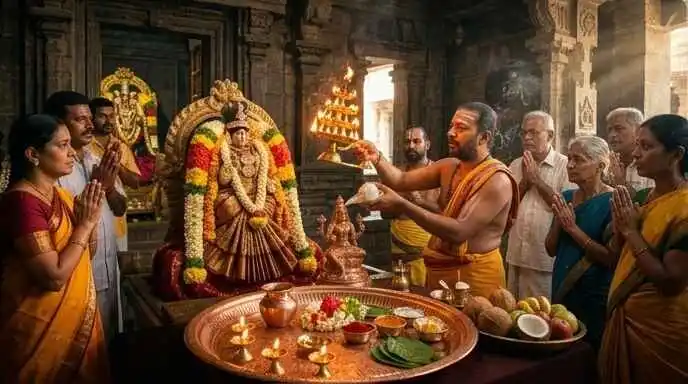
- Coconut: The coconut is often broken before the deity. The coconut has three eyes, representing the three eyes of Shiva. Breaking it symbolizes the breaking of the ego (the hard shell) to reveal the sweet white kernel (the pure soul) inside.
- Bananas: Represent fertility and prosperity.
- Turmeric and Kumkum: Turmeric is antiseptic; applying it on the deity and then on one’s forehead transfers medicinal benefits. The spot between the eyebrows is the Ajna Chakra, the seat of wisdom.
- Fire (Yagna): Fire rituals (Homas) are performed to purify the atmosphere. The fire acts as a carrier, taking the offerings to the subtle realms and invoking celestial energies.
The Social and Psychological Impact
Temple rituals were designed not just for salvation but for social cohesion and psychological well-being.
- Community Building: Festivals and Prasad distribution bring the community together, fostering unity.
- Psychological Anchor: In times of distress, the rituals provide a structured way to channel anxiety. The act of surrendering to a higher power (Prapatti) relieves the burden of the individual ego.
- Preservation of Arts: Temples were the original patrons of classical dance (Bharatanatyam, Kuchipudi) and music. The rituals often involve dance performances before the deity, keeping the cultural heritage alive.
Conclusion
The rituals of a Hindu temple form a sophisticated spiritual technology. They are not merely superstitious acts but are deeply symbolic gestures that engage the senses, purify the mind, and elevate the soul. From the ringing of the bell that clears the mind, to the Abhisheka that charges the water with energy, to the Aarti that illuminates the divine form, every step is a move toward Yoga union.

Understanding these meanings transforms a routine visit to the temple into a profound spiritual experience. It turns the devotee from a passive observer into an active participant in the cosmic dance of the Divine. Whether one seeks material prosperity, mental peace, or ultimate liberation (Moksha), the Hindu temple and its sacred rituals offer a time-tested path to fulfillment. They remind us that the Divine is not distant, but is right here, accessible through a simple offering of water, a fragrant flower, and a heart full of devotion.
FAQs
- What are Hindu Temple Rituals?
Hindu temple rituals are an intricate system of sacred practices, prayers, and offerings performed in temples to honor and connect with the Divine. These rituals, often guided by ancient scriptural texts like the Agamas, involve various symbolic actions, sounds, and offerings designed to purify the environment, invoke divine presence, and facilitate spiritual communion between devotees and the deity. They serve as a structured framework for expressing devotion, seeking blessings, and fostering spiritual growth.
- Why are rituals important in Hinduism?
Rituals are important in Hinduism because they provide a tangible and structured way for devotees to express their faith and connect with the Divine. They serve as spiritual disciplines that help focus the mind, purify the senses, and cultivate devotion. While the ultimate goal is internal realization, rituals act as powerful external aids, creating a sacred atmosphere and guiding individuals on their spiritual journey towards self-realization and connection with the ultimate reality.
- What is “Darshan” and its significance?
“Darshan” is the act of seeing and being seen by the deity in the temple, often through the consecrated image (murti). It is considered a moment of profound spiritual communion, where devotees believe they receive the grace and blessings of the divine. More than just physical sight, Darshan implies an active engagement with the divine presence, fostering a deep emotional and spiritual connection that can bring peace, solace, and inspiration.
- Why do Hindus worship idols (murtis)?
Hindus do not worship the idol itself as a mere piece of stone or metal, but rather the divine principle it represents and embodies. The murti acts as a focal point or a conduit for the devotee to focus their mind and connect with the formless Brahman (ultimate reality) through a specific divine form. It’s seen as a tangible representation of a particular aspect of God, helping humans understand and relate to the divine more easily, especially for those who find abstract concepts challenging.
- What is “Pranapratishtha” and why is it crucial?
“Pranapratishtha” is the consecration ceremony that infuses a deity’s idol (murti) with divine life force, effectively transforming it from a mere sculpture into a living embodiment of the deity. During this elaborate ritual, mantras, prayers, and offerings are used to invite the specific deity to reside within the murti. This process is crucial because it makes the temple a vibrant spiritual center where the divine is actively present, allowing devotees to experience a direct connection with God.
- What is “Aarti” and what does it symbolize?
Aarti is a ritual of waving lighted lamps or camphor before the deity, accompanied by prayers and devotional songs. It symbolizes the removal of darkness (ignorance) by the light of divine knowledge and grace. The circular motion of the lamp also represents the cycle of life and the light of consciousness that illuminates all existence, offering profound reverence and dedication to the divine presence.
- What is “Prasad” and its spiritual meaning?
“Prasad” refers to food or other offerings that have been sanctified by being offered to the deity and then distributed to devotees. It is considered a sacred gift imbued with the deity’s blessings and grace. Consuming Prasad is believed to purify the body and mind, bestowing spiritual merit and connecting the devotee directly with the divine energy of the offering.
- Why do devotees circumambulate (Parikrama/Pradakshina) the deity or temple?
Circumambulation, known as Parikrama or Pradakshina, involves walking clockwise around the deity or the temple’s inner sanctum. This act symbolizes acknowledging the deity as the center of one’s existence and the universe, demonstrating respect and devotion. It represents the cyclical nature of life and the devotee’s journey towards the divine, with each step taken in reverence and prayer.
- What is the significance of the temple bell?
The ringing of the temple bell is an integral part of Hindu rituals, serving multiple purposes. It is believed to clear the mind of distractions and invoke the divine presence by creating a sacred sound vibration. Furthermore, it helps to synchronize the minds of devotees, preparing them to receive the divine energy and focus on the worship within the temple. The sound is also thought to ward off negative energies and usher in auspiciousness.
- Why are lamps (Deepam) lit in temples?
Lighting lamps (Deepam) in temples symbolizes the presence of light over darkness, knowledge over ignorance, and good over evil. The flame is considered a representation of divine consciousness and purity, illuminating the path to spiritual truth. Offering light is an act of devotion, signifying the surrender of one’s ego and the aspiration for divine guidance and enlightenment.
- What is the role of Kumkum, Vibhuti, and Sandalwood paste in rituals?
These sacred substances are applied to the forehead as blessings after worship. Kumkum (red powder) symbolizes prosperity, devotion, and feminine energy. Vibhuti (sacred ash) signifies detachment, purity, and the transient nature of material existence, often associated with Lord Shiva. Sandalwood paste offers cooling, calming properties and symbolizes purity, peace, and auspiciousness. Each application marks the devotee as having received divine grace and provides spiritual protection.
- Why are flowers and incense offered?
Flowers and incense are offered as expressions of love, reverence, and devotion to the deity. Flowers, beautiful and fragrant, symbolize the delicate beauty of creation and the fleeting nature of life, inviting devotees to offer their purest intentions. Incense creates a sacred atmosphere, purifying the air and carrying prayers upwards to the heavens, symbolizing the diffusion of positive energy and devotion.
- What is “Abhishekam” and its meaning?
Abhishekam is a ritual bathing of the deity with sacred substances like water, milk, yogurt, honey, ghee, and fruit juices. This act symbolizes purification, rejuvenation, and the showering of devotion unto the divine. Each ingredient used in the bathing carries specific symbolic meanings, collectively aiming to refresh the deity, invoke blessings, and cleanse the devotee’s spiritual impurities.
- What is the purpose of chanting Mantras?
Mantras are sacred sounds, words, or phrases believed to possess spiritual power. Chanting them purifies the mind, focuses energy, and invokes specific divine vibrations. The repetitive recitation helps to still the mental chatter, connect with higher consciousness, and can lead to deep states of meditation and spiritual realization, aligning the individual consciousness with the cosmic divine.
- What is a “Homam” or “Yagna”?
A Homam or Yagna is a fire ritual where offerings are made into a consecrated fire, considered a messenger to the divine. It symbolizes the burning away of impurities and ego, while inviting divine presence and blessings. The smoke from the fire is believed to carry prayers and offerings to the gods, purifying the environment and fostering collective religious unity and spiritual energy.
- What is the significance of the “Garbhagriha” (Sanctum Sanctorum)?
The Garbhagriha, meaning “womb chamber,” is the innermost sanctum of a Hindu temple where the main deity is enshrined. It is considered the most sacred space, representing the spiritual heart of the temple and the universe itself. Only priests are usually allowed inside to perform precise rituals, as it is believed to be the direct point of contact with the divine energy emanating from the consecrated murti.
- What is the role of the “Gopuram” in South Indian temples?
The Gopuram is the towering, ornate gateway structure found predominantly in South Indian temples, often elaborately sculpted with numerous deities and mythological figures. More than just an entrance, it symbolizes the grandeur and spiritual significance of the temple, serving as a visual marker that draws devotees in. Passing through it represents leaving the mundane world behind and entering a sacred space.
- What is the “Dhvaja Stambha” (Flagpole) and its symbolism?
The Dhvaja Stambha, or flagpole, is a prominent feature in front of many Hindu temples. It symbolizes the temple as a sacred space and serves as an identifier of the deity within. On special occasions, a flag bearing the emblem of the presiding deity is hoisted, signifying the beginning of festivals and inviting the divine presence, unifying devotees under its spiritual banner.
- What is the general etiquette for visitors to a Hindu temple?
Visitors should dress modestly, preferably in traditional attire or respectful clothing that covers shoulders and knees. Shoes must be removed before entering the main temple hall or sanctum. Maintain silence or speak softly, and avoid pointing at deities or people. It’s customary to show respect through folded hands (Namaste), and photography may be restricted in certain areas, especially the Garbhagriha.
- How do temple rituals benefit an individual’s spiritual growth?
Temple rituals provide a structured path for spiritual discipline, helping individuals cultivate devotion, surrender, and mindfulness. Regular participation purifies the mind and senses, reduces ego, and creates a sense of peace and connection with the divine. By engaging in these ancient practices, devotees can experience inner transformation, gain clarity, and foster a deeper understanding of their spiritual purpose.
- Are Hindu rituals rigid, or can they be adapted?
While the core principles and major rituals prescribed in the Agamas are generally followed with precision to maintain their sanctity and efficacy, there can be some flexibility in their adaptation over time and across different traditions or regions. However, the fundamental steps and symbolic meanings are usually preserved, ensuring the integrity of the spiritual practice. Priests ensure adherence to scriptural guidelines, while domestic rituals might incorporate more personal variations.
- What is the significance of specific offerings like coconuts or bananas?
Coconuts symbolize the human head and ego, which are offered to the divine in surrender, with the breaking of the coconut representing the breaking of the ego. The three eyes of the coconut can also symbolize the Trinity (Brahma, Vishnu, Shiva). Bananas, often offered in bunches, symbolize fertility, abundance, and auspiciousness due to their quick growth and prolific nature. Each offering carries deep spiritual and cultural symbolism.
Disclaimer: The content on this blog is for informational purposes only. The author’s opinions are personal and not endorsed. Efforts are made to provide accurate information, but completeness, accuracy, or reliability are not guaranteed. The author is not liable for any loss or damage resulting from the use of this blog. It is recommended to use the information on this blog at your own discretion.
