
Table of Contents
Winter’s Exile Ends: Readers’ Most Breathtaking Spring Flowers Across the Continent
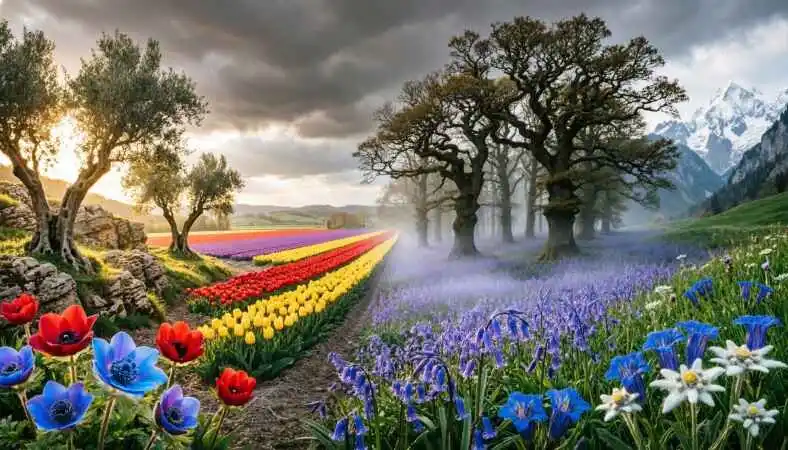
There is a specific, almost miraculous shift that occurs across the European continent sometime between the middle of March and the end of May. It is not merely a change in the weather; it is a radical transformation of the earth’s palette, a sensory awakening that signals the definitive end of winter’s long, monochromatic exile. For months, the landscapes of Europe—from the wind-battered coastlines of the Atlantic to the snow-capped peaks of the Alps—have been draped in shades of slate, charcoal, and bare umber. But as the axis of the earth tilts and the daylight hours lengthen, a quiet, relentless alchemy begins.
The soil warms. The frost recedes. And from the damp, dark earth, an abundance of blooms erupts in a breathtaking display of life. But spring in Europe is not a monolith. It is not a single event that happens simultaneously across the continent. Rather, it is a slow, rolling wave of color that begins in the sun-drenched southern Mediterranean and sweeps steadily northward, crossing mountain ranges and plains, eventually reaching the northernmost fjords of Scandinavia.
To truly capture the essence of a European spring, we realized that looking at botanical textbooks or horticultural guides was insufficient. We needed to understand how these blooms live in the human heart. We reached out to our readers across the continent—from the cobbled streets of Prague to the rugged coastlines of Crete—and asked them a simple question: Which spring flower defines the season for you, and why?
The responses were overwhelming in their passion, poetry, and geographical diversity. What emerged was a vivid, reader-curated map of Europe’s finest spring flora, proving that the arrival of the blooms is not just a biological event, but a deeply personal, cultural, and historical phenomenon.

The Atlantic Awakening: The Ancient Woodlands of the British Isles
In the British Isles, spring does not arrive with a sudden, tropical explosion. It is a slow, creeping invasion that begins in the hedgerows and culminates in one of the most famous natural spectacles on earth. When we asked our readers in the UK and Ireland to name their definitive spring flower, the response was deafeningly unified: the Bluebell (Hyacinthoides non-scripta).
Sarah, a reader from the Cotswolds, encapsulated the sentiment of thousands when she wrote: “Nothing compares to walking into an ancient English woodland in late April. Before you see them, you smell them—a sweet, heady, green perfume. Then, you round a bend, and the entire forest floor is a rolling ocean of violet-blue. It feels like stepping into a fairy tale.”
Sarah is not exaggerating. The UK is home to roughly half of the world’s population of native bluebells. These are not the sturdy, upright garden hybrids commonly seen in North America; the British bluebell is a delicate, drooping wildflower with bells that hang from one side of an arching stem, like tiny, suspended lanterns. They thrive in ancient, undisturbed woodlands because their bulbs take years to establish in the deep leaf litter. When they bloom en masse, they create an ethereal blue haze so dense that it can be detected on satellite imagery.
But the British spring is not a one-hit wonder. As the bluebells reach their peak in the shaded woods, the open fields and suburban parks are being colonized by another quintessential reader favorite: the Daffodil (Narcissus). While famously associated with the poet William Wordsworth’s wanderings near Ullswater, the daffodil has transcended its literary roots to become a universal symbol of cancer awareness (through the Marie Curie charity) and the ultimate harbinger of brighter days. Readers love the daffodil for its unapologetic cheerfulness—its trumpet of gold blasting away the gray skies of a British March.
Rounding out the British triumvirate is the humble Primrose (Primula vulgaris). Poking their pale yellow faces out of muddy roadside banks and railway embankments, primroses are the quiet heroes of the European spring. They require no cultivation, asking only for a sliver of sunlight to burst into life, providing the first vital nectar source for awakening bumblebees.
The Geometric Masterpiece: The Dutch Bulb Fields
As the bluebells are fading in Britain, the ground in the Netherlands is preparing to surrender to a strictly man-made, yet entirely natural-looking, spectacle. If the British spring is about wild, untamed romanticism, the Dutch spring is a masterclass in agricultural geometry, designed and engineered over centuries.
When asked for their favorite spring bloom, our Dutch readers did not hesitate. The Tulip (Tulipa) is not just a flower in the Netherlands; it is a cultural obsession, a historical lesson in economic bubbles (Tulip Mania of the 1630s), and the lifeblood of an entire region.
Pieter, a reader from Leiden, described the experience: “People think of tulips as a single red flower in a vase. But you haven’t seen tulips until you have stood at the edge of a polder in April and seen millions of them striped across the flat Dutch landscape in perfect lines—blood reds, sunshine yellows, deep purples, and blinding whites. It is overwhelming.”
The Dutch landscape is partitioned into a dizzying patchwork quilt of color, anchored by the world-famous Keukenhof gardens, where over seven million bulbs are planted annually. But beyond the cultivated gardens, the commercial bulb fields in Lisse and Hillegom offer a raw, breathtaking scale.
Yet, the tulip does not rule alone. Our readers frequently paired the tulip with the Hyacinth (Hyacinthus orientalis). If the tulip is the visual star of the Dutch spring, the hyacinth is the olfactory star. Planted in dense ribbons alongside the tulips, hyacinths emit an incredibly potent, almost intoxicating fragrance that hangs heavy in the damp spring air. A single patch of pink or blue hyacinths can scent an entire garden for weeks, making them an indispensable part of the Dutch floral identity.
The Poetic Resilience: The Fields of France
Moving south across the English Channel, the French spring takes on a different character—one deeply intertwined with history, literature, and national traditions. Our French readers offered two incredibly distinct blooms that capture the dual nature of the French spring: the wild poppy and the delicate Lily of the Valley.
First, the Poppy (Papaver rhoeas). While the poppy blooms well into the summer, its first emergence in late spring across the rolling wheat fields of Normandy and Picardy evokes a powerful, visceral response. Elise, a reader from Normandy, wrote: “When the red poppies start to sway in the breeze among the green wheat, it is beautiful, but it is also heartbreaking. They are the ghosts of the First World War, reminding us of the scarred earth of the Western Front, yet they are also a symbol of life’s stubborn refusal to stop growing.”
The poppy thrives in disturbed soil. The relentless shelling and plowing of the battlefields of Northern France created the perfect conditions for the poppy seeds, which can lie dormant in the soil for decades, to finally germinate in massive numbers. Today, the spring bloom of the French poppy fields is a stunning natural phenomenon, a sea of vivid scarlet contrasting against the pale green crops, serving as a living, breathing war memorial.
In stark contrast to the rugged, blood-red poppy is the ultimate symbol of French springtime chic: the Lily of the Valley (Convallaria majalis), known locally as Muguet de Mai. On May 1st, a public holiday in France, the streets come alive with vendors selling small bouquets of these delicate, bell-shaped white flowers. The tradition dates back to the Renaissance, when King Charles IX received a sprig of Lily of the Valley as a lucky charm. Today, it is the quintessential French spring tradition. Readers adore the Lily of the Valley not just for its pristine white aesthetic, but for its incredibly sweet, lingering fragrance—a scent that instantly evokes the promise of summer in Paris.
The Ancient Mediterranean: Sun, Stone, and Wild Anemones
As the wave of spring pushes southward, the timeline accelerates. By March, while the British are still waiting for their daffodils to open, the Mediterranean basin is already ablaze with color. Here, spring is not a gentle awakening; it is a riotous explosion of life fueled by abundant sunlight and poor, rocky soil.
When we asked our readers in Greece, Italy, and the southern Balkans for their favorite spring flowers, the overwhelming response was not a cultivated garden variety, but a fierce, wild survivor: the Mediterranean Anemone (Anemone coronaria).
Nikos, a reader from Crete, captured the essence perfectly: “In Greece, spring comes fast and hard. The hillsides, which are baked brown by August, suddenly erupt in these impossible, saturated jewels. The anemones push up through the rocky, thorny scrubland without any help from anyone. They are the ultimate survivors.”
The Mediterranean anemone is a spectacular flower. Unlike the delicate British bluebell, the anemone is bold, boasting large, silky petals in colors that look almost artificially enhanced: deep, bruised purples, electric blues, and vivid, post-box reds, usually with a stark black center. They grow wild along the edges of ancient olive groves, among the ruins of Roman temples, and across the rocky hillsides of Puglia and the Peloponnese. They possess a raw, untamed beauty that perfectly matches the rugged, sun-bleached Mediterranean landscape.
But the Mediterranean spring is not solely about the visual spectacle of the anemone. It is also defined by an invisible, intoxicating sense experience. Our readers in Spain and Italy continually highlighted the Citrus Blossom (Citrus aurantium) as their truest sign of spring. In the courtyards of Seville, the valleys of Calabria, and the groves of the Amalfi Coast, millions of orange and lemon trees suddenly erupt with tiny, waxy white blossoms. The scent of citrus blossom on a warm, still Mediterranean evening is universally described by readers as intoxicating, exotic, and deeply calming—a perfume that has been captured in local colognes and culinary extracts for centuries.
The High Altitude Defiance: The Alpine Blooms
Spring in Europe is not confined to the lowlands. As the lower elevations bask in the warmth of late May, a completely different spring is just beginning high up in the European Alps. The Alpine spring is delayed by snowmelt and extreme altitude, but the flowers that emerge here are the ultimate botanical overachievers, surviving in conditions that would kill almost any other plant.
When we queried readers from Switzerland, Austria, and Bavaria, two flowers dominated the conversation: the Alpine Gentian and the legendary Edelweiss.
The Alpine Gentian (Gentiana species, particularly Gentiana acaulis) is a flower of impossible beauty. It grows low to the ground, hugging the rocky, windswept meadows to avoid the freezing alpine winds. What makes the gentian a reader’s favorite is its color. It is not merely blue; it is an intense, piercing, sapphire blue that seems to glow from within, standing out violently against the drab greens and grays of the high-altitude pastures. Lukas, a reader from Innsbruck, noted, “Hiking in the Alps in June, you are surrounded by gray rock and melting snow, and then you suddenly see a cluster of Gentians. That blue is so vivid it almost hurts your eyes. It is a miracle of nature.”
And then there is the Edelweiss (Leontopodium alpinum). Thanks to a certain 1950s musical, the Edelweiss is burdened with a heavy layer of romantic kitsch. But our Austrian and Swiss readers were quick to defend its true, rugged nature. Far from being a delicate, fluffy petal, the Edelweiss is a tough, woolly survivor. Its famous white “petals” are actually modified leaves covered in dense, white hairs— adaptations designed to protect the plant from extreme ultraviolet radiation, desiccating winds, and freezing temperatures. It grows on sheer, inaccessible limestone cliffs, making it a symbol of daring and alpine purity. To spot an Edelweiss in the wild requires a strenuous hike into the high Alps, making it a true trophy for European botanical enthusiasts.
The Nostalgic Bloomers: Eastern Europe and the Balkans
No survey of European spring flowers would be complete without venturing into Eastern Europe and the Balkan Peninsula, where the arrival of spring is celebrated with an intensity born from long, brutally cold, and gray winters. In countries like Romania, Bulgaria, and Poland, spring is a visceral relief.
Here, the Lilac (Syringa vulgaris) reigns supreme. While technically a shrub, the lilac is the defining floral scent and sight of the Eastern European spring. In late May and early June, the streets of Sofia, Bucharest, and Krakow are lined with towering lilac bushes erupting in dense panicles of pale lavender, deep purple, and stark white.
Maria, a reader from Sofia, described the lilac’s profound cultural resonance: “In Bulgaria, when the lilacs bloom, it means the end of the school year is near, and summer is finally here. The smell of lilacs drifting through an open window on a warm May evening is the smell of my childhood. It is pure nostalgia.”
The lilac thrives in the slightly alkaline soils and distinct seasonal climates of Eastern Europe. Its fragrance is heavy, sweet, and incredibly complex, a scent that has been bred into hundreds of cultivars but remains most potent in the old, heirloom varieties found in village gardens across the continent.
The Universal Language of the European Spring
Reading through the thousands of responses from our readers across the continent, a profound realization emerges. The “abundance of blooms” that marks the European spring is not just a botanical phenomenon; it is the shared heartbeat of a diverse continent.
From the ancient, misty bluebell woods of England to the geometric tulip fields of the Netherlands; from the blood-red, historical poppies of France to the fierce, sun-drenched anemones of Crete; from the impossible blue of the Alpine gentian to the nostalgic lilacs of Bulgaria—these flowers are deeply woven into the cultural, historical, and psychological fabric of Europe.
They are the markers of time, the anchors of memory, and the proof that no matter how harsh the winter, the earth will invariably, miraculously, bloom again. As you plan your European travels this spring, do not just look at the architecture or the museums. Look down at your feet. The greatest masterpieces on this continent are currently pushing their way up through the soil, waiting to take your breath away.
FAQ’s
- Does spring arrive at the same time all over Europe?
No, the European spring is not a single event. It acts as a slow, rolling wave of color that begins in the sun-drenched Mediterranean in March and sweeps steadily northward, finally reaching Scandinavia by late May.
- Why does the blog describe spring as the end of “winter’s exile”?
For months, European landscapes are draped in monochromatic shades of slate, charcoal, and bare umber. The arrival of spring flowers represents a radical, colorful transformation that signals the end of winter’s visual bleakness.
- What makes the European spring bloom culturally significant?
The blooms are deeply woven into the cultural, historical, and psychological fabric of the continent. They serve as markers of time, anchors of memory, and are tied to specific national traditions and historical events.
- Why were readers asked about their favorite flowers instead of just using botanical guides?
The blog wanted to understand how these blooms live in the human heart. Botanical guides provide facts, but reader insights provide the poetry, personal connection, and cultural context behind the flowers.
The British Isles
- What is the absolute favorite spring flower of readers in the UK and Ireland?
The native Bluebell (Hyacinthoides non-scripta) was the overwhelming favorite, praised for creating an ethereal, violet-blue haze in ancient woodlands.
- How can you tell a native British bluebell from a garden hybrid?
Native British bluebells are delicate and drooping, with bells that hang from one side of an arching stem, whereas garden hybrids are sturdier, stand upright, and have bells all around the stem.
- Where does the UK’s population of bluebells grow best?
They thrive in ancient, undisturbed woodlands because their bulbs take years to establish themselves deep within the damp leaf litter.
- What is the “quiet hero” of the British spring?
The Primrose. It is highly valued for requiring no cultivation, poking its pale yellow face through muddy banks to provide the first vital nectar for awakening bumblebees.
- Besides being beautiful, what modern association does the daffodil have in the UK?
It is a universal symbol of cancer awareness, heavily associated with the Marie Curie charity, alongside being a literary icon thanks to William Wordsworth.
The Netherlands
- How does the Dutch spring landscape differ from the British one?
While the British spring is about wild, untamed romanticism in woodlands, the Dutch spring is a masterclass in agricultural geometry, featuring millions of flowers planted in strictly perfect, visual lines.
- What historical event are Dutch tulips tied to?
The “Tulip Mania” of the 1630s was an economic bubble where tulip bulbs became extraordinarily expensive before the market dramatically crashed.
- Which flower provides the dominant scent in the Dutch bulb fields?
The Hyacinth. While tulips provide the visual spectacle, hyacinths are planted in dense ribbons alongside them and emit an incredibly potent, intoxicating fragrance that hangs heavy in the spring air.
- Where is the best place to see the scale of Dutch tulip cultivation?
Beyond the famous Keukenhof gardens, the commercial bulb fields in Lisse and Hillegom offer a raw, breathtaking look at millions of tulips striped across the flat Dutch landscape.
France
- What are the two distinct spring flowers chosen by French readers?
The wild poppy (representing resilience and history) and the Lily of the Valley (representing chic tradition and good luck).
- Why is the French wild poppy described as “heartbreaking”?
It grows abundantly across the wheat fields of Northern France—the exact battlefields of the Western Front. It serves as a beautiful but poignant living memorial to World War I.
- How did World War I lead to the abundance of French poppies?
The relentless shelling and plowing of the battlefields disturbed the soil. Poppy seeds, which can lie dormant in the soil for decades, finally had the perfect conditions to germinate in massive numbers.
- What is Muguet de Mai, and how is it celebrated?
It is the Lily of the Valley. On May 1st, a French public holiday, the streets fill with vendors selling small bouquets of these fragrant white flowers, a tradition dating back to the Renaissance when King Charles IX received one as a lucky charm.
The Mediterranean
- How does the Mediterranean spring timeline compare to Northern Europe?
It is highly accelerated. By March, when the British are still waiting for daffodils, the Mediterranean is already experiencing a riotous explosion of life.
- What makes the Mediterranean Anemone a “fierce” flower?
It pushes up through rocky, thorny scrubland without any human cultivation. It is a wild survivor boasting incredibly saturated, almost artificially enhanced colors like deep purples and electric blues.
- Where do Mediterranean anemones typically grow?
They grow wild in rugged environments: along the edges of ancient olive groves, among the ruins of Roman temples, and across the rocky hillsides of places like Crete and Puglia.
- Which non-visual floral experience defines the Mediterranean spring?
The scent of Citrus Blossom (Citrus aurantium). In places like Seville and the Amalfi Coast, millions of orange and lemon trees erupt with tiny white blossoms whose intoxicating perfume fills the evening air.
The Alps
- Why is spring delayed in the European Alps?
The high altitude means the environment remains frozen under snowmelt much longer than the lowlands, delaying the blooming season until the summer months approach.
- What makes the Alpine Gentian visually striking?
It possesses an intense, piercing, sapphire-blue color that seems to glow from within, creating a shocking contrast against the drab grays and greens of high-altitude rocky meadows.
- Why does the Edelweiss look “fluffy” or “woolly”?
Its famous white “petals” are actually modified leaves covered in dense, white hairs. This is an evolutionary adaptation to protect the plant from extreme UV radiation and freezing alpine winds.
- Where does the Edelweiss naturally grow?
It grows on sheer, inaccessible limestone cliffs high up in the mountains, making it a symbol of daring and alpine purity that is hard to find in the wild.
Eastern Europe & The Balkans
- What is the defining floral scent of the Eastern European spring?
The Lilac (Syringa vulgaris). In late May and early June, cities like Sofia, Bucharest, and Krakow are lined with these heavily blooming shrubs.
- Why is the lilac considered a flower of “pure nostalgia” in places like Bulgaria?
It’s blooming signals the end of the school year and the arrival of summer. The smell of lilacs drifting through an open window is deeply tied to fond childhood memories for locals.
- What colors do lilacs typically come in in Eastern Europe?
They bloom in dense clusters of pale lavender, deep purple, and stark white, with the old, heirloom varieties found in village gardens providing the most potent fragrance.
Travel & Experience
- What is the blog’s ultimate advice for travelers going to Europe in the spring?
Do not just look at the architecture and museums; look down at your feet. The blog states that the greatest masterpieces on the continent are currently pushing their way up through the soil.
- Can you actually see British bluebells from space?
Yes, the text notes that when native British bluebells bloom en masse in ancient woodlands, the dense violet-blue haze they create is so vast that it can be detected on satellite imagery.
Disclaimer: The content on this blog is for informational purposes only. The author’s opinions are personal and not endorsed.
Efforts are made to provide accurate information, but completeness, accuracy, or reliability are not guaranteed. The author is not liable for any loss or damage resulting from the use of this blog. It is recommended to use the information on this blog at your own discretion.
