
Table of Contents
Where the Desert Meets the Stars: The Ultimate Guide to Travelling Namibia — Africa’s Last Great Wilderness
There are countries you visit, and then there are countries that visit you — that crawl under your skin, rearrange something fundamental inside you, and refuse to leave long after you’ve returned home. Namibia is emphatically the latter.
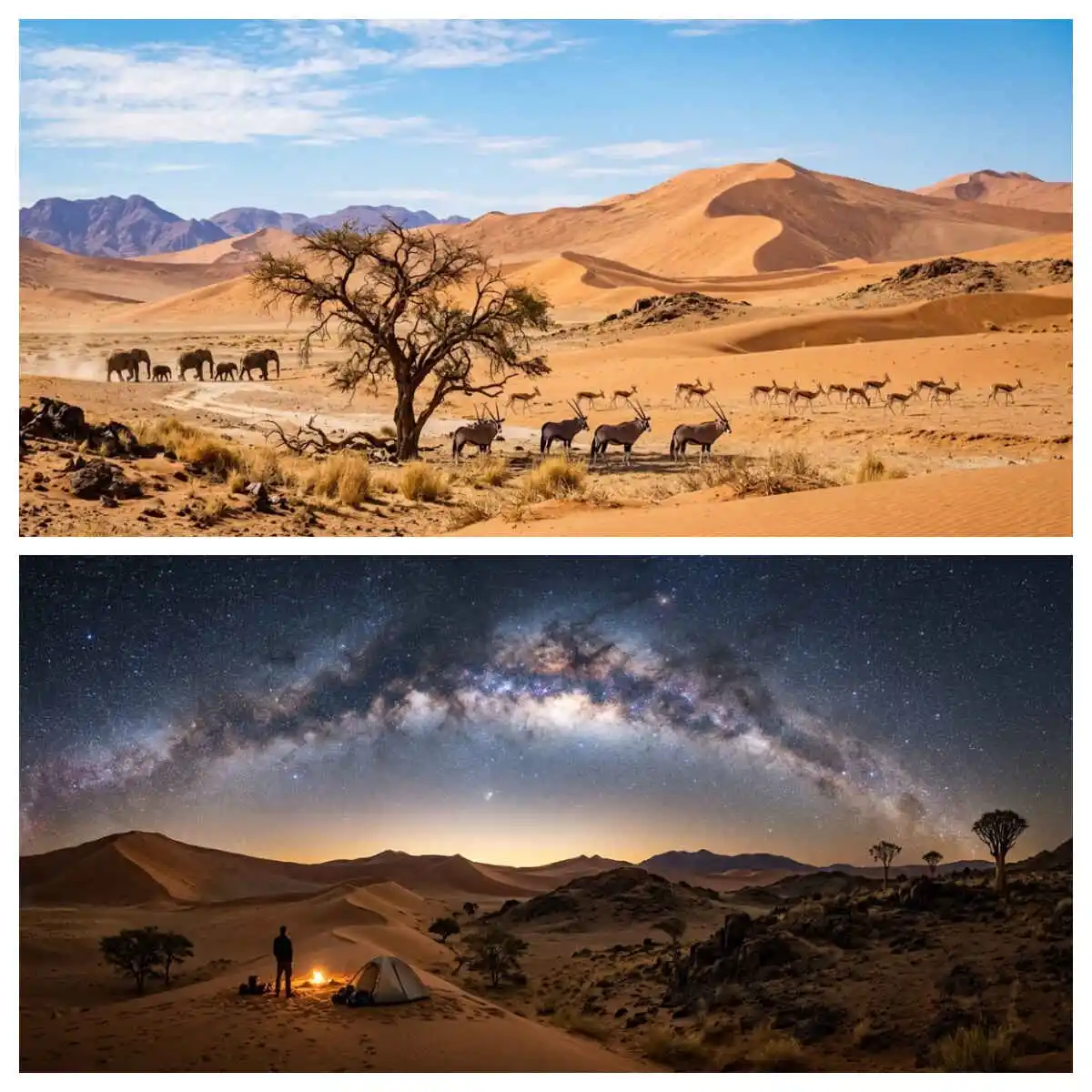
Wedged between the Atlantic Ocean and the Kalahari Desert on Africa’s southwest coast, Namibia is a country of such staggering, elemental beauty that it almost defies description. It is a land where 1,500-year-old camel thorn trees stand silhouetted against blood-orange dunes at dawn. Where desert-adapted elephants wander moonlit riverbeds. Where the night sky — uninterrupted by light pollution across a territory twice the size of California — blazes with so many stars it looks like fiction. Where you can drive for four hours on a red dirt road and not encounter another vehicle, and where that solitude, rather than feeling empty, feels like one of the rarest and most precious gifts the modern world can offer.
Namibia is not the Africa of postcards — the one of crowded safari lodges and well-worn tourist circuits. It is wilder, quieter, harsher, and infinitely more rewarding than that. It demands something of you: self-sufficiency, adaptability, a willingness to be uncomfortable, to be humbled, and to be completely, gloriously lost in a landscape that has been indifferent to human ambition for millennia.
This is your complete guide to travelling in Namibia — the when, the where, the how, and the why. Buckle up. The road is long, the gravel roads are rough, and it is absolutely worth every single kilometer.

Why Namibia? The Case for Africa’s Most Underrated Destination
Ask most travelers to name African safari destinations, and they’ll say Kenya, Tanzania, South Africa, maybe Botswana. Namibia rarely makes the first-pass list, and that is, paradoxically, one of its greatest attractions.
Namibia has the second-lowest population density in the world — approximately 3.5 people per square kilometer. This is not a statistic; it is a sensory experience. The silence here is so complete in places that you can hear your own heartbeat. The absence of crowds at major natural landmarks — the kind that would be swarming with tourists anywhere else in the world — creates an intimacy between traveler and landscape that is becoming vanishingly rare.
It is also, for a country of such remote wilderness, surprisingly well-structured for independent travel. Roads are good — by African standards, excellent — and the self-drive safari experience here is arguably the finest on the continent. Accommodation ranges from luxury desert lodges with plunge pools overlooking private waterholes to rustic campsites under the Milky Way where the only sound is the occasional bark of a distant hyena.
Namibia is also one of Africa’s great conservation success stories. When it gained independence from South Africa in 1990, it became the first country in the world to include environmental protection in its national constitution. Community-based conservancies now protect vast areas of land, ensuring that the benefits of wildlife tourism flow directly to local communities — making your visit here genuinely good for the places and people you encounter.
The Landscapes: An Embarrassment of Natural Riches
The Namib Desert — The World’s Oldest Desert
The Namib is believed to be the oldest desert on Earth, dating back between 55 and 80 million years. It stretches nearly 2,000 kilometers along Namibia’s Atlantic coastline, and it is unlike any desert you have ever imagined. This is not a wasteland of flat, featureless sand. It is a landscape of extraordinary sculptural drama — towering dune systems colored in shades from pale apricot to deep burnt sienna, ancient dried riverbeds choked with camel thorns, coastal fog-deserts where life survives on moisture extracted from Atlantic mist.
The centerpiece is Sossusvlei, a salt and clay pan surrounded by some of the tallest dunes on Earth. Dune 45, the most photographed, rises 170 meters from its base. But it is Big Daddy, at approximately 325 meters, that takes your breath away — and then demands it back on the climb up. At sunrise, when the angled light picks out every ripple and ridge in the sand, and the shadows fall as brushstrokes across the dune faces, Sossusvlei is as close to a religious experience as geography can provide.
Nearby is Dead Vlei — a white clay pan studded with skeletal camel thorn trees estimated to be 900 years old, long dead but preserved by the extreme aridity. The contrast of black dead trees, bone-white pan, and burnt-orange dunes against an impossibly blue sky creates the most photographed image in all of Namibia, and for very good reason.
Etosha National Park — The Wildlife Heartland
Etosha is Namibia’s flagship national park and one of Africa’s finest wildlife destinations. At its center is the Etosha Pan — a vast, shimmering salt flat visible from space — which gives the park its name. The Ovambo word “Etosha” means “great white place of dry water,” and it is an apt description of the otherworldly white expanse that dominates the landscape.
What makes Etosha exceptional — and different from most other African parks — is its system of waterholes. In the dry season (May through October), animals converge on these waterholes in extraordinary concentrations, making wildlife viewing here almost effortless. You simply park at a floodlit waterhole at dusk and watch the parade: elephants, rhinos, lions, leopards, cheetahs, giraffes, zebras, wildebeest, and dozens of antelope species arriving throughout the night for their critical drink. Many camps have waterhole viewing areas where you can sit with a cold drink and watch this ancient drama unfold from the comfort of a deckchair.
Etosha is one of the best places in Africa to see black rhino — a critically endangered species that exists here in significant numbers, patrolled by remarkable anti-poaching conservation teams.
Damaraland — Ancient Land of Giants
North of the Namib and west of Etosha, Damaraland is a vast, rugged terrain of volcanic rock, petrified forests, and ancient river valleys. This is desert elephant country — a population of elephants that has adapted over generations to survive in arid conditions, developing longer legs, smaller bodies, and the ability to go several days without water.
Damaraland is also home to Twyfelfontein, one of Africa’s most important rock art sites, with over 2,000 engravings made by the San people over a period of at least 6,000 years. A UNESCO World Heritage Site, it offers direct and humbling contact with one of humanity’s oldest continuous cultural traditions.
The geological landmarks here are equally extraordinary — the Organ Pipes, a dramatic formation of columnar dolerite, and the Burnt Mountain, a hillside of shale that seems to smoulder with internal color in the afternoon light.
The Skeleton Coast — The Wildest Shore on Earth
The Skeleton Coast takes its name from the whale and seal bones once bleached by its shores, and from the fate of the countless sailors whose ships foundered on its treacherous, fog-shrouded coastline. It is one of the most remote and inhospitable stretches of coastline on Earth — and one of the most hauntingly beautiful.
Seals by the hundreds of thousands bark and writhe at Cape Cross. Shipwrecks rust in the surf. Desert-adapted lions roam the gravel plains. Cold Benguela Current upwellings bring extraordinary marine life — including enormous pods of dolphins and regular whale sightings — to just offshore. The Skeleton Coast is not for everyone; it requires commitment to reach, and it offers no comfort or concession. What it offers instead is the raw, unmediated wildness of a calibre almost impossible to find anywhere else on Earth.
Fish River Canyon — The Grand Canyon of Africa
In the south, Fish River Canyon is the largest canyon in Africa and the second largest in the world after the Grand Canyon. Stretching 160 kilometers in length, up to 27 kilometers in width, and reaching depths of 550 meters, it is a geological spectacle of immense scale. The five-day Fish River Canyon hiking trail — one of Africa’s iconic multi-day hikes — descends into the canyon and follows the river for 90 kilometers. It is demanding, requiring permits and medical certificates, and it is unforgettable.
The People: A Rich Tapestry
Namibia is home to approximately 13 distinct ethnic groups, each with its own language, culture, and traditions. The San (Bushmen) are the country’s original inhabitants, with a presence that stretches back over 20,000 years and a culture built around one of the most sophisticated ecological knowledge systems in human history. The Himba people of the Kunene region maintain a traditional pastoral lifestyle largely unchanged for centuries, the women wearing ochre-colored body paste and elaborate iron jewelry. The Herero people, whose history includes the devastating German colonial genocide of 1904–1908, wear distinctive Victorian-style dresses adopted as a form of dignified cultural resistance. The Ovambo, Namibia’s largest ethnic group, dominate the fertile north.
Interacting respectfully with these communities — through responsible cultural tourism, community conservancy visits, or simply through the small towns and roadside stalls that dot the travel routes — is one of the most enriching dimensions of any Namibian journey.
When to Go
May to October is the dry season and the prime time for wildlife viewing, particularly in Etosha. Days are warm to hot, nights can be surprisingly cold in the desert, and the absence of vegetation makes animals easier to spot. The dunes of Sossusvlei are at their most dramatic in the early morning and late afternoon light year-round.
November to April is the green season, coinciding with occasional rains. The landscape transforms dramatically — the Namib blooms, the pan fills in places, and bird life explodes. This is also the best time for photography due to dramatic cloudscapes, and accommodation rates drop significantly. However, some roads become impassable, and wildlife is more dispersed.
August and September represent the peak of the dry season in Etosha, with the highest animal concentrations at waterholes. These are also the busiest months — book accommodation well in advance.
How to Get Around: The Self-Drive Safari
The single best way to experience Namibia is to rent a four-wheel-drive vehicle and drive it yourself. This is not simply a logistical recommendation — it is the heart of the Namibian travel experience. The freedom to stop wherever you want, to watch a pair of desert-adapted oryx at dawn without checking a schedule, to pull off the road and sit in silence beneath a quiver tree while the sun goes down — this is what makes Namibia unlike anywhere else.
A 4×4 is essential for many of the most rewarding roads, particularly in Damaraland, the Skeleton Coast, and any destination involving gravel. Standard roads in Namibia are generally gravel rather than tarred, and while they are usually manageable, a high-clearance vehicle is strongly recommended. Carry extra water, extra fuel, and extra tyres — distances between services can be vast.
Windhoek, the capital, is the hub for vehicle hire and the starting point for most itineraries. The city itself is compact, clean, and walkable, with excellent German-influenced bakeries and an accessible city center that rewards an afternoon’s exploration.
Where to Stay: From Desert Camps to Luxury Lodges
Namibia offers an extraordinary range of accommodation, all of it, at its best, deeply integrated into the natural environment.
Namib Rand Nature Reserve offers some of the finest private lodge experiences in Africa — dark sky-compliant lodges where the Milky Way blazes overhead without interference. It is an International Dark Sky Reserve, recognized as one of the best stargazing destinations on Earth.
Little Kulala at Sossusvlei offers private “kulala” units on raised decks where you sleep beneath the open sky, waking before dawn to be first onto the dunes.
Wolwedans in the Namib Rand is a collection of tented camps that feel as though they have grown naturally from the red gravel plains.
Ongava Tented Camp on the southern boundary of Etosha offers private game drives and waterhole access alongside one of Namibia’s most important black rhino conservancies.
For budget travelers, Namibia’s network of NWR (Namibia Wildlife Resorts) camps within national parks offers reliable, clean accommodation at accessible prices, often with floodlit waterholes and excellent game viewing from within the camp itself.
Practical Travel Information
Visa: Most nationalities can enter Namibia visa-free for stays of up to 90 days. Check current requirements based on your passport.
Currency: The Namibian dollar (NAD) is pegged at parity with the South African rand, and both are widely accepted.
Language: English is the official language and is widely spoken alongside Afrikaans, Oshiwambo, and German.
Health: Yellow fever vaccination is required if arriving from a yellow fever endemic country. Malaria prophylaxis is recommended for travel in the Caprivi Strip and northern regions. Medical facilities are limited outside Windhoek — comprehensive travel insurance is essential.
Safety: Namibia is one of Africa’s safest countries for travelers. Standard urban precautions apply in Windhoek, but rural travel is generally very safe.
Internet and Connectivity: Coverage is good along main routes and in towns. Remote areas have no signal — plan accordingly and download offline maps.
The Night Sky: Namibia’s Most Overlooked Attraction
It would be a significant omission to discuss Namibia without dedicating specific attention to its night sky. With some of the lowest light pollution levels anywhere on Earth, and lying at a latitude that gives access to the spectacular southern sky, Namibia offers stargazing experiences that are, quite simply, among the most profound available to any human being with an open mind and a clear night.
The Namib Rand Nature Reserve is designated as Africa’s first International Dark Sky Reserve. On a moonless night, the Milky Way is not just visible here — it is so densely brilliant that it casts a discernible shadow. Southern hemisphere constellations, the Magellanic Clouds (satellite galaxies of the Milky Way visible to the naked eye), and the brilliant arc of the galactic core are visible with such clarity that most first-time viewers are reduced to silence.
Many lodges offer guided astronomy evenings with telescopes. The sky alone is worth the journey.
Conclusion
Namibia will not wrap its arms around you and make you feel immediately comfortable. It is not that kind of place. It is austere, demanding, vast, and — precisely because of all of these qualities — absolutely magnificent. The rewards it offers are not served on silver platters; they are discovered at the end of long dusty roads, in the silence before dawn on top of a dune, in the face of a desert elephant encountered unexpectedly in a dry riverbed, and in the night sky above a remote camp where nothing stands between you and the edge of the galaxy.
Africa will break your heart in beautiful ways. Namibia will then put it back together, rearranged, expanded, and fundamentally changed.
Go. The desert is waiting.
FAQs
- Do I need a visa to travel to Namibia?
Citizens of most countries — including the USA, UK, Australia, EU nations, and South Africa — can enter Namibia visa-free for up to 90 days. Always confirm the latest requirements with the Namibian embassy for your specific nationality before travel.
- What is the best time of year to visit Namibia?
May through October (dry season) is ideal for wildlife viewing, especially in Etosha. For the best dune photography at Sossusvlei, go year-round but visit at sunrise. The green season (November to April) offers dramatic landscapes and lower prices, but can bring impassable roads.
- Is Namibia safe for tourists?
Yes — Namibia is consistently rated one of Africa’s safest destinations for international travelers. Violent crime against tourists is rare. Standard precautions apply in Windhoek (avoid walking alone at night, don’t display valuables), but rural travel is generally very safe.
- Do I need a 4×4 vehicle in Namibia?
For most major tourist routes, a high-clearance 2-wheel-drive is manageable. However, a 4×4 is strongly recommended if you plan to visit Damaraland, the Skeleton Coast, the Kaokoveld, or any remote areas. A 4×4 opens Namibia’s most extraordinary landscapes to you.
- How do I get to Namibia?
The main international entry point is Hosea Kutako International Airport, approximately 42 kilometers east of Windhoek. Major airlines connect through Johannesburg, Cape Town, Frankfurt, London, Dubai, and Addis Ababa. There are no direct long-haul flights from North America or Asia to Namibia.
- What currency is used in Namibia?
The Namibian dollar (NAD) is the official currency, pegged at 1:1 with the South African rand. Both currencies are accepted in Namibia. US dollars, euros, and British pounds can be exchanged at banks and airports. Credit cards are accepted in cities and larger lodges, but rarely in remote areas.
- Is Namibia expensive to travel in?
Namibia occupies a mid-to-upper price range for African safari destinations. Luxury lodges can cost $500–$1,500 per person per night. Budget camping at national park campsites typically costs $20–$50 per site. Self-drive travel with camping brings the cost significantly down. Fuel and park entry fees are additional costs to budget for.
- What languages are spoken in Namibia?
English is Namibia’s official language and is widely understood. Afrikaans, German, Oshiwambo, Herero, and Nama are also commonly spoken. You can comfortably travel in Namibia speaking only English, though a few words of Afrikaans or local greetings are warmly appreciated.
- What vaccines do I need for Namibia?
Yellow fever vaccination is required only if you are arriving from a yellow fever-endemic country. Routine vaccinations (hepatitis A and B, typhoid, tetanus, rabies) are recommended. Malaria prophylaxis is advised for travel in northern regions, particularly the Caprivi Strip (Zambezi Region). Consult a travel medicine specialist at least four weeks before departure.
- What wildlife can I see in Namibia?
Namibia hosts extraordinary wildlife diversity, including African elephants (both savanna and desert-adapted), black and white rhinos, lions, leopards, cheetahs (Namibia has the world’s largest free-ranging cheetah population), African wild dogs, hippos, crocodiles, giraffes, zebras, wildebeest, springbok, oryx, and over 650 bird species.
- What is Sossusvlei, and why is it famous?
Sossusvlei is a salt and clay pan in the Namib-Naukluft National Park, surrounded by the world’s tallest dunes — some exceeding 300 meters. It is famous for the extraordinary visual drama of its dune landscapes and for nearby Dead Vlei, a white clay pan filled with ancient dead camel thorn trees.
- How do I visit Etosha National Park?
Etosha is easily accessible by sealed road from Windhoek (approximately 5 hours). The park has three main gates: Anderson, Von Lindequist, and Galton. Inside, you self-drive to waterholes and viewpoints using a park map. Accommodation options range from budget campsites to comfortable chalets at NWR camps, including Okaukuejo, Halali, and Namutoni.
- What is the Skeleton Coast?
The Skeleton Coast is Namibia’s remote and inhospitable northern coastline, named for the whale bones and shipwrecks along its shores. It is home to enormous Cape fur seal colonies, desert-adapted lions, and dramatic fog-desert landscapes. The northern Skeleton Coast wilderness requires special permits and is accessible mainly via fly-in safari.
- Can I see the Milky Way in Namibia?
Yes — Namibia is one of the world’s premier stargazing destinations. The Namib Rand Nature Reserve is Africa’s first and only International Dark Sky Reserve. With virtually no light pollution across vast areas of the country, the Milky Way is strikingly visible to the naked eye on clear, moonless nights.
- What is a community conservancy in Namibia?
Community conservancies are communally managed areas of land established to protect wildlife and natural resources while delivering direct economic benefits to local people through tourism. Namibia’s community conservancy program is internationally celebrated as one of conservation’s greatest success stories, covering over 20% of the country’s land.
- How long should I spend in Namibia?
A minimum of ten to fourteen days allows you to cover the key destinations: Windhoek, Sossusvlei, Damaraland, and Etosha. Three weeks gives a more relaxed pace with time for the Skeleton Coast and the south. A full month allows a comprehensive circuit including Fish River Canyon, the Caprivi Strip, and deeper exploration of Damaraland.
- Is Namibia suitable for families with children?
Yes. Namibia is an excellent family destination. Children are fascinated by wildlife and by the dramatic landscapes. Most lodges welcome children. The biggest considerations are the long driving distances, heat in the desert, and sun protection. Many family-friendly lodges offer dedicated children’s activities and guides.
- What is the Himba people’s culture like?
The Himba are a semi-nomadic pastoral people of the Kunene region who maintain traditional practices with remarkable continuity. Women coat their skin and hair with otjize — a mixture of ochre and butter — for protection and cosmetic reasons. Visits to Himba communities should be arranged through responsible operators who ensure communities benefit directly and consent to interactions.
- Can I see the Big Five in Namibia?
Namibia does host all five of the Big Five — lion, leopard, elephant, buffalo, and rhino — though buffalo are less commonly encountered. Etosha is the best place to see all five, with particularly strong rhino and elephant populations. The country’s vast open landscapes also make it an outstanding destination for the cheetah.
- What is the road like in Namibia for driving?
Main roads between major destinations are generally good gravel or sealed. Gravel roads require adjusted driving speeds (typically 80 km/h maximum) and awareness of corrugations, loose gravel, and oncoming vehicles. Distances are vast — plan driving days carefully and always carry more water and fuel than you think you’ll need.
- What is the food like in Namibia?
Namibian cuisine reflects its mixed colonial and indigenous heritage. Expect excellent game meat (kudu, oryx, and springbok are superb), German-influenced baked goods and sausages (Windhoek has outstanding German-style bakeries), and fresh seafood along the coast. Braai (barbecue) culture is central to social life. Vegetarians will find options limited outside Windhoek and major lodges.
- What should I pack for a trip to Namibia?
Essentials include lightweight, neutral-colored clothing for safari (avoid blue, which attracts tsetse flies), warm layers for cold desert nights, a wide-brimmed hat, high-SPF sunscreen, insect repellent for northern regions, quality binoculars, and a camera with extra memory and batteries. Offline maps (Maps.me or Hema) downloaded before departure are invaluable.
- Is there mobile phone coverage in Namibia?
Coverage is available in Windhoek, towns, and along main routes. Remote areas — Damaraland, Skeleton Coast, Fish River Canyon — have little or no signal. A local MTC SIM card is inexpensive and provides good data coverage in populated areas. Inform people of your route when venturing into remote regions without connectivity.
- What is the Namibian climate like?
Namibia is predominantly hot and arid. Coastal regions are moderated by the cold Benguela Current and can be cool and foggy year-round. The central plateau (including Windhoek) is pleasant with warm days and cool nights. Desert regions are extreme — temperatures exceeding 45°C in summer and dropping below freezing on winter nights.
