
Table of Contents
Venice Is Sinking — And That’s Exactly Why You Need to Go Right Now
Introduction: A City That Should Not Exist
Venice should not exist. It was built on 118 wooden-piled islands in a tidal lagoon by people desperate enough to flee barbarian invaders and clever enough to transform impossible geography into one of history’s greatest civilizations. For over a thousand years, it was the most powerful trading empire in the known world, controlling the spice routes between East and West, producing painters that redefined European art, and building a city so theatrical and so improbable that even today — in an age of skyscrapers and space stations — it stops people in their tracks.
More than 20 million visitors arrive every year. Many stay only a few hours, shuffle between San Marco and the Rialto, eat a mediocre pizza, and leave thinking they have experienced Venice. They have not. The real Venice — its ancient bacaro bars, its fish-scented morning markets, its silent back canals where a cat watches you from a windowsill — belongs to those willing to slow down and get a little lost.
This guide is your key to that other Venice. Whether you have two days or two weeks, a shoestring budget or a luxury itinerary, the city rewards the curious and punishes the impatient. Consider this your invitation.
A City Born of Desperation: Venice Through the Ages
The founding legend says refugees from the Roman city of Aquileia, fleeing Attila the Hun, waded into the Venetian lagoon and drove stakes into the mud. The reality is less dramatic but no less remarkable: from the 5th century onward, lagoon communities gradually consolidated, draining marshes, building on compacted islands, and constructing a labyrinth of canals that served simultaneously as streets, sewers, and defensive moats.

By the 9th century, Venice was an independent republic governed by an elected Doge and a sophisticated system of councils designed to prevent any single family from seizing total power. By the 13th century — after the Fourth Crusade, which ruthlessly redirected to sack Constantinople — Venice controlled trade routes from the eastern Mediterranean to northern Europe, accumulating a wealth that funded the extraordinary architecture still visible today.
The Republic of Venice lasted over a thousand years, until Napoleon dissolved it in 1797. Nowhere else in European history does a democratic institution — however oligarchic by modern standards — demonstrate such extraordinary longevity. That resilience, that refusal to accept the obvious limitations of its situation, is written into the very stones of every bridge and palazzo.
Getting There and Getting Around
By Air
Venice Marco Polo Airport (VCE) is the main gateway, receiving direct flights from most European hubs and transatlantic connections via Rome or Milan. Treviso Airport (TSF), 30 km away, serves low-cost carriers. From Marco Polo, the Alilaguna public water bus is the most atmospheric arrival option — after a 70-minute journey across the lagoon, you step directly into Venice rather than onto a bus.
By Train
Venice Santa Lucia station sits at the western tip of the main island, making train travel from Rome (3.5 hours on the Frecciarossa), Florence (2 hours), or Milan (2.5 hours) a seamless and scenic option. The first sight of the Grand Canal as you exit the station is one of Italy’s great arrival moments.
Getting Around the City
Venice has no cars, no bicycles, and no trams. You walk, or you float. The public vaporetto network covers the Grand Canal (Line 1, the slow scenic route; Line 2, faster), the outer islands, and the Giudecca. A 48-hour or 72-hour vaporetto pass offers unlimited travel and represents excellent value. Water taxis are elegant but expensive and best reserved for luggage-heavy arrivals.
The Six Sestieri: Venice Neighbourhood by Neighbourhood
San Marco
The historic and touristic heart of the city, home to the Piazza San Marco, the Doge’s Palace, the Basilica, and the Campanile. Undeniably magnificent; also the most crowded, the most expensive, and the least representative of daily Venetian life. Visit early morning before the day-tripper vaporetti arrive.
Cannaregio
The northernmost and most populous sestiere, containing the world’s first Jewish Ghetto (established 1516), the magnificent Madonna dell’Orto church, and the Ca’ d’Oro palace. Cannaregio’s fondamenta (canal-side walkways) are lined with authentic bacari and local grocery shops. It is the best sestiere for budget accommodation and genuinely local restaurants.
Dorsoduro
Dorsoduro occupies the southern edge of the main island and is home to two of Venice’s finest art museums — the Gallerie dell’Accademia and the Peggy Guggenheim Collection — as well as the dramatic Baroque church of Santa Maria della Salute. The Campo Santa Margherita is the best outdoor socialising spot in the city, packed with students from Venice’s Ca’ Foscari University.
San Polo and Santa Croce
Together, these western sestieri contain the Rialto Market (the best food shopping in the city), the Frari church with Titian’s extraordinary Assumption altarpiece, and the Scuola Grande di San Rocco with its breathtaking Tintoretto ceiling cycle. Narrow calli here feel genuinely labyrinthine — losing yourself in them is compulsory.
Castello
The largest sestiere, stretching east to the peaceful Via Garibaldi and the Giardini della Biennale. Castello feels furthest from the tourist mainstream; its residents still hang laundry across the calli, and the Arsenal — the vast medieval shipyard that once launched a warship a day — dominates the eastern waterfront.
What to Eat and Drink in Venice
Venetian cuisine is one of Italy’s most distinctive regional traditions, shaped by centuries of trading with the Orient, by the abundance of the lagoon, and by a culture that never stopped inventing. It bears little resemblance to the pizza-and-pasta template of most Italian tourist restaurants — which is precisely why eating well in Venice requires ignoring roughly 80% of the menus you see.
Cicchetti Culture
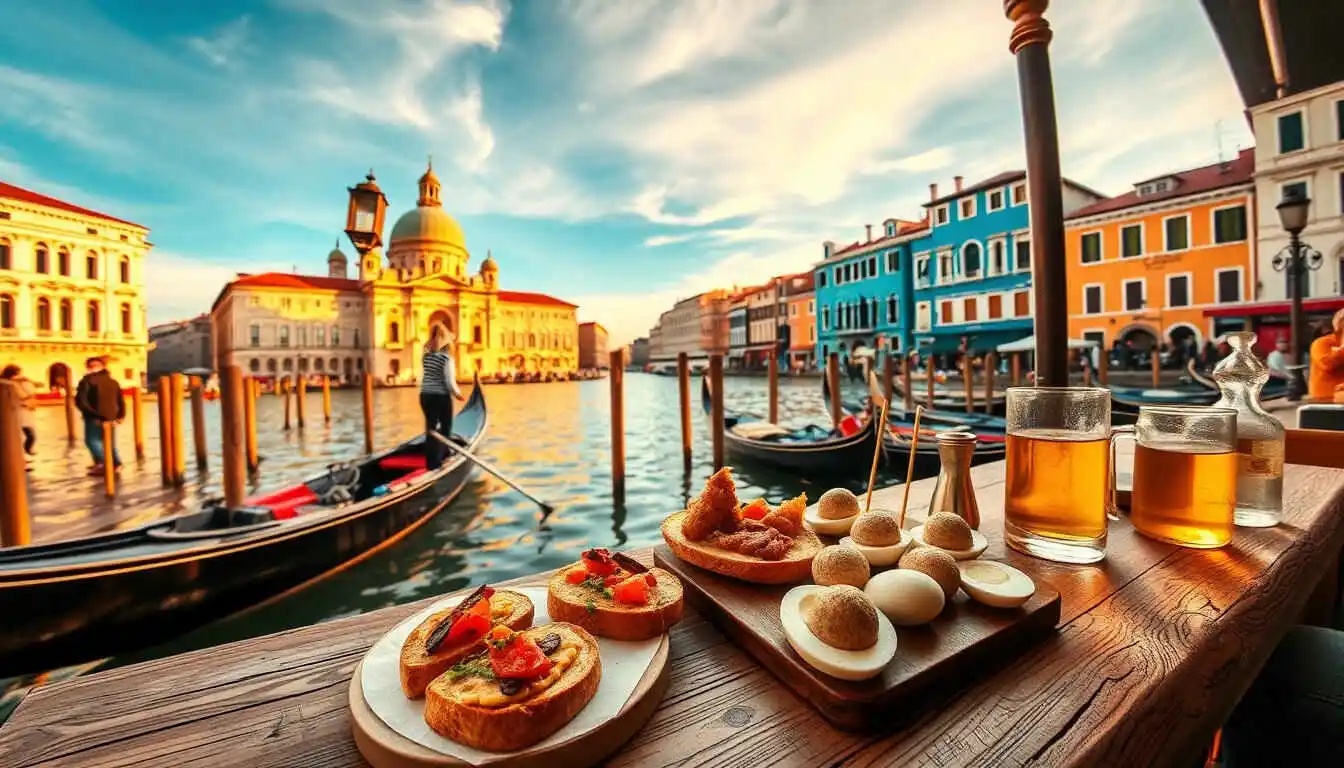
The cicchetti ritual is how Venetians eat. Between noon and 2 pm, and again from 6 to 8 pm, Venetians move between bacari — tiny, standing-room-only wine bars — sipping an ombra (a small glass of wine) and eating small snacks for EUR 1.50 to EUR 2.50 each. A three-bacaro giro (round) costs less than a single tourist-restaurant main course and is infinitely more delicious. Look for Cantina Do Mori, All’Arco, and Osteria all’Orto dei Mori.
Signature Dishes to Seek Out
- Sarde in saor: sardines marinated in sweet-sour onion, raisins, and pine nuts — a recipe unchanged since the 14th century
- Bigoli in salsa: thick whole-wheat pasta with a slow-cooked anchovy and onion sauce
- Baccala mantecato: salt cod whipped with olive oil into a creamy mousse, spread on grilled polenta
- Risi e bisi: a thick, porridge-like rice and pea dish that was served to the Doge every St. Mark’s Day
- Moleche: soft-shell crabs caught in the lagoon, dipped in beaten egg and deep-fried — available only in spring and autumn
- Tiramisu: invented in the Veneto region, though the exact provenance is disputed — Venice serves excellent versions
Art, Architecture & Culture: Venice’s Inexhaustible Treasures
It is tempting to call Venice an open-air museum, but that framing does it an injustice. Venice is a living city in which extraordinary art and architecture happen to be embedded in the fabric of everyday life. The Gothic arch over the neighbourhood grocery, the Bellini altarpiece in the parish church, the Baroque ceiling in the post office — this density of beauty is unparalleled anywhere on earth.
Must-See Art and Architecture
- Mark’s Basilica: the greatest Byzantine building in Western Europe, with its golden mosaics covering 8,000 square metres of ceiling
- Doge’s Palace: the political heart of the republic for 900 years, containing Tintoretto’s Paradise, the largest oil painting in the world
- Gallerie dell’Accademia: the supreme collection of Venetian painting, from medieval gold-ground altarpieces to the luminous canvases of Titian and Veronese
- Scuola Grande di San Rocco: Tintoretto spent 23 years painting its walls and ceilings — Ruskin called it one of the three greatest paintings in Europe
- Peggy Guggenheim Collection: the finest collection of 20th-century art in Italy, displayed in Peggy’s former palazzo on the Grand Canal
- Santa Maria della Salute: Baldassare Longhena’s masterpiece, built as a votive offering after the 1630 plague, commands the mouth of the Grand Canal
Practical Travel Tips: Surviving and Thriving in Venice
Timing Your Visit
The single most impactful decision you can make is when to arrive in Venice each day. Day-trippers arrive from cruise ships and tour buses between 10 am and 5 pm. If you are staying overnight — which you absolutely should — you have the city to yourself before 8 am and after 7 pm. Those hours are among the most magical in European travel.
Avoiding the Crowds
The tourist crush is concentrated in a surprisingly small area: Piazza San Marco, the Rialto Bridge, and the 200-metre stretch connecting them. Step two minutes off this route in any direction, and the crowds thin dramatically. The best rule: if a street is too wide to touch both walls simultaneously, you are probably on a tourist route.
Money-Saving Strategies
- Stay in Mestre (mainland) and commute in — saves 50-70% on accommodation
- Buy a 48- or 72-hour vaporetto pass for unlimited canal transport
- Eat cicchetti at bacari — budget EUR 10-15 for a full, satisfying meal
- Drink coffee standing at the bar — sit-down prices at tourist cafes can be five times higher
- Visit the Frari and San Zaccaria churches for free Bellini and Titian masterpieces
- Book museum tickets in advance online to avoid long queues and save on door prices
Flooding Preparedness
Acqua alta is part of the Venice experience. Check the Centro Maree Venice tide forecast app before your visit. If high water is forecast, rubber boots (stivali) are available for hire throughout the city and can be purchased cheaply at hardware shops. Elevated walkways (passerelle) are deployed in the main areas. The flooding typically recedes within four to six hours and, in the era of MOSE, major inundations are increasingly rare.
Day Trips from Venice: The Lagoon Islands
Murano
Just 15 minutes from Venice by vaporetto, Murano has been the capital of Venetian glass-making since 1291, when the republic moved the furnaces to the island to reduce fire risk on the main island. Today, you can watch master glassblowers at work in studio workshops, visit the excellent Glass Museum (Museo del Vetro), and shop directly from artisan studios for far better prices than Venice’s souvenir shops. Murano also has its own excellent bacari and considerably fewer tourists than Venice itself.
Burano
Forty minutes from Venice, Burano is the most photogenic village in the lagoon, its fishermen’s houses painted in a carnival of primary colours according to a system regulated by the local government. It is also the home of Venetian needle-lace (merletto), an intricate craft dating to the 16th century when Catherine de’ Medici ordered a set of lace for the French court. Visit the Lace Museum, have lunch at one of the canal-side trattorie, and walk the quiet northern end of the island where the colours are brightest and the selfie-seekers are fewest.
Torcello
Torcello is Venice in reverse: once the most populated island in the lagoon, home to 20,000 people in the 7th century, it was progressively abandoned as Venice rose and malaria spread. Today, fewer than 20 people live there. What remains is haunting — the Santa Maria Assunta cathedral contains Byzantine mosaics of terrifying beauty, and Attila’s Throne (a stone chair of mysterious origin) sits in an empty field. Ernest Hemingway wrote part of Across the River and Into the Trees while staying at the Locanda Cipriani here.
Venice Is Worth It: A Closing Argument
The criticisms of Venice are real. It is expensive, it is crowded, and it is commercialized in ways that would appall the merchants and painters who built it. The day-visitor fee is a pragmatic response to a genuine crisis of overtourism, and the flooding is not quaint — it is an existential threat to irreplaceable human heritage.
And yet. Stand on the Riva degli Schiavoni at six in the morning as the first light turns the lagoon to hammered copper. Eat a plate of sarde in saor in a bacaro where the same recipes have been made for six hundred years. Watch a glassblower on Murano pull a vase from a furnace and shape it in three seconds of precise, ancient skill. Sit in the Frari and look at Titian’s Assumption until your eyes adjust and the ceiling seems to dissolve into actual gold.
Venice is sinking slowly. The clocks are running. Go now, go properly, stay overnight, eat like a local, get magnificently lost — and you will understand why generation after generation of travelers have called it the most beautiful place on earth.
Frequently Asked Questions
| # | Question | Answer |
| 1 | Is Venice actually sinking? | Yes, Venice is subsiding at roughly 1–2 mm per year due to natural sediment compaction and historical groundwater extraction, while sea levels rise. The MOSE barrier system now protects it from the worst flooding. |
| 2 | When is the best time to visit Venice? | April to June and September to October offer the best balance of mild weather, fewer crowds, and lower prices. July and August are peak-crowded and very hot. |
| 3 | How many days do you need in Venice? | Two full days cover the main highlights; three to four days allow you to explore outer islands and quieter neighborhoods at a relaxed pace. |
| 4 | Is Venice expensive? | The city center is pricey, but booking accommodation in Mestre on the mainland, eating at bacaro bars, and buying a multi-day vaporetto pass cuts costs significantly. |
| 5 | What is acqua alta? | Acqua alta (high water) is seasonal flooding caused by high tides, wind, and low atmospheric pressure. It typically occurs between October and January and usually lasts only a few hours. |
| 6 | Do I need a water taxi from the airport? | Not necessarily. The Alilaguna public water bus connects Marco Polo Airport to central Venice for a fraction of the cost of a private water taxi. |
| 7 | What is the MOSE project? | MOSE (Modulo Sperimentale Elettromeccanico) is a system of 78 inflatable flood barriers installed at the three lagoon inlets. It became fully operational in 2020 and has since prevented major flooding. |
| 8 | Is a gondola ride worth it? | It depends on expectations. A standard 30-minute gondola costs around EUR 80-100 and is a romantic, iconic experience — but do it on a quiet back canal, not the Grand Canal, for atmosphere. |
| 9 | What is the Venice Carnival? | The Venice Carnival (Carnevale di Venezia) is a world-famous festival held in February before Lent. It features elaborate masks, costumes, parades, and masked balls dating to the 13th century. |
| 10 | Can you visit Venice on a day trip? | Yes, but it is the least satisfying way to experience the city. You will miss the magical early-morning and evening atmosphere when the cruise crowds have departed. |
| 11 | What neighborhoods should I explore beyond San Marco? | Cannaregio, Dorsoduro, and Castello are the most characterful and least touristy sestieri. Locals shop, eat, and live there largely undisturbed by tourism. |
| 12 | Which islands near Venice are worth visiting? | Murano (glass-blowing), Burano (colorful fishermen’s houses and lace), and Torcello (the haunting ancient cathedral) are the top three. All are reachable by public vaporetto. |
| 13 | What is a bacaro? | A bacaro is a traditional Venetian wine bar serving cicchetti — small snacks similar to tapas — paired with a glass of local wine called an ombra. It is the quintessential Venetian way to eat affordably. |
| 14 | What should I eat in Venice? | Must-try dishes include sarde in saor (sweet-and-sour sardines), bigoli in salsa (thick pasta with anchovy sauce), baccala mantecato (creamed salt cod), and risi e bisi (rice and peas). |
| 15 | Is Venice safe for tourists? | Venice is one of Italy’s safest cities. Petty theft (pickpocketing in crowded vaporetti) is the main risk. Violent crime is extremely rare. |
| 16 | What is the tourist access fee introduced in Venice? | Venice introduced a day-visitor entry fee for day-trippers arriving on peak days. Overnight guests, residents, workers, and students are exempt. Always check the current rules before visiting. |
| 17 | How do I get around Venice? | On foot and by vaporetto (public water bus). Venice has no cars. Walking is the best way to explore; vaporetto routes cover the Grand Canal and outer islands efficiently. |
| 18 | What is the Grand Canal? | The Grand Canal is Venice’s main waterway, roughly 4 km long and S-shaped, lined with over 170 Gothic, Renaissance, and Baroque palaces. Crossing it on the Rialto Bridge is a bucket-list moment. |
| 19 | Are there free things to do in Venice? | Absolutely. Walking the back calli (streets), attending Mass at the Frari church, visiting the Rialto market, and watching the sun set from Punta della Dogana cost nothing. |
| 20 | What is the Biennale? | The Venice Biennale is one of the world’s most prestigious cultural events, alternating between Contemporary Art (odd years) and Architecture (even years). It draws global artists and critics. |
| 21 | What museum should I not miss? | The Gallerie dell’Accademia houses the world’s finest collection of Venetian painting, including masterworks by Bellini, Titian, Tintoretto, and Veronese. Book tickets in advance. |
| 22 | Is the Doge’s Palace worth visiting? | Definitely, the Palazzo Ducale is one of Europe’s great Gothic buildings. The interior — including the Bridge of Sighs and vast council chambers — rivals Versailles in grandeur. |
| 23 | What is the Bridge of Sighs? | The Ponte dei Sospiri is a white limestone bridge connecting the Doge’s Palace to the New Prison. It was named by Lord Byron, who imagined prisoners sighing their last glimpse of Venice through its windows. |
| 24 | Is Venice child-friendly? | Very. Children love the boat transport, the fish market, the glass-blowing demonstrations in Murano, and the freedom of car-free streets. Pack comfortable shoes — there are many bridges with steps. |
| 25 | What should I wear in Venice? | Comfortable walking shoes are essential — cobblestones and bridge steps are relentless. Cover your shoulders and knees to enter churches. Bring a light waterproof jacket in autumn and winter. |
| 26 | How do I avoid tourist traps in Venice? | Eat at bacari rather than piazza restaurants, buy coffee standing at the bar, walk five minutes off the main tourist routes, and avoid any restaurant displaying photos of food on its menu. |
| 27 | What is Venetian glass? | Venetian (Murano) glass is a centuries-old craft producing exquisite chandeliers, mirrors, jewelry, and decorative pieces. Glassmakers were historically confined to Murano to protect trade secrets. |
| 28 | Can you swim in the Venice canals? | It is both illegal and inadvisable. Canal water is polluted with boat traffic runoff and untreated drainage. Venice’s nearest beaches are the Lido, reachable by vaporetto in 25 minutes. |
| 29 | What is the Rialto Bridge? | The Ponte di Rialto is the oldest and most iconic of the four bridges crossing the Grand Canal. Built between 1588 and 1591, it was for centuries the commercial heart of the city. |
| 30 | Is Venice worth visiting despite overtourism? | Absolutely. The crowds are real but concentrated in a small area. Step away from San Marco, visit in the shoulder season, and stay overnight — Venice’s extraordinary beauty is undiminished. |
Disclaimer: The content on this blog is for informational purposes only. The author’s opinions are personal and not endorsed. Efforts are made to provide accurate information, but completeness, accuracy, or reliability are not guaranteed. The author is not liable for any loss or damage resulting from the use of this blog. It is recommended to use the information on this blog at your own discretion.
© 2026 Travel & Culture Blog | All information correct at time of publication. Always verify current entry fees and transport schedules before travelling.
