
Table of Contents
The Open Mouth That’s Quietly Rewiring Your Face, Your Sleep, and Your Health
Why breathing through your mouth at night is doing far more damage than dry lips and morning breath, and what the science says about fixing it.
A Habit That Feels Harmless Until It Isn’t
Most people who breathe through their mouth at night have no idea they are doing it. There is no alarm, no obvious symptom in the moment, just a slow accumulation of consequences that show up elsewhere: a dry, cracked mouth in the morning, unusually bad breath, a scratchy throat, or a nagging sense of never quite waking up rested no matter how many hours were spent in bed. Because none of these individually seem alarming, mouth breathing tends to go undiagnosed for years, sometimes decades, quietly working against the body’s sleep quality, dental health, and even facial development the entire time.
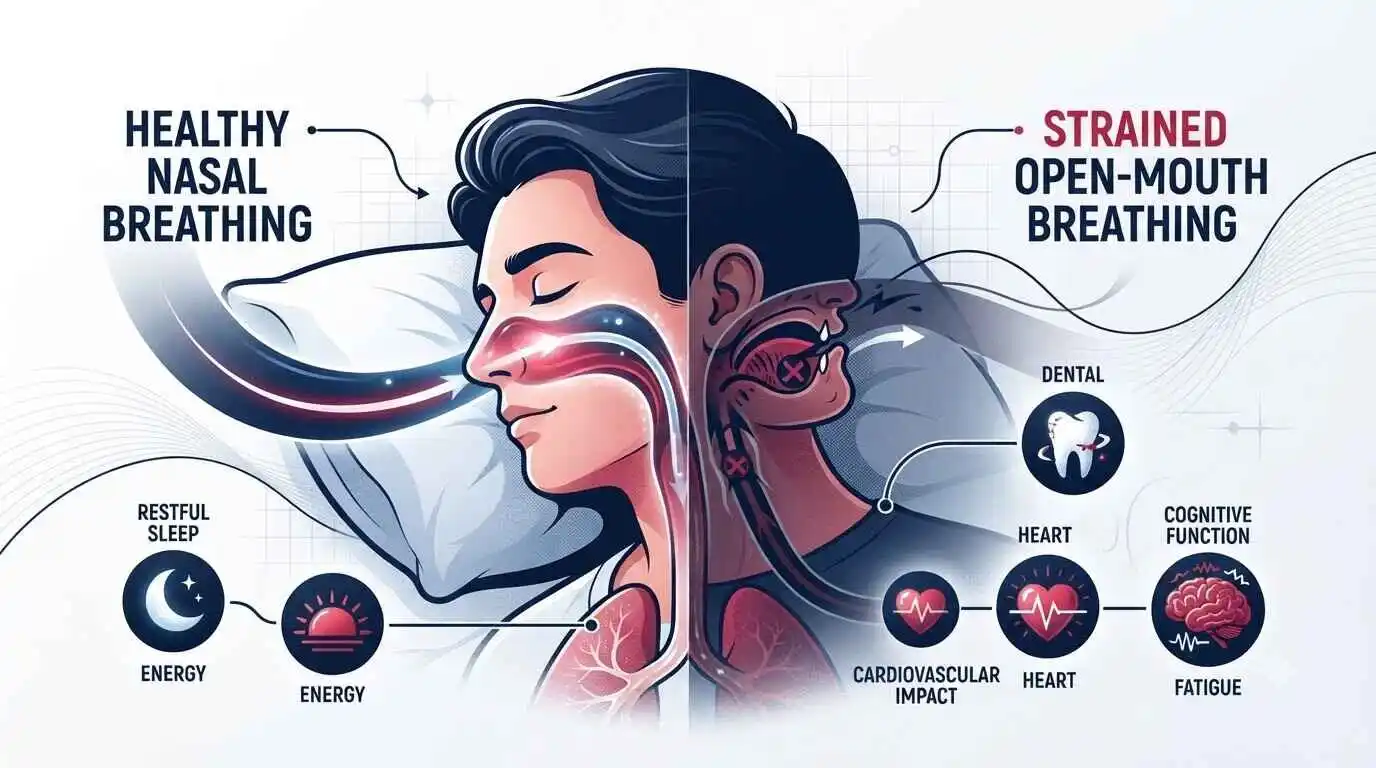
The nose is not simply a backup airway that the mouth can substitute for without consequence. It performs several distinct physiological jobs during breathing that the mouth cannot replicate, and bypassing it night after night, for years, produces measurable, well-documented downstream effects that researchers and clinicians across sleep medicine, dentistry, and pediatrics have been documenting with increasing detail over the past two decades. What follows is a closer look at exactly what those effects are, what actually causes the habit to form in the first place, and what current evidence says about correcting it safely.
What the Nose Actually Does That the Mouth Cannot
Nasal breathing filters incoming air through nasal hair and mucus, trapping dust, allergens, and airborne particles before they reach the lungs, a filtration step the mouth entirely skips. The nose also warms and humidifies air on its way to the lungs, protecting delicate lung tissue from the drying, irritating effect of breathing in cold, dry air directly, which is exactly what happens when the mouth serves as the primary airway instead.

Perhaps most significantly, nasal breathing generates and delivers nitric oxide, a signaling molecule produced in the sinuses that gets carried into the lungs with each nasal breath. Nitric oxide plays an important role in dilating blood vessels and improving oxygen uptake into the bloodstream, meaning nasal breathing is measurably more efficient at oxygenating the body than mouth breathing, which bypasses this nitric oxide pathway almost entirely.
Why the Mouth Becomes the Backup Airway in the First Place
Nobody chooses to mouth breathe for the fun of it; it typically happens because nasal breathing has become difficult or restricted in some way. Chronic nasal congestion from allergies, a deviated septum, chronic sinusitis, or enlarged tonsils and adenoids, particularly common in children, can all partially or fully block comfortable nasal airflow, forcing the mouth to take over as the path of least resistance, especially once a person lies down and gravity and congestion combine to worsen nasal obstruction.
In some cases, mouth breathing becomes habitual even after the original obstruction has resolved, since the body can settle into a learned breathing pattern that persists out of habit rather than ongoing physical necessity. This is part of why treatment sometimes requires more than simply clearing a blocked nose; retraining the habitual breathing pattern itself can be a separate, necessary step.
The Dental Damage Few People Connect to Breathing
Dentists are often among the first professionals to notice signs of chronic mouth breathing, since the condition leaves a distinctive signature inside the mouth itself. Saliva plays a critical protective role in oral health, neutralizing acids, washing away food particles, and delivering minerals that help repair early tooth enamel damage. Mouth breathing dries out the oral cavity throughout the night, sharply reducing saliva’s protective effect for hours at a stretch, which is directly linked to an increased risk of cavities, gum disease, and chronic bad breath.
Beyond the immediate oral environment, chronic mouth breathing, especially when it begins in childhood, has been linked in numerous studies to altered dental and facial development, including a higher likelihood of a narrow, high-arched palate, crowded or misaligned teeth, and an open-bite pattern where the front teeth do not properly meet. Orthodontists and pediatric dentists increasingly consider chronic mouth breathing a meaningful contributing factor when evaluating why a child has developed a particular pattern of dental crowding or bite misalignment.
Saliva is not just spit; it is an hours-long acid-neutralizing, enamel-protecting system that mouth breathing shuts off every single night.
How Mouth Breathing Shapes a Growing Face
The connection between mouth breathing and facial structure is one of the more striking findings in this area of research, particularly regarding children whose facial bones are still actively developing. Habitual mouth breathing during childhood has been associated with what researchers sometimes call “long face syndrome” or adenoid facies, a facial growth pattern characterized by a longer, narrower face, a recessed chin, and a more open-mouth resting posture, believed to result from the tongue resting low in the mouth rather than against the roof of the palate, where it normally provides a gentle, continuous molding pressure during nasal breathing.
This is not a cosmetic footnote; facial and airway structure are closely interconnected, and a narrower, more recessed dental and facial architecture can itself contribute to a smaller airway later in life, potentially increasing the risk of sleep-disordered breathing in adulthood. This creates a concerning feedback loop in some children: nasal obstruction leads to mouth breathing, which contributes to altered facial growth, which can in turn make future nasal and airway function less favorable.
The Sleep Quality Connection
Mouth breathing during sleep is strongly associated with snoring, since an open mouth allows the tongue and soft palate tissue to collapse more easily into the airway, creating the vibration responsible for snoring sounds. In more severe cases, chronic mouth breathing overlaps significantly with obstructive sleep apnea, a condition in which the airway repeatedly narrows or closes entirely during sleep, causing brief awakenings, often unnoticed by the sleeper, that fragment sleep architecture and reduce the amount of deep, restorative sleep achieved over the course of a night.
Even in the absence of full sleep apnea, habitual mouth breathing has been associated with lighter, more fragmented sleep and reduced sleep efficiency in several studies, which helps explain why chronic mouth breathers so frequently report waking up tired despite spending an apparently adequate number of hours in bed. Sleep quality, not just sleep quantity, depends heavily on an airway that functions efficiently throughout the entire night.
Daytime Effects That Trace Back to Nighttime Breathing
The consequences of poor nighttime breathing rarely stay confined to nighttime. Fragmented, lower-quality sleep driven by mouth breathing has been linked to daytime fatigue, difficulty concentrating, irritability, and in children specifically, behavioral and attention difficulties that are sometimes mistakenly attributed to unrelated causes rather than traced back to an underlying sleep-disordered breathing pattern. Pediatric researchers have specifically flagged this connection as clinically significant, since children with chronic mouth breathing and associated sleep-disordered breathing have in some studies shown behavioral profiles resembling attention-deficit conditions that improved measurably once the underlying breathing issue was addressed.
In adults, the cumulative effect of years of lower sleep quality driven by mouth breathing can contribute to chronic fatigue, reduced cognitive performance, and, through the broader well-documented links between poor sleep and cardiovascular and metabolic health, potentially wider health consequences extending well beyond the mouth and airway themselves.
How to Tell if You Are a Mouth Breather
Since mouth breathing typically happens during sleep, when a person has no conscious awareness of their own breathing pattern, most people rely on indirect signs rather than direct observation. A consistently dry mouth or throat upon waking, frequent morning bad breath despite good oral hygiene, waking up with a sore or scratchy throat, visible dry, cracked lips, and snoring reported by a partner are all common indirect indicators worth paying attention to.
A partner or family member observing an open-mouth sleeping posture is one of the more direct and reliable signs available without a formal sleep study. Some dentists and sleep specialists also use simple in-office observations, including how a person breathes while resting quietly with their mouth closed for a short period, or specific dental wear patterns, to help identify a chronic mouth-breathing pattern during a routine appointment.
Addressing the Root Cause First
Effective treatment for chronic mouth breathing generally starts with identifying and addressing whatever is causing nasal obstruction in the first place, rather than jumping directly to a workaround. Allergy management, whether through avoidance strategies, medication, or in some cases allergy immunotherapy, can meaningfully improve nasal airflow for people whose obstruction stems primarily from allergic rhinitis. A deviated septum or chronically enlarged turbinates may require evaluation by an ear, nose, and throat specialist, who can determine whether a structural or surgical intervention is warranted.
In children, enlarged tonsils and adenoids are a particularly common and often correctable cause of chronic mouth breathing, and removal, when clinically indicated, has been shown in multiple studies to improve nasal breathing, sleep quality, and in some cases even facial growth trajectory when addressed at a sufficiently young age, underscoring why pediatricians increasingly emphasize evaluating persistent mouth breathing in children rather than dismissing it as a passing habit.
Mouth Taping and Myo functional Therapy: What the Evidence Actually Shows
Mouth taping, the practice of placing a small piece of tape over the lips during sleep to encourage nasal breathing, has gained substantial popularity through social media and wellness circles in recent years. Some smaller studies suggest it may help reduce snoring and encourage nasal breathing in people without significant underlying obstruction, but sleep medicine specialists generally caution that it is not appropriate for anyone with significant nasal obstruction or diagnosed sleep apnea, since forcibly restricting mouth breathing without first ensuring the nose can adequately handle airflow could create a dangerous airway situation rather than solve one.
Myofunctional therapy, a set of targeted exercises designed to retrain tongue posture and strengthen the muscles involved in nasal breathing, has a more established, though still developing, evidence base, particularly for people whose mouth breathing has become a habitual pattern independent of ongoing physical obstruction. This approach is often used alongside, rather than instead of, addressing any underlying structural or medical cause of nasal obstruction, reflecting the reality that chronic mouth breathing frequently has more than one contributing factor that needs to be addressed together.
When It Is Time to See a Specialist
Persistent snoring, witnessed pauses in breathing during sleep, excessive daytime sleepiness despite adequate time in bed, or a partner’s repeated observation of open-mouth breathing and gasping during sleep are all reasonable prompts to seek an evaluation from a doctor, potentially including a referral to a sleep specialist or an ear, nose, and throat physician. In children, persistent mouth breathing, especially alongside snoring, restless sleep, or noticeable changes in facial or dental development, warrants a conversation with a pediatrician or pediatric dentist rather than an assumption that the child will simply grow out of it.
A formal sleep study remains the definitive way to assess whether mouth breathing has progressed into clinically significant sleep-disordered breathing or sleep apnea, and it is generally the appropriate next step for anyone with concerning symptoms rather than attempting to self-diagnose or self-treat a potentially serious underlying airway issue.
The Cardiovascular Link Researchers Are Watching Closely
Because chronic mouth breathing overlaps so heavily with sleep-disordered breathing and, in more severe cases, obstructive sleep apnea, it inherits much of the same cardiovascular concern that sleep medicine researchers have documented extensively around apnea specifically. Repeated drops in blood oxygen levels during fragmented, obstructed sleep place measurable strain on the cardiovascular system over time, and long-term, poorly managed sleep-disordered breathing has been associated with elevated risk of high blood pressure, irregular heart rhythms, and other cardiovascular complications in the broader research literature.
This does not mean every mouth breather is on a direct path toward heart disease, and the strength of this association depends heavily on severity and duration, but it does add another layer of medical rationale, beyond dental health and daytime fatigue, for treating chronic mouth breathing as a legitimate health concern worth investigating rather than a minor inconvenience to simply live with indefinitely.
Why This Deserves More Attention Than It Gets
Mouth breathing sits in an unusual blind spot within healthcare, straddling dentistry, sleep medicine, allergy care, and in children, pediatric development, which means it does not always fall clearly within any single specialist’s primary focus and can consequently go unaddressed for years despite its documented downstream effects. Recognizing chronic mouth breathing as a genuine, treatable condition, rather than a minor cosmetic quirk or an unavoidable side effect of allergy season, is the first step toward addressing a habit that quietly touches sleep quality, dental health, facial development, and daytime functioning all at once. For something this consequential, a conversation with a doctor or dentist is a considerably smaller undertaking than the years of accumulated, silent effects it can help prevent.
Frequently Asked Questions
| Question | Answer |
| What is mouth breathing? | It is breathing primarily through the mouth instead of the nose, often unconsciously during sleep. |
| Why is nasal breathing better than mouth breathing? | Nasal breathing filters, warms, and humidifies air, and delivers nitric oxide that improves oxygen uptake. |
| What causes mouth breathing at night? | Common causes include nasal congestion, allergies, a deviated septum, and enlarged tonsils or adenoids. |
| Can mouth breathing cause bad breath? | Yes, reduced saliva flow from mouth breathing allows odor-causing bacteria to increase overnight. |
| Does mouth breathing affect dental health? | Yes, it increases risk of cavities, gum disease, and altered dental development over time. |
| Can mouth breathing change facial structure? | Yes, particularly in children, chronic mouth breathing has been linked to altered facial growth patterns. |
| What is adenoid facies? | It refers to a facial growth pattern associated with chronic mouth breathing, including a longer face and recessed chin. |
| Is mouth breathing linked to snoring? | Yes, an open mouth allows airway tissue to collapse more easily, contributing to snoring. |
| Can mouth breathing lead to sleep apnea? | It is strongly associated with sleep-disordered breathing, including obstructive sleep apnea in some cases. |
| Does mouth breathing affect sleep quality? | Yes, it is linked to lighter, more fragmented sleep and reduced sleep efficiency. |
| Can mouth breathing cause daytime fatigue? | Yes, fragmented sleep from mouth breathing often leads to daytime tiredness and reduced concentration. |
| Is mouth breathing linked to attention problems in children? | Some studies show behavioral changes resembling attention issues that improve when breathing is corrected. |
| How can I tell if I mouth breathe at night? | Signs include dry mouth on waking, morning bad breath, sore throat, and partner-reported snoring or open-mouth sleep. |
| What is nitric oxide’s role in nasal breathing? | It helps dilate blood vessels and improves oxygen absorption, a benefit largely bypassed during mouth breathing. |
| Can allergies cause mouth breathing? | Yes, allergic rhinitis is a common cause of nasal congestion that leads to mouth breathing. |
| What is a deviated septum? | It is a structural misalignment of the nasal cavity that can restrict nasal airflow. |
| Do enlarged tonsils cause mouth breathing in children? | Yes, enlarged tonsils and adenoids are a common cause of childhood mouth breathing. |
| Does removing tonsils help mouth breathing? | In many cases yes, especially when tonsils or adenoids are significantly enlarged and obstructive. |
| What is mouth taping? | It is the practice of taping the lips shut during sleep to encourage nasal breathing. |
| Is mouth taping safe for everyone? | No, it is not recommended for people with significant nasal obstruction or sleep apnea. |
| What is myofunctional therapy? | It is a set of exercises designed to retrain tongue posture and support nasal breathing habits. |
| Can adults develop mouth breathing habits later in life? | Yes, though it often begins with an underlying nasal obstruction that triggers the habitual pattern. |
| Should I see a doctor for mouth breathing? | Yes, especially with snoring, daytime fatigue, or witnessed breathing pauses during sleep. |
| What specialist treats mouth breathing? | An ENT, sleep specialist, dentist, or pediatrician may be involved depending on the underlying cause. |
| Can a sleep study diagnose mouth breathing issues? | Yes, a sleep study can assess whether mouth breathing has progressed to sleep-disordered breathing. |
| Does mouth breathing affect saliva production? | It does not reduce saliva production but dries out the mouth by evaporating existing saliva faster. |
| Can children outgrow mouth breathing on their own? | Not always; underlying causes often need evaluation rather than assuming the habit will resolve naturally. |
| Is an open bite related to mouth breathing? | Yes, chronic mouth breathing has been linked to open bite and other dental misalignment patterns. |
| Can treating allergies reduce mouth breathing? | Yes, managing allergic rhinitis can significantly improve nasal airflow and reduce mouth breathing. |
| Why does mouth breathing matter for overall health? | It affects sleep quality, dental health, facial development, and daytime functioning simultaneously. |
⚕️Medical Disclaimer:
The information provided on this website is for general educational and informational purposes only and is not intended as a substitute for professional medical advice, diagnosis, or treatment. Always seek the advice of your physician or other qualified health provider with any questions you may have regarding a medical condition. Never disregard professional medical advice or delay in seeking it because of something you have read on this website.
