
Table of Contents
The Smiling Salamander That Can Regrow Its Own Brain, and Why That Terrifies Cancer to Death
Inside the axolotl’s extraordinary regenerative biology, and why researchers studying human disease keep coming back to this one strange, permanently juvenile amphibian.
An Animal That Refuses to Grow Up
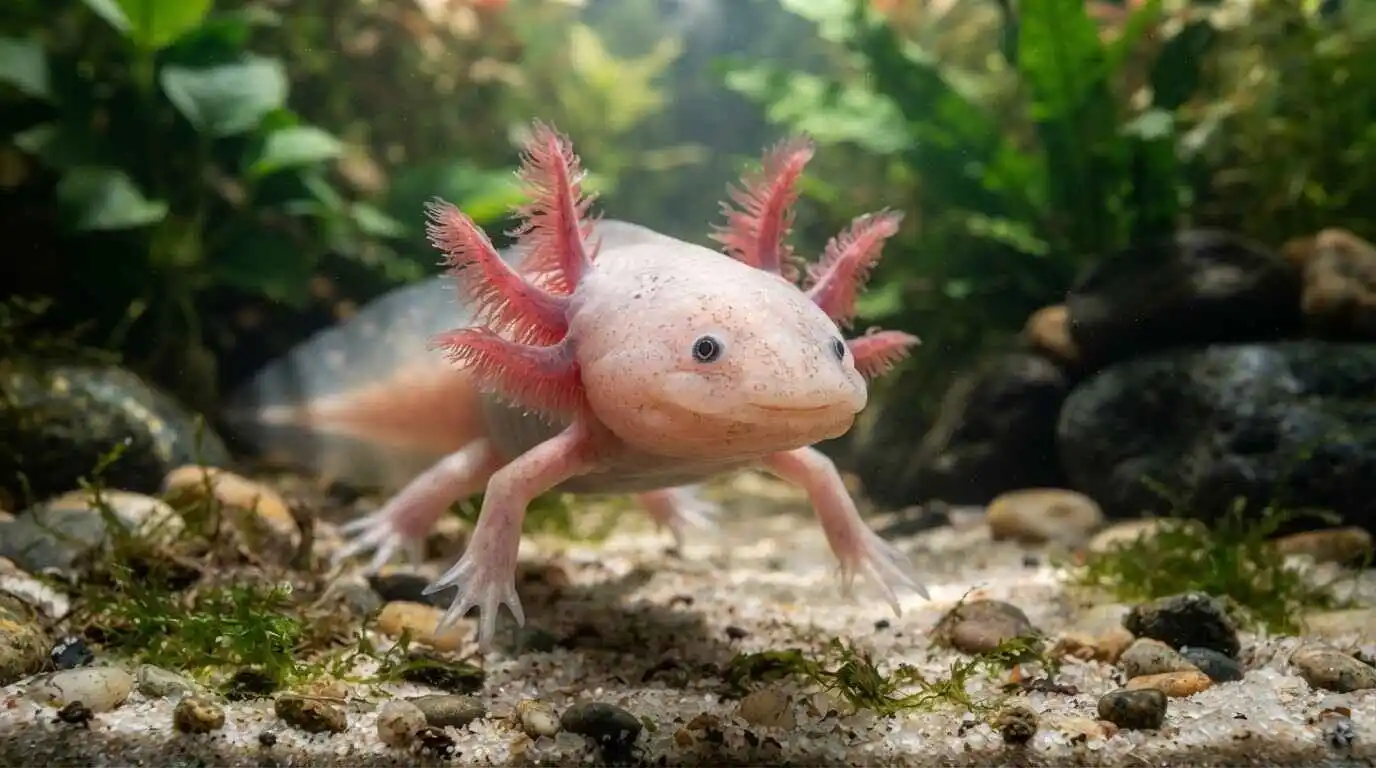
The axolotl looks almost cartoonish: a wide, perpetually smiling mouth, feathery external gills sprouting from either side of its head like a headdress, and stubby limbs that seem slightly too small for its body. That unusual appearance is not an accident of evolution gone strange for its own sake; it is the visible signature of a biological trait called neoteny, in which an animal retains its larval, juvenile features and remains aquatic its entire life instead of undergoing the metamorphosis into a land-dwelling adult that most other salamander species complete.
This alone would make the axolotl a biological curiosity worth a passing mention in a nature documentary. What has actually turned it into one of the most intensely studied animals in modern biology is a separate, far more consequential trait layered on top of its permanent childhood: an almost unmatched capacity to regenerate lost or damaged body parts, including limbs, portions of the heart, spinal cord tissue, and remarkably, parts of its own brain, all without forming the scar tissue that would permanently block that kind of repair in most other vertebrates, including humans.
What Regeneration Actually Looks Like
When an axolotl loses a limb, whether from a predator attack in the wild or a lab injury in controlled research, the wound does not heal over with scar tissue the way a comparable human injury would. Instead, cells at the injury site undergo a remarkable transformation, dedifferentiating, meaning specialized cells like skin, muscle, and bone cells revert to a more primitive, flexible state, forming a structure called a blastema, essentially a mass of cells capable of building an entirely new limb from scratch.

Over a period of weeks to a few months, depending on the animal’s age and the extent of the injury, that blastema develops into a fully functional replacement limb, complete with properly patterned bone, muscle, nerve, and blood vessel tissue, indistinguishable in most respects from the original. This is not a partial, malformed regrowth; axolotls can regenerate the same limb dozens of times over their lifespan without any apparent decline in the quality of the regenerated tissue, a feat essentially unmatched among vertebrate animals.
Beyond Limbs: What Else Grows Back
The axolotl’s regenerative ability extends considerably further than limbs alone, which is part of what has captured such sustained scientific attention. Axolotls can regenerate portions of their spinal cord after injury, restoring functional nerve connections in a way that would leave a human permanently paralyzed below the site of a comparable spinal injury. They can regrow damaged sections of their heart tissue after an induced injury, repairing cardiac muscle rather than replacing it with the non-functional scar tissue that forms after a human heart attack.
Perhaps most strikingly, axolotls have demonstrated the ability to regenerate portions of their own brain and even parts of their eyes, including the retina and lens, following significant injury, a capability found in extremely few other vertebrate species studied to date. Each of these regenerative feats targets a type of injury that, in humans, currently has no equivalent natural repair mechanism, which is precisely why axolotl research sits at the center of so much regenerative medicine research today.
Why Axolotls Don’t Get Cancer the Way Other Animals Do
One of the more counterintuitive findings in axolotl research involves cancer. An animal capable of triggering rapid, extensive cell division to regenerate an entire limb would, in principle, seem like an animal at elevated risk of that same cellular machinery malfunctioning into uncontrolled, cancerous growth. Remarkably, the opposite appears to be true: axolotls show a notably low incidence of cancer, and their tissue appears to have robust internal mechanisms that keep the intense cell proliferation involved in regeneration tightly controlled and properly directed.
Researchers studying this apparent contradiction believe axolotls may possess unusually effective tumor-suppression mechanisms operating alongside their regenerative machinery, essentially allowing controlled, purposeful rapid cell growth during regeneration while somehow preventing that same growth from spiraling into the uncontrolled division characteristic of cancer. Understanding exactly how axolotl cells manage this balance is an active area of ongoing research, with potential implications for understanding why the same regenerative signaling pathways sometimes go wrong in other animals, including humans, and result in tumors instead of repair.
The Genome That Almost Broke Science
Studying axolotl regeneration at the genetic level presented researchers with an enormous practical obstacle for years: the axolotl genome is roughly ten times larger than the human genome, making it, for a long stretch of time, too large and complex to fully sequence with the technology available. This was a serious barrier, since fully understanding the genetic mechanisms behind regeneration requires being able to read and analyze the complete genetic instructions involved.
Advances in sequencing technology eventually made a complete axolotl genome sequence possible, a milestone reached only within roughly the last several years, and it has already yielded significant insights, including the identification of specific genes that appear to play central roles in triggering and coordinating the regenerative process. This genomic breakthrough has meaningfully accelerated the pace of axolotl-related discoveries, since researchers can now investigate specific genetic mechanisms directly rather than working primarily from observational, whole-organism studies.
What This Means for Human Medicine
The ultimate reason axolotl research commands such sustained scientific interest and funding is its potential relevance to human regenerative medicine. If researchers can fully understand the genetic and cellular signaling pathways that allow axolotls to regenerate limbs, spinal cord tissue, and heart muscle without scarring, that knowledge could theoretically inform future therapies aimed at improving human tissue repair after injuries currently considered permanent, spinal cord injuries, heart attack damage, and severe limb trauma among them.
It is important to be realistic about the scale of this challenge. Humans are not axolotls, and the biological, evolutionary, and developmental differences between the two species are substantial; simply identifying a gene involved in axolotl regeneration does not mean that gene can be safely or effectively activated in human tissue to produce a similar effect. Most researchers in this field describe axolotl studies as providing a crucial map of biological possibility, showing what regenerative processes can look like in a vertebrate, rather than a direct, near-term blueprint for human treatments.
Understanding how an axolotl regrows a limb without scarring may matter less for salamanders than for the millions of people living with injuries doctors currently call permanent.
The Species Is Vanishing in the Wild
In a genuinely striking irony, the axolotl is simultaneously one of the most widely studied laboratory animals on the planet and critically endangered in its only natural habitat, a shrinking network of canals and lakes near Mexico City historically centered on Lake Xochimilco. Habitat degradation from urban expansion, water pollution, and the introduction of invasive fish species that prey on young axolotls and compete with them for food have driven wild populations to a fraction of historical levels, with some population surveys suggesting only a small number of individuals remain in the wild.
This creates an unusual conservation situation: laboratory and captive-bred axolotl populations around the world, used extensively in research, vastly outnumber wild individuals, meaning a species facing genuine extinction risk in nature is, at the same time, in no danger of disappearing from science entirely. Conservation efforts in Mexico, including habitat restoration projects and captive breeding programs aimed specifically at eventual wild reintroduction, continue, though reversing the ecological damage to Xochimilco’s waterways remains a significant, ongoing challenge.
Why Axolotls Became Popular Pets and Internet Icons
Beyond the laboratory, axolotls have developed a substantial following as exotic pets and, more recently, as a recognizable internet icon, largely thanks to their distinctive, almost perpetually cheerful facial expression and unusual, alien-like appearance. Their popularity accelerated considerably after an axolotl character became a well-known collectible item in the video game Minecraft, introducing the species to an enormous audience of players who had likely never previously encountered the animal or its underlying biology.
This cultural visibility has had a genuinely useful side effect for conservation awareness, since a species that might otherwise remain an obscure subject confined to biology journals has instead become widely recognized by name and appearance, occasionally translating into public interest in and support for the very real conservation challenges facing wild axolotl populations in Mexico.
Caring for Axolotls in Captivity
Axolotls kept as pets or in research settings require carefully maintained aquatic conditions, since they remain fully aquatic throughout their lives and never develop functional lungs suited for extended time on land the way a metamorphosed salamander would. They need cool, clean, well-oxygenated water, since they are notably sensitive to water temperature and quality, and they are entirely carnivorous, typically fed a diet of worms, small fish, and specially formulated pellets.
Their regenerative capabilities remain fully intact throughout captivity, and this is in fact part of why they have proven so useful and accessible as laboratory animals: researchers can study regeneration directly and repeatedly in a single long-lived individual animal, since axolotls can live ten to fifteen years or more in captivity, rather than needing to rely on a constant supply of new specimens for each stage of a longer research study.
What Scientists Still Don’t Fully Understand
Despite decades of accumulated research and the recent genomic breakthrough, significant gaps remain in scientists’ understanding of exactly how axolotl regeneration works at a complete mechanistic level. Researchers have identified numerous genes and signaling pathways involved in the process, but a full, integrated picture connecting the initial injury response, the formation of the blastema, and the precise patterning that ensures a regenerated limb grows with correctly placed bones, muscles, and nerves remains an active and genuinely unresolved area of ongoing investigation.
This incomplete understanding is not a failure of the research so far; it reflects just how biologically complex true regeneration actually is compared to simple wound healing. Many researchers in the field describe axolotl regeneration as one of the more intricate coordinated biological processes documented in any vertebrate animal, involving the precise, temporary reactivation of developmental programs that are normally used only once, during an animal’s initial embryonic development, and then permanently switched off in most other species.
How Axolotls Compare to Other Regenerating Animals
Axolotls are far from the only animal capable of regeneration, but the scope and quality of their regenerative ability stand out even among other regenerating species. Starfish can regrow lost arms, and some can even regenerate an entire body from a single severed arm under the right conditions, but this occurs through a different biological mechanism than the axolotl’s blastema-based limb regrowth. Zebrafish, another heavily studied laboratory species, can regenerate fin tissue and portions of their heart, making them a valuable comparison species for researchers studying cardiac regeneration specifically.
What distinguishes the axolotl from most of these other regenerating species is the sheer breadth of tissue types it can regenerate, combined with the complexity and completeness of the regrowth. Where many regenerating animals can restore relatively simple structures, the axolotl’s ability to regrow a fully patterned limb, complete with correctly positioned bones, functioning muscle, properly routed nerves, and blood vessels, represents a considerably more sophisticated regenerative feat, which is a significant part of why it remains the reference species researchers return to again and again.
The Ongoing Research Pipeline
Axolotl research today spans a wide range of institutions and approaches, from basic developmental biology labs mapping individual genes involved in regeneration, to more applied research programs specifically searching for parallels between axolotl regenerative signaling pathways and dormant or suppressed pathways that may exist, in a limited form, in human tissue. Some researchers have already identified certain signaling molecules active during axolotl limb regeneration that also appear, in far more limited and less effective form, during human wound healing, raising the tantalizing possibility that some remnant of a more powerful regenerative capacity may exist in a dormant state within human biology as well.
Large, multi-institution research initiatives, along with dedicated axolotl research colonies maintained at universities specifically for ongoing study, continue to expand the pace of discovery, particularly now that the full genome sequence provides a foundation for far more targeted genetic investigation than was possible even a decade ago. Researchers in this field generally describe the current period as an unusually active and promising one for axolotl-related discovery, driven directly by the recent removal of the genomic bottleneck that constrained the field for so long.
Why This One Salamander Keeps Earning Its Reputation
The axolotl has earned a genuinely unusual scientific reputation, not through any single dramatic discovery but through a sustained, decades-long accumulation of findings that keep reinforcing just how exceptional its biology actually is relative to nearly every other studied vertebrate. Its permanently juvenile form, its scarless multi-organ regeneration, its resistance to cancer during that regeneration, and its unusually large but now-mapped genome together make it one of the most scientifically productive animals currently being studied anywhere in biology.
Whether or not axolotl research eventually translates directly into new human medical therapies, and many researchers remain genuinely optimistic that some version of it eventually will, the animal has already reshaped scientific understanding of what regeneration can look like in a vertebrate body. For an amphibian that spends its entire life smiling in shallow water, permanently refusing to grow up, that is a remarkable scientific legacy.
Frequently Asked Questions
| Question | Answer |
| What is an axolotl? | An axolotl is a neotenic salamander species native to Mexico that retains juvenile features and remains aquatic its entire life. |
| What is neoteny? | Neoteny is the retention of juvenile physical traits into adulthood, seen in axolotls as their permanently larval, aquatic form. |
| What can axolotls regenerate? | They can regenerate limbs, spinal cord tissue, heart muscle, and parts of their brain and eyes. |
| What is a blastema? | A blastema is a mass of dedifferentiated cells that forms at an injury site and develops into a new body part. |
| Do axolotls scar when they heal? | No, axolotls regenerate tissue without forming the scar tissue typical in most other vertebrates. |
| How many times can an axolotl regrow a limb? | They can regenerate the same limb many times over their lifespan without apparent decline in quality. |
| Do axolotls get cancer? | They show a notably low incidence of cancer despite their rapid regenerative cell division. |
| Why is the axolotl genome significant? | It is roughly ten times larger than the human genome and was only fully sequenced in recent years. |
| Can axolotl regeneration help human medicine? | Researchers hope insights from axolotl biology could inform future human tissue repair therapies. |
| Are axolotls endangered in the wild? | Yes, they are critically endangered in their native habitat near Mexico City. |
| Where do wild axolotls live? | They live in a shrinking network of canals and lakes near Xochimilco, Mexico. |
| Why are wild axolotl populations declining? | Habitat degradation, pollution, and invasive predatory fish are major contributing factors. |
| Are there more axolotls in labs than in the wild? | Yes, captive and laboratory populations significantly outnumber wild individuals. |
| Why did axolotls become popular online? | Their distinctive appearance and a Minecraft character helped boost their popularity significantly. |
| Can axolotls regenerate their brain? | Yes, they can regenerate portions of their own brain following injury. |
| How long do axolotls live? | They typically live ten to fifteen years or more in captivity. |
| What do axolotls eat? | They are carnivorous, typically eating worms, small fish, and specially formulated pellets. |
| Can axolotls live on land? | No, they remain fully aquatic throughout their lives and lack lungs suited for extended land activity. |
| Do all salamanders regenerate like axolotls? | No, axolotls have an exceptionally strong regenerative capacity compared to most other salamander species. |
| What triggers axolotl limb regeneration? | Cells at the injury site dedifferentiate and form a blastema that regrows the missing structure. |
| Is axolotl regeneration fully understood by scientists? | No, significant gaps remain in understanding the complete mechanistic process involved. |
| What is dedifferentiation? | It is when specialized cells revert to a more primitive, flexible state capable of forming new tissue types. |
| Can axolotls repair heart damage? | Yes, they can regrow damaged heart tissue rather than forming permanent scar tissue. |
| Why don’t axolotls undergo metamorphosis? | Their neotenic trait means they retain larval features and skip the typical land-dwelling adult stage. |
| What is being done to conserve wild axolotls? | Habitat restoration and captive breeding programs aim to support eventual wild population recovery. |
| How big can axolotls grow? | Adult axolotls typically grow to around nine to twelve inches in length. |
| What water conditions do pet axolotls need? | They require cool, clean, well-oxygenated water and are sensitive to temperature and water quality. |
| Are axolotls related to other well-known salamanders? | Yes, they are part of the mole salamander family found across North America. |
| Why are axolotls considered valuable lab animals? | Their long lifespan and repeatable regenerative ability allow extensive study in a single individual. |
| What makes axolotl regeneration different from simple wound healing? | It involves precise reactivation of developmental programs to rebuild fully functional, properly patterned tissue. |
Disclaimer: The content on this blog is for informational purposes only. The author’s opinions are personal and not endorsed. Efforts are made to provide accurate information, but completeness, accuracy, or reliability are not guaranteed. The author is not liable for any loss or damage resulting from the use of this blog. It is recommended to use the information on this blog at your own discretion.
