
Table of Contents
The Drug That Could Make Losing a Tooth as Fixable as a Broken Bone
Inside the real science of tooth regeneration, from the sharks that never stop growing teeth to the human trials now underway.
Why Humans Only Get Two Chances
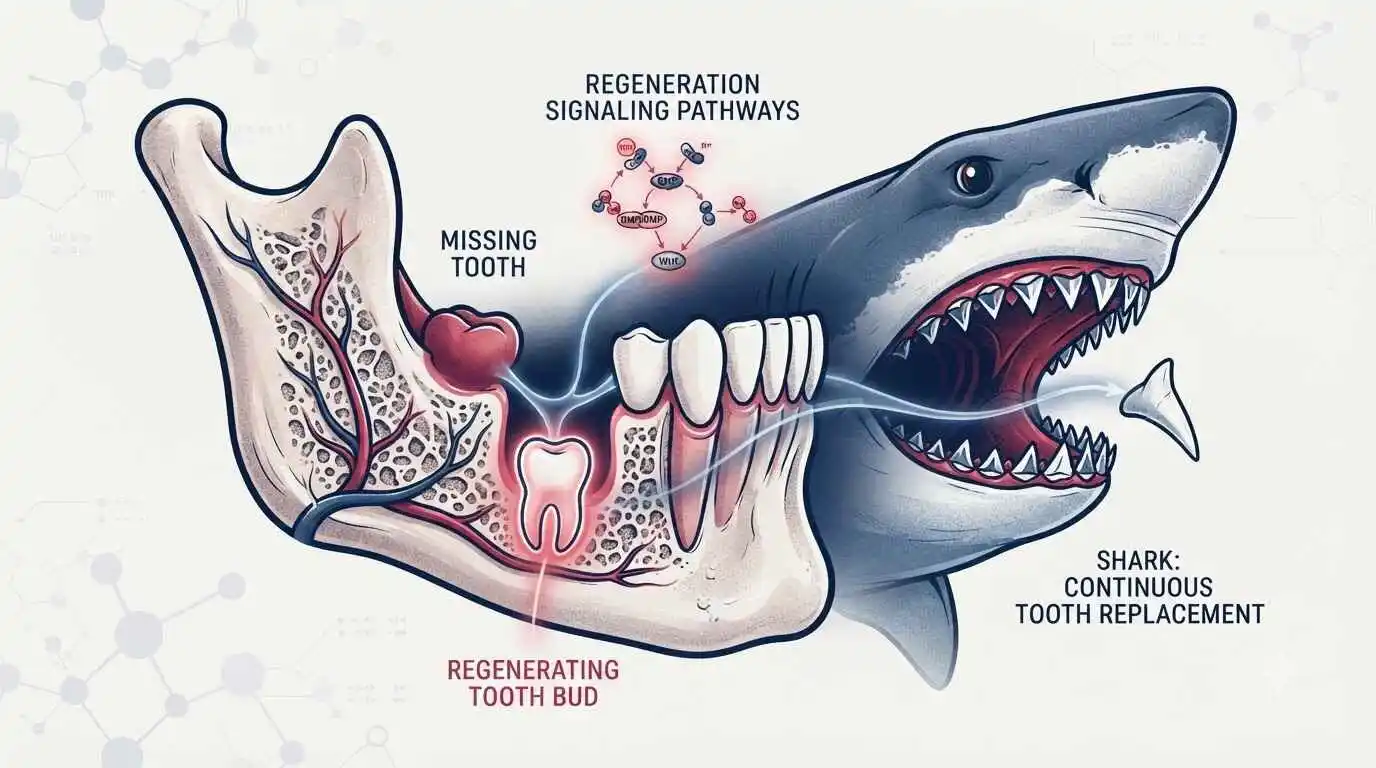
Humans are stuck with a strange biological limitation most people never think twice about: two sets of teeth, baby and adult, and nothing after that. Lose a permanent tooth to decay, injury, or disease, and the body has no natural mechanism to grow a replacement. This stands in sharp contrast to much of the animal kingdom. Sharks continuously regrow rows of teeth throughout their entire lives, some species cycling through tens of thousands of teeth over a lifetime, and many reptiles similarly replace teeth on an ongoing basis without ever running out.
For decades, this was treated as simply an accepted fact of human biology, addressed only through artificial workarounds like fillings, crowns, and implants. That is beginning to change. A growing body of dental and regenerative medicine research is now targeting the actual biological mechanisms behind tooth formation, with the explicit goal of restoring the ability to regrow a real, living tooth rather than replacing a lost one with an artificial substitute.
What Actually Stops Human Teeth From Re growing
Tooth development begins with structures called tooth buds, clusters of cells that form early in life and eventually mature into either baby teeth or, later, the permanent adult teeth that replace them. Humans do actually possess the genetic instructions necessary to form tooth buds beyond this second set, but a specific signaling protein, called USAG-1, actively suppresses the growth of any additional tooth buds once the permanent set has developed, effectively acting as a genetic brake that prevents further tooth formation.

This discovery, identified through research into rare genetic conditions where people naturally grow extra teeth due to reduced USAG-1 activity, gave researchers a specific, targetable mechanism rather than a vague biological mystery. If a treatment could safely and temporarily block USAG-1’s suppressive effect in a controlled way, the theory goes, dormant tooth bud formation could potentially be reactivated in people who have already lost adult teeth.
The Japanese Trial Making Headlines
A research team in Japan, led by dentist and researcher Katsu Takahashi at Kyoto University, has developed a monoclonal antibody drug specifically designed to block USAG-1 activity, building directly on this suppression mechanism discovery. Early animal studies in mice and ferrets showed the treatment could successfully stimulate the growth of additional teeth, results significant enough to justify moving into human clinical trials, a milestone reached in the early 2020s and continuing to progress through subsequent trial phases.
Initial human trials have focused primarily on safety and dosing in adults missing teeth due to a congenital condition, with researchers cautiously optimistic about eventually expanding the treatment to a broader population, including people who have lost teeth through decay or injury rather than a genetic condition. It is worth being precise about where this research actually stands: promising, genuinely novel, and progressing through legitimate clinical trial phases, but still years away from being an approved, widely available dental treatment.
Stem Cells and the Dental Pulp Connection
A separate, complementary line of research focuses on dental pulp stem cells, a population of stem cells found inside the soft tissue at the center of a tooth, which have demonstrated a notable capacity to differentiate into various tooth-related tissue types, including dentin, the hard material beneath tooth enamel. Because these stem cells are relatively accessible, particularly from extracted wisdom teeth or baby teeth, they have become one of the more actively studied cell sources for dental tissue regeneration research.
This has led to the emergence of commercial dental stem cell banking services, allowing parents to store a child’s baby teeth stem cells for potential future medical use, similar in concept to umbilical cord blood banking. It is worth noting that, as of now, the practical clinical applications for these banked cells remain largely in the research and early-development stage rather than an established, routinely used treatment, meaning the decision to bank dental stem cells is currently more of a speculative bet on future medical progress than a guaranteed future resource.
The stem cells sitting inside a child’s baby tooth may one day matter more than the tooth itself.
Bioengineering a Whole Tooth From Scratch
A more ambitious research approach aims to bioengineer an entire replacement tooth outside the body, growing what researchers call a “tooth germ,” essentially an artificially assembled cluster of the specific cell types and signaling molecules needed to develop into a complete, functional tooth, which can then be implanted into the jaw to continue developing in place. Japanese researchers have successfully demonstrated this approach in mice, producing lab-grown teeth that, once implanted, developed proper root structure, correctly connected to surrounding jawbone and nerve tissue, and functioned similarly to a naturally grown tooth.
Scaling this bioengineered tooth germ approach up to humans presents substantially greater complexity than the mouse studies suggest, given the significant differences in jaw size, tooth structure, and developmental timeline between species, and researchers in this field generally describe a fully bioengineered human tooth replacement as a longer-term research goal rather than a near-term clinical possibility, even relative to the more targeted USAG-1 antibody approach.
3D Bioprinting Enters the Picture
Advances in 3D bioprinting technology, which can precisely layer living cells and supportive scaffold materials into complex three-dimensional structures, have opened another research avenue specifically aimed at tooth and dental tissue regeneration. Researchers have used bioprinting techniques to create scaffold structures seeded with dental stem cells, designed to guide new tissue growth into the correct anatomical shape needed for a functional tooth or supporting dental structure, rather than relying entirely on a cell population’s natural self-organizing tendency.
This scaffold-based approach is considered particularly promising for regenerating specific damaged dental tissues, such as dentin or the periodontal ligament that anchors a tooth to the jawbone, even in cases where growing an entirely new, complete tooth from scratch may not be necessary, offering a potentially more near-term application than full tooth regeneration for people with more limited, localized tooth damage.
How This Differs From Dental Implants
It is worth being clear about how tooth regeneration research differs fundamentally from dental implants, the current standard treatment for a missing tooth. A dental implant is an artificial titanium post surgically anchored into the jawbone, topped with a ceramic crown designed to resemble and function like a natural tooth, but it remains, at its core, a mechanical prosthetic rather than living tissue. Implants lack a periodontal ligament, the tissue that allows a natural tooth to sense pressure and subtly adjust position, and they carry ongoing risks including potential implant failure, bone loss around the implant site, and the need for eventual replacement.
True biological tooth regeneration, by contrast, would produce a living tooth complete with functional nerve tissue, blood supply, and a properly integrated periodontal ligament, offering meaningfully different long-term durability and sensory function compared to even the most advanced current dental implant technology. This distinction is central to why researchers and clinicians view genuine tooth regeneration as a categorically different, more biologically complete solution rather than simply an incremental improvement on implant technology.
The Realistic Timeline Worth Understanding
Despite genuinely exciting headlines, researchers in this field are consistently careful to temper public expectations about timeline. The USAG-1 antibody treatment, currently the furthest along in human clinical trials, still requires completing multiple additional trial phases to establish safety and efficacy across a broader patient population before any regulatory approval process could even begin, a process that realistically spans years even under an optimistic scenario. Katsu Takahashi’s own public statements have generally projected a treatment becoming available sometime toward the latter part of this decade at the earliest, contingent on continued successful trial results.
Full bioengineered tooth replacement and advanced scaffold-based regeneration approaches remain considerably further from clinical availability, with most researchers describing these as longer-term research programs likely to take considerably longer to reach the same stage of human clinical testing the USAG-1 antibody approach has already achieved.
The Genetics Behind Why We Only Get Two Sets
From an evolutionary standpoint, humans belong to a broader mammalian pattern called diphyodonty, meaning two successive sets of teeth, in contrast to the polyphyodont pattern seen in sharks, many reptiles, and fish, which continuously replace teeth throughout life. Researchers believe this limitation evolved as mammals developed more complex, precisely occluding tooth structures suited to specialized chewing, since a constantly replacing set of teeth is harder to keep precisely aligned compared to a stable, mature set installed once and then permanently retained.
This evolutionary trade-off, greater chewing precision and efficiency in exchange for the loss of ongoing tooth replacement capacity, is part of why researchers view the USAG-1 discovery as so significant: it suggests the genetic machinery for additional tooth formation was not entirely lost through evolution but rather actively suppressed, meaning the biological potential for further tooth regrowth may still exist, dormant, within human genetics rather than having disappeared entirely over the course of mammalian evolutionary history.
What This Could Mean for the Cost and Accessibility of Dental Care
Beyond the biological breakthrough itself, researchers and dental economists have begun considering the broader healthcare implications if tooth regeneration treatments eventually become clinically available and reasonably affordable. Missing and damaged teeth represent a substantial global health burden, with dental implants and other restorative procedures remaining expensive and, in many parts of the world, inaccessible to large portions of the population, contributing to significant untreated tooth loss and associated nutritional and health consequences worldwide.
A successful, scalable tooth regeneration treatment could, in principle, offer a meaningfully more cost-effective and biologically superior alternative to current restorative options over the long term, though researchers caution that early-stage regenerative treatments, like most genuinely novel medical technologies, will likely carry a significant cost premium during their initial years of availability before broader adoption and manufacturing scale eventually bring costs down, a pattern seen repeatedly with other emerging medical technologies before they reach mainstream affordability.
Who Would Actually Benefit Most
While media coverage of tooth regeneration research often frames it broadly, researchers have specifically highlighted certain populations as likely early beneficiaries. People with congenital anodontia or hypodontia, conditions where a person is born missing some or most of their permanent teeth due to a genetic cause, represent a population with a clear, defined medical need that the USAG-1 antibody research specifically targeted in its initial human trials, given the more predictable, well-understood underlying biological cause in these cases.
Beyond congenital cases, researchers anticipate that people who have lost adult teeth due to injury, decay, or gum disease represent a considerably larger potential patient population that could eventually benefit from tooth regeneration approaches, though this broader application will likely require additional research and trial phases beyond what has currently been established for congenital tooth-loss cases specifically.
Why This Research Matters Beyond Dentistry
Tooth regeneration research sits within a broader, rapidly advancing field of regenerative medicine focused on restoring the body’s ability to regrow tissues and organs that, in adult humans, normally lack significant natural regenerative capacity. Insights gained from understanding how USAG-1 suppresses tooth bud formation, and how that suppression might be safely and temporarily reversed, could offer broader lessons relevant to other tissue regeneration research areas facing conceptually similar biological suppression mechanisms.
This is part of why tooth regeneration research attracts interest and funding beyond dental-specific research circles, with some regenerative medicine researchers viewing it as a relatively well-defined, more tractable test case for broader tissue regeneration principles, given teeth’s comparatively simpler, more accessible structure relative to more complex organs also being studied for potential future regeneration.
What to Watch for Next
The most immediate development to watch is the continued progress of the USAG-1 antibody human trials, with subsequent trial phases expected to expand participant numbers and potentially broaden eligibility criteria beyond the initial congenital tooth-loss population studied so far. Regulatory milestones, safety data from larger trial cohorts, and any announced timeline updates from the research team will offer the clearest, most concrete signals of how close this specific treatment actually is to real-world availability.
For the broader field, continued advances in bioprinting precision, stem cell differentiation control, and scaffold material science will likely determine how quickly the more ambitious full-tooth bioengineering approaches can close the gap with the more targeted, currently further-along antibody treatment strategy, making this a genuinely active, multi-pronged research area worth watching over the next several years rather than a single race toward one specific solution.
Frequently Asked Questions
| Question | Answer |
| Can humans regrow lost teeth naturally? | No, humans only develop two sets of teeth and have no natural mechanism to regrow lost adult teeth. |
| What is USAG-1? | It is a protein that suppresses the growth of additional tooth buds beyond the permanent adult set. |
| What does the USAG-1 antibody treatment do? | It blocks USAG-1 activity to potentially reactivate dormant tooth bud growth. |
| Who is leading the tooth regeneration drug trials? | Researcher Katsu Takahashi at Kyoto University leads the prominent Japanese clinical trials. |
| Has the USAG-1 treatment been tested in humans? | Yes, early-phase human clinical trials focused on safety and dosing are currently underway. |
| When might a tooth regeneration drug be available? | Researchers have suggested it could become available toward the latter part of this decade at the earliest. |
| What are dental pulp stem cells? | They are stem cells found inside a tooth capable of differentiating into various dental tissue types. |
| Can baby teeth stem cells be stored for future use? | Yes, commercial dental stem cell banking services allow storage, though clinical applications remain largely experimental. |
| What is a bioengineered tooth germ? | It is a lab-assembled cluster of cells designed to develop into a complete, functional tooth once implanted. |
| Has a bioengineered tooth been successfully implanted in animals? | Yes, researchers have successfully implanted lab-grown teeth in mice with proper root and nerve integration. |
| How does tooth regeneration differ from dental implants? | Regeneration produces a living tooth with nerves and ligament function, unlike an artificial implant. |
| What is 3D bioprinting used for in dentistry? | It creates scaffold structures seeded with stem cells to guide new dental tissue growth. |
| Who would benefit most from early tooth regeneration treatments? | People with congenital tooth-loss conditions are the primary focus of initial clinical trials. |
| What is anodontia? | It is a congenital condition where a person is born missing some or all of their permanent teeth. |
| Why do sharks regrow their teeth continuously? | Sharks retain an active tooth-replacement mechanism throughout their lives, unlike humans. |
| Is tooth regeneration research relevant beyond dentistry? | Yes, it offers insights applicable to broader regenerative medicine research. |
| What is the periodontal ligament? | It is the tissue that anchors a natural tooth to the jawbone and allows pressure sensation. |
| Do dental implants have the same function as a regenerated tooth? | No, implants lack living nerve tissue and periodontal ligament function present in a natural tooth. |
| What triggered the discovery of USAG-1’s role in tooth suppression? | Research into rare genetic conditions where people naturally grow extra teeth revealed the mechanism. |
| Can adults with tooth loss from decay benefit from this research? | Potentially in the future, though initial trials have focused on congenital tooth-loss cases first. |
| What risks are associated with dental implants? | Risks include implant failure, bone loss, and the potential need for eventual replacement. |
| Are full bioengineered human teeth available yet? | No, this approach remains in earlier research stages compared to the antibody treatment. |
| What is dentin? | It is the hard tissue beneath tooth enamel that dental pulp stem cells can help regenerate. |
| How many trial phases remain before regulatory approval? | Multiple additional trial phases are required to establish broader safety and efficacy data. |
| Is tooth regeneration considered safe so far? | Early trials are specifically designed to assess safety, with results still being evaluated. |
| What role do scaffolds play in dental tissue engineering? | Scaffolds guide new tissue growth into the correct anatomical shape during regeneration. |
| Could this research help people with gum disease-related tooth loss? | It may eventually, though current trials focus primarily on congenital tooth-loss populations. |
| Why is teeth regeneration considered a good test case for regenerative medicine? | Teeth have a relatively simple, accessible structure compared to more complex organs being studied. |
| What should someone do if genuinely interested in future treatment options? | Following updates from ongoing clinical trials is the most reliable way to track real progress. |
| Is tooth regeneration guaranteed to succeed as a treatment? | No, while promising, it remains an active area of research without guaranteed clinical success. |
Disclaimer: The content on this blog is for informational purposes only. The author’s opinions are personal and not endorsed. Efforts are made to provide accurate information, but completeness, accuracy, or reliability are not guaranteed. The author is not liable for any loss or damage resulting from the use of this blog. It is recommended to use the information on this blog at your own discretion.
