
Table of Contents
Overactive Thyroid? How to Manage Graves’ Disease
Your heart is doing that thing again — pounding hard enough that you can feel it in your ears while you’re just sitting at your desk answering emails. You’ve dropped eight pounds without trying, which sounds like a win until you realize your hands are shaking too much to hold a coffee cup steady. Your eyes feel gritty and strangely puffy, like you’ve been crying even though you haven’t. And you’re hot. Not “turn the AC down a notch” hot — sweating-through-your-shirt-in-a-cold-office hot.
If any of that sounds familiar, you’re not losing your mind, and you’re not just “stressed.” This is one of the more common ways Graves disease introduces itself, and it’s frustratingly easy to write off as anxiety, menopause, too much coffee, or a rough patch at work — right up until a blood test says otherwise.
Graves disease is the most common cause of hyperthyroidism in the United States, and it’s an autoimmune thyroid disease, which means the story here isn’t really about your thyroid gland misbehaving on its own. It’s about your immune system mistaking a helpful gland for a threat and revving it into overdrive. Once you understand that distinction, a lot of the weirder symptoms — the eye changes, the skin changes, the way it can flare and settle over months — start to make a lot more sense.
This is the deep-dive I wish existed the day I started actually researching this condition instead of just Googling symptoms at 1 a.m. We’re going to walk through what’s actually happening in your body, the full symptom picture (including the ones your doctor might not mention up front), how the diagnosis actually gets made, every major Graves disease treatment path with the honest trade-offs, and what day-to-day life looks like once you’re managing it. No fear-mongering, no oversimplification — just the real picture.

What Is Graves’ Disease, Really?
Let’s start with the gland itself. Your thyroid sits low in your neck, roughly where a bowtie would sit, and it produces two hormones — T3 and T4 — that essentially set the pace for your entire metabolism. Heart rate, body temperature, how fast you digest food, how your brain processes information, even your menstrual cycle — all of it takes cues from thyroid hormone levels. When that system runs at the right speed, you don’t think about it at all. That’s the goal. Boring is good.
Graves disease throws a wrench into that quiet, well-calibrated system. It’s an autoimmune thyroid disease, meaning your immune system produces antibodies that, instead of fighting off an infection, attach themselves to the receptors on your thyroid cells that are normally meant to respond to TSH (thyroid-stimulating hormone) from your pituitary gland. These are called TSH receptor antibodies, and they act like a stuck accelerator pedal. They tell your thyroid to keep producing hormone, over and over, regardless of what your body actually needs.
The result is hyperthyroidism — an excess of thyroid hormone circulating through your system. Your body, which is used to receiving a steady, regulated supply, suddenly gets flooded. Everything speeds up: your heart rate, your metabolism, your nervous system, sometimes even your bowel habits. It’s a bit like someone reached into your car while you were doing a comfortable 60 on the highway and jammed the throttle to the floor.
Here’s the part that surprises most people: Graves disease is far more common in women, roughly seven to eight times more common than in men, and it tends to show up between ages 30 and 50, though it absolutely can appear earlier or later. There’s also a strong genetic and family component — if a parent or sibling has Graves disease, or another autoimmune condition like type 1 diabetes, rheumatoid arthritis, or lupus, your own risk goes up. Smoking is another significant risk factor, and it specifically raises the risk of eye involvement, which we’ll get into shortly.
One thing worth sitting with: having Graves disease doesn’t mean your thyroid is “broken” in the way a worn-out mechanical part is broken. The gland itself is often perfectly healthy tissue caught in the crossfire of an immune system that’s misfiring. That reframe matters, because it shapes how you think about treatment. You’re not trying to “fix” a defective organ. You’re trying to calm down an immune response and manage the downstream hormone excess it’s causing.
The Symptoms Nobody Fully Warns You About
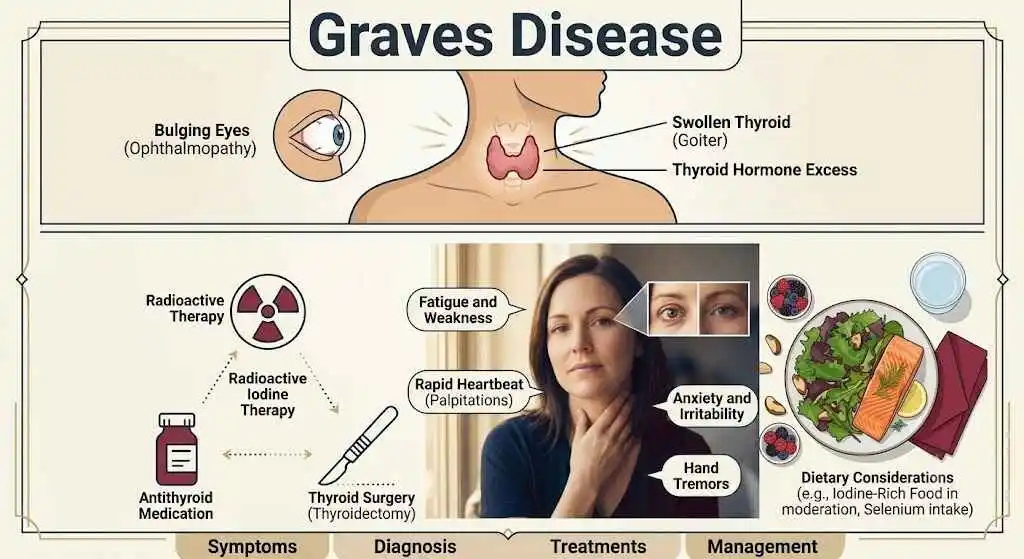
The textbook list of Graves disease symptoms usually reads like this: rapid or irregular heartbeat, unexplained weight loss, heat intolerance, tremor, anxiety, fatigue, and an enlarged thyroid (called a goiter). All true. All worth knowing. But if you’ve actually lived through it, or watched someone you love go through it, you know the list undersells the experience quite a bit.
Let’s break the symptom picture into categories, because Graves disease genuinely touches almost every system in the body.
Cardiovascular and Physical Symptoms
- A resting heart rate that sits stubbornly above 100 beats per minute, sometimes accompanied by palpitations or a fluttering sensation
- Fine tremor in the hands, often most noticeable when trying to do something precise like sign a check or thread a needle
- Unintentional weight loss despite eating the same amount, or even eating more than usual
- Heat intolerance and excessive sweating, even in mild temperatures
- Muscle weakness, particularly in the thighs and upper arms — climbing stairs or standing up from a low chair can suddenly feel harder
- Changes in bowel habits, usually more frequent bowel movements
- Thinning hair or hair that feels finer and sheds more than usual
- Skin that feels warm, moist, and unusually smooth
Emotional and Cognitive Symptoms
- Anxiety or a persistent jittery, on-edge feeling that doesn’t match the actual stress level of your day
- Irritability that feels out of character — snapping at people over small things
- Difficulty concentrating, or a sense that your thoughts are racing faster than you can organize them
- Trouble sleeping, even when you’re physically exhausted
- In some cases, symptoms that get misdiagnosed as a panic disorder or generalized anxiety disorder before anyone thinks to check the thyroid
The Symptoms People Don’t Expect
- Thyroid eye disease (also called Graves ophthalmopathy) — bulging or protruding eyes, a gritty or sandy feeling, excessive tearing, double vision, light sensitivity, or a startled, wide-eyed appearance that others may comment on before you notice it yourself
- Pretibial myxedema — a thickening and reddish discoloration of the skin on the shins, which is uncommon but distinctly linked to Graves disease specifically
- Changes to menstrual cycles, including lighter or irregular periods
- A visibly enlarged thyroid (goiter) that can sometimes be felt or even seen as swelling at the base of the neck
- Brittle nails or nails that separate from the nail bed (a phenomenon called Plummer’s nails)
The eye involvement deserves special attention because it’s one of the most misunderstood aspects of this condition, and it doesn’t always track with how well-controlled your hormone levels are. You can have thyroid eye disease flare up even after your hyperthyroidism is successfully treated, which catches a lot of people off guard. We’ll come back to this later, because it genuinely deserves its own section.
How Doctors Actually Diagnose Graves Disease
If you suspect something’s off and you’re heading in for testing, it helps to know what the diagnostic path actually looks like, because it’s more layered than “one blood test and you’re done.”
The first step is almost always a TSH test. In Graves disease and hyperthyroidism generally, TSH comes back low — sometimes undetectably low — because your pituitary gland senses that there’s already too much thyroid hormone circulating and stops sending the signal to produce more. That’s the body’s braking mechanism, and it’s being completely overridden by the excess hormone.
From there, your doctor will typically check free T4 and free T3 levels directly, which in Graves disease are usually elevated. But an elevated T3/T4 with a suppressed TSH tells you that you have hyperthyroidism — it doesn’t by itself tell you the cause. Hyperthyroidism can come from a few different sources: Graves disease, toxic nodules, thyroiditis (temporary inflammation of the thyroid), or excess iodine intake, among others. Figuring out which one you’re dealing with changes the entire treatment plan.
This is where TSH receptor antibodies come in, sometimes ordered as TRAb (TSH receptor antibody) or TSI (thyroid-stimulating immunoglobulin) testing. A positive result is highly specific for Graves disease — it’s essentially confirming the presence of the antibodies causing the whole process. Many endocrinologists now use this test as a fast, reliable way to confirm Graves disease without needing additional imaging in straightforward cases.
In cases where the picture is less clear, a radioactive iodine uptake scan can help distinguish Graves disease from other causes of hyperthyroidism. In this test, you take a small, tracked dose of radioactive iodine, and imaging shows how much of it your thyroid absorbs and where. In Graves disease, uptake is typically diffusely and significantly increased across the entire gland, since the whole thyroid is being stimulated. This is different from a toxic nodule, where uptake would be concentrated in one specific area, or thyroiditis, where uptake is often low because the gland is inflamed rather than overactive.
A physical exam matters here too — a doctor feeling for a goiter, checking your pulse, looking for hand tremor, and examining your eyes for the telltale signs of thyroid eye disease. None of this is exotic or invasive; it’s a matter of putting the pieces together methodically rather than guessing.
Your Treatment Options, Weighed Honestly
There is no single “correct” Graves disease treatment — this is genuinely one of those areas of medicine where the right answer depends heavily on your age, whether you’re planning a pregnancy, how severe your symptoms are, whether you have eye involvement, and honestly, your own personal comfort level with each option’s trade-offs. Here’s the real, unfiltered rundown of the three main paths.
1. Antithyroid Medication
- Methimazole (and less commonly propylthiouracil, or PTU) work by blocking the thyroid’s ability to produce hormone in the first place
- This is usually the first-line approach in the U.S. for most adults, particularly those with mild-to-moderate disease or who want to avoid more permanent interventions right away
- Treatment typically runs 12–18 months, with the hope that the immune process goes into remission during that window — though remission isn’t guaranteed, and relapse after stopping medication happens in a meaningful percentage of patients
- Requires regular blood work to monitor thyroid function and watch for rare but serious side effects, including liver issues and a drop in white blood cell count (agranulocytosis) — sore throat or fever while on anti thyroid medication warrants an immediate call to your doctor
- PTU is generally preferred over methimazole during the first trimester of pregnancy due to a lower risk of certain birth defects, then often switched back to methimazole afterward
2. Radioactive Iodine Treatment
- Radioactive iodine treatment involves swallowing a single dose of iodine-131, which your thyroid absorbs (since the gland naturally concentrates iodine) and which then gradually destroys the overactive thyroid tissue from within
- It’s a one-time outpatient treatment for most people, with effects building over several weeks to months
- The near-universal outcome is that the thyroid eventually becomes underactive (hypothyroidism), which sounds like trading one problem for another — but hypothyroidism is generally much easier and more predictable to manage with a single daily levothyroxine pill than ongoing hyperthyroidism is
- Not recommended during pregnancy or breastfeeding, and typically not the first choice for people with moderate-to-severe thyroid eye disease, since it can sometimes worsen eye symptoms, particularly in smokers
- Requires some temporary precautions around close contact with pregnant women and young children immediately after treatment due to residual radioactivity
3. Thyroidectomy (Surgical Removal)
- A thyroidectomy removes all or most of the thyroid gland surgically, providing the fastest, most definitive resolution of hyperthyroidism
- Often the preferred choice for people with a very large goiter causing compression symptoms, suspicious nodules that need to be evaluated, significant thyroid eye disease, or those who want to become pregnant in the near future and don’t want to wait through a long medication trial or the aftermath of radioactive iodine
- Like radioactive iodine, thyroidectomy results in lifelong hypothyroidism requiring daily thyroid hormone replacement — but again, this tends to be far more stable and predictable than untreated hyperthyroidism
- Carries standard surgical risks, plus specific risks to the parathyroid glands (which regulate calcium) and the nerve controlling the vocal cords — both manageable in experienced surgical hands, but worth discussing directly with your surgeon
There’s no prize for picking the “toughest” option or the “easiest” one. The right choice is the one that fits your actual life circumstances, and it’s worth having a genuinely candid conversation with an endocrinologist about all three before committing to a path.
Thyroid Eye Disease: The Complication People Miss
This deserves its own spotlight because it trips up so many people, including some who’ve otherwise done a great job managing their thyroid levels. Thyroid eye disease, sometimes called Graves ophthalmopathy, happens when the same autoimmune process that’s driving your thyroid also targets the muscles and fatty tissue behind your eyes, causing inflammation and swelling in the eye socket.
The tricky part is timing. Thyroid eye disease doesn’t always move in lockstep with your thyroid hormone levels. Some people develop eye symptoms before any thyroid symptoms show up at all. Others notice it months after their hyperthyroidism has already been treated and their labs look perfectly normal. This mismatch is genuinely confusing, and it’s a common reason people feel dismissed when they bring up eye symptoms to a provider who’s focused purely on thyroid numbers.
Early signs include a gritty, sandy feeling in the eyes, excess tearing, sensitivity to light, and mild puffiness around the eyelids. As it progresses, it can cause visible bulging (proptosis), difficulty fully closing the eyes, double vision from swollen eye muscles affecting alignment, and in more severe cases, pressure on the optic nerve that can threaten vision. Smoking is the single biggest modifiable risk factor for developing or worsening thyroid eye disease — if you smoke and you have Graves disease, quitting is one of the most protective things you can do for your eyes specifically.
Management ranges from simple supportive care — lubricating eye drops, sunglasses, sleeping with your head elevated — to more targeted treatments like corticosteroids for active inflammation, and in recent years, targeted biologic medications designed specifically to treat moderate-to-severe thyroid eye disease. In cases with significant proptosis or optic nerve involvement, orbital decompression surgery may be needed. If you have Graves disease and notice any changes in your vision or the appearance of your eyes, that’s worth flagging to both your endocrinologist and an ophthalmologist familiar with thyroid eye disease specifically — general eye exams don’t always catch the nuances of this particular condition.
Living With Graves Disease: Diet, Lifestyle, and the Long Game
Once treatment is underway, day-to-day management becomes less about crisis mode and more about steady maintenance — though there are real, practical things worth knowing.
On the subject of a Graves disease diet, there’s no single miracle food or forbidden food that will cure or cause this condition — it’s an autoimmune process, not a dietary one. That said, a few specific, evidence-informed points are worth knowing:
Dietary Considerations Worth Understanding
- Iodine intake matters more than most people realize, since iodine is the raw material your thyroid uses to produce hormone — very high-iodine supplements or seaweed-heavy diets can potentially aggravate hyperthyroidism and are generally worth discussing with your doctor before adding to your routine
- Calcium and vitamin D deserve attention, since prolonged hyperthyroidism can affect bone density over time — leafy greens, dairy or fortified alternatives, and sensible sun exposure or supplementation (as advised by your provider) all help support bone health
- Selenium has some research behind it specifically for mild thyroid eye disease, though it should be used under medical guidance rather than as a self-directed high-dose supplement
- Caffeine can amplify the jittery, heart-racing symptoms that hyperthyroidism already causes, so many people find real relief in cutting back, especially during periods when hormone levels are still being brought under control
- A generally anti-inflammatory, whole-foods pattern — vegetables, lean proteins, healthy fats, whole grains — supports overall immune balance, even though it’s not a replacement for actual medical treatment
Lifestyle Adjustments That Actually Help
- Prioritizing sleep, even though hyperthyroidism can make that genuinely difficult — a cool, dark room and a consistent wind-down routine help more than people expect
- Gentle to moderate exercise rather than high-intensity training while your levels are still unstable, since an already-elevated heart rate combined with intense cardio can feel overwhelming or even risky
- Stress management isn’t just a nice-to-have here — there’s a recognized (though not fully understood) link between significant stress and the onset or flare of autoimmune conditions including Graves disease
- Quitting smoking, particularly given its direct, well-documented connection to worsening thyroid eye disease
- Building a support system, whether that’s an online community of people managing the same condition, a therapist, or simply friends and family who understand this isn’t “in your head”
| Graves disease isn’t a story about a broken gland — it’s a story about an immune system that’s forgotten which team it’s playing for. |
If there’s one thing worth taking away from all of this, it’s that Graves disease is manageable — genuinely, reliably manageable — even though the symptoms can feel chaotic and disorienting while you’re in the thick of it. Between anti thyroid medication, radioactive iodine treatment, and thyroidectomy, there’s a real path to stability for almost everyone, and understanding thyroid eye disease as its own separate track means you won’t be caught off guard if your eyes act up independently of your labs.
| Hypothyroidism after treatment isn’t a failure. For most people, it’s simply an easier, more predictable problem to manage than the hyperthyroidism it replaced. |
The single most useful thing you can do right now, whether you’re newly diagnosed or you’ve been living with this for years, is to stop normalizing symptoms you’ve quietly been explaining away. A racing heart isn’t just “being anxious.” Unexplained weight loss isn’t automatically a win. Gritty, puffy eyes aren’t just allergies. Bring the full picture to an endocrinologist, ask about TSH receptor antibody testing if it hasn’t been done, and don’t settle for a treatment plan that doesn’t account for your actual life and goals.
Have you or someone you love navigated a Graves disease diagnosis? Share your experience in the comments — the more real stories are out there, the less isolating this whole process becomes for the next person Googling their symptoms at 1 a.m.
FAQs
| Question | Answer |
| What is Graves disease in simple terms? | Graves disease is an autoimmune condition where your immune system produces antibodies that overstimulate your thyroid gland, causing it to make too much thyroid hormone. That excess hormone is what’s called hyperthyroidism, and it speeds up nearly every system in your body. |
| What causes Graves disease? | The exact trigger isn’t fully understood, but it involves a combination of genetic predisposition and environmental factors. Family history of autoimmune disease, being female, smoking, high stress levels, and sometimes pregnancy or infection are all recognized risk factors. |
| Is Graves disease the same as hyperthyroidism? | Not exactly. Hyperthyroidism is the general term for an overactive thyroid producing too much hormone, and it can have several causes. Graves disease is the most common specific cause of hyperthyroidism, driven by autoimmune antibodies. |
| What are the earliest signs of Graves disease? | Early signs often include a racing or irregular heartbeat, unexplained weight loss, feeling unusually warm or sweaty, hand tremor, anxiety or irritability, and fatigue despite feeling wired. Eye changes can also appear early for some people. |
| Can Graves disease go away on its own? | Spontaneous remission is uncommon but not impossible, particularly with certain forms of thyroiditis that mimic Graves disease temporarily. True Graves disease usually requires active treatment, though antithyroid medication can sometimes lead to lasting remission after a treatment course. |
| How is Graves disease diagnosed? | Diagnosis typically starts with blood tests showing low TSH and elevated free T4/T3, followed by TSH receptor antibody (TRAb or TSI) testing to confirm the autoimmune cause, and sometimes a radioactive iodine uptake scan if the picture is unclear. |
| What do TSH receptor antibodies actually do? | TSH receptor antibodies attach to the same receptors on thyroid cells that TSH normally binds to, but instead of being regulated by the body’s feedback system, they continuously stimulate the thyroid to produce hormone, regardless of actual need. |
| Is Graves disease genetic? | There’s a clear genetic component — having a close relative with Graves disease or another autoimmune condition raises your risk. However, genetics alone don’t guarantee you’ll develop it; environmental triggers typically play a role as well. |
| Can men get Graves disease? | Yes, though it’s significantly less common in men — women are affected roughly seven to eight times more often. When men do develop Graves disease, symptoms and treatment options are largely the same. |
| What is thyroid eye disease and is it always part of Graves disease? | Thyroid eye disease (Graves ophthalmopathy) is an autoimmune inflammation of the tissue behind the eyes. It occurs in a meaningful percentage of people with Graves disease, but not everyone develops it, and its severity doesn’t always match how severe the thyroid symptoms are. |
| Why do my eyes look different since my diagnosis? | Eye changes in Graves disease come from inflammation and swelling of the muscles and fat behind the eyeball, which can cause bulging, a wide-eyed stare, puffiness, or difficulty closing the eyes fully. This should be evaluated by an ophthalmologist familiar with thyroid eye disease. |
| What’s the best treatment for Graves disease? | There isn’t a universal “best” option — antithyroid medication, radioactive iodine treatment, and thyroidectomy are all valid paths. The right choice depends on your age, pregnancy plans, severity of symptoms, eye involvement, and personal preference. |
| How long do you have to take antithyroid medication? | A typical course of antithyroid medication like methimazole runs about 12 to 18 months, after which some people achieve lasting remission and others relapse and need to consider a more definitive treatment. |
| What are the side effects of methimazole? | Most people tolerate methimazole well, but possible side effects include rash, joint pain, and in rare cases more serious issues like liver problems or a significant drop in white blood cells. Any fever or sore throat while on this medication should be reported to your doctor immediately. |
| Is radioactive iodine treatment safe? | Radioactive iodine treatment has a long, well-established safety record for treating hyperthyroidism. It does result in the thyroid becoming underactive over time for nearly everyone treated, which is managed with daily thyroid hormone replacement. |
| Does radioactive iodine treatment cause cancer? | Large long-term studies have not shown a significant increased risk of cancer from standard radioactive iodine treatment doses used for hyperthyroidism. It’s a different dose range than treatments used for thyroid cancer. |
| Can I get pregnant after radioactive iodine treatment? | Yes, but doctors typically recommend waiting at least six months to a year after treatment before trying to conceive, to allow thyroid hormone levels to stabilize on replacement therapy. |
| What happens to my thyroid after a thyroidectomy? | After a thyroidectomy, your body can no longer produce its own thyroid hormone, so you’ll take a daily synthetic thyroid hormone replacement (commonly levothyroxine) for the rest of your life, with periodic blood tests to fine-tune the dose. |
| Will I definitely become hypothyroid after treatment? | With radioactive iodine treatment or thyroidectomy, yes — hypothyroidism is the expected and generally intended long-term outcome, since it’s far easier to manage with a single daily medication than ongoing hyperthyroidism. |
| Can Graves disease affect pregnancy? | Yes, uncontrolled hyperthyroidism during pregnancy carries risks for both mother and baby, so careful management is essential. Antithyroid medication (often PTU in early pregnancy, then methimazole) is typically used, and close monitoring by both an endocrinologist and obstetrician is standard. |
| Is there a specific Graves disease diet I should follow? | There’s no single required diet, but paying attention to iodine intake, supporting bone health with calcium and vitamin D, moderating caffeine, and eating an overall anti-inflammatory, whole-foods pattern can all support your body through treatment. |
| Should I avoid iodine completely if I have Graves disease? | You don’t need to eliminate iodine entirely, but very high-iodine supplements, some seaweed products, and iodine-based contrast dyes should be discussed with your doctor, since excess iodine can potentially worsen hyperthyroidism in some cases. |
| Can stress trigger Graves disease? | Significant physical or emotional stress is a recognized potential trigger for the onset or flare of autoimmune conditions, including Graves disease, though it’s rarely the sole cause — it typically interacts with existing genetic susceptibility. |
| Does smoking make Graves disease worse? | Smoking is strongly linked to a higher risk of developing thyroid eye disease and to more severe eye symptoms in people who already have Graves disease. Quitting is one of the most protective steps available for eye health specifically. |
| Can Graves disease come back after treatment? | After antithyroid medication, relapse is possible, sometimes years later. After radioactive iodine treatment or thyroidectomy, the hyperthyroidism itself typically doesn’t return since the thyroid tissue producing excess hormone has been destroyed or removed. |
| How often will I need blood tests? | Frequency varies by treatment stage — often every few weeks while medication doses are being adjusted, then spacing out to every few months once levels stabilize, and periodically for life if you’re on thyroid hormone replacement. |
| Can children get Graves disease? | Yes, though it’s less common than in adults. Pediatric Graves disease is managed similarly, with treatment decisions weighted heavily toward antithyroid medication first, given long-term considerations around radioactive iodine and surgery in children. |
| Is Graves disease considered a disability? | Graves disease itself typically isn’t classified as a disability once effectively treated, though severe or poorly controlled cases, or significant thyroid eye disease affecting vision, could potentially qualify for accommodations depending on individual circumstances and local regulations. |
| What’s the difference between Graves disease and Hashimoto’s thyroiditis? | Both are autoimmune thyroid conditions, but they push in opposite directions — Graves disease causes an overactive thyroid (hyperthyroidism), while Hashimoto’s thyroiditis typically causes an underactive thyroid (hypothyroidism) by gradually damaging thyroid tissue. |
| Can I exercise normally with Graves disease? | Gentle to moderate exercise is generally fine and encouraged, but high-intensity training is often better postponed until your thyroid hormone levels are more stable, since an already elevated heart rate can make intense cardio feel disproportionately taxing. |
| When should I see a doctor about possible Graves disease symptoms? | If you notice a persistently racing heart, unexplained weight loss, heat intolerance, hand tremor, or any changes in your eyes such as bulging or grittiness, it’s worth getting thyroid function tests done rather than waiting for symptoms to resolve on their own. |
⚕️Medical Disclaimer:
The information provided on this website is for general educational and informational purposes only and is not intended as a substitute for professional medical advice, diagnosis, or treatment. Always seek the advice of your physician or other qualified health provider with any questions you may have regarding a medical condition. Never disregard professional medical advice or delay in seeking it because of something you have read on this website.
