
Table of Contents
The Ocean’s Light Show: Why Bioluminescence Exists
The Night the Sea Lit Up Beneath My Feet
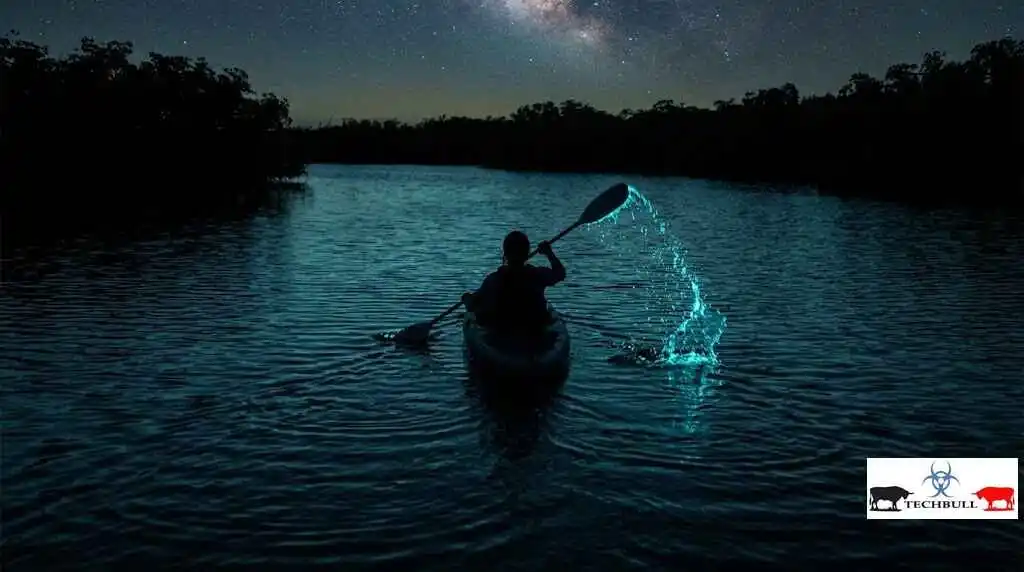
I still remember the first time I dipped my paddle into a bay that glowed. It was well past midnight, the air warm and heavy with salt, and the guide had asked us to turn off every light and go quiet. I thought she was joking about the quiet part until my paddle broke the surface and a trail of blue-green sparks ran off the blade like something spilled from a jar of stars. I pulled my hand through the water and my fingers came up dripping with light. For a moment I forgot to breathe.
Ten years of walking beaches at odd hours, wading through tide pools with a red headlamp, and sitting still in mangrove channels waiting for something to move, and that night still sits at the top of my list. Not because the science surprised me. I already knew, in the dry way you know things from books, that certain plankton glow when they are disturbed. What surprised me was how personal it felt. Every stroke of the paddle, every fish that darted beneath the kayak, left a ribbon of cold fire behind it, as if the sea itself were breathing light instead of air.
I have since chased that same feeling in tide pools at low tide, in mangrove creeks at the edge of the jungle, and once, memorably, on a boat deck off the coast where the wake behind us glowed for a full minute after the engine cut out. Every single time, the reaction from the people around me was the same. Someone always laughs out loud, a short, surprised laugh, the kind you make when your body understands something before your mind catches up. That laugh is, I think, the most honest response a person can have to bioluminescence. It is delight before it is science.
That night is the reason I wanted to write this piece. Bioluminescence is often described in cold, clinical language, chemical reactions and enzyme names, and all of that is true and worth knowing. But it is also one of the most quietly emotional things nature does. It is the ocean whispering instead of shouting, choosing to speak in light rather than sound. This post is my attempt to explain what that glow actually is, why it exists, where you can still find it, and why it deserves our care.

The ocean is not performing for us. It has been doing this quietly, for hundreds of millions of years, long before we arrived to watch.
What Is Bioluminescence, Really?
Bioluminescence is light made by a living body, without heat, without electricity, without sunlight. It happens when a molecule called luciferin reacts with oxygen, helped along by an enzyme called luciferase, and the reaction releases energy as light instead of heat. Scientists call it cold light because almost none of that energy is wasted warming anything up. A light bulb in your home turns most of its energy into heat and only a little into light. A firefly, or a glowing comb jelly, does the opposite almost perfectly.
It is worth separating this glow from two things people often confuse it with. Fluorescence happens when an organism absorbs light of one color and instantly gives off light of another color, like the way a highlighter pen seems to glow under a black light. It needs an outside light source to work, and the glow stops the instant that source is removed. Phosphorescence is similar but slower, soaking up light and releasing it gradually over minutes or hours, the way a glow in the dark star sticker keeps glowing after you turn off the lamp. Bioluminescence needs neither. The light comes from inside the animal itself, made fresh, on demand, in the dark.
Cold Light, Warm Meaning
What strikes me most, even after years of seeing it, is how deliberate this light feels. It is not a byproduct or an accident, the way a hot engine gives off heat nobody asked for. Every flash of a firefly squid or flicker of a comb jelly is switched on for a reason. Somewhere in the animal’s short, quiet life, that light is doing a job, and figuring out what that job is has become one of my favorite parts of studying the sea.
Where the Glow Comes From: Origins and Types
Ancient Beginnings
Bioluminescence is not one single trick that life stumbled upon once and then passed down. It evolved independently dozens of separate times, in bacteria, in fungi, in insects, and again and again across different branches of marine life. Some researchers estimate it arose more than forty times throughout the history of life on Earth, which tells you something important: this is not a rare fluke. It is a solution so useful that evolution kept reinventing it, in creatures that share no common glowing ancestor at all.
In the ocean specifically, the glow may stretch back hundreds of millions of years, long before anything with a backbone swam through those waters. The deep sea, dark below a few hundred meters where sunlight simply cannot reach, became a perfect stage for organisms that could carry their own light source with them.
Think about what that means for a moment. In a place with no sunrise and no sunset, where the only light comes from the creatures themselves, an entire economy of survival grew up around who could produce light, who could see it, and who could hide from it. It is easy to imagine the deep sea as a barren, silent void, but in truth it may be one of the most visually active places on Earth, just on a wavelength and a schedule that has nothing to do with our own days and nights.
The Main Types You Might Encounter
Bacterial bioluminescence is the quiet, steady kind, a soft continuous glow rather than a flash, and it often lives inside other creatures, including some fish and squid that host glowing bacteria in special pouches.
Dinoflagellates are single celled plankton, and they are almost certainly the source of that glow I paddled through. When the water is disturbed by a wave, a fish, or an oar, these tiny cells flash blue-green light in self defense, and in large enough numbers they turn an entire bay into something out of a dream.
Jellyfish and comb jellies carry their own quiet light shows, and one jellyfish in particular, Aequorea victoria, gave science one of its most useful tools, a glowing protein that researchers now use to light up cells and study diseases.
Anglerfish use a single glowing lure dangling above their mouths like a fishing rod tipped with a lantern, tempting curious prey close enough to snap up in the crushing dark of the deep sea.
Ostracods, tiny crustaceans nicknamed sea fireflies, release glowing mucus into the water in careful patterns, and in some species males use these patterns like a secret language to attract mates.
Lanternfish, viperfish, and countless other deep sea fish carry rows of light producing organs called photophores along their bellies and sides, arranged with real precision rather than scattered at random.
Importance and Role in the Ecosystem
Defense: The Burglar Alarm of the Sea
One of my favorite explanations for dinoflagellate glow is what scientists sometimes call the burglar alarm strategy. When a small predator disturbs the water to feed on plankton, the sudden flash of light can attract an even bigger predator, one that is more interested in eating the thing that just lit up the water than in the tiny plankton itself. In other words, the glow turns the small predator into the hunted, which makes the plankton far less appealing to bother in the first place.
Attraction: Luring Prey and Finding Mates
Light pulls things closer in the deep sea the same way a porch lamp pulls in moths on a summer night. Anglerfish use their glowing lure to draw curious prey within striking distance. Certain squid and fish use light patterns during courtship, flashing in rhythms specific to their species so they can find a partner in a world with almost no other way to be seen.
Camouflage: Hiding in Plain Sight
This is the one that took me the longest to wrap my head around, because it sounds backwards. Many mid water animals use a trick called counter illumination, producing a faint glow on their undersides that matches the dim light filtering down from the surface above. Seen from below, a predator looking up would normally spot a dark silhouette against the brighter water above. With counter illumination, that silhouette disappears into the background glow instead.
Communication in the Dark
Beyond hunting and hiding, light lets deep sea creatures recognize their own kind, warn off intruders, and coordinate behavior in an environment where sound and smell only carry them so far. In a place with almost no sunlight and few visual landmarks, a species specific flash pattern can work like a name tag and a greeting all at once.
Scientists who study these light patterns often compare them to a kind of grammar, a set of flashes, pauses, and colors that mean something specific to the right audience and nothing at all to everyone else. A flash that says come closer to one species might mean back away to another, and learning to read that language, even a little, has been one of the quiet joys of my own fieldwork. It reminds me that the ocean is not silent or empty in the dark. It is simply speaking in a way most of us never learned to notice.
A Night I Won’t Forget: Field Notes from Mosquito Bay
The kayak trip I described earlier happened in Mosquito Bay, on the island of Vieques off Puerto Rico, widely considered the brightest bioluminescent bay on the planet. The bay is shaped almost like a bottle, with a narrow mouth that traps huge concentrations of a dinoflagellate called Pyrodinium bahamense inside, fed by nutrients washing off the surrounding mangrove forest. Mangrove roots, it turns out, are part of the reason the bay glows so brightly, since they release vitamin B12 into the water, which these tiny organisms need to thrive.
Local guides paddle visitors out in non motorized kayaks, because engine noise and fuel would damage the very organisms people come to see. I remember our guide dipping a cupped hand into the water and letting it drain slowly back, each drop striking the surface and blooming into a tiny ring of light, over and over, like rain falling upward. A fish swam beneath my kayak and left behind a perfect glowing outline of its body, a ghost of itself hanging in the water for a second before fading.
I have also read about Toyama Bay in Japan, where firefly squid rise from the deep each spring in such numbers that the shoreline itself seems to glow blue at night, and fishing boats haul in nets that sparkle like they are full of scattered stars rather than fish. I have not seen it myself, but the descriptions from researchers who study it echo exactly what I felt in that Puerto Rican bay: a feeling that the ocean is showing you something it does not often show.
Facts That Still Amaze Me After All These Years
- Roughly seventy six percent of animals living in the open ocean below the sunlit surface layer are thought to produce their own light in some form, according to research from Monterey Bay Aquarium Research Institute.
- Bioluminescent light is sometimes called cold light because it converts nearly all of its energy into light rather than heat, compared with an old incandescent bulb, which wastes most of its energy as heat.
- Most marine bioluminescence glows blue or blue-green, because blue light travels farthest through seawater, while red light is absorbed quickly near the surface.
- In 2020, researchers confirmed that the kitefin shark, which can grow over five feet long, glows in the dark, making it the largest known bioluminescent vertebrate on record.
- During the Second World War, soldiers in the Pacific reportedly crushed dried ostracods, the tiny sea fireflies mentioned earlier, to create a faint glow they could use for reading maps without giving away their position with a flashlight.
- The vampire squid, despite its dramatic name, does not use ink like other squid. When threatened, it uses bioluminescent organs to produce a confusing cloud of glowing mucus instead.
- Bioluminescence is not limited to the ocean. Certain species of fungi glow faintly on rotting wood, an effect sometimes called foxfire, and some earthworms and click beetle larvae glow as well.
- Fireflies, the most familiar glowing creature to most of us, use their light almost entirely for finding mates, flashing in patterns so specific that a firefly can often recognize its own species by rhythm alone.
- Some deep sea shrimp have a striking backup defense. When threatened, instead of fighting or fleeing, they spit a cloud of glowing chemicals into the water, much like an ink cloud, except this one lights up and startles the predator rather than simply hiding the shrimp behind a dark screen.
- Antarctic krill, tiny shrimp like creatures that form the base of an enormous food web, are also bioluminescent, and their glow is thought to help them coordinate the massive, tightly packed swarms that whales and penguins depend on for food.
The Shadows Threatening the Glow
For all its resilience, this ancient light is not immune to what we do on land and along the coast. Artificial light pollution spilling from cities, resorts, and boats washes out the faint glow of bioluminescent organisms and can confuse animals that rely on natural light cues to feed, hide, or find mates.
Coastal development often means cutting down the mangrove forests that feed nutrients into bays like Mosquito Bay, and losing that mangrove fringe can quietly starve the very plankton that make the water glow.
Chemical pollution is a subtler threat. Sunscreen, insect repellent, and boat fuel residue washing off human skin and hulls can be toxic to the delicate single celled organisms responsible for much of the ocean’s glow, and popular bioluminescent bays have measurably dimmed in places with heavy uncontrolled tourism.
Climate change adds pressure from another direction, warming and acidifying ocean water in ways that can shift or shrink plankton populations, including the dinoflagellates behind so much of this phenomenon.
Overfishing disrupts the wider food web that many glowing species depend on, removing predators or prey in ways that ripple outward and change which creatures thrive in a given patch of ocean.
Even well meaning tourism, when poorly managed, can cause harm. Motorized boats stir up sediment and introduce fuel and noise, swimmers wearing standard sunscreen introduce chemicals directly into the glowing water, and sheer visitor volume in a small enclosed bay can overwhelm a fragile ecosystem faster than it can recover.
I have watched this happen in slow motion over the years, returning to the same bay a few seasons apart and noticing the glow was noticeably dimmer than I remembered, only to learn later that a rise in unregulated boat tours had coincided with the decline. Local guides who depend on the bay for their livelihood are often the loudest voices pushing for stricter rules, because they are the ones who notice the dimming first, long before it shows up in any official survey.
Bioluminescence vs Fluorescence vs Phosphorescence: A Quick Comparison
These three words get mixed up constantly, even in nature documentaries, so here is the difference laid out plainly.
| Feature | Bioluminescence | Fluorescence | Phosphorescence |
| Light source | Made inside the organism by a chemical reaction | Absorbed light, re-emitted instantly | Absorbed light, released slowly over time |
| Needs outside light? | No | Yes | Yes |
| Glows in total darkness? | Yes | No | Briefly, then fades |
| Typical duration | On demand, seconds to minutes | Only while light source is present | Minutes to hours after light removed |
| Common examples | Fireflies, anglerfish, dinoflagellates | Coral, some jellyfish under UV light | Glow-in-the-dark stickers, some minerals |
| Found mainly in | Deep sea, plankton-rich bays, insects | Reefs, minerals, some plants | Manufactured materials, rare in live animals |
5 Ways We Can Help Protect the Ocean’s Living Light
- Choose reef safe sunscreen, or skip it entirely — Wear a swim shirt and rash guard instead of sunscreen when visiting bioluminescent bays, since many common sunscreen chemicals are toxic to the plankton that make the water glow.
- Book paddle only or electric powered tours — Choose operators who use kayaks or electric motors rather than gas motorboats, since fuel residue and engine noise disturb the very organisms visitors are hoping to see.
- Support dark sky friendly coastal lighting — Whether that means shielded streetlamps in your own town or simply asking hotels and resorts about their lighting policies near sensitive bays, less spilled light means a clearer view of natural glow.
- Never touch, scoop, or bottle glowing water — No matter how tempting it looks as a souvenir, handling stresses and kills the organisms, and a single scoop removes life from an already fragile population.
- Back mangrove restoration and marine protected areas — Support this through donations, volunteer planting days, or by choosing tour operators who put a portion of proceeds back into conservation of the bay they profit from.
Carrying the Light Forward
I think about that night in Mosquito Bay more often than almost any other memory from ten years of fieldwork. Not because it was the most scientifically significant thing I ever witnessed, but because it reminded me that wonder is still one of the best reasons to protect something. Bioluminescence exists because life needed a way to hide, hunt, warn, and call out to itself in the dark, and it found that answer in light rather than in size or speed or strength. There is something humbling in that, a reminder that even in the deepest, darkest corners of this planet, life still finds a way to shine.
The glow in that bay is not guaranteed to be there forever. It depends on mangrove roots staying in the ground, on sunscreen staying off certain waters, on boats staying quiet, and on all of us treating a glowing bay as something closer to a cathedral than a photo opportunity. If you ever get the chance to dip your hand into water that lights up around your fingers, take it slowly, and take it gently. The ocean is not performing for us. It has been doing this quietly, for hundreds of millions of years, long before we arrived to watch, and it will keep doing it long after, if we simply give it the room it needs.
Frequently Asked Questions
| Question | Answer |
| 1. What is bioluminescence in simple words? | It is light made by a living creature through a chemical reaction inside its own body. No sunlight, electricity, or heat is needed to produce it. |
| 2. Why does the ocean glow at night? | Tiny plankton called dinoflagellates flash blue-green light when the water around them is disturbed, which is what makes waves and paddles appear to glow. |
| 3. Is bioluminescence dangerous to touch? | The organisms themselves are not dangerous to touch, but handling or scooping the water can stress and kill them, so it is best to simply watch. |
| 4. What chemicals make bioluminescence happen? | A molecule called luciferin reacts with oxygen, helped by an enzyme called luciferase, and this reaction releases energy as light instead of heat. |
| 5. Where can I see bioluminescent water in real life? | Mosquito Bay in Puerto Rico, Toyama Bay in Japan, and parts of the Maldives and California coast are well known spots, though timing and conditions vary. |
| 6. What is the best time of year to see bioluminescence? | It depends on the location and species involved, but warm summer nights with little moonlight generally offer the clearest, darkest viewing conditions. |
| 7. Do all jellyfish glow in the dark? | No, only certain species produce light. Aequorea victoria is one of the most famous because its glowing protein became a major tool in scientific research. |
| 8. Why do fireflies glow if bioluminescence is mostly an ocean thing? | Bioluminescence evolved independently many times across life, and fireflies are a well known land based example that uses the same basic light producing chemistry. |
| 9. Is bioluminescence the same as fluorescence? | No. Bioluminescence is light made internally through chemistry, while fluorescence requires absorbing outside light and instantly re-emitting it in a different color. |
| 10. How deep in the ocean does bioluminescence occur? | It is most common below a few hundred meters where sunlight cannot reach, though surface plankton near coastlines also glow when disturbed at night. |
| 11. What percentage of deep sea animals are bioluminescent? | Researchers estimate roughly seventy six percent of animals in the open ocean’s deep, sunlight-free layers produce some form of their own light. |
| 12. Can bioluminescence be man-made or artificial? | Scientists can extract and use bioluminescent proteins, like the one from certain jellyfish, as lab tools, but the light itself is always produced through a natural biological process. |
| 13. Why is most bioluminescent light blue or green? | Blue and green wavelengths travel farthest through seawater, so organisms that glow those colors are seen more easily by others in the dark water. |
| 14. Does sunscreen really harm bioluminescent bays? | Yes, certain common sunscreen chemicals are toxic to the delicate plankton responsible for the glow, which is why many bays now ask visitors to avoid it entirely. |
| 15. What is a bioluminescent bay? | It is a coastal body of water, often shaped like a narrow-mouthed bottle, with unusually high concentrations of glowing dinoflagellates fed by nearby mangrove forests. |
| 16. Why do mangroves matter for bioluminescent bays? | Mangrove roots release vitamin B12 and other nutrients into the water, which the glowing plankton need in large numbers to thrive and stay visible. |
| 17. Can climate change affect bioluminescence? | Yes, warming and acidifying ocean water can shift or shrink plankton populations, potentially dimming natural light displays in affected regions over time. |
| 18. Do sharks glow in the dark? | Some do. In 2020, researchers confirmed the kitefin shark glows, making it the largest known bioluminescent vertebrate discovered so far. |
| 19. What is the burglar alarm theory of bioluminescence? | It suggests that a plankton’s flash of light, triggered by a small predator, attracts an even bigger predator that then targets the original attacker instead. |
| 20. How do anglerfish use bioluminescence? | They dangle a glowing lure above their mouths to attract curious prey close enough to catch in the dark, crushing depths of the deep sea. |
| 21. What is counter illumination? | It is a camouflage trick where an animal glows faintly on its underside to match the dim light above, hiding its silhouette from predators looking upward. |
| 22. Are bioluminescent bays disappearing? | Some have dimmed noticeably due to pollution, unregulated tourism, and coastal development, though protected bays with strict rules have fared much better. |
| 23. Is it legal to swim in bioluminescent bays? | Rules vary by location. Some protected bays, including Mosquito Bay, restrict or ban swimming and sunscreen use to protect the glowing organisms. |
| 24. What is foxfire? | Foxfire is the faint glow produced by certain fungi growing on rotting wood, an older folk name for a land based form of bioluminescence. |
| 25. Do vampire squid use ink to escape predators? | No, they use bioluminescent organs to release a glowing, confusing mucus cloud instead of the ink most other squid species rely on. |
| 26. How did soldiers once use bioluminescent creatures? | During the Second World War, Pacific soldiers reportedly crushed dried ostracods to create a faint reading light without revealing their position. |
| 27. Why do some squid glow in large numbers each year? | Species like the firefly squid rise from deep water in seasonal migrations to spawn, and their combined glow can light up entire shorelines at night. |
| 28. Can bioluminescence help scientists in medicine? | Yes, glowing proteins from jellyfish and other organisms are widely used as markers in labs to study cells, genes, and disease processes. |
| 29. What is the difference between phosphorescence and bioluminescence? | Phosphorescence slowly releases previously absorbed light, like a glow in the dark sticker, while bioluminescence generates fresh light through internal chemistry on demand. |
| 30. How can tourists help protect bioluminescent bays? | Choosing paddle only tours, avoiding sunscreen, never touching the water, and supporting mangrove conservation are simple, effective ways to help. |
Disclaimer: The content on this blog is for informational purposes only. The author’s opinions are personal and not endorsed. Efforts are made to provide accurate information, but completeness, accuracy, or reliability are not guaranteed. The author is not liable for any loss or damage resulting from the use of this blog. It is recommended to use the information on this blog at your own discretion.
