
Table of Contents
Nature’s Most Lethal Arsenal: A Journey Through Earth’s Most Poisonous Creatures
From the ocean’s darkest depths to the jungle canopy, Earth is home to creatures so toxic they can kill with a single touch, sting, or bite. Welcome to the most dangerous neighborhood on the planet.
Introduction
Life on Earth has had roughly 3.8 billion years to experiment with chemistry, and some of its most remarkable results are written in venom and poison. Across every continent and ocean, creatures have evolved extraordinary toxic arsenals — not out of malice, but out of the fundamental biological imperative to survive, hunt, and reproduce.
The words “venomous” and “poisonous” are often used interchangeably in everyday conversation, but to a biologist, the distinction matters enormously. A venomous creature actively delivers its toxin through a bite, sting, or spine, while a poisonous creature is harmful when touched or eaten. A snake that bites you and injects venom is venomous. A poison dart frog that saturates its skin with deadly alkaloids is poisonous. Some creatures, remarkably, are both.
This distinction shapes everything: how these animals hunt, how they defend themselves, how they interact with the ecosystem, and critically, how humans should respond when they encounter them.

What follows is a deep dive into the most toxic, most fascinating, and most medically significant poisonous and venomous creatures on Earth — a journey through jungles, oceans, deserts, and rainforests, guided by the chemistry of death and the biology of survival.
The Ocean’s Most Dangerous Residents
Box Jellyfish (Chironex fleckeri)
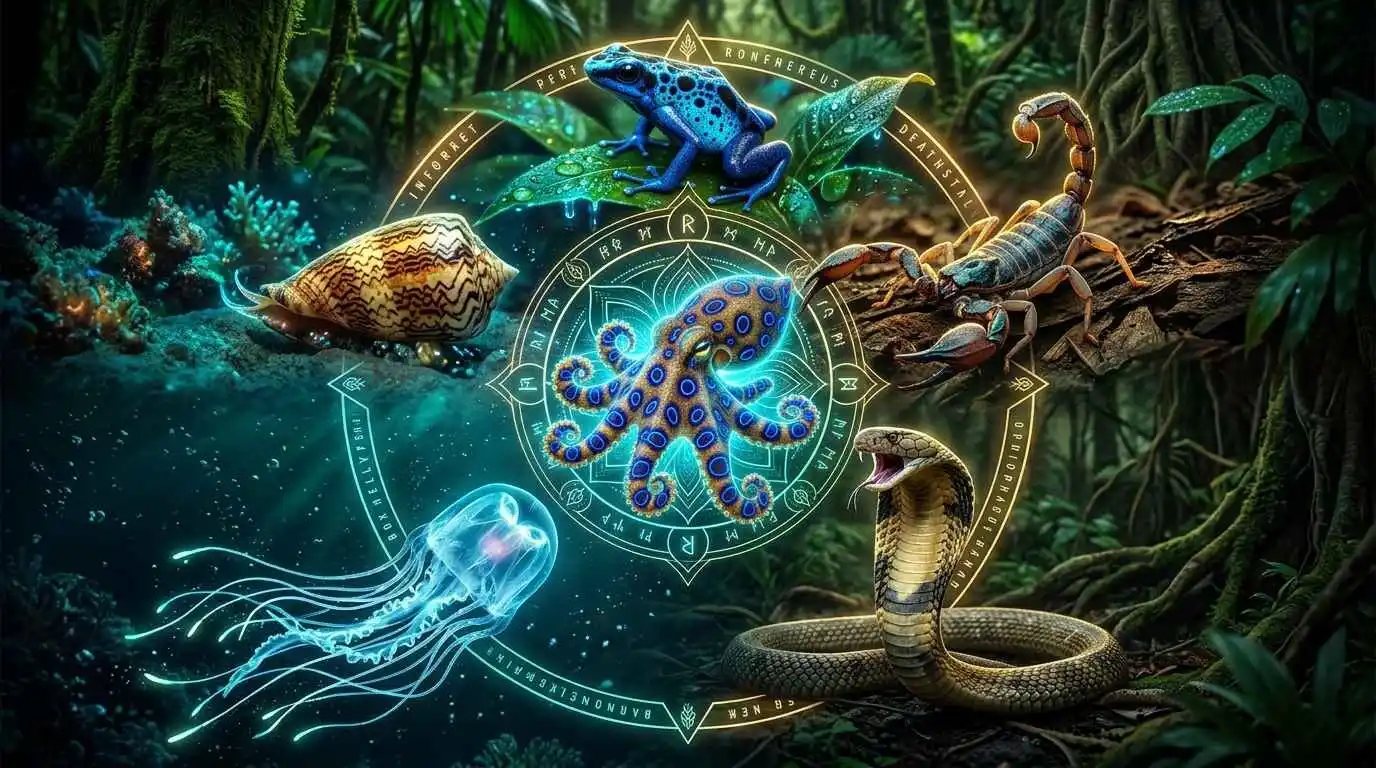
In the warm coastal waters of northern Australia and the Indo-Pacific, something almost invisible drifts through the shallows — and it is widely regarded as the most venomous marine animal on Earth. The box jellyfish, specifically Chironex fleckeri, carries enough venom in its tentacles to kill sixty adult humans. Its tentacles — which can extend up to 3 meters — are lined with millions of microscopic stinging cells called nematocysts that fire with extraordinary speed upon contact, injecting venom that simultaneously attacks the cardiovascular system, nervous system, and skin.
Death can occur within minutes of a severe sting. Survivors often report excruciating pain described as the worst sensation imaginable, and significant scarring from the chemical burns the tentacles leave behind. The box jellyfish is particularly dangerous because it is nearly transparent, making it nearly invisible in water, and it actively swims rather than simply drifting, meaning encounters are less predictable than with other jellyfish species.
Cone Snails (Conus geographus)
Few creatures better illustrate the principle that the most dangerous things often come in the most beautiful packages than the cone snail. These ornately patterned marine molluscs, found in tropical reefs worldwide, are prized by shell collectors — and that collection hobby has proven fatal numerous times.
The geographic cone snail (Conus geographus) is the most dangerous of approximately 700 known species. When threatened or handled, it extends a flexible, harpoon-like tooth called a radula from virtually any part of its shell, injecting conotoxins — a complex cocktail of hundreds of peptide compounds that block ion channels in the nervous system, causing progressive paralysis. There is no antivenom. Treatment is purely supportive. Mortality rates from significant envenomation are estimated between 20 and 70 percent without intensive medical care.
Conotoxins, paradoxically, have become one of the most exciting frontiers in pain medicine. The drug ziconotide (Prialt), derived from cone snail venom, is now used clinically to treat severe chronic pain, proving more potent than morphine without the addictive properties.
Stonefish (Synanceia verrucosa)
Lurking camouflaged among rocks and coral on the seafloor, the stonefish holds the grim distinction of being the world’s most venomous fish. Its spine-covered dorsal fin delivers a venom so excruciatingly painful that historical accounts describe victims begging to have the affected limb amputated. The venom causes tissue death, temporary paralysis, heart failure, and, in untreated cases, death. Antivenom exists but must be administered quickly to prevent permanent damage.
Amphibians: Small Bodies, Lethal Chemistry
Poison Dart Frogs (Dendrobatidae)
Among the most iconic of Earth’s poisonous creatures, poison dart frogs of the Dendrobatidae family are tiny — often no larger than a thumbnail — and dazzling. Their vivid coloration in electric blues, blazing oranges, and neon yellows is not decorative vanity. It is aposematism — a biological warning signal that screams “do not eat me” to any predator with the good sense to listen.
The golden poison dart frog (Phyllobates terribilis) of Colombia’s Pacific coast is considered the most toxic vertebrate on Earth. A single frog carries enough batrachotoxin to kill ten adult humans. This compound is extraordinarily potent: it prevents sodium ion channels in nerve and muscle cells from closing, causing continuous nerve firing, muscle contraction, heart failure, and death.
Critically, poison dart frogs are not born toxic. Their poison is derived entirely from their diet — specifically from certain beetles, mites, and other invertebrates in the wild habitat that themselves carry or accumulate these alkaloids from plant sources. Frogs raised in captivity on a standard diet develop no toxicity. This dietary origin of poison is one of the most remarkable examples of how toxicity flows through ecosystems in unexpected ways.
The indigenous Emberá people of Colombia have used the frogs’ skin secretions for centuries to poison the tips of blowgun darts — hence the name that has stuck across languages and cultures.
The Rough-Skinned Newt (Taricha granulosa)
In the forests of the Pacific Northwest of North America lives an unassuming brown amphibian whose skin is saturated with tetrodotoxin — the same compound found in puffer fish, and one of the most potent naturally occurring toxins known. A single rough-skinned newt carries enough tetrodotoxin to kill thousands of mice, or several adult humans.
The species that primarily preys on it — the common garter snake (Thamnophis sirtalis) — has evolved resistance to tetrodotoxin through mutations in its sodium channels, creating one of nature’s most spectacular ongoing evolutionary arms races, documented with extraordinary precision by biologist Edmund Brodie Jr. and his colleagues.
The most fascinating Toxic birds on Earth
To understand toxic birds, we must first make a crucial distinction: these birds are poisonous, not venomous. Venomous animals inject toxins (like a snake bite), whereas poisonous animals deliver toxins passively, usually through ingestion or skin contact.
Remarkably, no bird synthesizes its own poison. Instead, they acquire their toxicity through dietary sequestration—eating toxic insects or plants and safely storing the toxins in their flesh, feathers, and skin without harming themselves.
- The Hooded Pitohui (Pitohui dichrous)
Location: New Guinea The Toxin: Batrachotoxin
The Hooded Pitohui was the first documented poisonous bird in the world, discovered by scientists in 1989. If you were to pick up this striking black-and-orange bird, you would quickly feel a tingling, burning sensation, and your fingers would go numb.
The bird’s skin and feathers are laced with batrachotoxin—the same incredibly potent neurotoxin found in South American poison dart frogs. A single grain of this toxin is enough to kill a mouse, and it works by forcing the nervous system’s sodium channels to remain open, causing paralysis and death.
The pitohui acquires this toxin by eating Melyrid beetles. Because the toxin is embedded in its brightly colored feathers, it serves as a powerful defense mechanism (a biological warning sign called aposematism) against snakes, hawks, and humans. Local New Guinean tribes call it the “rubbish bird” because it smells musty and cannot be eaten unless its skin and feathers are completely removed and the meat is carefully roasted.
- The Blue-capped Ifrita (Ifrita kowaldi)
Location: New Guinea The Toxin: Batrachotoxin
Sharing the same misty, mountainous rainforests as the Pitohui is the Blue-capped Ifrita. This small, elusive bird looks a bit like a robust wren with a striking blue crown.
Like the Pitohui, the Ifrita sequesters batrachotoxin from its diet of toxic beetles. However, the Ifrita takes its chemical defense a step further. While the Pitohui passively carries the toxin in its skin and feathers, the Ifrita actively applies it. The bird has a specialized tuft of feathers on its flank that it uses like a paintbrush, manually rubbing the concentrated toxin from its skin over its eggs and chicks to protect them from nest-raiding predators.
- The Rufous Shrikethrush (Colluricincla megarhyncha)
Location: Australia and New Guinea. The Toxin: Batrachotoxin
The Rufous Shrikethrush is another inhabitant of the New Guinea region and parts of northern Australia that belongs to the exclusive “batrachotoxin club.” Unlike the vividly colored Pitohui, the Shrikethrush is rather drab—brown and gray, resembling a thrush.
Despite its unassuming appearance, its skin and feathers contain the same lethal neurotoxin. The presence of batrachotoxin in three completely unrelated bird families (Pitohuis, Ifritas, and Shrikethrushes) is a stunning example of convergent evolution. It proves that in the intense evolutionary arms race of the New Guinean rainforest, adapting to eat toxic beetles and using their poison as a shield is a highly successful survival strategy.
- The Common Quail (Coturnix coturnix)
Location: Europe, Asia, and Africa. The Toxin: Unknown (Causes “Coturnism”)
The Common Quail presents an entirely different kind of toxicity. Unlike the New Guinean birds, the quail is not brightly colored, does not have poisonous skin, and is completely safe to handle. Its poison lies entirely in its meat, and it is highly seasonal.
During their massive spring and autumn migrations, quail fly vast distances across the Mediterranean. Along the way, they stop to feed heavily on the seeds of a specific plant called Galeopsis ladanum (or similar toxic plants). Humans who hunt and eat these migrating quail can fall victim to Coturnism—a severe, sometimes fatal form of food poisoning.
Symptoms include acute muscle breakdown (rhabdomyolysis), vomiting, kidney failure, and paralysis. Strangely, quail hunted in the same locations at other times of the year, or quail raised in captivity, are perfectly safe to eat. The phenomenon was so well-documented in ancient Greece that the philosopher Aristotle wrote about the dangers of eating quail during migration season.
- The Spur-winged Goose (Plectropterus gambensis)
Location: Sub-Saharan Africa The Toxin: Cantharidin
The Spur-winged Goose is the largest goose in Africa and a highly aggressive, territorial bird. It looks somewhat like a cross between a goose and a pheasant.
This bird acquires its toxicity by gorging on blister beetles. Blister beetles contain cantharidin, a highly toxic compound famous historically as the main ingredient in “Spanish Fly” (an alleged aphrodisiac). The goose absorbs the cantharidin into its tissues, particularly its flesh.
If a predator—or a human hunter—manages to kill and eat a Spur-winged Goose, the consequences are agonizing. Cantharidin is a severe irritant that causes blistering of the mouth, throat, and digestive tract, intense abdominal pain, kidney damage, and potentially death. Interestingly, the toxin does not seem to bother the goose at all, and predators have largely learned to leave these massive birds alone.
- The Common Bronzewing (Phaps chalcoptera)
Location: Australia The Toxin: Sodium fluoroacetate (1080)
Australia is famous for its highly toxic flora and fauna, and the Common Bronzewing pigeon fits right in. This ground-dwelling bird feeds heavily on the seeds of native Australian plants, particularly the Gastrolobium genus, also known as “poison peas.”
These plants contain sodium fluoroacetate, an incredibly potent metabolic poison. In fact, this exact chemical is commercially manufactured and used by farmers as a pesticide called “1080” to control invasive pest species. The Common Bronzewing has evolved a complete immunity to the poison, happily eating the seeds. However, the toxin bioaccumulates in the bird’s flesh, making the pigeon highly poisonous to any carnivore or human that attempts to eat it.
A Rare Evolutionary Trick
Toxic birds are an extreme rarity in the animal kingdom. Out of the roughly 11,000 known bird species, only a tiny fraction have evolved this chemical defense. They prove a fascinating biological rule: if a non-lethal resource (like a toxic beetle or noxious weed) exists in an environment, evolution will eventually find a way to weaponize it for survival.
Reptiles: Venom With Ancient Lineage
Inland Taipan (Oxyuranus microlepidotus)
The inland taipan of central Australia possesses the most toxic venom of any snake species, as measured by the LD50 assay — the dose lethal to 50 percent of a test population. A single bite delivers enough venom to kill 289 humans, or 250,000 mice. Its venom is a sophisticated cocktail of neurotoxins, hemotoxins, and myotoxins that simultaneously attack the nervous system, destroy red blood cells, prevent blood clotting, and damage muscle tissue.
Remarkably, despite this extraordinary lethality, there has never been a recorded human fatality from the inland taipan. This is due in large part to its remote habitat and notably non-aggressive temperament — it is an ambush hunter of small mammals and tends to retreat rather than confront humans when given the opportunity.
King Cobra (Ophiophagus hannah)
While not possessing the most toxic venom drop-for-drop, the king cobra earns its fearsome reputation through sheer volume. A single bite can deliver 7 milliliters of venom — enough to kill an elephant, or twenty humans. It is the world’s longest venomous snake, reaching lengths of up to five and a half meters, and uniquely in the snake world, it preys almost exclusively on other snakes — including other venomous species.
The king cobra is also unusual in its neurological sophistication. It exhibits behaviors associated with planning and territory awareness, and the female constructs a nest and guards her eggs — a rarity among snakes that speaks to a level of parental investment unusual in reptiles.
Komodo Dragon (Varanus komodoensis)
The Komodo dragon of the Indonesian islands was long believed to kill its prey through bacterial infection from its notoriously bacteria-laden saliva. More recent research by Bryan Fry and colleagues at the University of Queensland revealed the truth to be more dramatic: the Komodo dragon has venom glands that produce anticoagulant and hypotensive compounds, inducing shock and preventing blood clotting in prey. Combined with their serrated teeth and ambush hunting strategy, they are among the most effective apex predators in their ecosystem.
Insects and Arachnids: Tiny Bodies, Outsized Danger
Brazilian Wandering Spider (Phoneutria)
The Brazilian wandering spider (Phoneutria nigriventer) holds the Guinness World Record for the world’s most venomous spider — a distinction it earns through a combination of venom toxicity, aggressive behavior, and the frequency with which it encounters humans. Unlike most spiders that retreat when disturbed, the phoneutria species adopts a distinctive threat posture, raising its front legs and swaying side to side before striking.
Its venom contains a compound called PhTx3, a neurotoxin that causes extreme pain, inflammation, loss of muscle control, and in severe cases, priapism — an involuntary, painful erection lasting hours — a symptom so distinctive that the spider’s toxin has attracted genuine pharmaceutical interest as a potential treatment for erectile dysfunction.
Sydney Funnel-Web Spider (Atrax robustus)
Australia’s Sydney funnel-web spider is arguably the world’s most dangerous spider to humans, specifically. Its venom contains a compound called robustoxin (δ-atracotoxin-Ar1) that is uniquely devastating to primate nervous systems — including humans — while being relatively harmless to other mammals. It is aggressive, fast-moving, and capable of biting multiple times. Before antivenom was developed in 1980, funnel-web envenomation was frequently fatal. Since the antivenom’s introduction, there have been no recorded deaths.
Deathstalker Scorpion (Leiurus quinquestriatus)
Found across the deserts of North Africa and the Middle East, the deathstalker scorpion is responsible for the majority of scorpion-related fatalities worldwide. Its venom is a complex mixture of neurotoxic peptides, including chlorotoxin — a compound that has generated significant interest in oncology research because it selectively binds to glioma brain cancer cells, making it a potential vehicle for targeted drug delivery.
Asian Giant Hornet (Vespa mandarinia)
The Asian giant hornet, sometimes sensationally called the “murder hornet,” measures up to five centimeters in length and delivers a venom that includes mandaratoxin — a compound that at sufficient doses can cause organ failure. More alarming than individual stings is the pheromone-triggered mass attack behavior: when a scout marks a target, a whole colony can mobilize. In Japan, hornets kill an average of 30 to 50 people per year, more than any other animal in the country.
Plants and the Creatures That Carry Their Poison
It is worth pausing to note that many of Earth’s most toxic creatures do not synthesize their poisons internally. They acquire them through diet — eating toxic plants, toxic invertebrates, or toxic prey — and sequester those compounds in their tissues for their own defense. This process, called toxin sequestration, creates remarkable chains of chemical dependence across ecosystems.
The monarch butterfly (Danaus plexippus) is perhaps the most famous example. By feeding exclusively on milkweed plants (Asclepias), monarch caterpillars accumulate cardiac glycosides that make them toxic and foul-tasting to birds. The vivid orange and black coloring of the adult butterfly is a warning to predators with prior experience of the unpleasant effect of eating one.
This relationship extends further: the viceroy butterfly (Limenitis archippus), which is not toxic, has evolved nearly identical coloration to the monarch — a strategy called Batesian mimicry, in which a harmless species free-rides on the hard-earned reputation of a genuinely dangerous one.
The Deadliest of All: The Blue-Ringed Octopus
Saved for a special mention is the blue-ringed octopus (Hapalochlaena), a creature of heartbreaking beauty and alarming lethality. Palm-sized and adorned with iridescent blue rings that pulse and glow when the animal is threatened, it is perhaps the most visually striking creature in this entire catalogue.
Its weapon is tetrodotoxin — the same compound found in rough-skinned newts and puffer fish — produced not by the octopus itself, but by symbiotic bacteria living in its salivary glands. The venom is injected through a painless bite, and therein lies the danger: victims often do not realize they have been bitten until symptoms begin. There is no antivenom. The only treatment is mechanical ventilation to keep the patient breathing until the toxin clears — a window of several hours during which a paralyzed but fully conscious victim must be kept alive by medical support.
Despite carrying enough toxin to kill 26 adults, the blue-ringed octopus is shy, docile, and remarkably reluctant to bite. Nearly all documented bites have involved humans handling the animal.
Why Toxicity Evolved: The Bigger Picture
Understanding why these creatures evolved their toxicity is as important as cataloguing their effects. Venom and poison serve a small number of fundamental biological functions: predation (acquiring food), defense (avoiding becoming food), and in some species, competition (defeating rivals).
The biochemical diversity of animal toxins is staggering — and it represents one of the most underexplored pharmacological libraries on Earth. Approximately half of all modern medicines derive from or were inspired by natural compounds, and venoms and poisons are contributing at an accelerating rate. Beyond ziconotide from cone snails and chlorotoxin from scorpions, captopril — a widely used antihypertensive medication — was derived from the venom of the lancehead pit viper (Bothrops jararaca). Tirofiban, used to prevent blood clots during cardiac procedures, derives from the saw-scaled viper. Exenatide, a treatment for type 2 diabetes, comes from the saliva of the Gila monster.
The creatures that many humans fear and reflexively wish to destroy may, in fact, hold the biochemical keys to some of medicine’s most intractable challenges.
Conservation: Protecting Nature’s Most Feared
The irony of the world’s most toxic creatures is that many of them are among its most threatened. Habitat destruction, climate change, the illegal wildlife trade, and direct persecution have put numerous venomous and poisonous species under severe pressure.
Golden poison dart frogs face habitat loss as Colombia’s Pacific rainforest is cleared. King cobras are killed on sight across much of their range. Many scorpion species face collection pressure for the medical and cosmetic industries, where their venom is harvested — sometimes sustainably, often not. The Komodo dragon faces the dual threat of habitat loss and prey depletion.
Protecting these creatures is not merely a matter of sentiment or biodiversity for its own sake. It is, quite practically, protecting an irreplaceable biochemical library that human medicine is only beginning to read. Every extinct species takes its unique molecular toolkit with it — permanently.
Conclusion: Fear Less, Understand More
The natural world’s most toxic creatures are easy to fear and difficult to appreciate from a distance. But understanding them — their biology, their chemistry, their ecological roles, and the evolutionary pressures that shaped them — transforms fear into something far more useful: informed respect.
Most of the creatures described in this article pose little or no threat to humans who observe them sensibly from a distance. The genuine dangers are real but also largely avoidable. Far more people are harmed by domestic animals, road traffic, and preventable disease than by all of the world’s venomous and poisonous species combined.
The true story of Earth’s most toxic creatures is not a horror story. It is an astonishing testament to the ingenuity of evolution — a 3.8-billion-year research-and-development program that has produced chemical solutions of breathtaking elegance and complexity. We are only beginning to learn how to read its findings.
In nature’s most lethal arsenal, there is medicine, there is wonder, and there is, above all, a reason to protect what remains.
Frequently Asked Questions
- What is the difference between venomous and poisonous?
Venomous creatures actively deliver toxins through a bite, sting, or spine. Poisonous creatures are harmful when touched or consumed. The distinction lies in the delivery mechanism.
- What is the most venomous animal on Earth?
The box jellyfish (Chironex fleckeri) is widely considered the most venomous animal by total toxicity — its tentacles carry enough venom to kill 60 adult humans.
- What is the most poisonous vertebrate on Earth?
The golden poison dart frog (Phyllobates terribilis) is the most toxic vertebrate, carrying enough batrachotoxin in its skin to kill approximately ten adult humans.
- Is the inland taipan the deadliest snake?
It has the most toxic venom drop-for-drop, but “deadliest” depends on context. The saw-scaled viper causes more human deaths annually due to its range and proximity to human populations.
- Why are poison dart frogs so colorful?
Their bright colors are a warning signal called aposematism, signaling to predators that they are toxic and should not be eaten.
- Do poison dart frogs produce their own poison?
No. They sequester alkaloids from their diet of toxic invertebrates. Captive-bred frogs raised on non-toxic food develop no toxicity.
- Can touching a poison dart frog kill you?
The most toxic species can transfer dangerous compounds through skin contact, especially if you have cuts or then touch your eyes or mouth. Handling without precaution is inadvisable.
- Is the Komodo dragon venomous?
Yes. Research by Bryan Fry revealed venom glands that produce anticoagulant compounds, challenging the older bacterial-saliva theory.
- What makes tetrodotoxin so dangerous?
Tetrodotoxin blocks sodium channels in nerve and muscle cells, causing progressive paralysis, including respiratory failure, without loss of consciousness. There is no antivenom.
- Which spider is the most dangerous to humans specifically?
The Sydney funnel-web spider (Atrax robustus) is considered the most dangerous to humans due to its uniquely primate-specific neurotoxin, aggressive behavior, and proximity to populated areas.
- What should you do if stung by a box jellyfish?
Remove tentacles carefully (do not use bare hands), apply commercial vinegar to deactivate nematocysts, and seek emergency medical care immediately. Do not apply fresh water, which can worsen nematocyst discharge.
- Are there any treatments derived from animal venoms?
Yes. Medications derived from or inspired by animal venoms include captopril (viper), ziconotide (cone snail), exenatide (Gila monster), and tirofiban (saw-scaled viper).
- Why is the blue-ringed octopus particularly dangerous?
Its bite is painless and often unnoticed. There is no antivenom. By the time symptoms appear, respiratory failure can follow rapidly. Its attractive appearance encourages dangerous handling.
- What is batrachotoxin, and how does it work?
Batrachotoxin prevents sodium ion channels in nerve and muscle cells from closing, causing continuous uncontrolled firing, leading to cardiac arrest and death.
- How do cone snails deliver their venom?
Through a flexible, harpoon-like radula tooth that can extend from virtually any direction on the shell, allowing the snail to strike even handlers approaching from behind.
- What is the deadliest scorpion?
The deathstalker scorpion (Leiurus quinquestriatus) of North Africa and the Middle East is responsible for the majority of scorpion-related human fatalities worldwide.
- Why do monarch butterflies eat milkweed?
To accumulate cardiac glycosides from the plant into their tissues, rendering themselves toxic and unpalatable to predators such as birds.
- What is Batesian mimicry?
A form of mimicry where a harmless species evolves to resemble a genuinely toxic or dangerous species, benefiting from the predator avoidance that the dangerous species has earned.
- Is there an antivenom for cone snail stings?
No. There is currently no approved antivenom for cone snail envenomation. Treatment is entirely supportive, which may include mechanical ventilation.
- How does the deathstalker scorpion’s venom contribute to cancer research?
Its chlorotoxin selectively binds to glioma brain cancer cells, making it a candidate vehicle for targeted drug delivery to tumors.
- Are Asian giant hornets (“murder hornets”) actually a major threat?
They are dangerous in mass attacks, killing 30–50 people annually in Japan, primarily through anaphylaxis and organ failure. Individual stings, while painful, are rarely fatal to healthy adults.
- What is the rough-skinned newt’s evolutionary arms race with garter snakes?
As newts evolved more tetrodotoxin, garter snakes evolved greater toxin resistance through sodium channel mutations — a coevolutionary cycle documented as one of nature’s finest examples of an ongoing arms race.
- Can stonefish stings be fatal?
Yes, if untreated. Antivenom is available and effective, but must be administered promptly. The venom causes severe pain, cardiovascular effects, and tissue death.
- Why is the Brazilian wandering spider being studied by pharmaceutical researchers?
One of its venom compounds causes priapism — prolonged erection — and researchers are investigating PhTx3 derivatives as potential treatments for erectile dysfunction.
- What makes the king cobra unique among venomous snakes?
It is the world’s longest venomous snake, preys almost exclusively on other snakes, and is one of the few snake species to build and actively guard a nest.
- Why are many venomous species threatened with extinction?
Habitat loss, climate change, direct persecution, and collection for the venom trade are major pressures. Many species are killed on sight due to fear or misidentification.
- How is blue-ringed octopus venom treated?
Through mechanical ventilation to maintain breathing until the tetrodotoxin clears — typically over several hours. The patient remains conscious throughout, as the toxin does not affect higher brain function.
- Is the inland taipan the snake most likely to kill you?
No. Despite its extraordinary venom potency, its remote habitat and non-aggressive temperament mean it has never caused a recorded human fatality. More medically significant snakes include the saw-scaled viper and Russell’s viper.
- What is aposematism?
Aposematism is the use of warning coloration, sound, or smell by toxic or unpalatable animals to signal their danger to potential predators, reducing the likelihood of attack.
- Can venom research help develop new antibiotics?
Yes. Several compounds derived from animal venoms and skin secretions, including those from frogs and snakes, have shown antibacterial properties and are being investigated as candidates to address antibiotic resistance.
Written in awe of nature’s most extraordinary, most feared, and most misunderstood inhabitants.
Disclaimer: The content on this blog is for informational purposes only. The author’s opinions are personal and not endorsed. Efforts are made to provide accurate information, but completeness, accuracy, or reliability are not guaranteed. The author is not liable for any loss or damage resulting from the use of this blog. It is recommended to use the information on this blog at your own discretion.
