
Table of Contents
PSC is a progressive inflammatory disease of the bile ducts leading to biliary cirrhosis. It is strongly associated with IBD — particularly Ulcerative Colitis. UC patients with PSC have a substantially elevated risk of colorectal cancer and need intensive surveillance.
22 Why is the right lower quadrant (RLQ) the typical pain site in Crohn’s?
Because Crohn’s most commonly affects the terminal ileum, located in the right lower quadrant of the abdomen. This can mimic appendicitis clinically, and indeed some patients with Crohn’s first present with an “appendicitis-like” episode.
23 Can Crohn’s Disease affect the mouth?

Yes. Oral Crohn’s can manifest as aphthous ulcers (mouth sores), mucosal tags, cobblestoning of the buccal mucosa, or swelling of the lips and gums. It is one of the less common but diagnostically telling extraintestinal presentations.
24 What is “creeping fat” in Crohn’s Disease?
Creeping fat refers to the extension of mesenteric adipose tissue around the bowel wall, wrapping around inflamed segments. It is a macroscopic (visible to the naked eye) hallmark of Crohn’s Disease observed during surgery or on cross-sectional imaging.
25 What is the IPAA procedure, and for which IBD is it used?
Ileal Pouch-Anal Anastomosis (IPAA), or “J-pouch” surgery, is performed after proctocolectomy in UC patients. It creates a reservoir from the terminal ileum to restore bowel continuity. It is not suitable for Crohn’s patients due to the high risk of pouch failure and fistula formation.
26 What serological markers help differentiate CD from UC?
ASCA (anti-Saccharomyces cerevisiae antibodies) are associated with Crohn’s Disease; p-ANCA (perinuclear anti-neutrophil cytoplasmic antibodies) are associated with UC. However, neither is sufficiently sensitive nor specific to be used as a standalone diagnostic test.
27 Is IBD the same as IBS (irritable bowel syndrome)?
No, they are fundamentally different. IBD (Crohn’s and UC) involves measurable structural inflammation of the bowel and carries risks of serious complications, including cancer, surgery, and malnutrition. IBS is a functional disorder with no structural inflammation, not associated with these risks.
28 Does diet cause or cure IBD?
Diet does not cause IBD, and no specific diet cures it, though dietary choices can influence symptom control and nutritional status. Low-residue diets may help during Crohn’s strictures; high-fiber diets may aggravate active disease. Nutritional therapy (exclusive enteral nutrition) is effective for inducing remission in paediatric Crohn’s.
29 What psychological impact does IBD have on patients?
The burden is substantial — rates of anxiety and depression are significantly higher in IBD patients than in the general population. Unpredictable symptoms, social restrictions, medication burden, and fear of complications all contribute. Integrated mental health support is an essential component of IBD care.
- What is the most important single clinical clue to differentiate Crohn’s from UC at the bedside?
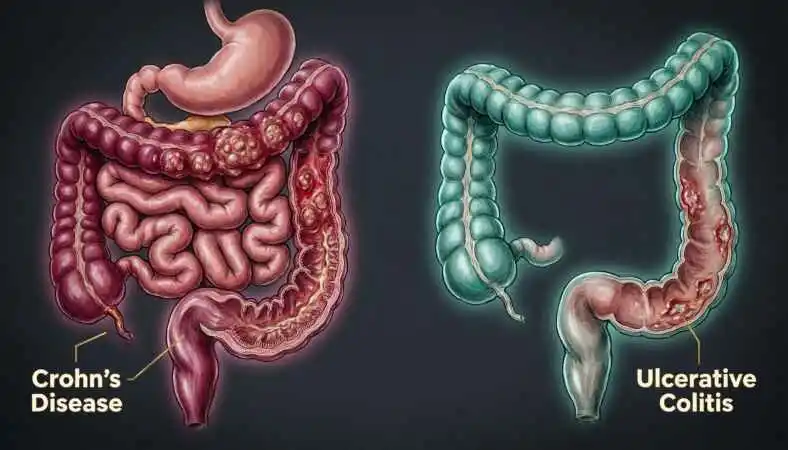
Rectal involvement. If the rectum is always inflamed and the disease is continuous, think UC. If the rectum is spared, the disease is patchy, there is perianal disease, or the small bowel is involved: think Crohn’s. This single observation guides a large proportion of the diagnostic reasoning in IBD.
Medical Disclaimer:
The information provided on this website is for general educational and informational purposes only and is not intended as a substitute for professional medical advice, diagnosis, or treatment. Always seek the advice of your physician or other qualified health provider with any questions you may have regarding a medical condition. Never disregard professional medical advice or delay in seeking it because of something you have read on this website.
