
Table of Contents
Same Gut, Different War: The Complete Guide to Crohn’s Disease vs Ulcerative Colitis
Two inflammatory bowel diseases. One diagnosis that changes a life. An essential deep-dive into the differences, overlaps, and everything medical students, patients, and caregivers need to know.
Introduction: The Inflammatory Bowel Disease Dilemma
Imagine living with a gut that is perpetually at war with itself. Cramping pain that arrives without warning. Diarrhea that disrupts work, relationships, and sleep. Fatigue so profound that getting out of bed requires negotiation. This is the daily reality for millions of people worldwide living with Inflammatory Bowel Disease (IBD) — an umbrella term for a group of chronic conditions in which the immune system mistakenly attacks the gastrointestinal tract.
The two most prevalent and clinically significant forms of IBD are Crohn’s Disease and Ulcerative Colitis (UC). While they share the same inflammatory umbrella, the two conditions are fundamentally different in their location, depth of tissue involvement, pattern of damage, clinical presentation, management strategy, and prognosis. Confusing them is not merely an academic error — it has real consequences for treatment decisions, surgical planning, and long-term patient outcomes.
This article is a comprehensive, evidence-informed guide to understanding both conditions — their similarities, their critical distinctions, and the clinical wisdom that helps differentiate them at the bedside, in the laboratory, and on the imaging table.

3M+Americans living with IBD
50%of CD cases involve the terminal ileum
100%of UC cases involve the rectum
5×higher colon cancer risk in long-standing UC
Understanding Crohn’s Disease: The Wanderer of the Gut
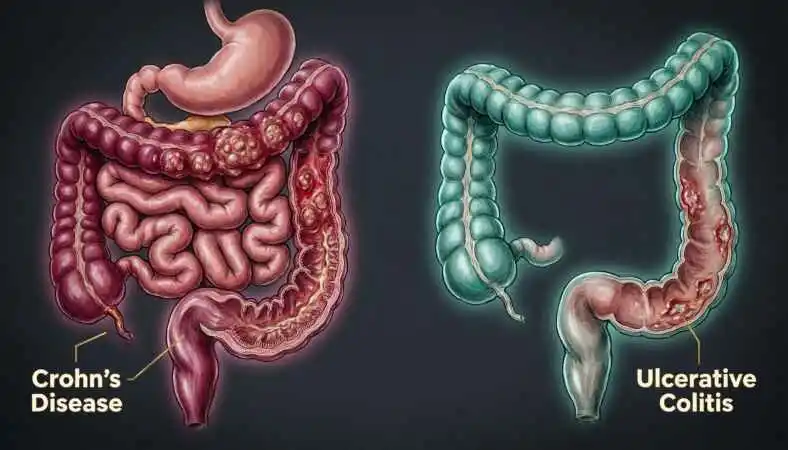
Crohn’s Disease is, in essence, a condition without boundaries. Named after the American gastroenterologist Burrill Crohn, who described it in 1932, Crohn’s can affect any segment of the gastrointestinal tract, from the mouth all the way to the anus. However, the most commonly affected site — in approximately 50% of cases — is the terminal ileum, the last segment of the small intestine, where it meets the colon.
What makes Crohn’s particularly distinctive is its transmural nature — the inflammation does not stay superficial. It penetrates through the full thickness of the bowel wall, from the innermost mucosa all the way through the submucosa, muscularis propria, and into the serosa. This depth of involvement has profound consequences. Fistulas — abnormal connections between loops of bowel, or between bowel and adjacent structures like the bladder, vagina, or skin — are a hallmark complication. Strictures, or narrowing of the intestinal lumen caused by fibrous scar tissue, are also common and can lead to partial or complete bowel obstruction.
Perhaps the most visually striking feature of Crohn’s pathology is the cobblestone mucosa — a lumpy, irregular surface pattern created when deep ulcers are interspersed between relatively spared islands of oedematous mucosa. On barium studies, the narrowed terminal ileum produces the classic “string sign”, a thin line of contrast through a fibrotic, inflamed segment.
Histologically, the defining feature of Crohn’s is the presence of non-caseating granulomas on biopsy, found in approximately 50% of specimens. These compact clusters of immune cells are not specific to Crohn’s alone, but their presence in the appropriate clinical context is strongly suggestive. Importantly, while Crohn’s raises the risk of colorectal cancer, the more pressing cancer concern in small bowel Crohn’s is adenocarcinoma of the small intestine — a rare but serious complication.
“Crohn’s is the wanderer — striking anywhere from mouth to anus, burrowing deep through the bowel wall, leaving fistulas, strictures, and cobblestone scars in its wake.”
Understanding Ulcerative Colitis: The Continuous Fire
Ulcerative Colitis is, in many ways, Crohn’s photographic negative. Where Crohn’s roams, UC stays confined. Where Crohn’s strikes in patches, UC burns continuously. And where Crohn’s penetrates deep, UC stays shallow — but no less destructive for it.
UC is exclusively a disease of the colon and rectum. It virtually always begins in the rectum and spreads proximally (upwards toward the caecum) in a continuous, uninterrupted fashion. There are no skip lesions. There is no sparing of segments within the affected zone. The rectum is always involved in UC — this is a critical clinical fact and one of the most reliable differentiating features between the two diseases.
The inflammation in UC is mucosal and submucosal — it does not go full thickness. This shallower invasion pattern explains why fistulas are rare in UC and why, crucially, colectomy (surgical removal of the entire colon) is considered curative in UC, in a way that surgery cannot cure Crohn’s. Because the disease is confined to the colon and the rectum, removing those organs removes the disease. Crohn’s, by contrast, can recur at anastomotic sites and new segments after surgery.
The dominant symptom of UC is bloody diarrhea. The continuous mucosal inflammation leads to ulceration, friability, and bleeding, producing the characteristic bloody, mucus-laden stools that bring many patients to medical attention. Abdominal pain, when present, tends to be left-sided, correlating with sigmoid colon involvement. On biopsy, rather than granulomas, UC typically shows crypt abscesses and distorted crypt architecture, along with goblet cell depletion and basal plasmacytosis.
One of the most serious complications of UC is toxic megacolon — a life-threatening dilation of the colon accompanied by systemic sepsis, which requires urgent surgical intervention. The risk of colorectal cancer in UC is substantially elevated, particularly in patients with pancolitis (disease involving the entire colon) and those with long disease duration, rising significantly after 8–10 years of disease.
Head-to-Head: The Complete Clinical Comparison
The table below, adapted from standard clinical teaching, captures the key distinguishing features between the two conditions across every major clinical, pathological, and investigative dimension:
| Feature | CD Crohn’s Disease | UC Ulcerative Colitis |
| Location | Any part of the GI tract (mouth to anus), commonly the terminal ileum | Limited to the colon and rectum only |
| Pattern of Involvement | Skip lesions (patchy, segmental) | Continuous from the rectum upwards |
| Depth of Inflammation | Transmural (full-thickness); cobblestone mucosa, creeping fat | Mucosal and submucosal only |
| Granulomas on Biopsy | Non-caseating granulomas (~50%) | Rare; crypt abscesses/ulcers |
| Ulcers | Deep linear, knife-like ulcers | Superficial, broad-based ulcers |
| Fistulas & Strictures | Common (due to transmural involvement) | Rare |
| Rectal Involvement | Often spared | Always involved |
| Bloody Diarrhea | Less common (unless colonic involvement) | Common and prominent |
| Abdominal Pain | Common, especially the right lower quadrant (RLQ) | May occur; usually left-sided |
| Perianal Disease | Common (fistulas, fissures, abscesses) | Rare |
| Risk of Colon Cancer | Increased (especially with colonic involvement) | Increased; rises with duration and extent |
| Smoking Effect | Worsens Crohn’s | May be protective in UC |
| Surgery | Not curative; recurrence common at anastomosis | Colectomy is curative |
| Extraintestinal Manifestations | Seen in both (arthritis, uveitis, erythema nodosum) | Seen in both |
| Classic Imaging Finding | “String sign” on barium (narrowed terminal ileum) | “Lead pipe” colon (loss of haustra) on barium enema |
The Curious Case of Smoking
One of the most fascinating — and clinically counterintuitive — aspects of IBD is the divergent effect of smoking on the two conditions. Smoking unambiguously worsens Crohn’s Disease. Smokers with Crohn’s have more aggressive disease, higher rates of fistula formation, more frequent flares, and a greater need for surgery than non-smoking Crohn’s patients.
In Ulcerative Colitis, however, the relationship is inverted. Epidemiological data have long noted that UC is more common in non-smokers and ex-smokers, and that nicotine may have a modest protective or suppressive effect on colonic inflammation. This is not a recommendation to smoke — the cardiovascular, pulmonary, and carcinogenic consequences of tobacco vastly outweigh any colonic benefit — but it does illuminate the different immunological mechanisms underlying the two diseases and has spurred research into nicotine patches as an adjunctive UC therapy.
Extraintestinal Manifestations: When IBD Leaves the Gut
Both Crohn’s Disease and Ulcerative Colitis are systemic diseases that can affect organs far beyond the gastrointestinal tract. These extraintestinal manifestations (EIMs) are not rare — they occur in roughly 25–40% of IBD patients and can sometimes predate the bowel diagnosis by years.
The joints are the most commonly affected non-GI site. Arthritis in IBD takes two forms: peripheral arthritis, which typically parallels bowel disease activity, and axial arthropathy (including sacroiliitis and ankylosing spondylitis), which can progress independently. The skin can develop erythema nodosum — painful, raised red nodules typically on the shins — or the more severe pyoderma gangrenosum. The eyes may show uveitis, episcleritis, or scleritis. The liver and biliary tree are implicated in primary sclerosing cholangitis (PSC), which has a particularly strong association with UC. Kidney stones (oxalate stones in Crohn’s) and gallstones are also more common in IBD patients.
Diagnosis: Reaching the Right Answer
No single test diagnoses either condition definitively. The diagnosis of IBD — and the differentiation between Crohn’s and UC — relies on an integrative assessment combining clinical history, laboratory markers, endoscopic findings, histopathology, and imaging.
Colonoscopy with biopsy is the cornerstone of diagnosis. It allows direct visualization of the mucosa, assessment of the distribution of disease, and tissue sampling for histology. In Crohn’s, colonoscopy may reveal the characteristic skip lesions, deep linear ulcers, and cobblestone appearance, with a normal rectum in many cases. In UC, the continuous inflammation beginning at the rectum, the granular friable mucosa, and the loss of vascular pattern are characteristic.
Laboratory investigations, including faecal calprotectin (a sensitive marker of intestinal inflammation), C-reactive protein, full blood count, and inflammatory markers, help establish disease activity. Serology — including ASCA (anti-Saccharomyces cerevisiae antibodies, associated with Crohn’s) and p-ANCA (perinuclear anti-neutrophil cytoplasmic antibodies, associated with UC) — can sometimes assist differentiation, though neither is specific enough to be diagnostic alone.
Imaging plays a crucial supporting role. MRI enterography is the preferred modality for assessing small bowel Crohn’s, evaluating fistulas, and monitoring disease extent without radiation. CT enterography provides similar information in acute settings. The classic barium studies — the string sign of Crohn’s and the lead pipe colon of UC — remain important teaching cases, though their use has been largely supplanted by cross-sectional imaging in clinical practice.
Clinical Caveat — Indeterminate Colitis
In approximately 10–15% of IBD cases, the clinical, endoscopic, and histological features do not clearly distinguish Crohn’s colitis from Ulcerative Colitis. These cases are classified as Indeterminate Colitis (IC) or, more recently, IBD-Unclassified (IBD-U). Long-term follow-up eventually resolves the diagnosis in the majority of cases, but surgical planning — especially regarding pouch surgery — must be undertaken with particular caution in this group.
Treatment: Shared Tools, Different Strategies
The medical management of Crohn’s and UC shares significant common ground, though the differences in disease location and behavior mean that strategies are tailored accordingly. The therapeutic ladder for both conditions includes aminosalicylates (5-ASAs), which are particularly effective in mild-to-moderate UC; corticosteroids for inducing remission during flares; immunomodulators such as azathioprine and 6-mercaptopurine for maintenance; and biologic therapies — including anti-TNF agents like infliximab and adalimumab, anti-integrin agents like vedolizumab, and anti-IL-12/23 agents like ustekinumab.
The key surgical divergence remains the most clinically important distinction: colectomy cures UC. Patients with refractory UC, severe toxic megacolon, or dysplasia can achieve disease remission through proctocolectomy with ileal pouch-anal anastomosis (IPAA). In Crohn’s, surgery is reserved for complications — strictures, fistulas, abscesses, or medically refractory disease — with the understanding that disease can recur at new or anastomotic sites.
Living with IBD: Beyond the Diagnosis
Both conditions demand far more than medical management — they require a wholesale renegotiation of how a person lives. Diet, stress management, medication adherence, regular surveillance colonoscopies, and mental health support are all integral components of IBD care. The psychological burden of IBD is substantial: rates of anxiety and depression are significantly elevated in IBD populations compared to the general public, driven by unpredictable symptoms, social embarrassment, medication side effects, and the chronic nature of the illness.
Patient education — understanding the difference between disease activity and remission, recognizing early warning signs of flares and complications, and knowing when to seek urgent care — is a cornerstone of good IBD management. The distinction between Crohn’s and UC is not merely academic. It guides every clinical decision, from which medication to prescribe, to whether surgery offers a cure or merely a stopgap, to the surveillance protocol required to monitor cancer risk.
Conclusion: Two Diseases, One Commitment to Understanding
Crohn’s Disease and Ulcerative Colitis are not simply two names for the same condition. They are distinct pathological entities with different locations, different inflammatory patterns, different complications, different surgical implications, and different long-term trajectories. Yet they are united by the suffering they inflict, the systemic reach of their effects, and the profound impact they have on the lives of those who live with them.
For clinicians, accurate differentiation between the two is a non-negotiable competency — one that demands mastery of clinical history, endoscopic findings, histopathology, and imaging. For patients and caregivers, understanding the specific nature of their diagnosis empowers more informed decision-making, better adherence, and a more productive partnership with their healthcare team.
The gut is, increasingly, understood to be at the center of human health in ways that extend far beyond digestion. When it is inflamed, the consequences ripple outward into joints, skin, eyes, liver, and mind. Understanding the precise nature of that inflammation — whether it follows Crohn’s wandering, transmural path, or UC’s relentless mucosal march — is the foundation of care that is not just adequate, but genuinely excellent.
Beyond the Prescription: Natural Remedies and Lifestyle Changes for Crohn’s Disease vs. Ulcerative Colitis
Living with Inflammatory Bowel Disease (IBD) feels like walking on a tightrope. You never quite know when the next flare-up will strike—bringing with it agonizing abdominal cramps, relentless urgency, profound fatigue, and the isolating fear of being caught far from a bathroom.
While Crohn’s Disease and Ulcerative Colitis (UC) are often lumped together under the IBD umbrella, they are distinct adversaries. Crohn’s is a transmural (full-thickness) inflammation that can attack any part of the digestive tract from mouth to anus, often creating “skip lesions” and strictures. Ulcerative Colitis, on the other hand, is a continuous, superficial inflammation limited to the innermost lining of the colon and rectum.
Because the anatomical battlegrounds are different, the medical interventions—like biologics, immunosuppressants, and surgeries like colectomies—often differ. However, when it comes to natural remedies and lifestyle modifications, there is a massive overlap.
Dietary Architecture (Feeding the Gut, Starving the Inflammation)
There is no single “IBD Diet,” because triggers vary wildly from person to person. However, the goal is universally the same: reduce the mechanical and chemical workload on the digestive tract while flooding the body with anti-inflammatory nutrients.
The Universal IBD Diet Rules:
- Eliminate Trigger Foods: During a flare, you must temporarily remove raw vegetables, nuts, seeds, and high-fiber whole grains. These act like tiny shards of glass on an inflamed gut.
- Ditch Processed Foods: Emulsifiers (like polysorbate 80 and carageenan) found in processed foods literally strip away the protective mucus layer of your gut, triggering flares.
- Cook Everything Low and Slow: Switch to a low-residue diet. Steam vegetables until they are fork-tender. Eat lean proteins (skinless chicken, white fish, tofu).
Nuance – Crohn’s Disease: Because Crohn’s frequently attacks the small intestine (where most nutrient absorption happens), Crohn’s patients are at a massive risk for malnutrition and vitamin deficiencies (specifically B12, Iron, and Vitamin D).
- The Fix: Focus on liquid nutrition during flares. Bone broths, meticulously blended protein shakes, and easily absorbable amino acid supplements are critical. Crohn’s patients must also be hyper-vigilant about dairy, as the small intestine is where lactose is broken down; dairy intolerance is highly prevalent in Crohn’s.
Nuance – Ulcerative Colitis: UC is limited to the large intestine (colon). The colon’s job is to absorb water. When it is inflamed, it cannot absorb water, resulting in severe, dehydrating diarrhea.
- The Fix: Hydration is your #1 priority, but water alone isn’t enough. You need electrolytes (sodium, potassium, magnesium). UC patients often tolerate soluble fiber better than Crohn’s patients (like the inner flesh of apples or oats) because it turns into a soothing gel in the colon. However, avoid insoluble fiber (wheat bran, leafy greens) during active flares.
Targeted Natural Supplements (The Anti-Inflammatory Arsenal)
While food provides the foundation, certain concentrated natural compounds act as powerful, scientifically-backed anti-inflammatories.
- Curcumin (The UC MVP) Extensive clinical trials have shown that Curcumin (the active compound in turmeric) is incredibly effective at inducing and maintaining remission in Ulcerative Colitis. It inhibits the exact inflammatory pathways (NF-kB) that cause UC flares.
- How to use: Must be taken as a highly bioavailable supplement (paired with black pepper/piperine) at therapeutic doses (usually 2-3 grams daily), as you cannot get enough from food alone. Note: Curcumin is less effective for Crohn’s, as Crohn’s inflammation is driven by different immune pathways (Th1/Th17).
- Omega-3 Fatty Acids (EPA/DHA) Found in high-quality fish oil or wild-caught salmon, Omega-3s block the production of inflammatory prostaglandins and leukotrienes. They are highly beneficial for both conditions, helping to soothe the mucosal lining and reduce joint pain (which often accompanies IBD).
- L-Glutamine L-Glutamine is an amino acid that serves as the primary fuel source for the cells lining your intestines (enterocytes). During a flare, the gut lining becomes “leaky.” Supplementing with L-Glutamine powder can help repair the intestinal barrier.
- Nuance: While excellent for UC (colon lining), be cautious with Crohn’s if you have active strictures (narrowing), as rapid cell turnover can sometimes exacerbate blockages. Always clear this with your GI doctor.
- Zinc Carnosine This specific chelated form of zinc adheres directly to the ulcerated areas of the stomach and intestines, acting like a liquid bandage. It has been shown to accelerate mucosal healing in both Crohn’s and UC.
Lifestyle Interventions (Rewiring the Gut-Brain Axis)
Your gut and your brain are physically connected by the vagus nerve. Stress doesn’t cause IBD, but science unequivocally proves that psychological stress triggers flares, increases intestinal permeability (leaky gut), and worsens pain perception.
- Vagus Nerve Stimulation (Breathwork) When you are stressed, your sympathetic nervous system (fight-or-flight) pulls blood away from your digestive tract, halting digestion and causing spasms. You must manually activate your parasympathetic nervous system (rest-and-digest).
- The Fix: Deep diaphragmatic breathing. Inhale for 4 seconds, exhale for 6-8 seconds. Doing this for 10 minutes before meals prepares your gut to digest food smoothly, reducing cramping and bloating.
- Sleep Architecture The vast majority of your body’s repair and anti-inflammatory processes happen between 10 PM and 2 AM. Sleep deprivation spikes cortisol, which directly fuels gut inflammation.
- The Fix: Treat sleep as a medication. Prioritize 8 hours in a pitch-black, cool room. If nighttime diarrhea or urgency is ruining your sleep (common in UC), discuss nighttime dosing of anti-diarrheals with your doctor.
- Mindful Movement During a severe flare, bed rest is often required. But during remission, moderate exercise is non-negotiable. Exercise increases blood flow to the gut, promotes healthy peristalsis (bowel movements), and reduces systemic inflammation. Yoga and walking are ideal; avoid high-impact sports or heavy weightlifting during active flares, as they can increase intra-abdominal pressure and cause GI bleeding.
The Microbiome Makeover
IBD patients have a drastically altered microbiome compared to healthy individuals—they lack diversity and have an overgrowth of aggressive bacteria.
While probiotic foods (like kombucha, kefir, and sauerkraut) are great for healthy people, they can be a nightmare for someone in an IBD flare, as the active bacteria can trigger immune responses.
- The Strategy: Only introduce probiotics (specifically Saccharomyces boulardii or Lactobacillus GG, which have clinical backing for IBD) after your gastroenterologist has confirmed you are in deep remission. Instead of probiotics during a flare, focus on Prebiotics—foods that feed the good bacteria you already have. Mashed bananas, cooked oats, and asparagus are excellent, gentle prebiotics.
Summary Checklist: Crohn’s vs. UC Natural Focus
For Crohn’s Disease: Focus heavily on liquid nutrition, strict avoidance of dairy/small-intestine irritants, prioritize checking B12/Iron levels, and use Omega-3s to combat systemic inflammation. Be cautious with high-fiber supplements if strictures are present.
For Ulcerative Colitis: Focus aggressively on electrolyte hydration, utilize therapeutic doses of Curcumin, use soluble fiber (psyllium husk or oatmeal) during remission to form perfect stools, and utilize Zinc Carnosine to heal the rectal lining.
Living with IBD requires immense resilience. By aligning your diet, supplements, and lifestyle habits with the specific mechanics of your disease, you take back control. You may not be able to cure IBD yet, but through natural, mindful living, you can absolutely build a life where the disease no longer defines you.
Frequently Asked Questions
01 What is the fundamental difference between Crohn’s Disease and Ulcerative Colitis?
Crohn’s can affect any part of the GI tract in a patchy, transmural (full-thickness) pattern, while UC exclusively involves the colon and rectum in a continuous, mucosal-only pattern, always starting from the rectum.
02 Which condition is more likely to cause bloody diarrhea?
Ulcerative Colitis — bloody diarrhea is a hallmark symptom due to continuous mucosal ulceration. In Crohn’s, bloody diarrhea occurs mainly when the colon is significantly involved.
03 Why is the rectum always involved in UC but often spared in Crohn’s?
UC begins in the rectum and spreads continuously upward. Crohn’s, being patchy and segmental, frequently spares the rectum even when other parts of the colon or GI tract are affected — a clinically important differentiator.
04 What are skip lesions, and in which condition do they occur?
Skip lesions are areas of normal bowel interspersed between diseased segments. They are characteristic of Crohn’s Disease. UC, by contrast, always shows continuous involvement with no areas of normal mucosa between inflamed zones.
05 What does “transmural” inflammation mean, and why does it matter?
Transmural means the inflammation extends through all layers of the bowel wall — mucosa, submucosa, muscularis, and serosa. This depth explains Crohn’s hallmark complications: fistulas, strictures, and abscesses, which are rare in UC’s shallower mucosal inflammation.
06 Is surgery curative for Ulcerative Colitis?
Yes. Because UC is confined to the colon and rectum, a total proctocolectomy effectively cures the disease. This is not true for Crohn’s, which can recur anywhere in the GI tract after surgery.
07 What are the classic barium imaging findings in each condition?
Crohn’s shows the “string sign” — a thin thread of contrast through a narrowed, fibrotic terminal ileum. UC shows the “lead pipe” colon — loss of normal haustra (pouches) on barium enema, producing a smooth, featureless colon.
08 What is a non-caseating granuloma, and why is it important?
A non-caseating granuloma is a compact cluster of immune cells (macrophages) without central necrosis (caseation). Found in approximately 50% of Crohn’s biopsies, it is a key histological clue supporting the diagnosis, though not present in UC.
09 Which condition has a higher risk of colorectal cancer?
Both carry elevated colorectal cancer risk, but UC — especially pancolitis of long duration — carries a particularly high risk, rising significantly after 8–10 years of disease. Regular surveillance colonoscopy is recommended for both.
10 Why does smoking worsen Crohn’s but potentially protect against UC?
The two conditions have different immunological mechanisms. Nicotine appears to modulate colonic mucosal immunity in ways that suppress UC activity, while in Crohn’s it promotes microvascular changes and T-cell responses that worsen inflammation. This paradox has driven research into nicotine patches for UC.
11 What are fistulas, and in which IBD conditions are they more common?
Fistulas are abnormal connections between two body cavities or surfaces — such as bowel-to-bowel, bowel-to-bladder, or bowel-to-skin. They are a hallmark complication of Crohn’s Disease due to transmural inflammation, and are rare in UC.
12 What is cobblestone mucosa?
Cobblestone mucosa is an endoscopic and radiographic appearance in Crohn’s Disease where deep ulcers surrounding islands of oedematous (swollen) mucosa create a raised, bumpy pattern resembling cobblestones.
13 What are the extra intestinal manifestations of IBD?
Both conditions can affect joints (arthritis, sacroiliitis), skin (erythema nodosum, pyoderma gangrenosum), eyes (uveitis, episcleritis), and liver (primary sclerosing cholangitis — most strongly associated with UC). These affect 25–40% of IBD patients.
14 What is a crypt abscess, and in which IBD is it characteristic?
Crypt abscesses are accumulations of neutrophils within the mucosal crypts of the colon. They are the characteristic histological findings in Ulcerative Colitis, along with distorted crypt architecture and goblet cell depletion.
15 Is perianal disease (fistulas, abscesses) common in UC?
No. Perianal fistulas, fissures, and abscesses are characteristic of Crohn’s Disease and are rare in Ulcerative Colitis. Their presence in a patient with colitis strongly suggests Crohn’s.
16 What is toxic megacolon, and which condition is it associated with?
Toxic megacolon is a life-threatening dilation of the colon (transverse diameter >6 cm) with systemic toxicity. It is most commonly associated with severe Ulcerative Colitis, but can occur in Crohn’s colitis. It requires urgent surgical evaluation.
17 What role does faecal calprotectin play in IBD diagnosis?
Fecal calprotectin is a highly sensitive marker of intestinal inflammation. Elevated levels suggest active bowel inflammation and help differentiate IBD from non-inflammatory conditions like irritable bowel syndrome (IBS), but cannot distinguish Crohn’s from UC alone.
18 What is indeterminate colitis?
In 10–15% of IBD cases, features are insufficient to clearly classify the disease as Crohn’s colitis or UC. These are termed indeterminate colitis (IC) or IBD-Unclassified (IBD-U), and require careful long-term monitoring, particularly before surgical planning.
19 Which biologic agents are used in IBD treatment?
Anti-TNF agents (infliximab, adalimumab), anti-integrin agents (vedolizumab), and anti-IL-12/23 agents (ustekinumab) are key biologics for moderate-to-severe IBD. Newer agents targeting JAK pathways (tofacitinib, upadacitinib) are also used, particularly in UC.
20 Are 5-aminosalicylates (5-ASAs) equally effective in both conditions?
5-ASAs like mesalazine are highly effective first-line therapy for mild-to-moderate UC. Their benefit in Crohn’s Disease is significantly more limited and is not recommended for small bowel Crohn’s or as maintenance therapy in most guidelines.
21 What is primary sclerosing cholangitis (PSC) and its IBD link?
