
Table of Contents
The Body’s Secret Command Center: Why Your Adrenal Glands Quietly Run Everything
Two glands the size of walnuts control your stress response, blood pressure, metabolism, and more — here’s how
Perched on top of each kidney, weighing barely a few grams apiece, sit two glands that most people never think about until something goes wrong. The adrenal glands do not get the attention that the heart, the brain, or even the thyroid receives in everyday health conversations, yet almost nothing the body does under stress, activity, or even during ordinary rest happens without their involvement. They are small, but they are relentless — quietly regulating blood pressure, blood sugar, metabolism, immune response, and the entire stress cascade around the clock.
Because their output is chemical rather than mechanical, the adrenal glands tend to stay invisible in daily life. There is no adrenal ‘heartbeat’ to feel, no obvious rhythm to notice. Their work only becomes visible when something disrupts it — a racing heart during a near-miss on the highway, an inexplicable afternoon energy crash, or, in more serious cases, a diagnosed disorder like Addison’s disease or Cushing’s syndrome. Understanding what these glands actually do, and why they matter, turns a lot of otherwise confusing symptoms into something explainable.
This guide walks through the adrenal glands from the ground up: their structure, the hormones they produce, the specific bodily functions they control, what happens when they malfunction, and the everyday habits that support — or undermine — healthy adrenal function.

What the Adrenal Glands Actually Are
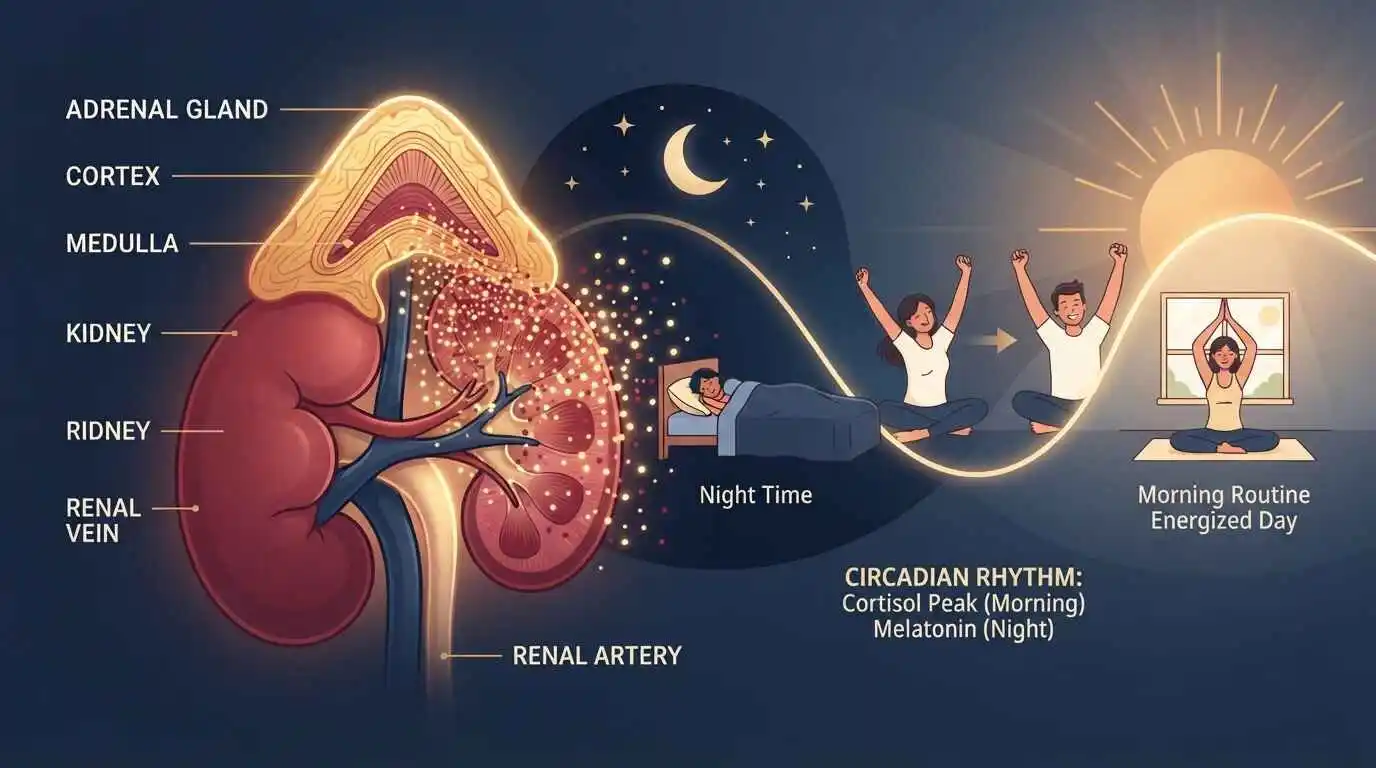
Each adrenal gland sits atop a kidney and is made of two structurally and functionally distinct regions: the outer adrenal cortex and the inner adrenal medulla. Despite being fused into a single organ, these two regions behave almost like separate glands working side by side, each producing its own set of hormones and each answering to a different part of the body’s control system.
The adrenal cortex, which makes up roughly eighty percent of the gland, produces steroid hormones organized into three functional zones: the outermost zone produces mineralocorticoids that regulate salt and water balance, the middle zone produces glucocorticoids that regulate metabolism and the stress response, and the innermost zone produces small amounts of androgens, precursor sex hormones. The adrenal medulla, by contrast, is essentially an extension of the nervous system, producing the fast-acting hormones adrenaline and noradrenaline that drive the immediate fight-or-flight response.
This dual structure explains why adrenal health touches so many different systems at once. A gland built from two functionally distinct organs stacked together does not just do one job — it manages an entire portfolio of physiological processes simultaneously.
It is also worth noting how the adrenal glands receive their instructions. The adrenal cortex responds primarily to hormonal signaling from the brain over a timescale of minutes to hours, while the adrenal medulla responds to direct nerve signals from the sympathetic nervous system within seconds. This is why an adrenaline surge feels almost instantaneous — a car swerving into your lane, a sudden loud noise — while the broader cortisol-driven stress response builds and fades more gradually over the following hour. The two halves of the same small organ are, in effect, running on two different response speeds.
You never feel your adrenal glands working — you only notice when they stop keeping pace.
Core Functions of the Adrenal Glands
Eight systems these two small glands help regulate every day
1. Regulating the Stress Response
The adrenal medulla releases adrenaline and noradrenaline within seconds of a perceived threat, producing the classic fight-or-flight response: heart rate increases, airways widen, blood is redirected toward muscles, and alertness sharpens. Meanwhile the adrenal cortex releases cortisol on a slightly slower timescale, sustaining the body’s heightened state for as long as the stressor persists and helping the body return to baseline once it passes. Together, these two response systems form the body’s primary defense against acute danger.
2. Controlling Blood Pressure
Aldosterone, produced in the outer zone of the adrenal cortex, regulates sodium and potassium balance in the kidneys, which directly controls how much fluid the body retains. More retained fluid means higher blood volume and higher blood pressure; less retained fluid means the opposite. This makes the adrenal glands one of the primary long-term regulators of blood pressure, working continuously in the background rather than only during moments of acute stress.
3. Managing Blood Sugar and Metabolism
Cortisol plays a central role in glucose metabolism, prompting the liver to release stored glucose into the bloodstream during periods of stress or fasting, and influencing how the body processes fats, proteins, and carbohydrates more broadly. This is part of why chronic stress is so often linked to blood sugar irregularities — sustained cortisol elevation keeps glucose production elevated even when the body does not actually need the extra fuel. Over months or years, this pattern can contribute to insulin resistance, since cells exposed to persistently elevated glucose and cortisol become progressively less responsive to insulin’s signal to absorb that glucose.
4. Supporting the Immune System
Cortisol has a significant anti-inflammatory effect, which is why synthetic versions of it are prescribed for conditions ranging from asthma to autoimmune flare-ups. In normal amounts, cortisol keeps the immune response appropriately calibrated. In excess — as seen in chronic stress or Cushing’s syndrome — it can suppress immune function to the point of increasing infection risk, illustrating how the same hormone can be protective or harmful depending on dose and duration.
5. Regulating Sleep-Wake Rhythms
Cortisol follows a natural daily rhythm, peaking shortly after waking to promote alertness and gradually declining throughout the day to allow for rest at night. This cortisol curve is one of the body’s primary circadian signals, working alongside melatonin to structure the sleep-wake cycle. Disruption of this rhythm — through shift work, chronic stress, or irregular sleep — is a common, underappreciated contributor to fatigue and poor sleep quality.
6. Producing Precursor Sex Hormones
The innermost zone of the adrenal cortex produces small quantities of androgens, which serve as precursor molecules that are converted into testosterone and estrogen in other tissues throughout the body. While the gonads remain the primary source of sex hormones during reproductive years, the adrenal contribution becomes proportionally more significant after menopause, when adrenal androgens become one of the few remaining sources of sex hormone precursors.
7. Maintaining Electrolyte and Fluid Balance
Beyond blood pressure regulation, aldosterone’s control over sodium and potassium levels is essential for basic cellular function throughout the body, since these electrolytes govern nerve conduction, muscle contraction, and fluid distribution between cells and tissues. Even modest disruptions to aldosterone output can produce symptoms as varied as muscle cramps, irregular heartbeat, and persistent fatigue.
8. Enabling the Body’s Response to Illness and Injury
During physical illness, surgery, or major injury, the adrenal glands increase cortisol output substantially to help the body cope with the physiological demands of healing and immune activation. This is why individuals with adrenal insufficiency face genuine medical danger during illness or surgery — their glands cannot mount the increased output the body needs, a scenario clinicians refer to as adrenal crisis risk.
The HPA Axis: How the Brain Keeps the Adrenal Glands in Check
The adrenal glands do not operate independently — they are the final link in a three-part feedback loop known as the hypothalamic-pituitary-adrenal axis, or HPA axis. When the brain perceives a stressor, the hypothalamus releases corticotropin-releasing hormone, which signals the pituitary gland to release adrenocorticotropic hormone, which in turn signals the adrenal cortex to release cortisol. Once cortisol reaches sufficient levels in the bloodstream, it signals back to the hypothalamus and pituitary to reduce their output, completing a negative feedback loop that keeps cortisol levels from rising indefinitely.
This feedback loop is elegant under normal conditions, but it can be disrupted by chronic stress, certain medications, or underlying disease at any of the three levels involved. A problem in the adrenal glands themselves is called primary adrenal insufficiency, while a problem in the pituitary or hypothalamus that reduces the signal reaching otherwise healthy adrenal glands is called secondary adrenal insufficiency. Distinguishing between these is a key part of diagnostic workups, since the underlying cause changes both the treatment approach and the associated risks.
Understanding the HPA axis also explains why psychological stress has measurable physical effects throughout the body. The pathway from a stressful thought to a physiological cortisol spike is direct and fast, which is part of why chronic psychological stress is so consistently linked to real, measurable changes in blood pressure, blood sugar, and immune markers rather than being a purely subjective experience.
How Adrenal Function Changes Across the Lifespan
Adrenal gland activity is not static across a lifetime. In the developing fetus, the adrenal cortex is disproportionately large relative to body size and plays an important role in supporting pregnancy before shrinking down to typical proportions after birth. Through childhood and into the reproductive years, the glands maintain a fairly stable division of labor between cortisol regulation, blood pressure control, and modest sex hormone precursor production.
The most notable lifespan shift happens around a process called adrenarche, typically in the years leading up to puberty, when the adrenal glands increase their output of androgens well before the gonads become the primary driver of sexual maturation. Later in life, particularly after menopause, adrenal androgens take on relatively greater importance as a source of sex hormone precursors, since ovarian production declines sharply while adrenal output declines much more gradually.
Aging is also associated with a gradual blunting of the stress response’s efficiency — older adults often take slightly longer to return to baseline cortisol levels after a stressor resolves, which is one of several reasons recovery from illness, surgery, or major physical stress can take longer later in life even when the adrenal glands themselves show no signs of disease.
How the Adrenal Glands Compare to Other Endocrine Glands
The human body relies on a network of endocrine glands — the thyroid, pancreas, pituitary, ovaries, testes, and adrenals among them — each releasing hormones that travel through the bloodstream to influence distant tissues. What sets the adrenal glands apart is the sheer breadth of physiological territory they touch relative to their size. The thyroid primarily governs metabolic rate, the pancreas primarily governs blood glucose through insulin and glucagon, and the gonads primarily govern reproductive function. The adrenal glands, by contrast, sit at the intersection of the nervous system and the endocrine system, producing hormones that influence metabolism, blood pressure, immune activity, electrolyte balance, and the stress response simultaneously.
This breadth also means the adrenal glands interact heavily with other endocrine organs rather than operating in isolation. Cortisol influences how effectively insulin functions, which is why chronic cortisol elevation is associated with insulin resistance over time. Aldosterone works alongside the kidney’s own renin-angiotensin system to fine-tune blood pressure. Adrenal androgens interact with the reproductive hormone system, particularly later in life. Very few endocrine glands sit at this many functional intersections at once, which is part of why adrenal dysfunction can produce such a wide and sometimes misleading spread of symptoms — the problem may show up as a blood pressure issue, a blood sugar issue, or a fatigue issue, even though the root cause is the same pair of small glands above the kidneys.
When the Adrenal Glands Malfunction
Because the adrenal glands influence so many systems, dysfunction can produce a wide and sometimes confusing range of symptoms. Two conditions represent the opposite ends of the spectrum.
Addison’s Disease (Adrenal Insufficiency)
This occurs when the adrenal cortex does not produce enough cortisol and aldosterone, often due to autoimmune destruction of the gland. Symptoms tend to develop gradually and include persistent fatigue, unexplained weight loss, low blood pressure, salt cravings, and darkening of the skin. Left untreated, a sudden physical stressor can trigger an adrenal crisis, a life-threatening emergency requiring immediate medical intervention.
Cushing’s Syndrome (Cortisol Excess)
This results from prolonged exposure to excess cortisol, whether from a tumor on the adrenal or pituitary gland, or from long-term use of corticosteroid medications. Symptoms include weight gain concentrated around the face and midsection, thinning skin, muscle weakness, elevated blood pressure, and mood disturbances. Because corticosteroid medications are so widely prescribed, medication-induced Cushing’s syndrome is more common than the tumor-driven form.
Adrenal Fatigue: A Term Worth Clarifying
The term ‘adrenal fatigue’ has become popular in wellness circles to describe persistent tiredness attributed to overworked adrenal glands, but it is not a recognized clinical diagnosis, and mainstream endocrinology does not use it. The fatigue people describe under this label is real and worth investigating, but it typically has a different, diagnosable cause — ranging from thyroid dysfunction to sleep disorders to true adrenal insufficiency — which is why a proper medical workup matters more than a self-applied label.
Everyday Habits That Support Healthy Adrenal Function
- Prioritize consistent sleep timing rather than just total sleep hours, since regular wake times help stabilize the natural cortisol rhythm that governs energy throughout the day.
- Moderate, regular physical activity supports healthy cortisol regulation, while chronic overtraining without adequate recovery can push the stress-response system into prolonged overdrive.
- Maintain steady blood sugar through balanced meals rather than skipping meals or relying heavily on high-sugar snacks, since large glucose swings place additional demand on cortisol’s regulatory role.
- Build in deliberate recovery practices — whether that is structured downtime, breathing exercises, or simply protected non-work hours — since the stress response is designed for short bursts, not sustained activation.
- Limit unsupervised long-term use of corticosteroid medications where possible, and never stop a prescribed steroid abruptly, since sudden discontinuation can trigger adrenal insufficiency symptoms in a gland that has adapted to external supplementation.
- Moderate caffeine and alcohol intake, particularly later in the day, since both can interfere with the natural evening decline in cortisol that supports restful sleep.
When to Seek Medical Care
Persistent, unexplained fatigue, sudden changes in blood pressure, unexplained weight changes, salt cravings, or new skin darkening all warrant a conversation with a physician rather than self-diagnosis. Adrenal disorders are diagnosed through blood and urine hormone testing, sometimes paired with imaging, and both insufficiency and excess are manageable with proper medical treatment once identified. The earlier a genuine adrenal disorder is caught, the more straightforward the treatment path tends to be. It is also worth noting that a normal routine blood panel does not automatically rule out an adrenal issue, since standard checkups do not typically include cortisol or aldosterone testing unless specifically requested — a detail worth raising directly with a physician if symptoms persist despite otherwise unremarkable bloodwork.
Final Thoughts
The adrenal glands are easy to overlook precisely because they do their job so continuously and so quietly. There is no single moment where you feel your aldosterone regulating your blood pressure or your cortisol structuring your sleep cycle — these processes simply happen, thousands of times a day, in the background of ordinary life. It is only when something goes wrong that their scope becomes obvious, and by then the disruption often touches several systems at once, from energy and mood to blood pressure and immune function.
Understanding what these glands actually do is not just trivia — it reframes a lot of common, hard-to-explain symptoms as physiologically coherent rather than mysterious. Fatigue that will not resolve with rest, blood pressure that will not stabilize, or a stress response that never seems to switch off are not random; they often trace back to this small, easily ignored pair of organs sitting quietly above the kidneys, doing more work than almost any other structure in the body its size.
None of this requires becoming an amateur endocrinologist. What it does call for is a basic working knowledge of what these glands do and what their dysfunction tends to look like, so that if symptoms ever do appear, they read as recognizable signals worth investigating rather than as vague, disconnected complaints. That kind of awareness is often the difference between an early, manageable diagnosis and a prolonged, frustrating search for answers.
FAQs
| # | Question | Answer |
| 1 | What is the main function of the adrenal glands? | They regulate the stress response, blood pressure, blood sugar, metabolism, immune function, and electrolyte balance through hormone production. |
| 2 | Where are the adrenal glands located? | One sits on top of each kidney, which is why they are also called suprarenal glands. |
| 3 | What are the two main parts of the adrenal gland? | The outer adrenal cortex, which produces steroid hormones, and the inner adrenal medulla, which produces adrenaline and noradrenaline. |
| 4 | What hormones do the adrenal glands produce? | Cortisol, aldosterone, adrenaline, noradrenaline, and small amounts of precursor sex hormones called androgens. |
| 5 | What does cortisol do? | Cortisol regulates blood sugar, metabolism, inflammation, and the daily sleep-wake cycle, and rises during stress to help the body cope. |
| 6 | What does aldosterone control? | Aldosterone regulates sodium and potassium balance, which directly controls blood volume and blood pressure. |
| 7 | What is the fight-or-flight response? | It is the rapid physiological reaction triggered by adrenaline and noradrenaline in response to a perceived threat, increasing heart rate and alertness. |
| 8 | What is Addison’s disease? | A condition where the adrenal glands do not produce enough cortisol and aldosterone, often due to autoimmune damage. |
| 9 | What is Cushing’s syndrome? | A condition caused by prolonged excess cortisol, resulting in weight gain, high blood pressure, and other metabolic symptoms. |
| 10 | Is adrenal fatigue a real medical diagnosis? | No, it is not a recognized clinical diagnosis; persistent fatigue usually has another identifiable, diagnosable cause. |
| 11 | Can stress damage the adrenal glands? | Chronic stress does not damage the glands structurally, but sustained cortisol elevation can disrupt metabolism, sleep, and immune balance over time. |
| 12 | What are symptoms of adrenal insufficiency? | Persistent fatigue, low blood pressure, salt cravings, unexplained weight loss, and skin darkening. |
| 13 | What are symptoms of excess cortisol? | Weight gain around the face and midsection, thinning skin, muscle weakness, and elevated blood pressure. |
| 14 | How are adrenal disorders diagnosed? | Through blood and urine hormone testing, sometimes combined with imaging of the glands. |
| 15 | Can adrenal disorders be treated? | Yes, both insufficiency and excess cortisol conditions are manageable with appropriate medical treatment once diagnosed. |
| 16 | What is an adrenal crisis? | A life-threatening emergency in which the body cannot produce enough cortisol during acute stress, illness, or injury. |
| 17 | Do the adrenal glands affect blood sugar? | Yes, cortisol prompts the liver to release stored glucose, playing a central role in blood sugar regulation. |
| 18 | How do the adrenal glands affect sleep? | Cortisol follows a daily rhythm that peaks after waking and declines through the day, helping structure the sleep-wake cycle. |
| 19 | Can the adrenal glands affect mood? | Yes, both cortisol excess and insufficiency are associated with mood disturbances, including anxiety and depression-like symptoms. |
| 20 | Do adrenal glands produce sex hormones? | They produce small amounts of precursor androgens that are converted into testosterone and estrogen elsewhere in the body. |
| 21 | Why do corticosteroid medications affect the adrenal glands? | Long-term steroid use can suppress the body’s natural cortisol production, and abrupt discontinuation can trigger insufficiency symptoms. |
| 22 | What lifestyle habits support healthy adrenal function? | Consistent sleep timing, regular moderate exercise, balanced meals, and structured recovery from stress. |
| 23 | Can exercise affect adrenal hormone levels? | Yes, moderate exercise supports healthy cortisol regulation, while chronic overtraining can keep the stress response elevated. |
| 24 | Is adrenal insufficiency common? | It is relatively rare, but medication-induced cortisol suppression from long-term steroid use is more common than the autoimmune form. |
| 25 | What organ system controls the adrenal glands? | The hypothalamus and pituitary gland regulate adrenal hormone output through a feedback loop called the HPA axis. |
| 26 | Can high blood pressure be linked to adrenal problems? | Yes, excess aldosterone or cortisol production can be an underlying, often overlooked cause of high blood pressure. |
| 27 | Do the adrenal glands shrink with age? | Some age-related decline in function occurs, but the glands generally continue producing essential hormones throughout life. |
| 28 | Can adrenal problems cause weight changes? | Yes, both unexplained weight loss and weight gain can result from adrenal insufficiency or cortisol excess, respectively. |
| 29 | What doctor treats adrenal gland disorders? | Endocrinologists specialize in diagnosing and treating adrenal and other hormone-related conditions. |
| 30 | When should someone see a doctor about adrenal symptoms? | Persistent fatigue, blood pressure changes, unexplained weight changes, or new skin darkening warrant a medical evaluation rather than self-diagnosis. |
⚕️Medical Disclaimer:
The information provided on this website is for general educational and informational purposes only and is not intended as a substitute for professional medical advice, diagnosis, or treatment. Always seek the advice of your physician or other qualified health provider with any questions you may have regarding a medical condition. Never disregard professional medical advice or delay in seeking it because of something you have read on this website.
