
Table of Contents
BEYOND THE PITCH : Football Series
The Match That Stopped a Civil War
How Didier Drogba and the Ivory Coast’s 2006 World Cup qualification produced one of football’s most extraordinary moments of peace
October 2005: A Nation on the Edge
To understand what happened in the Ivory Coast national team’s dressing room on the night of October 8th, 2005, you first need to understand the country those players were carrying on their backs.
The Ivory Coast — Cote d’Ivoire — had been torn apart by civil war since September 2002. A failed coup attempt had fractured the nation along lines of ethnicity, religion, and geography. The government controlled the Christian-majority south. Rebel forces known as the Forces Nouvelles held the Muslim-majority north. In between, a buffer zone patrolled by French and United Nations peacekeepers. In between, the daily reality of a society at war with itself.
In this context, football had become one of the few things that still belonged to everyone. The Elephants — Les Elephants, the national team — were one of the rare institutions that drew support from across the divide. And on that October night in Abidjan, they achieved something the country had not managed in 24 years: qualification for the World Cup.

| Historical Context
The First Ivorian Civil War began in September 2002 when a rebel military faction attempted to overthrow President Laurent Gbagbo. The country split into a government-controlled south and a rebel-held north, with international peacekeepers maintaining a fragile buffer zone. The war officially ended in 2007, but political tensions persisted through a second civil conflict in 2010–2011. |
The Qualifying Campaign: A Team as a Symbol
Ivory Coast’s route to the 2006 World Cup was part of the African qualifying process, requiring them to navigate a competitive group before a play-off route for the final slot. Throughout the campaign, the team’s coach — at the time Henri Michel, later Henryk Kasperczak — worked with a generation of players who were unusually talented by African standards.
By 2005, Didier Drogba was one of the best strikers in European football. His move from Marseille to Chelsea the previous summer had established him as a genuine top-tier Premier League presence. Kolo Toure was a regular at Arsenal. His younger brother Yaya was developing at Olympiakos. Emmanuel Eboue was at Arsenal. The core of the squad played at the highest level of club football in Europe, making this the most talented Ivory Coast generation in history.
But the weight they carried was not purely sporting. Players spoke openly during the campaign about their desire to be more than a football team — to be a message. In press conferences and interviews, several referenced the conflict at home and their hope that success could unite rather than merely entertain.
The Decisive Night
The decisive qualifying match was against Sudan in Abidjan. Ivory Coast needed the win. They delivered it — a 3-1 victory that confirmed their place at Germany 2006. The Stade Félix Houphouet-Boigny erupted.
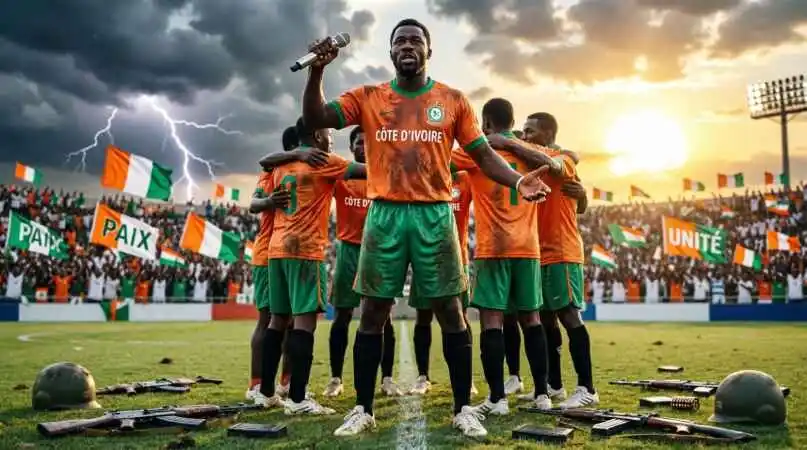
What happened next is one of those moments in football that exists entirely outside the normal frame of the sport. The Ivory Coast team retreated to their changing room. Ivorian television cameras followed. And there, in the humid intimacy of a post-match dressing room, Didier Drogba dropped to his knees and made a plea that had nothing to do with football.
His speech was not scripted. It was not coordinated with government officials or media strategists. It was the spontaneous outpouring of a man who knew that his moment of sporting triumph was happening against a backdrop of national agony. He begged. He pleaded. He asked the men with guns — on both sides — to lay them down.
| Drogba’s Words
His appeal to the nation — broadcast live on Ivorian television — is remembered for its raw sincerity. Drogba and his teammates physically kneeled in the dressing room and asked for peace. In a country where armed factions controlled entire regions, the national team had no coercive power. They had only football and the love of the country that both sides claimed. |
The Ceasefire
What followed was, by any rational measure, improbable. The ceasefire came. In the weeks after the qualifying match, the government and rebel representatives agreed to a pause in hostilities. The duration, the depth, and the causal relationship between Drogba’s speech and the ceasefire are debated by historians. Post-conflict analysis rarely produces clean cause-and-effect chains.
But people who were in the Ivory Coast during that period — diplomats, journalists, ordinary citizens — consistently report that something shifted after the qualification. The Elephants had given the country a shared point of joy at a moment of collective exhaustion. The request for peace, coming from players who represented something loved by everyone, carried a moral weight that political speeches had failed to achieve.
The ceasefire held long enough to allow peace negotiations to resume. The political process that eventually ended the First Ivorian Civil War took years more. But October 2005 was, for many Ivorians, the moment when they first allowed themselves to imagine that their country might survive.
Germany 2006: The Tournament
The World Cup itself was, by strict footballing standards, a disappointment for the Ivory Coast. They had been drawn into what many analysts called the most difficult group in the tournament — Argentina, the Netherlands, and Serbia and Montenegro. Despite winning their final group game 3-2 against Serbia, their goal difference was insufficient, and they were eliminated without advancing to the knockout stage.
But the group stage performance deserves more generous assessment than its outcome suggests. Ivory Coast played attacking football against two of the tournament’s elite nations. They were unlucky in their draw. In a different group, with the squad they had, they might have reached the quarter-finals.
More importantly, their presence at the tournament — their very existence at Germany 2006 — had already fulfilled its purpose before a ball was kicked. The shirt with the orange stripes and the elephant badge was being worn by people in Abidjan and Bouake, in government territory and rebel territory alike. The team was the country’s most effective ambassador for the idea that the country still existed as a singular thing.
Drogba’s Legacy Beyond Football
Didier Drogba went on to have one of the most celebrated careers in Premier League history. His performances for Chelsea — including an extraordinary Champions League final in Munich in 2012 where he scored a late equaliser and then converted the winning penalty — established him as one of the great strikers of his generation.
But in the Ivory Coast, and among many who follow African football, he is known for something larger. His Didier Drogba Foundation — established in 2007 — has funded hospitals, schools, and community projects across the country. His role in the 2005 ceasefire, however imprecise its impact is to measure, is regarded as the defining act of a career that happened to include winning the Champions League.
He is, in a meaningful sense, the most politically consequential footballer Africa has produced — not because he sought political power, but because he wielded cultural authority at a moment when his nation desperately needed someone to say the obvious: stop fighting.
| Beyond the Pitch | Reflection
Football cannot end wars. But it can create moments of shared humanity in which the abstract arguments for peace become something felt rather than merely understood. The Ivory Coast story is the most documented example of this phenomenon in the modern game — and it offers a model, however imperfect, for understanding what sport can accomplish when the stakes go beyond the scoreboard. |
Why This Story Matters
Stories like this one risk sentimentalisation. The reality of civil conflict is brutal, protracted, and resistant to sporting intervention. No football match really stops a civil war. People on both sides of the Ivory Coast’s conflict continued to suffer long after October 2005.
But the story matters because it is true. Something happened in that dressing room that reached across the lines of armed conflict and touched something human. Whatever the exact causal chain between Drogba’s speech and the subsequent ceasefire, the team’s appeal was heard. The ceasefire happened. People who had been shooting at each other stopped, at least temporarily, because a footballer they all loved asked them to.
In a world accustomed to thinking of football as entertainment, commerce, and spectacle, this is a useful reminder of what the game carries within it. The World Cup is the most-watched event in human history. The players who wear their nations’ colours in their qualifying rounds are, whether they seek it or not, among the most powerful communicators on Earth. Sometimes, when the circumstances align, they communicate something that matters beyond football.
The Ivory Coast dressing room in October 2005 is one of those moments. It belongs in the same conversation as the great World Cup goals, the great saves, the great upsets. Because it is, in its way, the most extraordinary thing that has ever happened inside a football stadium.
FAQs
| # | Question | Answer |
| 1 | What civil war was taking place in the Ivory Coast in 2005–2006? | The First Ivorian Civil War (2002–2007) divided the country between the government-controlled south and rebel-held north. |
| 2 | Who is Didier Drogba? | Didier Drogba is the Ivory Coast’s greatest footballer — a powerful striker who played for Chelsea and became his nation’s most beloved sporting figure. |
| 3 | When did the Ivory Coast qualify for the 2006 World Cup? | Ivory Coast secured qualification in October 2005, ending a 24-year absence from the World Cup finals. |
| 4 | What did Drogba say in the dressing room after qualifying? | He delivered an emotional televised plea for peace, asking rival factions to lay down arms and unite behind the national team. |
| 5 | Did the ceasefire actually happen? | Yes. Following the team’s appeal, a ceasefire was agreed between the government and rebel forces, holding for several crucial months. |
| 6 | Was this the first time football paused a conflict? | No. The most cited example is a reported Christmas Day ceasefire during World War I involving football; other sporting ceasefires have been documented historically. |
| 7 | Where did the Ivory Coast play their qualifying match? | The decisive qualifier was played in Abidjan. Ivory Coast won 3-1 against Sudan to confirm their place at the 2006 World Cup. |
| 8 | What was the Ivory Coast’s group at the 2006 World Cup? | Ivory Coast was drawn into the Group of Death alongside Argentina, the Netherlands, and Serbia & Montenegro. |
| 9 | How did the Ivory Coast perform at the 2006 World Cup? | Despite winning their final group game, they were eliminated in the group stage due to goal difference. |
| 10 | Why was the team called the Elephants? | The Ivory Coast national team is nicknamed Les Elephants, after the elephant, a national symbol of power and dignity in Ivorian culture. |
| 11 | Who were the key players alongside Drogba in 2006? | The Toure brothers — Kolo and Yaya — along with Didier Zokora, Aruna Dindane, and Bonaventure Kalou were key figures. |
| 12 | How long had the Ivory Coast’s civil war been ongoing by the time of qualification? | The conflict had begun in 2002, meaning the country had been divided for approximately three years by the time of the qualifying campaign. |
| 13 | What political impact did the ceasefire have beyond sport? | The ceasefire provided breathing room for political negotiations and contributed to a broader peace process that eventually ended the first civil war. |
| 14 | Did the Ivory Coast players speak publicly about the political situation? | Yes, unusually so. Drogba and others were explicit in connecting their footballing mission to a message of national reconciliation. |
| 15 | Is the story documented in a film or a documentary? | Yes, the story has been covered in football documentaries and forms a central chapter in several books about football and politics. |
| 16 | What makes this story different from general football diplomacy? | The players took direct, personal political action in the immediate aftermath of a sporting result — making it unusually intimate and spontaneous. |
| 17 | Has Drogba spoken about this moment publicly? | Extensively. Drogba has described the qualifying campaign as more important to him than any club trophy, including his Champions League winner’s medal. |
| 18 | What role did religion play in the Ivory Coast’s divided society? | The conflict had ethnic and geographic dimensions; Drogba, a Christian in a partially Muslim country, was embraced as a unifying figure across divides. |
| 19 | What is football diplomacy? | The use of sporting events and athletes to advance political goals, build relationships, or signal peaceful intent between conflicting parties. |
| 20 | What other football moments have carried political weight? | The ‘Football War’ between El Salvador and Honduras in 1969, the North vs South Korea football negotiations, and the Iran-USA World Cup match in 1998. |
| 21 | Was Drogba recognised for his role in the ceasefire? | Drogba received considerable international recognition; his foundation and humanitarian work in the Ivory Coast continued long after his playing career. |
| 22 | Did the Ivory Coast ever win the World Cup? | No. They appeared at three World Cups (2006, 2010, 2014) without progressing beyond the group stage. |
| 23 | What is the significance of 2006 in the Ivory Coast’s football history? | The 2006 qualification ended 24 years of absence from the World Cup and coincided with the country’s most turbulent modern political period. |
| 24 | How was the dressing room message broadcast? | Ivorian television broadcast the team’s post-match celebration live; Drogba’s emotional speech was captured and broadcast nationally. |
| 25 | What does ‘Les Elephants’ qualifying mean culturally for the Ivory Coast? | The national team represents a rare point of common identity across ethnic, religious, and geographic lines in a diverse and divided nation. |
| 26 | Did both sides of the conflict follow football? | Yes. Football was one of the few cultural touchpoints shared across the north-south divide, making the team’s appeal uniquely positioned to reach both factions. |
| 27 | How does this story compare to Mandela’s use of sport in South Africa? | Both cases used sport as a vehicle for national reconciliation — though the Ivory Coast example was more immediate and athlete-driven rather than government-directed. |
| 28 | Was the ceasefire permanent? | The first ceasefire did not permanently end the conflict. The civil war resumed and fully concluded only in 2011. But the 2006 ceasefire provided a period of reduced violence. |
| 29 | What lessons does this story offer for sports diplomacy? | Athletes with genuine moral authority can catalyse political change in moments of national vulnerability, but sport cannot substitute for long-term political solutions. |
| 30 | Why does this story resonate beyond football? | Because it is a story about human beings — not politicians or generals — choosing hope at a moment when hope was genuinely dangerous to choose. |
Disclaimer: The content on this blog is for informational purposes only. The author’s opinions are personal and not endorsed. Efforts are made to provide accurate information, but completeness, accuracy, or reliability are not guaranteed. The author is not liable for any loss or damage resulting from the use of this blog. It is recommended to use the information on this blog at your own discretion.
