
Table of Contents
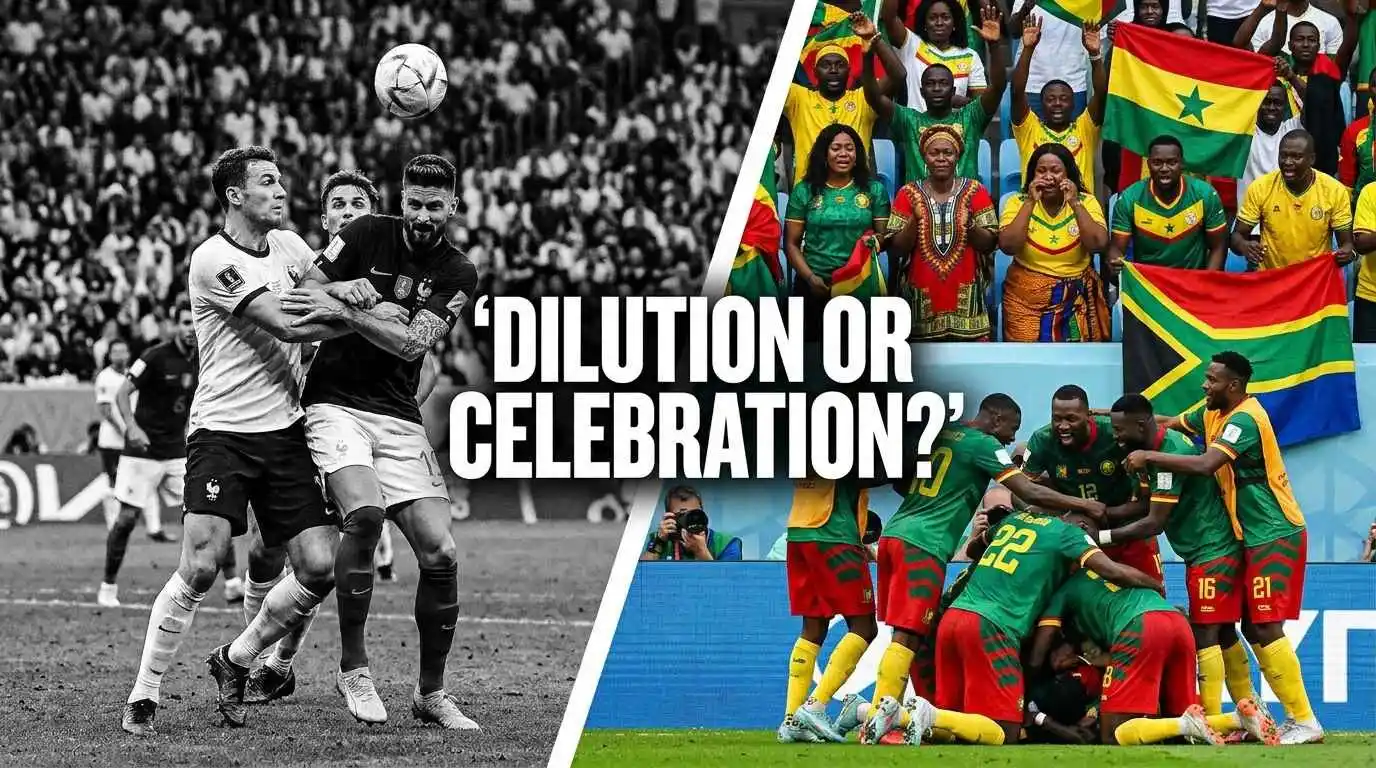
Dilution or Celebration? The Most Passionate, Divisive, and Unresolved Argument in Modern Football — Does the 48-Team World Cup Make the Beautiful Game Better or Worse?
The 48-Team Era: Football Series
Focus: A rigorously balanced opinion piece presenting the strongest arguments on both sides of football’s most heated contemporary debate
Introduction: Football’s Defining Question
Every generation of football produces its defining controversy — the argument that splits supporters, players, coaches, and commentators into irreconcilable camps and tests the fundamental assumptions about what the game is and what it should be. In the early twentieth century, that argument was about whether football should be played professionally at all. In the 1990s, it was about whether the back-pass rule would destroy the game or save it. In the 2010s, it was about Video Assistant Referee technology. Today, in the mid-2020s, the defining argument is about the 48-team World Cup.
This post does not take a side. It is not a polemic in favour of expansion or a manifesto for the purist position. It is, instead, an honest, rigorous, and unflinching examination of both cases at their strongest — an attempt to understand why intelligent, passionate, football-loving people hold diametrically opposite views on the same set of facts and whether either position can claim the decisive advantage in this ongoing debate.
What makes the 48-team debate genuinely difficult — and genuinely interesting — is that it is not really about football at all. Beneath the surface of arguments about group-stage quality and travel logistics lies a fundamental philosophical disagreement about what sport is for, who it belongs to, and how it should balance the competing demands of excellence and inclusion. That disagreement is older than FIFA, deeper than any specific format, and unlikely to be resolved by a single tournament. But the 2026 World Cup has forced it into the open in a way that football can no longer ignore.
The Purist’s Case: When the Stakes Define the Drama
The argument against the 48-team World Cup begins not with statistics but with an emotion: the feeling of watching a World Cup group match when everything is at stake. The 32-team format, in its finest expression, produced matches where elimination was a genuine possibility for every team from the opening whistle of the group stage. The psychological pressure of that format generated some of football’s most transcendent moments — moments that exist precisely because the tournament’s architecture forced teams into situations of maximum intensity with minimum margin for error.

Consider the specific texture of World Cup group-stage drama that the old format produced. Spain’s elimination in the 2022 group stage despite having won their opening match. Defending champions Germany eliminated in the 2018 group stage in a result that stunned a billion viewers. Italy, four-time World Cup winners, eliminated from the 2010 group stage. Cameroon’s shock elimination on goal difference despite a famous victory. These moments define the World Cup’s character — they are proof that no nation, regardless of historical prestige, is immune from the tournament’s merciless demands.
Critics of the 48-team format argue that the introduction of third-place advancement, the proliferation of groups, and the diluted competitive weight of individual group matches systematically reduce the probability of these defining moments. When the mathematical reality of the format allows for more routes to qualification, the desperate intensity of must-win football — the specific emotional crucible that forges World Cup legends — becomes structurally rarer. You cannot manufacture the pressure of elimination; it must emerge organically from the format’s mathematics. The 48-team format, critics contend, reduces the temperature at which that pressure crystallises.
The Quality Differential: A Real Problem or a Comfortable Prejudice?
The most common argument against expansion is the quality argument: that adding sixteen teams inevitably means adding sixteen weaker teams, producing group-stage matches between significantly mismatched opponents that fail to justify their place on the world’s biggest sporting stage. This argument has surface plausibility — the FIFA World Ranking gap between the 32nd and the 48th best international teams is objectively significant, and the best teams in the world are not genuinely threatened by the worst teams in the 48-nation field.
But the quality argument has several significant vulnerabilities. First, the 32-team World Cup already contained mismatches — the gap between the top 8 and the bottom 8 of a 32-nation field was substantial, and nobody proposed eliminating those bottom 8 nations in the name of quality. Second, the quality argument implicitly assumes that lower-ranked nations’ performances are predictable from their ranking — an assumption that actual World Cup history consistently refutes. Saudi Arabia defeated Argentina in 2022. Cameroon and Japan defeated the same Spain and Germany that were among the tournament favourites. Third, and most fundamentally, the quality argument tends to define ‘quality’ according to European and South American standards, measuring the entire global game by the benchmark of its most historically dominant regions.
Morocco’s 2022 World Cup story is the purist’s quality argument’s most uncomfortable counter-example. African football was widely categorised as a tier below European and South American football in the estimation of many traditional analysts before Qatar 2022. Morocco proved that estimation incorrect with performances of tactical sophistication, collective intensity, and individual quality that matched and surpassed some of the tournament’s most storied nations. The 48-team format’s critics must explain why, if quality is their concern, expanding the field to include more nations like Morocco is a threat rather than an opportunity.
The Celebration Case: Football’s Democratic Imperative
The case for the 48-team World Cup does not begin with commercial projections or administrative logic. It begins with a moral claim: that football, as the world’s most universal game — played in every nation, on every continent, in every economic circumstance — has an obligation to be represented at its highest level by more of the world than was previously permitted. A 32-team World Cup that excludes more than 175 of FIFA’s 211 member associations is, from this perspective, not a meritocratic achievement but a structural injustice dressed in competitive clothing.
The democratic argument notes that the criteria for determining which 32 nations participated in the old World Cup were not purely meritocratic — they were shaped by confederation allocation systems that encoded historical power imbalances. Europe received 13 spots not because its 13 representative nations were objectively the world’s 13 best teams but because UEFA’s political and financial weight within FIFA gave it preferential allocation. The expansion to 48 teams does not eliminate these structural advantages, but it meaningfully reduces their distorting effect on global participation.
There is also a compelling argument about football’s commercial obligations to its global fan base. Football generates its extraordinary revenues — tens of billions of dollars annually — not from a narrow European and South American audience but from a genuinely global viewership that includes hundreds of millions of fans across Africa, Asia, the Middle East, and the Americas. If fans in Indonesia, Nigeria, Jamaica, and Vietnam are contributing to the financial ecosystem of global football through subscription streaming, merchandise purchases, and tournament engagement, there is a legitimate question about whether those fans’ national teams deserve more than a statistical near-impossibility of participating in the sport’s flagship event.
The Dead-Rubber Problem: Real or Overstated?
One of the most specific criticisms of the 48-team format concerns the inevitable existence of dead-rubber matches — group-stage games where one or both teams have already secured advancement or face certain elimination regardless of the result. The concern is that the format’s structure, particularly the third-place advancement mechanism, will produce a greater number of matches where competitive meaning is absent, reducing the viewing experience for the global audience that the expansion is ostensibly designed to serve.
This concern is legitimate but frequently overstated. The 32-team format also produced dead rubbers — final group-stage matches where one or more teams had nothing to play for. The critical question is whether the 48-team format produces significantly more of them, and whether the third-place qualification mechanism introduces new incentive distortions. The answer, based on probability modelling and analysis of comparable UEFA European Championship formats, is that dead rubbers do increase marginally but that the third-place qualification system creates its own form of competitive incentive — teams fighting to maximise their comparative record across groups — that partially compensates.
More fundamentally, the dead-rubber concern reveals an assumption about what makes football valuable that deserves scrutiny. The assumption is that only the result matters — that a match without competitive implications is inherently worthless. But the experience of watching a World Cup group-stage game between, say, Jamaica and Vietnam — both nations’ first World Cup appearances, played before passionate, historically under-represented fan bases in a packed stadium — carries emotional and cultural value that transcends the question of which team has already qualified. Football is not only about results. It is also about stories, and the 48-team format creates more stories than any previous tournament format.
The Middle Ground: Reforming Rather Than Reversing
An increasingly influential school of thought in football analysis rejects the binary choice between supporting and opposing the 48-team format, arguing instead for refinements that preserve the democratic principle of expanded participation while addressing the legitimate competitive quality concerns. Several specific proposals have gained traction in football media and academic circles.
One proposal involves creating a preliminary round within the tournament itself — sixteen first-round matches between the sixteen lowest-seeded qualified teams, with eight winners advancing to a reformed main group stage of 40 teams. This would maintain 48-team participation while ensuring the main group phase features more evenly matched contests. Another proposal restructures the group stage into fewer, larger groups (eight groups of six teams) that produce more matches per group, reducing the distorting effects of third-place qualification while maintaining expanded team numbers. A third approach involves revising the confederation allocation to ensure that the additional spots go to nations that have demonstrated development progress rather than simply to underperforming confederations.
None of these proposals has received formal FIFA consideration, and the likelihood of structural reform between now and the 2026 tournament is essentially zero. But the proliferation of reform ideas reflects something important: the football community is not simply divided into pro-expansion and anti-expansion camps. There is a genuine desire among thoughtful observers to find formats that honour both values — competitive excellence and democratic inclusion — without sacrificing either. The binary debate may itself be the problem, obscuring the real question of how the tournament can be designed to best serve both imperatives simultaneously.
What the Evidence Actually Says
Given the intensity of the debate, it is worth asking what the empirical evidence — as opposed to opinion, prediction, or principle — actually suggests about the effects of World Cup expansion. The historical record of previous expansions is instructive. When the tournament expanded from 16 to 24 teams in 1982, critics predicted quality decline and tournament dilution. The 1982 World Cup in Spain is instead remembered for some of the most dramatic football in the tournament’s history, including Germany’s 3-3 draw with France in what many consider the greatest World Cup match ever played. When the tournament expanded from 24 to 32 teams in 1998, the same predictions were made — and the 1998 tournament produced Zinedine Zidane’s twin header in the Final, Michael Owen’s individual brilliance against Argentina, and one of the sport’s most celebrated opening chapters.
The expansion to 48 teams will also, in all probability, produce its own moments of transcendent football that make the quality-dilution argument seem ridiculous in retrospect. The question is not whether the 2026 World Cup will produce great moments — it will. The question is whether the structural changes to the tournament reduce the probability and intensity of those moments compared to what a continued 32-team format would have produced. That counterfactual is, by definition, unknowable.
What is knowable is the fans’ response. Television audiences and stadium attendance are the ultimate arbiters of whether a tournament format is working, and those measures will tell their own story over the course of the 2026 tournament and the World Cups that follow. If viewership surges in newly qualifying nations while remaining stable in traditional markets, the expansion will be commercially and politically entrenched regardless of the quality debate. If the expanded format produces a viewing experience that even expansion advocates find unsatisfying, the pressure for reform will grow from within the football community rather than from its margins.
The Verdict: A Tournament in Productive Tension
If this debate has a conclusion, it is this: both sides are right about something important, and neither side is entirely right about everything. The purists are correct that the competitive intensity of must-win football is one of the World Cup’s most precious qualities, and that any format change that dilutes that intensity carries genuine costs. The democrats are correct that football is a global sport with global obligations, and that a World Cup which excludes the vast majority of its member associations is not fulfilling its potential as an event for all of humanity.
The tension between these truths is not a problem to be solved but a productive creative tension to be managed. The 48-team World Cup is an attempt to manage it — imperfect, commercially motivated, and contested, but also historically significant, potentially transformative, and aligned with a vision of football as something that genuinely belongs to the world rather than to its most established football powers.
The 2026 World Cup will not settle this debate. Its results will be cherry-picked by both sides — the quality advocates will highlight whatever mismatches occur, and the inclusion advocates will celebrate whatever underdog stories emerge. But it will provide new evidence, new perspectives, and perhaps most importantly, new football memories that complicate both positions in ways that neither currently anticipates. That, ultimately, is the most honest thing that can be said about any new football format: we will know what it truly is only after we have lived through it. And for football, the living is precisely the point.
FAQs
Q01. What is the central argument of those who say the 48-team World Cup dilutes quality?
Opponents argue that adding sixteen teams inevitably means including nations with significantly lower football quality, producing mismatched group-stage games that lack the competitive tension and drama that define the World Cup’s greatest moments. They contend that quality and competitive intensity are inversely related to tournament size.
Q02. What is the central argument of those who support the 48-team expansion?
Supporters argue that football is a global sport with global obligations, and that a World Cup representing fewer than one in six FIFA member associations fails to honour that universality. They believe inclusion has intrinsic value and that expanded participation builds long-term global football quality through development incentives.
Q03. Has World Cup quality actually declined after previous expansions?
Historical evidence does not support the quality-decline prediction. The 1982 and 1998 expansions both produced iconic World Cups with legendary moments. The assumption that quality declines with expansion has been consistently challenged by the actual results of expanded tournaments.
Q04. Does a larger tournament necessarily produce more dead-rubber matches?
Probability modelling suggests a marginal increase in dead-rubber scenarios, but the third-place qualification mechanism creates comparative incentives that partially offset this effect. Historical experience with the UEFA European Championship’s similar format shows that dead rubbers are less common than critics predict.
Q05. Is there a Eurocentric bias in arguments about football quality dilution?
Many analysts believe so. The definition of ‘quality football’ has historically been measured against European and South American standards. Morocco’s 2022 semi-final performance, Senegal’s Afcon victories, and Asian football’s technical development all challenge the assumption that non-traditional football nations produce lower-quality competition.
Q06. What does Morocco’s 2022 World Cup performance tell us about the expansion debate?
Morocco’s semi-final run — defeating Spain and Portugal — is the strongest single counter-argument to the quality-dilution position. It demonstrates that African football competes at the highest level and that expanded representation would yield more competitive performances, not more mismatches.
Q07. Could the 48-team format ever be reversed by FIFA?
No formal reversal plans exist, and the commercial revenues generated by the expanded format make reversal extremely unlikely. FIFA may refine the specific mechanics of the format, but a return to 32 teams would require abandoning billions of dollars in commercial commitments.
Q08. What is the ‘dead-rubber’ concern and is it valid?
The dead-rubber concern holds that groups will more frequently produce meaningless final matches where teams have nothing competitive to gain or lose. This is a legitimate structural risk, but it applies to all tournament formats and is partially mitigated by the 48-team format’s third-place qualification system.
Q09. Do players prefer the 32-team or 48-team format?
Player opinion is genuinely divided. Players from nations newly eligible to qualify overwhelmingly support expansion. Players from traditional football powers express more mixed views, with many concerned about the physical demands of additional matches and extensive travel within the tri-nation hosting model.
Q10. What philosophical question underlies the entire expansion debate?
The core question is: what is the World Cup for? Is it primarily a meritocratic competition to identify the world’s best football nation, prioritising competitive quality above all else? Or is it a celebration of football as a universal cultural phenomenon, where inclusion and global representation are values equal to — or greater than — competitive excellence?
Q11. Is the quality argument against expansion essentially an argument for exclusion?
Critics of the quality argument make precisely this point: that framing exclusion as ‘quality control’ is a comfortable rationalisation for maintaining historical power imbalances in football. The counter-argument is that meritocratic exclusion through qualifying competition is a fundamentally different concept from structural exclusion through confederation allocation limits.
Q12. What historical World Cup moments prove the value of competitive tension?
Germany’s 2018 group elimination, Spain’s 2022 group stage exit, Italy’s 2010 elimination, and Cameroon’s agonising goal-difference exit are all cited as examples of the devastating, memorable drama that the old format’s competitive intensity produced and that critics fear the expanded format will dilute.
Q13. How does the expansion debate reflect broader tensions in world football governance?
The debate mirrors broader tensions between football’s traditional powers — wealthy European clubs and South American federations — and FIFA’s emerging-market development agenda. It is simultaneously a debate about tournament format and a debate about who controls football’s direction and who benefits from its commercial success.
Q14. What are the strongest reform proposals for improving the 48-team format?
Major proposals include: a preliminary round between the 16 lowest-seeded qualifiers; restructuring into eight groups of six teams; revising confederation allocations to reward development progress; and creating a fixed knockout bracket structure that eliminates the comparative third-place ranking mechanism.
Q15. How do broadcasters view the expansion debate?
Broadcasters have mixed views. The additional matches create more programming inventory and revenue opportunity. However, the risk of non-competitive group-stage matches in major markets creates scheduling and audience retention challenges. Broadcasters from expanding regions are broadly enthusiastic; traditional European broadcasters are more cautious.
Q16. What do football analytics say about the competitive probability of 48-team matches?
Analytical modelling suggests that the expected competitive quality of individual group-stage matches decreases marginally in the 48-team format, but that the overall tournament distribution of high-quality matches remains strong. The knockout rounds — which are unchanged in their competitive structure — maintain the highest quality standards.
Q17. Is the World Cup’s prestige diminished by expansion?
This is subjective and contested. Critics argue prestige requires scarcity and that easier access diminishes the achievement of qualification. Supporters argue prestige is enhanced by wider participation and that a genuinely global tournament is more prestigious, not less, than an exclusive club.
Q18. How has the World Cup survived and benefited from previous format controversies?
Every significant World Cup format change — from the introduction of the group stage, to the adoption of penalty shootouts, to the expansion from 24 to 32 teams — was initially controversial and is now either accepted or retrospectively celebrated. Football’s format history suggests that controversies resolve into acceptance over time.
Q19. What would a ‘perfect’ World Cup format look like according to expansion critics?
The ideal format for quality advocates would return to 32 or even 24 teams, with a strict meritocratic qualification system that ruthlessly eliminates underperforming nations regardless of confederation and prioritises competitive intensity in every match above all other considerations.
Q20. What would a ‘perfect’ World Cup format look like according to expansion supporters?
The ideal format for inclusion advocates might actually exceed 48 teams, potentially reaching 64, with qualification structured to ensure every continent has genuine access and the tournament functions as a true global celebration rather than a competition dominated by two geographical regions.
Q21. How does the expansion debate relate to debates about other sports’ expansion?
Similar debates have occurred across major global sports: the NBA’s expansion, cricket’s T20 format growth, rugby’s World Cup expansion. In virtually every case, initial quality concerns were followed by commercial success and eventual competitive adjustment, suggesting a pattern that football may follow.
Q22. Does FIFA’s commercial motivation undermine the credibility of its development arguments?
Many football analysts believe so. FIFA’s expansion arguments blend genuine development philosophy with obvious commercial imperatives in ways that are difficult to disentangle. The cynical reading is that development rhetoric provides cover for revenue maximisation; the charitable reading is that commercial success and development goals are genuinely aligned in the expanded format.
Q23. How should fans approach watching the 48-team World Cup to get the most from it?
Embracing the stories of newly qualifying nations — following debut World Cup appearances, learning about unfamiliar football cultures, engaging with the human drama of first-time qualification — can transform the viewing experience. The 48-team World Cup rewards curiosity and global football literacy as much as loyalty to traditional powerhouses.
Q24. Could the 2026 World Cup settle the expansion debate definitively?
Unlikely. Both sides will find evidence supporting their positions in any tournament outcome. A dramatic, high-quality Final will be cited by expansion supporters; any low-quality group-stage match will be highlighted by critics. The debate is structural and philosophical, not empirically resolvable by a single tournament’s results.
Q25. What is the long-term prediction for global football quality if the 48-team format is sustained?
Most development economists and football analysts predict a gradual improvement in global football quality as more nations receive sustained World Cup exposure and the development incentives of qualification spread across more football cultures. The 2046 World Cup is predicted to feature significantly stronger participation from Africa, Asia, and the Americas than the 2026 edition.
Q26. How does the expansion affect the preparation of elite national teams?
Elite teams can no longer treat any group-stage match as truly low-stakes, given the third-place comparative ranking system and the reputation risks of high-profile defeats against lower-ranked opponents. Some managers argue this is positive; others see it as an unwanted complication of squad management.
Q27. Is the expansion debate ultimately resolvable, or will it persist indefinitely?
The debate reflects a fundamental value disagreement — between meritocratic excellence and democratic inclusion — that is unlikely to be permanently resolved by any format decision. The specific terms of the debate will evolve as the 48-team format produces evidence, but the underlying tension will persist as long as football remains both a competitive sport and a global cultural institution.
Q28. What is the strongest single argument in favour of the expansion?
The strongest pro-expansion argument is the development cascade: that sustained World Cup participation transforms football infrastructure in qualifying nations, building competitive quality from the ground up over multiple tournament cycles and ultimately producing a more competitive global football landscape — as Japan’s trajectory from 1998 debutant to Round of 16 regular convincingly demonstrates.
Q29. What is the strongest single argument against the expansion?
The strongest anti-expansion argument is the competitive integrity concern: that the World Cup derives its iconic status and emotional power from the absolute stakes of every match, and that any structural change that reduces those stakes — even marginally — diminishes the specific quality of drama that has made the tournament the world’s most watched sporting event for over 90 years.
Q30. Where does football’s future lie — with the purists or the democrats?
Football’s history suggests it lies with neither camp exclusively, but with the ongoing creative tension between them. The sport has always balanced excellence with access, tradition with innovation, commercial logic with sporting purity. The 48-team World Cup is the latest expression of that balance — imperfect, contested, and alive with the productive contradictions that have always made football the world’s most compelling sport.
Disclaimer: The content on this blog is for informational purposes only. The author’s opinions are personal and not endorsed. Efforts are made to provide accurate information, but completeness, accuracy, or reliability are not guaranteed. The author is not liable for any loss or damage resulting from the use of this blog. It is recommended to use the information on this blog at your own discretion.
