
Table of Contents
Unsung Heroes & Heartbreaks – Football Series
Lions, Magic, and Roger Milla’s Dance: How Cameroon’s 1990 Fairytale Changed World Football Forever
Introduction: The Night the World Fell in Love with Lions
On June 8, 1990, in the cauldron of Milan’s San Siro, something happened that nobody — not the journalists, not the coaches, not even the most romantic footballing optimists — had dared to predict. Cameroon, a team from sub-Saharan Africa that most European neutrals could barely locate on a map, walked onto the pitch to face Argentina, the reigning World Cup champions. By the final whistle, the Indomitable Lions had won 1-0, and football would never quite see itself the same way again.
Italia 90 is remembered for many things: Schillaci’s improbable golden-boot run, Gazza’s tears, the stifling defensive football that produced the lowest goals-per-game average in World Cup history. But above all, it is remembered for Cameroon — for the dancing, the defiance, and the 38-year-old man who emerged from semi-retirement on the island of Réunion to become the tournament’s heartbeat, its soul, and its most joyful story.
This is the tale of how Roger Milla and the Indomitable Lions captured the imagination of a planet, how they rewrote the script for what African football could achieve, and why their 1990 fairytale remains one of the most extraordinary stories in the history of sport.
Context: Africa’s Place in the World Game Before 1990
To understand what Cameroon achieved in Italy, you need to understand where African football stood in the global hierarchy at the dawn of the 1990s. The continent had long produced technically gifted, athletically explosive players, but the prevailing wisdom — whispered in European boardrooms and printed in broadsheet sports sections — was that African teams lacked the tactical discipline, the temperament, and the organisational infrastructure to compete at the very highest level.

Africa’s World Cup record to that point had been patchy. Zaire’s 1974 campaign had ended in humiliation, including a 9-0 thrashing by Yugoslavia. Morocco had acquitted themselves reasonably in 1986, advancing from the group stage before losing to West Germany. But the ceiling seemed firmly in place: African sides were colourful, energetic additions to the tournament, not genuine contenders.
Cameroon had been at the 1982 World Cup in Spain, where they went unbeaten in the group stage — drawing with Poland, Peru, and eventual champions Italy — but failed to advance on goal difference. It was an admirable performance that suggested promise without providing the breakthrough moment the continent craved.
By 1990, the squad had evolved significantly. A generation of players had been hardened by European club football. Thomas N’Kono, one of the finest goalkeepers of his era, provided a fortress at the back. And then there was the question of Roger Milla — technically retired, living quietly in the sun, until a phone call changed everything.
Roger Milla: The Man Who Came Back from Nowhere
Albert Roger Miller — known to the world as Roger Milla — was born on May 20, 1952, in Yaoundé, Cameroon. He had enjoyed a distinguished career in French football, winning league titles with Montpellier and earning African Footballer of the Year awards in 1976 and 1990. By the time the 1990 World Cup loomed, however, he had drifted into footballing retirement, playing casual football on the French island of Réunion with the leisure of a man at peace with his legacy.
What happened next became one of sport’s great anecdotes. Cameroonian President Paul Biya, a passionate football supporter, personally intervened and requested — some accounts say insisted — that Milla be included in the World Cup squad. The national coach, Valery Nepomniachi, was reportedly sceptical. Milla himself may have needed some persuasion. But a president’s call is not easily declined, and so, at the age of 38, Roger Milla packed his boots and headed for Italy.
He was not expected to start. He was not expected to be decisive. He was expected, perhaps, to provide experience, to mentor the younger players, to carry the flag of Cameroonian football history onto the grandest stage. What nobody predicted was that he would become the tournament’s defining figure, scoring four goals in four matches, each one celebrated with a hip-swivelling, arm-waving, corner-flag-embracing dance that the world watched, rewound, and imitated for decades.
The Opening Salvo: Beating the Champions
The Group Stage draw had placed Cameroon in Group B alongside Argentina, Romania, and the Soviet Union. On paper, this was a group Cameroon were expected to lose. Argentina were the defending champions, led by Diego Maradona at the peak of his powers. Romania were a technically proficient European side. The Soviet Union were a tournament fixture. Cameroon were the outsiders.
The opening match against Argentina on June 8 in Milan’s San Siro was supposed to be a formality — a coronation for Maradona’s men before the serious business of the knockout rounds. Instead, what unfolded was one of the great upsets in World Cup history. Cameroon defended with organised ferocity, disrupting Argentina’s passing rhythms, pressing high, and refusing to be intimidated by the occasion or the opposition.
The decisive moment came from an unlikely source. Omam-Biyik’s header from a Massing cross fell awkwardly for Argentine goalkeeper Nery Pumpido, who fumbled it over the line in an act of goalkeeping misfortune that Argentine fans would discuss for years. Cameroon held on despite finishing the match with nine men — two players sent off for brutal challenges — to claim one of the most seismic results in World Cup history.
The football world sat up and took notice. But this was just the beginning.
The Magic of the Group Stage and the Roger Milla Effect
Milla entered as a substitute in Cameroon’s second group game against Romania and announced himself to the world in the most emphatic way possible, scoring twice in a 2-1 victory. The goals were taken with the composure and craft of a man who had spent decades perfecting the art. But it was what happened afterwards that captured the world’s heart.
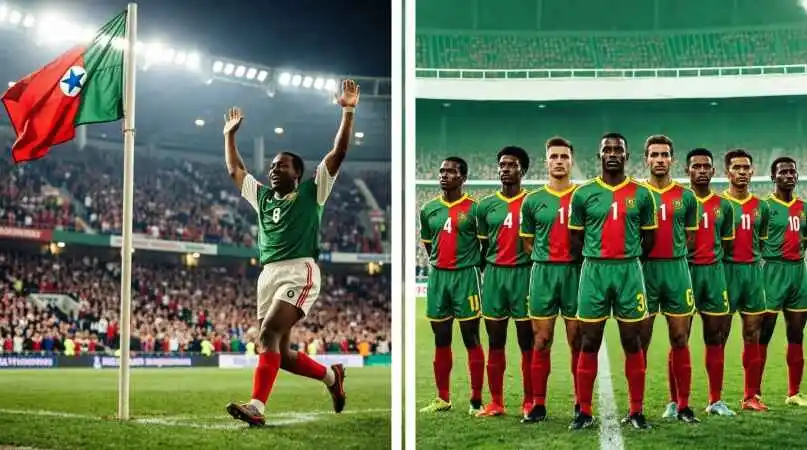
Milla jogged to the corner flag, arms aloft, hips swaying, performing a spontaneous dance that was pure, uninhibited joy. No rehearsed choreography, no commercial calculation — just a 38-year-old man expressing his absolute happiness at being alive, being on this stage, and scoring goals that mattered. The world fell instantly in love.
Cameroon advanced from the group as runners-up, setting up a round of 16 clash against Colombia — a side containing the eccentric goalkeeping genius René Higuita. What followed became the stuff of legend.
The Colombia Game and the Higuita Moment
The round of 16 clash with Colombia on June 23 produced one of the most celebrated and bizarre moments in World Cup history. Colombia’s eccentric sweeper-keeper René Higuita had a reputation for wandering far from his goal line — a high-risk, high-entertainment approach that had become his trademark.
Cameroon were trailing 0-1 with time running out when Milla was introduced from the bench. Within minutes, he had drawn a foul for a penalty and then, in the dying minutes of extra time, he pounced on a catastrophic Higuita error. The Colombian keeper, dribbling nonchalantly deep into his own half, was robbed of the ball by Milla, who calmly slotted into an empty net. Cameroon went 2-1 up. Milla sprinted to the corner flag, the dance began again, and an entire continent erupted.
Cameroon held on to win 2-1 in extra time, becoming the first African nation to reach the quarter-finals of a World Cup. The footballing world had never seen anything like it.
The Heartbreak: Quarter-Final Against England
Cameroon’s quarter-final against England on July 1 in Naples was, perhaps, the greatest advertisement for attacking football that Italia 90 produced. England led through Platt before Cameroon equalised through a Kunde penalty and then took a stunning lead via Ekeke. At 2-1 to Cameroon, with 25 minutes remaining, the semi-finals beckoned. History was within touching distance.
Then Gary Lineker won two penalties — one in regular time, one in extra time — both converted with clinical precision. England squeezed through 3-2, and Cameroon’s World Cup was over. The Lions trudged off the pitch having produced some of the tournament’s most exhilarating football, robbed of a fairy-tale ending by the slimmest of margins.
The manner of the defeat — leading in the quarter-final, only to be undone by late penalties — added a bittersweet poignancy to the whole campaign. It was a heartbreak that, paradoxically, only amplified the romance of what Cameroon had achieved.
The Ripple Effect: How 1990 Transformed African Football
The immediate and long-term impact of Cameroon’s 1990 run on African football cannot be overstated. Before that tournament, Africa had two guaranteed places at the World Cup finals. After 1990, the conversation changed dramatically. FIFA, responding to the quality and entertainment value of African participation, expanded the continent’s allocation to three places for 1994, and further increases followed with subsequent tournaments.
More profoundly, the 1990 campaign transformed how African players saw themselves and how European clubs saw African talent. A generation of young footballers across the continent grew up watching Roger Milla dance at the corner flag and decided they could do the same. The investment in African academies, youth structures, and professional pathways that followed — however imperfect and commercially driven — was in no small part energised by the 1990 inspiration.
Senegal reaching the quarter-finals in 2002, Ghana going deep in 2010, Morocco’s extraordinary semi-final run in 2022 — each of these milestones carries the DNA of Cameroon 1990 within them. Every time an African side upsets a European giant, every time a tournament is illuminated by a player from the continent, the long shadow of the Indomitable Lions stretches a little further.
Roger Milla’s Enduring Legacy
Roger Milla returned to the World Cup stage in 1994, this time in the United States, where he scored against Russia to become — at the age of 42 — the oldest goalscorer in World Cup history. It was a record that still stands, a final flourish from a man who seemed to operate by different rules from ordinary footballers.
After his playing days, Milla became a global ambassador for football, for Africa, and for the idea that sport could transcend borders, expectations, and age. His corner-flag dance became an enduring cultural touchstone — referenced in films, television programmes, advertising campaigns, and the memories of anyone who watched that summer of 1990.
Roger Milla passed away on May 24, 2024, aged 72. The tributes that poured in from every corner of the footballing world confirmed what those of us who watched him in Italy already knew: he was not merely a footballer. He was a spirit — unbounded, joyful, utterly alive — who used a corner flag as his stage and a dance as his language.
Conclusion: The Fairytale That Changed Everything
The 1990 World Cup in Italy was many things: a defensive tournament, a tournament of drama and controversy, a tournament of Gazza and Schillaci and Maradona struggling through injury. But what it will be remembered for, above all else, is a group of men from Central Africa who arrived as outsiders and left as legends.
Cameroon’s run was not just a sporting achievement. It was a cultural earthquake. It proved that football’s highest stage belonged to everyone — not just the established European and South American powers, but to any people with enough skill, enough heart, and enough unbridled joy to compete on the grandest stage. Roger Milla and the Indomitable Lions did not just reach a World Cup quarter-final. They expanded what the World Cup could be.
Every underdogs’ story told at every subsequent World Cup owes something to that summer. Every African player who has lifted their eyes toward the horizon and believed they could reach it carries a piece of the Indomitable Lions with them. The fairytale of 1990 did not end with that defeat to England. It never ended. It is still being written — in every dusty schoolyard in Yaoundé, in every training ground across the continent, in every moment when the world’s football map shifts just a little further toward the south.
Frequently Asked Questions
| Who was Roger Milla? | Roger Milla was a Cameroonian striker born in 1952, widely considered the greatest African footballer of his era. He came out of retirement at age 38 to star at the 1990 World Cup and again at the 1994 edition. |
| What made Cameroon’s 1990 World Cup run so special? | Cameroon became the first African team to reach the World Cup quarter-finals, defeating reigning champions Argentina in the group stage and Colombia in the round of 16, thrilling the world with their energy and unpredictability. |
| Why did Roger Milla dance around the corner flag? | Milla’s iconic corner-flag dance was a spontaneous celebration that became one of football’s most recognisable images. It was pure joy — unrehearsed, authentic, and infectious. |
| How old was Roger Milla at the 1990 World Cup? | Roger Milla was 38 years old, having come out of semi-retirement on the island of Réunion at the personal request of Cameroonian President Paul Biya. |
| Who did Cameroon beat in the 1990 World Cup? | Cameroon defeated reigning champions Argentina 1-0 in the opening game, then Romania in the group stage, and Colombia 2-1 in the round of 16, before losing narrowly to England 3-2 in the quarter-finals. |
| How did Cameroon lose to England in the quarter-finals? | Cameroon led 2-1 and were heading for a historic semi-final before Gary Lineker scored two late penalties to make it 3-2, ending Cameroon’s dream in heartbreaking fashion. |
| Did Roger Milla play in any other World Cups? | Yes — Milla appeared at the 1982 and 1994 World Cups too. At USA 1994, aged 42, he scored against Russia, making him the oldest goalscorer in World Cup history. |
| What impact did Cameroon 1990 have on African football? | The 1990 run inspired a generation of African footballers and proved that African teams could compete with the world’s elite. It directly contributed to FIFA expanding Africa’s World Cup allocation in subsequent tournaments. |
| Who was Cameroon’s goalkeeper in 1990? | Thomas N’Kono was Cameroon’s experienced goalkeeper in 1990, a veteran who had starred at previous tournaments and was known as one of the best keepers of his generation. |
| Was Cameroon’s 1990 run the biggest World Cup upset ever? | Defeating holders Argentina in the opening game is widely considered one of the greatest opening-match upsets in World Cup history, though their overall run is certainly among the most magical in tournament lore. |
| How did the 1990 World Cup affect the popularity of football in Africa? | The 1990 run triggered a massive surge in football participation and viewership across Africa, inspiring thousands of young players and elevating the continent’s football infrastructure and ambition. |
| What was Cameroon’s nickname and why? | Cameroon are known as the Indomitable Lions — a name that perfectly captured their fierce, untameable spirit at the 1990 tournament. |
| Who coached Cameroon in 1990? | Valery Nepomniachi, a Soviet coach with a low-profile background, was at the helm for Cameroon in 1990, deploying a disciplined yet dynamic style that surprised all of their opponents. |
| How many goals did Roger Milla score in 1990? | Roger Milla scored four goals at the 1990 World Cup, all as a substitute — each one accompanied by his legendary corner-flag celebration. |
| Did Cameroon qualify for World Cups after 1990? | Yes — Cameroon has qualified for multiple World Cups since 1990, including 1994, 1998, 2002, 2010, 2014, and 2022, though they have never again replicated their 1990 heroics. |
| What year did FIFA expand African World Cup places? | FIFA increased Africa’s quota from two to three teams for the 1994 World Cup, and further expansions followed, largely influenced by the quality and excitement of African performances from 1990 onward. |
| Who scored Cameroon’s winning goal against Argentina? | Omam-Biyik headed in what proved to be the decisive goal, though Argentine goalkeeper Nery Pumpido inadvertently let the ball slip under his body in one of the tournament’s defining moments. |
| Was Roger Milla a professional footballer at the time of the 1990 World Cup? | Not in the traditional sense — Milla was semi-retired and playing recreational football on the island of Réunion before being recalled to the national squad at presidential request. |
| How did the world react to Cameroon’s 1990 campaign? | Global audiences fell in love with Cameroon’s free-spirited, attacking football and the exuberant personality of Milla. They became the tournament’s adopted darlings outside their group opponents. |
| What legacy did the 1990 Cameroonian squad leave? | They shattered the perception that African football was merely decorative in World Cups, establishing a blueprint of physical intensity, tactical awareness, and individual brilliance that African teams have tried to replicate ever since. |
| Was the 1990 World Cup Cameroon’s debut tournament? | No — Cameroon had appeared at the 1982 World Cup, where they went unbeaten in the group stage despite not advancing. 1990 was their breakout tournament where they truly captured the world’s attention. |
| How has Roger Milla been honoured in Cameroon? | Milla is revered as a national hero in Cameroon, celebrated with statues, cultural commemorations, and recognised as an enduring symbol of African footballing pride and possibility. |
| What shirt number did Roger Milla wear in 1990? | Milla wore the number 17 shirt, coming off the bench as a substitute — making his four goals and global impact even more extraordinary. |
| How did Italia 90 change global football broadcasting? | Italia 90 was one of the most widely televised World Cups to that point, and Cameroon’s run was central to the tournament’s global captivation, drawing new audiences to football across Asia, the Americas, and beyond. |
| Were there any disciplinary issues in Cameroon’s campaign? | Yes — Cameroon had several players sent off during the tournament, including two red cards in the opening win over Argentina. Their combative style drew criticism, but also admiration for their refusal to be intimidated. |
| What is the significance of the corner flag in football culture? | Roger Milla’s corner-flag dance transformed the corner flag into a symbol of World Cup jubilation. It remains one of football’s most iconic cultural images and has inspired countless imitations. |
| Was Roger Milla the first African player to become a World Cup star? | While African players had impressed before, Milla was the first to truly transcend the tournament and become a global household name, recognised far beyond football audiences. |
| How did Cameroon’s 1990 squad compare to modern African teams? | In terms of squad depth and resources, modern African teams are far more developed, but the 1990 Cameroonian side had something intangible — a collective hunger and naivety of expectation that made them genuinely dangerous to anyone. |
| What happened to the Cameroon players after 1990? | Several went on to long European club careers. Thomas N’Kono moved into coaching. Milla remained a national ambassador and inspirational figure until his death in May 2024. |
| When did Roger Milla pass away? | Roger Milla passed away on May 24, 2024, aged 72, mourned by the entire footballing world as one of the game’s immortal characters and Africa’s greatest World Cup ambassador. |
Disclaimer: The content on this blog is for informational purposes only. The author’s opinions are personal and not endorsed. Efforts are made to provide accurate information, but completeness, accuracy, or reliability are not guaranteed. The author is not liable for any loss or damage resulting from the use of this blog. It is recommended to use the information on this blog at your own discretion.
