
Table of Contents
Unsung Heroes & Heartbreaks : Foot ball Series
The Divine Ponytail’s Last Kick: Roberto Baggio, the 1994 World Cup Final, and Football’s Most Heartbreaking Miss
Introduction: The Weight of a Single Kick
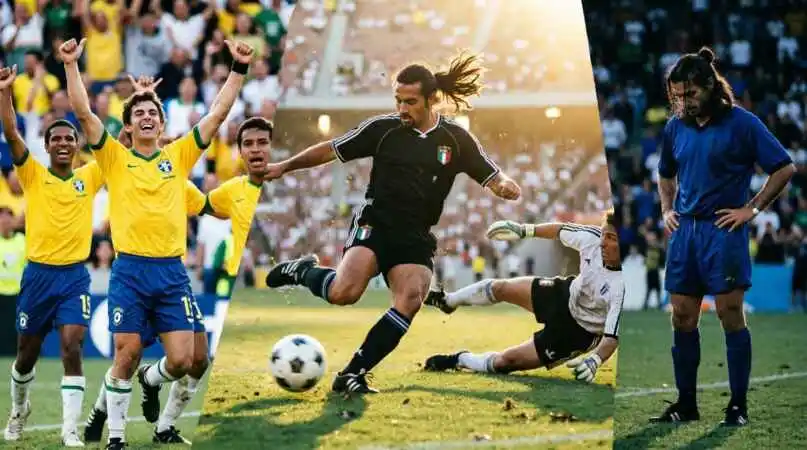
There is a photograph — or rather, an image burned so deeply into football’s collective memory that it functions like one — of Roberto Baggio standing in the Californian sunshine with his head bowed and his hands on his hips. The ball has sailed over the crossbar. Brazil is the world champion. Italy’s greatest footballer, the man who single-handedly carried his nation to the final, stands alone with the unbearable weight of what has just happened.
The 1994 World Cup Final penalty miss is, without question, one of the most defining moments in the sport’s history. Not because it was the worst miss ever struck — technically, it wasn’t — but because of the unbearable accumulation of context, expectation, and poetic injustice that surrounded it. Of all the players in all the tournaments in all the world, that final kick fell to Roberto Baggio. The man who had scored when it mattered most, again and again, for weeks. The Divine Ponytail. The Ballon d’Or winner. The nation’s saviour and its most brilliant son.
And he missed.
This is the story of that miss — but more importantly, it is the story of everything that came before it, and why the context makes it football’s most heartbreaking moment.

Who Was Roberto Baggio? The Making of a Genius
Roberto Baggio was born on February 18, 1967, in Caldogno, in the Veneto region of northern Italy, the fourth of eight children in a football-loving family. From the earliest age, his talent was obvious — a natural elegance of movement, an instinctive understanding of space, a left foot that seemed to operate in harmony with some inner music that nobody else could quite hear.
He rose through the youth ranks of local clubs before signing for Fiorentina, where he became one of the most worshipped players in Italian football history. The Fiorentina fans adored him with a possessiveness that bordered on the religious — so when Juventus paid a then-world-record fee of £8 million to take him north in 1990, riots broke out in Florence. Cars were overturned. Windows were broken. A footballer being transferred had caused a civil disturbance.
At Juventus, Baggio flourished further, winning Serie A titles and the UEFA Cup, and in 1993, he was awarded the Ballon d’Or — the official recognition that he was the greatest footballer on the planet. He was 26 years old, ostensibly at the beginning of his prime. The 1994 World Cup, to be held in the United States, would be his stage.
The 1994 Tournament: One Man’s Crusade
Italy arrived in the United States with a squad of considerable talent but with question marks about their cohesion and attacking depth. The group stage provided little comfort — Italy ground out results without dazzling, with Baggio appearing fitful and underused in the early games. By the time the round of 16 arrived, the whispers were growing. Perhaps the tournament had come too late, or too soon, for the Divine Ponytail.
Then Nigeria happened, and everything changed.
Against the Super Eagles in the round of 16, Italy trailed 1-0 with three minutes remaining. Elimination beckoned. The entire Italian football infrastructure — the tifosi, the federation, the journalists who had questioned Baggio’s form — held its breath. And then Roberto Baggio received the ball 25 yards from goal, turned, and curled a shot of such perfect, devastating precision into the net that the collective Italian exhale could almost be heard across the Atlantic.
The game went to extra time. And Baggio scored again — a penalty, cool and placed, to send Italy through. The Divine Ponytail had arrived.
Rescue Artist: Spain and Bulgaria
Having rediscovered himself against Nigeria, Baggio continued his one-man salvage operation with the controlled intensity of an artist who knows exactly what he is doing and why. Against Spain in the quarter-final, Italy needed another defining moment. Baggio provided it — a goal of clinical elegance that settled the tie and sent Italy to the final four of the World Cup.
In the semi-final against Bulgaria, with Italy again needing something special in a tense, tightly contested match, Baggio stepped forward. His goal — a curling, swerving shot that left the goalkeeper grasping at air — was struck with the confidence of a man who had been in this position before and knew, instinctively, where the ball needed to go. Italy was in the final.
Five crucial goals across four knockout matches. Games that Italy would have lost without him. A tournament that would have been forgettable without his presence. Roberto Baggio had not merely played in the 1994 World Cup — he had constituted it, had been its reason for existing, had been the thread that pulled an entire nation’s hopes behind him like a comet’s tail.
The Final: A Goalless Epic and the Weight of the Shootout
The 1994 World Cup Final, played on July 17 at the Rose Bowl in Pasadena, California, before 94,000 spectators and a global television audience of over a billion, was always going to struggle to match the narrative weight preceding it. Brazil, marshalled by the brilliance of Romario and the craft of Bebeto, was a formidable opponent — perhaps the greatest Brazilian side of the modern era, equipped with both individual genius and collective discipline.
The match itself was cagey. Both teams, perhaps fearful of the other, retreated into tactical calculation. Chances were scarce. The first half passed goalless. The second half did the same. Thirty minutes of extra time produced little clarity. Italy’s captain, Franco Baresi, who had played through the tournament with a recently injured knee, looked limited. Baggio, marked aggressively, could find no space.
When the final whistle blew on 0-0, the penalty shootout was inevitable. For the first time in World Cup Final history, the greatest prize in football would be decided by spot-kicks.
The Shootout: A Theatre of Nerves
The penalty shootout of the 1994 World Cup Final has been studied, analyzed, and mourned over the decades. Baresi, Italy’s captain and defensive colossus, stepped up first — and blazed his kick over the bar. The mood darkened. Marcio Santos hit back for Brazil, but Taffarel saved from Albertini’s kick. Romario converted. Evani scored for Italy. Branco converted for Brazil. Massaro stepped up for Italy — and Taffarel saved again.
At this point, with Brazil leading 3-2 in the shootout and Dunga needing only to score to win the World Cup for Brazil, there was still a mathematical route for Italy. But only if Baggio converted. Dunga scored. It was now 4-2 to Brazil. Italy needed Baggio to score, and then needed Brazil to miss their fifth kick, for the shootout to continue.
But football rarely deals in such orderly mathematics. For Italy to survive, Baggio simply had to score. And so the man who had scored every time Italy needed him — in Foxboro, in New Jersey, in Dallas — walked to the penalty spot for what would be either his greatest moment or his most devastating.
The Kick
What happens in the human body in the seconds before a penalty kick of this magnitude is beyond ordinary description. The distance from the penalty spot to the goal seems both impossibly short and impossibly long. The keeper is enormous and also tiny. The crowd is deafeningly loud and also completely absent from consciousness.
Baggio placed the ball. He stepped back. He ran. He struck the ball with his right foot — and it flew, soaring, climbing, arcing upward in the Californian evening air, over the crossbar, over everything, into the place where footballs go when the only place they were ever supposed to go was the net.
Brazil were world champions. Italy was not. Roberto Baggio, who had given everything — who had scored every goal that mattered, who had played through physical and tactical limitations, who had dragged an entire nation with him on his ponytail — stood with his head bowed. The image was complete. Football had its most poignant moment.
The Aftermath: Living with the Miss
What sets Roberto Baggio apart from other players defined by a single moment of failure is the grace and wisdom with which he confronted it. As a convert to Nichiren Buddhism, Baggio approached the miss not with bitterness or denial but with a kind of aching, philosophical acceptance. He has spoken in interviews about the ball going over the bar following him through life — a companion, not an enemy.
He continued to play at the highest level, representing AC Milan, Bologna, Inter Milan, and finally Brescia with distinction. He appeared at the 1998 World Cup in France, scoring an extraordinary goal against the Czech Republic in the group stage, though his relationship with coach Cesare Maldini — who used him sparingly — was fraught. He retired in 2004, having scored over 200 goals in his club career and 27 for Italy in 56 appearances.
His post-football life has been characterized by quiet dignity. He has engaged in humanitarian work, participated in football education initiatives, and spoken movingly about his Buddhist faith. He is no recluse — he engages with the game, appears at events, and comments thoughtfully on modern football. But he does so on his own terms, with the composure of a man who has made peace with what happened in Pasadena.
Why the Miss Matters More Than the Goals
This might seem counterintuitive. Roberto Baggio scored five goals in the 1994 World Cup, each of decisive importance. He carried Italy further than they had any right to go without him. Why should one missed penalty — in a shootout, no less, where luck and randomness are inherent — define his legacy more than any of those moments of brilliance?
The answer lies in narrative structure and human psychology. We are drawn to moments of contrast — to the distance between height and depth, between glory and devastation. Baggio’s miss is so affecting precisely because of what preceded it. Had he missed that penalty in a group stage game, or had he not scored those crucial knockout goals, the moment would carry little weight. It is the accumulation of everything — the savior becoming the fallen, the hero undone — that gives it its power.
Football, ultimately, is a story we tell ourselves about human endeavor. And no story is complete without its rupture, its moment of devastating reversal. Baggio’s miss is the most human moment in football’s history because it took the most gifted man in the most important moment and showed us, with brutal clarity, that genius and fate do not make prior arrangements.
Conclusion: The Divine Ponytail’s True Legacy
Roberto Baggio will be debated for as long as football is played. Arguments about his place in the pantheon — alongside Maradona and Pelé, or beneath them — will continue to generate heat and light in trattorie and sports programs for generations. The penalty miss will continue to surface in conversations about heartbreak and fate.
But here is what matters most: Roberto Baggio, through the summer of 1994, showed us what a single human being could do when given a football and asked to carry an entire nation. He showed us beauty, precision, invention, and courage of the highest order. He gave Italy everything he had, and then, at the very end, the ball went over the bar.
That is not a failure of the man. It is simply the truth of sport — brutal, random, indifferent to merit. And it is also, in its own terrible way, the thing that made Roberto Baggio immortal. Not the Ballon d’Or, not the Serie A titles, not the goals against Nigeria or Bulgaria. The bowed head. The ponytail is falling forward. The ball sails into history.
There is no footballer more fully human than Roberto Baggio in July 1994. And no moment in football reminds us more powerfully of why we love this game — its cruelty, its beauty, and its absolute refusal to guarantee that genius and justice will always meet.
FAQs
| Who is Roberto Baggio? | Roberto Baggio is an Italian football legend widely regarded as one of the greatest players of all time. He played for clubs including Fiorentina, Juventus, AC Milan, and Inter Milan, winning the Ballon d’Or in 1993. |
| What happened with Baggio’s penalty in 1994? | In the penalty shootout of the 1994 World Cup Final against Brazil, Baggio — who had carried Italy to the final almost single-handedly — stepped up needing to score to keep Italy alive. He blasted the ball over the crossbar, handing Brazil the title. |
| How many goals did Baggio score at the 1994 World Cup? | Baggio scored five goals during the 1994 World Cup, including a hat-trick of crucial knockout goals that single-handedly rescued Italy from elimination on multiple occasions. |
| Why was Baggio so important to Italy in 1994? | Italy’s 1994 campaign was built almost entirely on Baggio’s genius. He scored the winning goals against Nigeria in extra time, against Spain in the quarter-final, and against Bulgaria in the semi-final — keeping Italy alive in the tournament at every turn. |
| How did Baggio describe the penalty miss? | In later interviews, Baggio described the moment as something that would stay with him forever. He has spoken movingly about the image of the ball flying over the crossbar haunting him for years afterward. |
| Did Italy have other chances in that final? | The 1994 World Cup Final was a cautious, tight affair that ended 0-0 after 120 minutes. Brazil and Italy both struggled to create clear chances, with Baggio’s penalty miss deciding the most anticipated penalty shootout in history. |
| What club did Baggio play for in 1994? | At the time of the 1994 World Cup, Baggio had just completed a record-breaking transfer from Fiorentina to Juventus, where he had been the Serie A’s dominant creative force. |
| Did Baggio play in other World Cups? | Yes — Baggio appeared at three World Cups: 1990, 1994, and 1998. His 1994 campaign was by far his most significant and tragic. |
| What is the Divine Ponytail nickname? | Baggio earned the nickname Il Divin Codino — the Divine Ponytail — due to his distinctive ponytail hairstyle and his almost supernatural quality of play that made him seem to operate on a different level from his contemporaries. |
| How did Brazil win the 1994 World Cup? | Brazil won the 1994 World Cup Final against Italy on penalties after a goalless draw through 120 minutes. Their shootout was successful when Baggio’s decisive spot-kick sailed over the bar. |
| Was 1994 Baggio’s greatest tournament? | By most assessments, yes. Baggio virtually carried Italy to the final, scoring decisive goals when nobody else could, in a performance of sustained individual brilliance rarely matched in World Cup history. |
| What was Baggio’s relationship with Buddhist philosophy? | Baggio converted to Nichiren Buddhism in 1988, and his faith was central to his character and perspective. He approached football and life’s challenges through a Buddhist lens of acceptance and mindfulness. |
| How has the penalty miss shaped Baggio’s public memory? | The image of Baggio standing with his head bowed after the miss is one of football’s most iconic photographs. Despite his extraordinary career achievements, this single moment has become inseparable from his public image. |
| Did Baggio ever take important penalties successfully? | Yes — throughout his career, Baggio was generally reliable from the spot. His miss in Pasadena was a tragic anomaly, not reflective of his penalty-taking record overall. |
| What did Baggio achieve in his club career? | Baggio won multiple Serie A titles, the UEFA Cup with Juventus, and the Ballon d’Or in 1993. He scored over 200 goals in his club career and was revered at every club he represented. |
| Why did Italy struggle to create chances in the 1994 final? | The 1994 final was tactically constrained, with both teams playing cautiously. Brazil’s organization neutralized Italy’s attack, and Baggio — often isolated and heavily marked — could not find the openings that had characterized his earlier tournament performances. |
| Who else missed in that 1994 shootout? | For Italy, Baresi (the captain) missed first, and Massaro also failed to convert, so the shootout had already gone poorly before Baggio stepped up last. For Brazil, Taffarel saved Italian kicks before Baggio’s final miss. |
| Did Baggio win the Ballon d’Or? | Yes — Roberto Baggio won the Ballon d’Or in 1993, recognizing him as the world’s finest footballer that year, in the build-up to his defining World Cup summer. |
| How is Baggio remembered in Italy? | Baggio is revered as one of the greatest Italians ever to play football. He is celebrated for his artistry, his charisma, his loyalty to his Buddhist faith, and — despite everything — the 1994 World Cup campaign that remains his most bittersweet legacy. |
| Was the 1994 World Cup Final the worst ever for goals? | The 1994 final remains one of only two World Cup finals to end 0-0 after extra time, the other being the 2006 edition between Italy and France. It was a tactical battle that robbed spectators of goals but not drama. |
| What happened to Baggio’s career after 1994? | Baggio continued to play at the highest level through the late 1990s, representing AC Milan, Bologna, Inter Milan, and Brescia. He qualified for the 1998 World Cup despite tensions with coach Maldini over his role. |
| Is there a film about Roberto Baggio? | Yes — a 2021 Netflix biographical film titled Il Divin Codino (The Divine Ponytail) dramatized Baggio’s life and career, bringing his story to a new generation of global football fans. |
| How did Buddhist philosophy help Baggio cope with the miss? | Baggio has cited his Buddhist faith as central to his ability to process the pain of the 1994 final. He has described finding peace in acceptance rather than resentment, though he acknowledges the miss never completely left him. |
| What made Baggio technically special? | Baggio possessed an extraordinary combination of close control, vision, balance, and an ability to carry the ball at pace in tight spaces. His free-kick technique was among the finest of his generation, and his link play between midfield and attack was unrivalled. |
| Was Baggio a good team player? | Despite his individual brilliance, Baggio was never a selfish player — he created as many goals as he scored and was celebrated by teammates for his intelligence and generosity on the pitch. |
| Did Baggio retire with any regrets? | Beyond the 1994 final, Baggio has spoken about his complex relationships with coaches who he felt underused him, particularly in 1998 when he felt marginalized. But he has approached retirement with characteristic Buddhist equanimity. |
| Was Baggio ever considered the best player in the world? | Baggio’s 1993 Ballon d’Or reflected a genuine global consensus that he was the world’s finest player, ahead of Romario and Cantona. His peak years, roughly 1992-1995, placed him among the absolute elite of any era. |
| How old was Baggio at the 1994 World Cup? | Roberto Baggio was 27 years old during the 1994 World Cup — very much at the prime of his physical and creative powers, which makes his tournament dominance all the more remarkable. |
| What records does Baggio hold at World Cups? | Baggio scored 9 goals in 16 World Cup matches across three tournaments, becoming one of the most prolific Italian scorers in World Cup history. His 1994 run of decisive goals in knockout rounds has few equals. |
| Would Baggio be considered differently without the penalty miss? | Almost certainly. Without the miss, Baggio would be remembered purely as a transcendent genius who almost won a World Cup. With it, he carries a bittersweet halo — the greatest player never to lift the trophy, undone by a single moment of cruel fate. |
Disclaimer: The content on this blog is for informational purposes only. The author’s opinions are personal and not endorsed. Efforts are made to provide accurate information, but completeness, accuracy, or reliability are not guaranteed. The author is not liable for any loss or damage resulting from the use of this blog. It is recommended to use the information on this blog at your own discretion.
