
Table of Contents
Neurofibromatosis: The Hidden Condition Written on the Nervous System — And What Actually Helps
A mother notices her four-year-old has a handful of light-brown birthmarks scattered across his back. Six of them, maybe seven. They’re flat, painless, the kind of thing a pediatrician might wave off as “just birthmarks.” But there are more than there used to be, and lately she’s spotted a few tiny freckles in his armpits that weren’t there last summer. She asks Dr. Google at 11 p.m., falls down a rabbit hole, and lands on a word she can’t pronounce: neurofibromatosis.
Or maybe it’s a different version. A young adult in her twenties starts losing her hearing on one side. A ringing that won’t quit. A few clumsy moments she blames on bad sleep. An MRI ordered “just to rule things out” shows a tumor wrapped around the nerve that connects her ear to her brain. The word comes back the same: neurofibromatosis. This time with a “type 2” attached.
Or a third. A man in his thirties has been living with unexplained, relentless pain for years. Lumps along his arms and legs that come and go under the scan. Doctor after doctor tells him it’s stress, or fibromyalgia, or “just how some people are.” Eventually a genetic test lands on the real answer — schwannomatosis, the rarest of the three.
These aren’t hypotheticals stitched together for effect. They’re the actual way people learn they have neurofibromatosis. Because the strange and difficult truth about this condition is that it’s common enough to affect roughly one in every 2,000 to 2,500 people, yet invisible enough that most people have never heard of it until it lands in their own family. It hides in plain sight, in skin and nerves and the quiet machinery of cells, and the journey from first symptom to real understanding is often measured in years.

This is a guide for the people in that journey — patients, parents, partners, the newly diagnosed, and the long-diagnosed who are still trying to make sense of what they carry. We’ll cover what neurofibromatosis actually is (there are three distinct types, and the differences matter enormously), how it’s diagnosed, what the treatment landscape looks like in 2026, how to navigate a life with it, and the honest answers to the questions that keep people up at 3 a.m. No false hope, no doom, just the grounded picture of where the science stands and what actually helps.
Three Conditions, One Confusing Name
Here’s the first thing to understand, and it trips up almost everyone: neurofibromatosis isn’t one disease. It’s three. They share a name because of historical accident, they share a tendency to grow tumors along nerves, and that’s roughly where the resemblance ends. They involve different genes, produce different tumor types, demand different management, and carry different outlooks. Confusing them is like confusing a heart attack with heartburn because both involve the chest.
Let’s take them one at a time.
Neurofibromatosis Type 1 (NF1)
This is the common one — about 95% of neurofibromatosis cases are NF1, with a birth incidence of roughly one in 2,000 to 2,500 . It’s caused by a change (a pathogenic variant) in the NF1 gene, which normally produces a protein called neurofibromin. Neurofibromin’s job, among other things, is to put the brakes on cell growth. When the gene is broken, those brakes fail in certain cells, and tumors — mostly benign ones — start to grow along nerves and in the skin.
Roughly half of people with NF1 inherited it from a parent; the other half are the first in their family, the result of a brand-new (de novo) variant. That “sporadic” half is why the condition so often appears with no family history to prepare anyone.
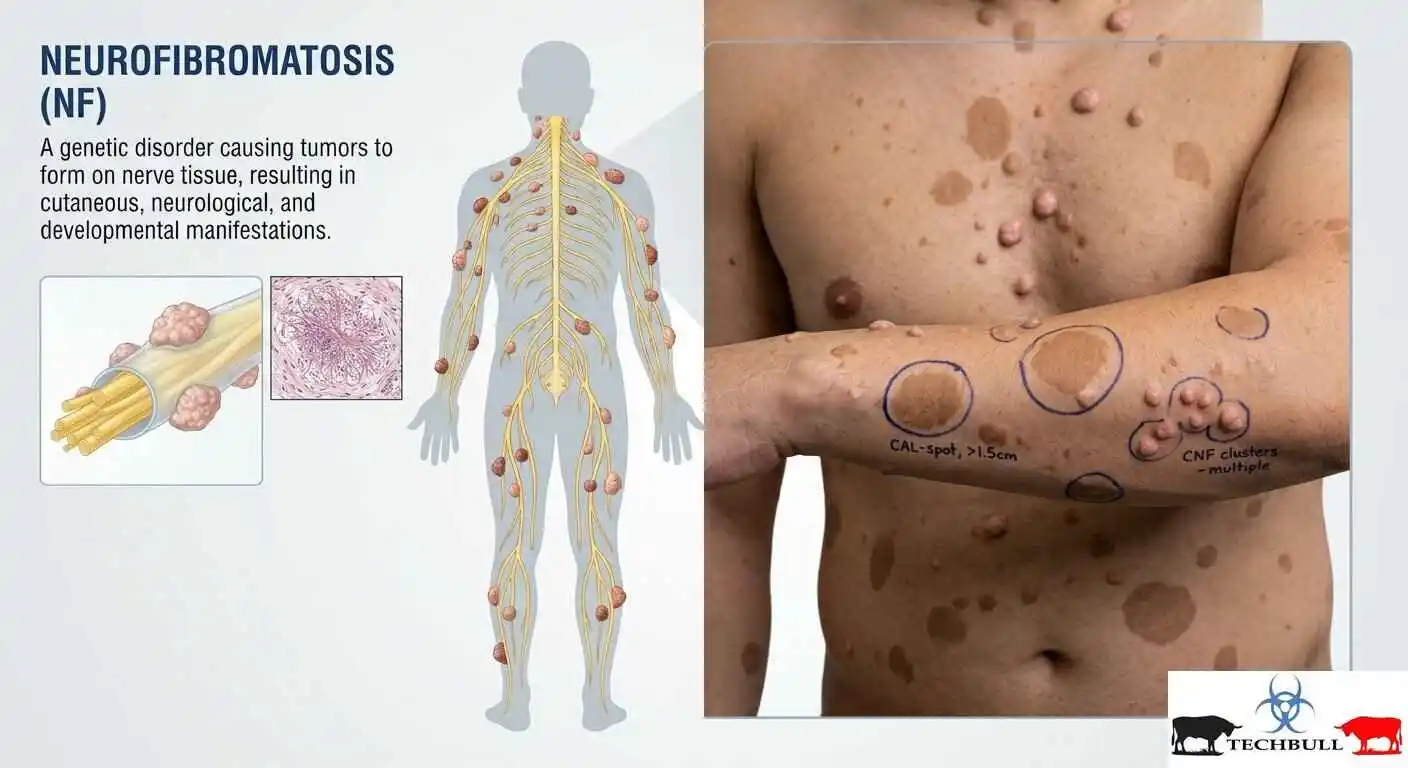
The signs of NF1 are wide-ranging, because the gene affects many tissues. The classic features include:
- Café-au-lait spots — flat, light-brown skin marks, usually present from early childhood
- Skinfold freckling — tiny freckles in the armpits, groin, or base of the neck
- Neurofibromas — benign tumors on or under the skin, or deeper along nerves
- Optic pathway gliomas — tumors along the vision nerves, mostly in young children
- Lisch nodules — tiny, harmless bumps on the iris
- Bone dysplasia — thinning or bowing of certain bones, like the shin
What makes NF1 genuinely tricky is its variability. Two people with the same gene change can have wildly different courses. One person might have a few skin spots and live an entirely normal life never needing treatment. Another might develop dozens of tumors, learning difficulties, scoliosis, and a malignant nerve sheath tumor in their twenties. There is no way to predict at birth which path a child will take, and that uncertainty is one of the hardest parts for families to live with.
NF2-Related Schwannomatosis (Formerly “NF2”)
This is where the naming has recently changed, and for good reason. What was historically called neurofibromatosis type 2 has been officially renamed NF2-related schwannomatosis by an international consensus group in 2022, because the condition actually doesn’t involve neurofibromas at all. The old name was, in the words of the experts, “factually incorrect.” The tumors here are schwannomas — tumors of the Schwann cells that insulate nerves — not neurofibromas.
NF2 is far rarer than NF1 (roughly one in 25,000 to one in 40,000) and is caused by changes in the NF2 gene, which makes a tumor-suppressor protein called Merlin. The hallmark is bilateral vestibular schwannomas — tumors growing on the hearing and balance nerves in both ears, sometimes called acoustic neuromas. People can also develop meningiomas, ependymomas, other schwannomas, and peripheral neuropathy, which affects up to 60% of patients.
The typical first sign is hearing loss, ringing (tinnitus), or balance problems in one or both ears, often starting in the teens or twenties. Skin changes are usually mild, which is part of why it hides longer than NF1. The condition is slower-growing than many people fear — these are typically benign tumors — but because of where they sit, on the nerves for hearing and balance and near the brainstem, even slow growth has real consequences.
Schwannomatosis (Non-NF2)
The third and rarest form — estimated at roughly one in 40,000 — is schwannomatosis, now properly distinguished from NF2. It’s defined by multiple schwannomas on peripheral and spinal nerves without the bilateral vestibular schwannomas that define NF2. The defining symptom, more than any tumor location, is pain — often severe, chronic, and notoriously hard to control.
Genetically it’s more complex. Two genes, SMARCB1 and LZTR1, sitting near the NF2 gene on chromosome 22, account for 70–85% of familial cases and 30–40% of isolated ones, through a multi-step “four-hit” mechanism For many patients no gene is yet identified, which makes the diagnosis partly clinical.
The cruel part of schwannomatosis is how long people suffer before an answer arrives. The pain is real and disabling, but the tumors are often small and the condition obscure, so patients cycle through misdiagnoses — fibromyalgia, psychosomatic pain, drug-seeking — before anyone thinks to scan for schwannomas or order the right genetic panel.
A Quick Comparison
| Feature | NF1 | NF2-related schwannomatosis | Schwannomatosis |
| Frequency | ~1 in 2,000–2,500 | ~1 in 25,000–40,000 | ~1 in 40,000 |
| Gene | NF1 (neurofibromin) | NF2 (Merlin) | SMARCB1 , LZTR1 , often unknown |
| Main tumors | Neurofibromas, gliomas | Schwannomas (esp. vestibular), meningiomas | Schwannomas (non-vestibular) |
| Hallmark sign | Café-au-lait spots, skin tumors | Bilateral hearing loss | Chronic pain |
| Typical onset | Early childhood | Teens–young adulthood | Adulthood |
Getting the Diagnosis Right (And Why It Takes So Long)
If there’s one universal frustration in the neurofibromatosis community, it’s how long the road to diagnosis can be. NF1 is usually spotted in childhood, but NF2 and schwannomatosis often take years — sometimes decades — to pin down. Understanding why helps you advocate for yourself or your child.
The Clinical Criteria for NF1
Neurofibromatosis diagnosis for NF1 rests on a set of clinical criteria, revised in 2021, that look for at least two of the following :
- Six or more café-au-lait macules
- Skinfold freckling
- Neurofibromas (or plexiform neurofibromas)
- Optic pathway glioma
- Lisch nodules or choroidal abnormalities
- Characteristic bone dysplasia
- A pathogenic NF1 variant on genetic testing
- A parent with NF1
The catch is that young children often don’t have enough features yet. A two-year-old with six café-au-lait spots might meet only one criterion. The freckling shows up later; the neurofibromas usually appear closer to puberty. So the diagnosis is often a waiting game — you watch, you re-examine, you wait for the picture to fill in. This is exactly where genetic testing neurofibromatosis-style work earns its keep: confirming a pathogenic variant can settle the question years before the clinical signs fully emerge .
When to Push for Genetic Testing
Genetic testing isn’t just about confirmation. It matters for three practical reasons:
- Early certainty. For a child with ambiguous signs, a positive NF1 result ends the wait-and-see and lets monitoring begin immediately.
- Distinguishing look-alikes. NF1 can be confused with Legius syndrome (a SPRED1 variant), Noonan syndrome, and other RASopathies that share some features but have different implications. A multigene panel — including NF1, SPRED1, and RASopathy genes — sorts this out.
- Family planning. Because NF1 is autosomal dominant, a parent has a 50% chance of passing it on. Knowing your status informs decisions about future pregnancies and about testing other family members.
Modern testing isn’t just reading the gene’s DNA. Because a large fraction of disease-causing NF1 variants affect how the gene is spliced — and many of those are missed by standard DNA sequencing — labs now include complementary DNA (cDNA) analysis, which catches variants plain DNA sequencing misses. If you or your child had “negative” genetic testing years ago, it may be worth revisiting with a lab that uses current methods.
The NF2 and Schwannomatosis Diagnostic Path
For NF2-related schwannomatosis, the diagnosis usually starts with an MRI showing vestibular schwannomas — classically on both sides, which is essentially diagnostic. Genetic testing for the NF2 variant supports it, though mosaicism (where the variant is only in some cells) can make testing trickier than for NF1.
For schwannomatosis, the diagnosis is built from: a history of schwannomas without vestibular involvement, MRI findings, and increasingly, genetic testing for SMARCB1 or LZTR1 . Because pain is the dominant symptom and the tumors can be small, the diagnosis is one of exclusion and persistence — you keep pushing until someone listens and scans.
Practical Tip: Bring a Map to the Appointment
One of the most useful things a patient or parent can do is keep a simple running record: a list of symptoms and when they appeared, a body map of any skin marks or lumps, family history (even vague), and questions ranked by priority. Neurofibromatosis is a multisystem condition, and appointments are short and scattered across specialists. A clear, organized history turns a 15-minute visit from a confused shrug into a productive plan.
The Management Landscape: What Treatment Actually Looks Like in 2026
Here’s the line nobody wants to hear but everyone needs to: there is no cure for neurofibromatosis. Not yet. The goal of care is monitoring, managing symptoms, treating tumors when they threaten function, and — increasingly — using targeted drugs that actually change the course of the disease for some patients. The picture has shifted meaningfully in just the last few years, and it’s worth understanding where the hope is real.
The Backbone: Surveillance, Not Heroics
For the vast majority of people with NF1, the foundation of care is structured surveillance — watching for the things that, caught early, are manageable, and caught late, are not. International consensus guidelines, including those from the European Reference Network GENTURIS, lay out a surveillance framework:
- Regular clinical exams — twice a year until age 5, at least annually through childhood, annual symptom checks in adults with specialist review every few years.
- Eye exams — to monitor for optic pathway gliomas, particularly through early childhood
- MRI when indicated — targeted imaging for symptomatic tumors, plus a baseline whole-body MRI around the transition to adulthood (ages 16–18) to map internal tumor burden.
- Blood pressure monitoring — because NF1 carries a higher risk of a specific vascular tumor (pheochromocytoma) and renal artery issues
- Developmental and learning assessments — because NF1 often comes with learning differences, ADHD, or fine-motor challenges that respond well to support
The point of all this watching isn’t anxiety. It’s the opposite. Knowing where your tumors are, and which ones are stable, turns the unknown into a known. Most neurofibromas in NF1 grow slowly or not at all, and many never need treatment. The surveillance is there to catch the few that do.
Surgery: Still the Workhorse
When a tumor causes a problem — pain, pressure, disfigurement, or threatens a nerve’s function — neurofibromatosis treatment still relies heavily on surgery. This is truest for NF2-related schwannomatosis, where the tumors sit in delicate places and surgery is often the only way to relieve pressure on the brainstem or hearing nerve. For schwannomatosis, surgical removal of a painful schwannoma can be transformative when the tumor is accessible and the source of the pain.
But surgery here is high-stakes. Removing a vestibular schwannoma can cost the remaining hearing. Removing a plexiform neurofibroma in NF1 can risk nerve damage and bleeding, because these tumors weave through nerve bundles. This is why the best outcomes come from surgeons and centers that do this work often — not a general neurosurgeon who sees one of these every few years. If you’re facing surgery, ask how many of these specific procedures the surgeon performs annually. The answer should be more than a handful.
The Drug Revolution: MEK Inhibitors and Beyond
The most significant advance in the last decade has been the arrival of MEK inhibitors, especially for plexiform neurofibromas in NF1. The gene NF1 normally dampens the RAS/MAPK cell-growth pathway; when it’s broken, that pathway runs hot. MEK inhibitors like selumetinib (Koselugo) directly turn down that overactive pathway, and they’ve been shown to shrink inoperable plexiform neurofibromas in children — the first drug to do so. Other MEK inhibitors, like trametinib, are being studied as well.
This isn’t a cure. Tumors often regrow if the drug stops, and side effects — skin, cardiac, eye — are real and require monitoring. But for a child who was facing disfiguring, inoperable tumors, a MEK inhibitor can genuinely change the trajectory. It’s the difference between “there’s nothing we can do” and “we have a tool that helps.”
For NF2, the drug story is different but moving. The only approved drug treatment is bevacizumab, an antibody that starves tumors of blood supply; it shrinks vestibular schwannomas in about 41% of patients and stabilizes them in most, with hearing improvement in about 20% . Beyond that, several targeted drugs are in active clinical trials — brigatinib, crizotinib, a YAP/TEAD inhibitor called VT3989, and even selumetinib being repurposed for NF2. These are early days, but the pipeline, which was nearly empty a decade ago, is no longer.
For schwannomatosis, there’s still no approved drug that shrinks the tumors. Management is about pain control — and pain control here is an art form. First-line drugs are typically neuropathic pain agents like tricyclic antidepressants and gabapentinoids; second-line options include SSRIs and other anticonvulsants like topiramate or carbamazepine . Nerve blocks, physical therapy, and sometimes surgery all have roles. Radiotherapy is generally avoided because it can raise the risk of malignant transformation .
A Word on the Watchlist: MPNST
The complication everyone with NF1 is taught to watch for is malignant peripheral nerve sheath tumor (MPNST) — a cancer that arises, rarely, from a plexiform neurofibroma. It’s the reason any sudden change matters: rapid growth, new severe pain, or loss of function in a known tumor warrants an urgent scan. It’s uncommon, but it’s the one thing in NF1 that’s genuinely life-threatening, and early detection is the whole ballgame.
Living With It: The Daily Reality Nobody Warns You About
The medical side is only part of the story. The other part — the bigger part, for many people — is what neurofibromatosis does to a Tuesday afternoon. The visible tumors someone has to decide whether to explain. The learning differences that shaped a childhood. The hearing loss that quietly reshapes a career. The pain that makes every day a negotiation.
The Visible and the Invisible
NF1 can be visible in ways NF2 and schwannomatosis usually aren’t. Neurofibromas on the face, neck, or arms can’t be hidden, and people — especially children — face stares, questions, and sometimes cruelty. Adults learn scripts: “It’s a benign tumor, it’s genetic, it’s not contagious.” Kids shouldn’t have to. If you’re parenting a child with visible NF1, one of the most powerful things you can give them is language — simple, confident words to explain what they have, so the questions from other kids lose their power. Several NF organizations publish kid-friendly scripts and even classroom materials for exactly this.
The invisible burdens matter too. NF1 is associated with higher rates of ADHD, learning differences, anxiety, and social challenges . These aren’t side notes; for many kids they shape the school years more than the tumors do. Early educational support, an IEP or 504 plan where appropriate, and a clinician who looks at the whole child — not just the scans — make a measurable difference.
For NF2, the invisible burden is hearing loss and balance. Careers built on meetings, phone calls, or music get harder. Conversations in restaurants become exhausting. Hearing aids, cochlear implants, and assistive tech are real tools, and audiologic care should be woven into management from diagnosis. For schwannomatosis, the burden is pain — and the secondary burden of not being believed, which is its own kind of damage.
Building Your Team
Neurofibromatosis doesn’t fit in one specialty. The best care comes from a multidisciplinary team — and the consensus guidelines across continents emphasize this repeatedly. A realistic team might include:
- A neurologist or geneticist as the quarterback
- A neurosurgeon with NF experience (not just any neurosurgeon)
- An ophthalmologist for NF1 (optic gliomas) or an audiologist for NF2
- An orthopedist if bone dysplasia is present
- A psychologist or counselor — the emotional load is real and undertreated
- A pain specialist for schwannomatosis
- A genetic counselor for testing and family planning
- A primary care doctor who coordinates the whole mess
Not everyone has access to a dedicated NF clinic. If you don’t, your job is to build this network yourself and make sure your primary doctor knows how the pieces connect. Bring the guidelines to your appointments — the published consensus criteria exist so that care is standardized, and a good doctor will welcome them.
The Transition From Pediatric to Adult Care
One of the most overlooked moments is the handoff from pediatric to adult care. Kids with NF1 are often well-watched in a children’s hospital; then they turn 18, age out, and the structured surveillance evaporates. The GENTURIS guidelines specifically recommend a whole-body MRI around ages 16–18 precisely to bridge this gap — giving the adult team a map to work from . If you’re a parent of a teenager with NF1, start planning this transition two years early. Don’t let it happen by accident.
The Mental Health Side, Honestly
I’d be lying if I said the psychological impact of neurofibromatosis was well-managed in most patients. It isn’t. The uncertainty, the visible differences, the chronic pain or hearing loss, the fear of passing it on, the repeated scans — it accumulates. And yet mental health support is treated as optional far more often than it should be. If there’s one actionable thing to take from this section, it’s this: treat your mental health as part of the medical plan, not a luxury. A therapist who understands chronic illness, a support group of people who actually get it, and permission to grieve the version of life you expected — these are treatments, not indulgences.
The Road Ahead: Research, Hope, and Honest Limits
It’s worth ending the clinical picture with where things are going, because the trajectory genuinely matters for anyone reading this who was diagnosed a decade ago and remembers being told “there’s nothing we can do.”
Gene Therapy and the Underlying Cause
The most exciting frontier is work aimed at the root — the broken gene itself. Researchers are testing gene therapies for NF1 that could, in principle, restore the function of neurofibromin . This is early, and gene therapy for a condition expressed throughout the body and from birth is among the hardest problems in genetics. But it’s no longer science fiction; it’s an active, funded research direction.
A Fuller Drug Pipeline
Beyond MEK inhibitors, the pipeline now includes drugs targeting other points in the RAS/MAPK pathway, immune-based approaches, and drugs repurposed from cancer therapy. For NF2, the trial list — brigatinib, crizotinib, VT3989, selumetinib — represents a genuine shift from “nothing in development” to “several credible options being tested”. For schwannomatosis, the pipeline is thinner, partly because the condition is rarer and the genetics more complex, but pain-focused research and targeted therapy trials are beginning to appear.
Clinical Trials: A Real Option, Not a Last Resort
A common misconception is that clinical trials are only for people who’ve exhausted every other option. For neurofibromatosis, that’s backward. Because the standard options are still limited, trials are often where the most promising therapies live, and well-designed trials can offer access to care that simply isn’t available otherwise. If you or your child has NF1 with inoperable plexiform neurofibromas, or NF2 with progressing tumors, ask your team about open trials. The NF Foundation and clinicaltrials.gov are the practical starting points.
The Honest Limits
At the same time, it’s vital not to overstate where we are. MEK inhibitors help many but not all, and they come with real side effects. The gene therapy work is years from the clinic. No drug yet cures any form of neurofibromatosis. Be wary of anyone — clinic, influencer, or supplement seller — who promises more than the published evidence supports. The community has seen enough false hope to last a lifetime.
FAQs
- What is neurofibromatosis?
Neurofibromatosis refers to three distinct genetic conditions — NF1, NF2-related schwannomatosis, and schwannomatosis — that cause tumors to grow along nerves. They share a name and a tendency toward nerve tumors, but involve different genes and have different courses.
- How common is neurofibromatosis?
NF1 affects roughly one in 2,000–2,500 people; NF2-related schwannomatosis roughly one in 25,000–40,000; and schwannomatosis roughly one in 40,000.
- Is neurofibromatosis inherited?
Yes, all three are autosomal dominant, meaning a parent has a 50% chance of passing it on. However, roughly half of NF1 cases are de novo (new variants with no family history).
- What are café-au-lait spots?
They’re flat, light-brown birthmarks, often present from infancy. Six or more is a diagnostic criterion for NF1.
- Is NF1 the same as NF2?
No. They’re different conditions with different genes, different tumors, and different management. NF1 involves neurofibromas; NF2 involves schwannomas .
- Why was NF2 renamed?
Because the tumors are schwannomas, not neurofibromas — so the old name “neurofibromatosis type 2” was factually wrong. It’s now called NF2-related schwannomatosis.
- What are the first signs of NF1?
Usually café-au-lait spots in infancy or early childhood, followed by freckling and neurofibromas over time. Learning differences and developmental concerns can also appear early.
- What are the first signs of NF2?
Hearing loss, tinnitus, or balance problems, often in the teens or twenties, caused by vestibular schwannomas.
- What is the main symptom of schwannomatosis?
Chronic, often severe pain along nerves, due to multiple schwannomas without vestibular involvement.
- How is neurofibromatosis diagnosed?
Through clinical criteria, imaging (MRI), and genetic testing. NF1 can often be diagnosed clinically; genetic testing confirms and helps in ambiguous cases.
- Should I get genetic testing?
Yes, if neurofibromatosis is suspected. It confirms the diagnosis, distinguishes look-alike conditions, and informs family planning. Modern cDNA-based testing catches variants older tests missed.
- Is there a cure for neurofibromatosis?
No. Treatment focuses on monitoring, managing symptoms, and treating tumors when they cause problems. Targeted drugs like MEK inhibitors are changing the outlook for some patients.
- Are the tumors cancerous?
Most neurofibromas and schwannomas are benign. In NF1, a small fraction of plexiform neurofibromas can transform into a malignant peripheral nerve sheath tumor (MPNST), which is cancerous .
- What is a plexiform neurofibroma?
A complex, often large benign tumor that weaves through nerve bundles. These are the tumors MEK inhibitors like selumetinib can shrink.
- What are MEK inhibitors?
Drugs that turn down an overactive cell-growth pathway (RAS/MAPK) in NF1. Selumetinib is approved to shrink inoperable plexiform neurofibromas in children.
- Can NF1 affect learning?
Yes. NF1 is associated with higher rates of ADHD, learning differences, and fine-motor challenges. Early support makes a real difference.
- Will my child with NF1 need surgery?
Not necessarily. Many neurofibromas never need treatment. Surgery is reserved for tumors causing pain, pressure, or functional problems.
- Can you drive with NF2?
It depends on the degree of hearing and balance impairment. Discuss with your doctor; some people can drive safely, others cannot.
- Can I work with neurofibromatosis?
Most people with neurofibromatosis work. Adjustments may be needed — for hearing loss, pain, or learning differences — but the condition doesn’t preclude a full working life for most.
- Can neurofibromatosis be passed to my children?
Yes, with a 50% chance per pregnancy if you carry the gene. Genetic counseling before pregnancy is strongly recommended.
- Does everyone with NF1 get tumors?
Almost everyone develops some neurofibromas over their lifetime, but the number, size, and impact vary enormously between individuals.
- Is pain always present in schwannomatosis?
Pain is the hallmark, but its severity varies. Some patients have schwannomas with relatively little pain; others have disabling chronic pain .
- What is whole-body MRI and why is it done?
A full-body scan to map internal tumor burden. Guidelines recommend it around ages 16–18 in NF1 to guide adult surveillance and to assess MPNST risk.
- Are clinical trials worth considering?
Yes. Because standard options are limited, trials often offer access to promising therapies. Ask your team about open trials for your specific type.
- Can diet or supplements cure neurofibromatosis?
No. There is no evidence that any diet or supplement treats the underlying condition. A healthy lifestyle supports general health but does not change the genetics.
- Is neurofibromatosis a disability?
It can be, depending on severity. Many people qualify for accommodations or disability support; this is a personal and legal determination based on individual impact.
- What’s the life expectancy for someone with NF1?
Average life expectancy is somewhat reduced, largely due to the small risk of MPNST and other complications, but many people live full, normal-length lives.
- How often should I see a doctor?
Children typically twice a year until age 5, then annually; adults at least annually with specialist review every few years. Your team will tailor this.
- Where can I find support?
The Children’s Tumor Foundation, the Neurofibromatosis Network, and country-specific NF organizations offer patient resources, support groups, and specialist referrals.
- Is gene therapy a real possibility?
It’s an active research area, with early work aimed at restoring the NF1 gene’s function. It’s not yet clinical, but it’s a genuine frontier.
A Condition You Plan Around, Not A Life That Ends
Neurofibromatosis is one of those diagnoses that arrives like a door slamming shut in the middle of an ordinary day. The first weeks and months are a blur of scary search results, unfamiliar vocabulary, and the awful feeling that the future you’d imagined has just been rewritten. That part is real, and it’s worth naming, because pretending it isn’t hard helps no one.
But here’s what the search results don’t always tell you: most people with neurofibromatosis live full lives. They go to school, build careers, fall in love, raise kids, travel, create, contribute. The condition is a fact of their biology, not the sum total of their story. The tumors are watched, the symptoms are managed, the complications are caught early because of surveillance, and — increasingly — there are drugs that actually change the course for the people who need them. Five years ago, “inoperable plexiform neurofibroma” was the end of the conversation. Today there’s a MEK inhibitor that can shrink it. That’s not a footnote. That’s a different world.
The path forward isn’t complicated, even when the emotions are. Get the right diagnosis, confirmed by modern genetic testing if there’s any doubt. Build a real team — not one well-meaning doctor, but a coordinated group that knows neurofibromatosis. Follow the surveillance guidelines; they exist precisely because catching problems early is what changes outcomes. Treat your mental health as part of the medical plan. Connect with the community; the isolation of a rare condition is one of its heaviest burdens, and it lifts the moment you meet someone who actually understands. Ask about clinical trials when standard options run out. And hold the hope honestly — neither the false promise of a cure around the corner, nor the despair of nothing to be done, but the steady, evidence-based reality that the options are better now than they were, and will be better still in the years ahead.
Your call to action: If this resonates because you or someone you love is living with neurofibromatosis, do one concrete thing this week. If you’re undiagnosed but suspicious, ask your doctor for a referral to a genetics service. If you’re diagnosed but uncoordinated, ask for a written surveillance plan. If you’re isolated, find the nearest NF organization and join a support group. The condition is part of your life, but it does not have to run it. The science is moving, the community is strong, and you are far less alone than the rare-disease statistics suggest.
⚕️Medical Disclaimer:
The information provided on this website is for general educational and informational purposes only and is not intended as a substitute for professional medical advice, diagnosis, or treatment. Always seek the advice of your physician or other qualified health provider with any questions you may have regarding a medical condition. Never disregard professional medical advice or delay in seeking it because of something you have read on this website.
