
Table of Contents
Mahua: The Forgotten Forest Tree That Feeds, Heals, and Intoxicates an Entire Culture
Inside the flower, the fire-water, and the folklore of India’s most misunderstood tree
What Exactly Is Mahua?
Mahua, known botanically as Madhuca longifolia, is a slow-growing, deciduous tree native to the forests and plains of central and eastern India, stretching across states like Madhya Pradesh, Chhattisgarh, Jharkhand, Odisha, and parts of Maharashtra. It is not a rare or ornamental species — it is one of the most economically and culturally important trees in the region, quietly holding together the food security, income, and ritual life of millions of people, most of them from tribal and forest-dwelling communities who have depended on it for generations.
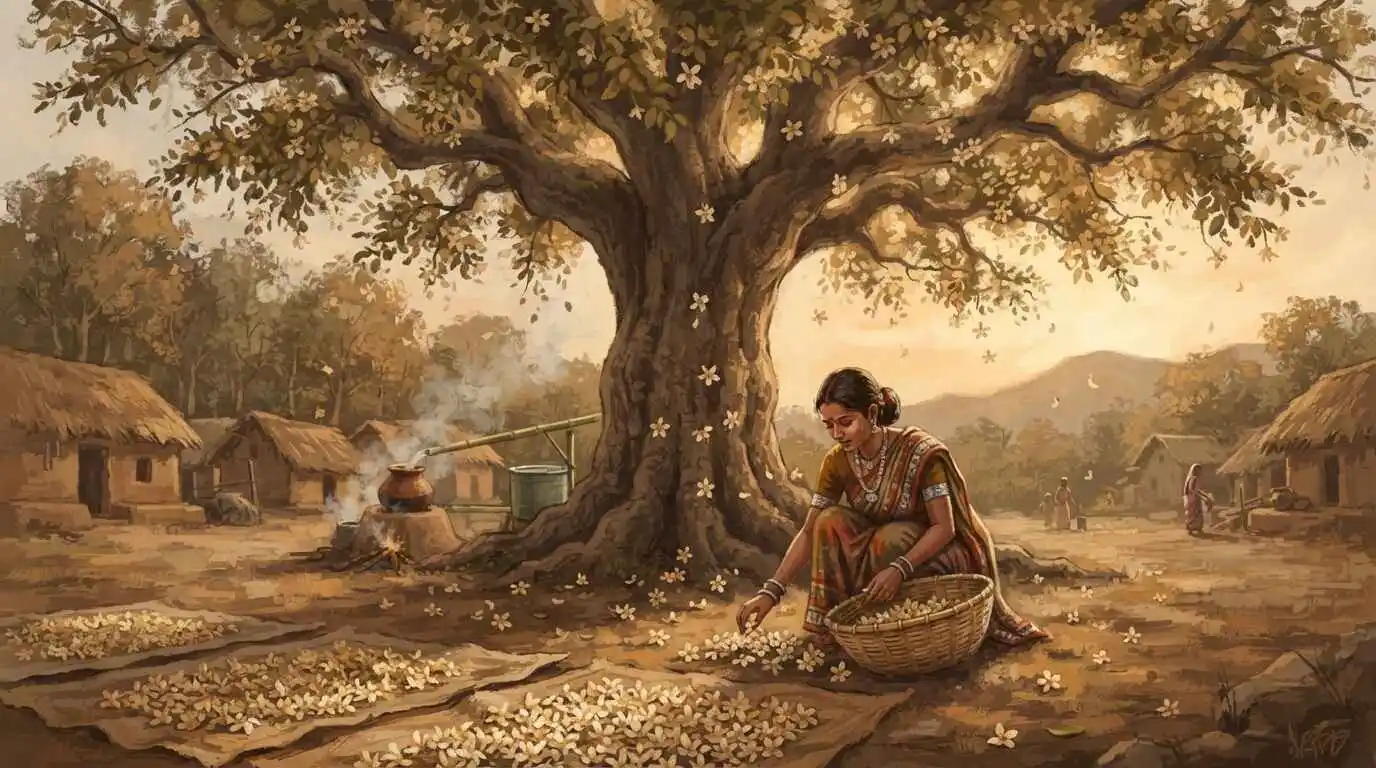
The tree itself is unassuming at first glance: broad-canopied, hardy, capable of surviving poor soil and long dry seasons that would kill more delicate species. What makes Mahua remarkable is not its appearance but its output. Between the months of March and April, the tree drops small, fleshy, cream-colored flowers by the thousands, usually overnight, so that villagers wake before dawn to gather them off the forest floor before birds, animals, and the rising sun can claim them first. Those flowers are the beginning of almost everything Mahua is known for.
Unlike crops that require planting, tending, and a full agricultural cycle, Mahua largely gives itself. The tree flowers on its own schedule, drops its bounty naturally, and asks only that someone show up early enough to collect it. That simplicity is part of why Mahua has remained so deeply embedded in subsistence economies — it rewards presence and patience rather than capital or land ownership, making it one of the rare forest resources accessible to even the poorest households in the areas where it grows.

A single mature Mahua tree can produce a substantial quantity of flowers over the course of a flowering season, and because the trees are long-lived — often standing for well over a century — a household’s relationship with a particular tree can stretch across generations, with grandparents, parents, and children all gathering from the same canopy over decades. That continuity gives Mahua a different character from most other forest produce: it is not simply harvested, it is inherited, remembered, and passed down as part of a family’s working relationship with a specific patch of land.
The Flower That Feeds a Season
The Mahua flower itself is sweet, fleshy, and calorie-dense, and in many tribal communities it has historically functioned as a genuine food source during the lean months of late spring, when stored grain from the previous harvest is running low and the new crop is still months away. Fresh flowers are eaten raw, cooked into simple dishes, or dried in the sun and stored for later use, much the way other communities might preserve fruit or grain for the off-season.
Dried Mahua flowers keep remarkably well and can be ground, boiled, or mixed into flour-based preparations, giving families a reliable caloric buffer at a point in the agricultural calendar when very little else is available. In some regions, Mahua flour is combined with millet or rice flour to make flatbreads, porridges, and sweets, particularly around festivals and community gatherings where the flower’s natural sweetness is put to direct use rather than being fermented or distilled.
This nutritional role is easy to overlook from the outside, since Mahua’s fame today rests almost entirely on the alcoholic drink made from it. But long before it became known for that, and still today alongside it, Mahua flowers have functioned as an essential, no-cost food source for communities whose access to the broader cash economy has historically been limited — a fact that matters enormously when discussing policy around the tree and its regulation.
From Flower to Fire-Water: How Mahua Becomes a Drink
The transformation of Mahua flowers into alcohol is a process refined over countless generations, passed down almost entirely through oral tradition and hands-on practice rather than written recipes. Collected flowers are first sun-dried to reduce moisture and concentrate their natural sugars, then soaked in water and left to ferment naturally over several days, with wild airborne yeasts doing the work rather than any commercially cultivated culture.
Once fermentation is complete, the liquid is distilled, traditionally over an open wood fire using earthen pots and bamboo piping in a setup that looks almost identical across many rural households, refined by necessity into something remarkably consistent despite having no standardized instructions behind it. The resulting spirit, often simply called Mahua or desi daru in different regions, is potent, faintly sweet, and carries a distinctive earthy aroma that comes directly from the flower itself.
For outsiders, the drink is often reduced to a curiosity or, worse, dismissed as crude moonshine. Within the communities that make it, however, Mahua liquor occupies a very different place — it is a fixture of hospitality, a ritual offering, a wedding-day staple, and in many households, a modest source of supplemental income earned by women who have historically controlled much of its production and local sale, even in social structures where other forms of income generation were far more restricted.
“Within the communities that make it, Mahua liquor is a fixture of hospitality, a ritual offering, and a wedding-day staple.”
Mahua Oil: The Quiet Workhorse of the Forest Economy
Beyond the flower, the Mahua tree produces seeds that yield a thick, pale butter-like oil, extracted through pressing much like other traditional vegetable oils. Mahua oil has long served multiple roles in rural households: as cooking oil in regions where it remains affordable and locally available, as a base for traditional skincare and haircare preparations, and as an ingredient in soap-making, where its natural fat content makes it well suited to saponification.
In more recent decades, Mahua oil, sometimes called mahua butter in cosmetic contexts, has drawn interest from natural skincare brands looking for alternatives to more heavily processed oils, prized for its moisturizing properties and relatively neutral scent once refined. This growing external market has created a new, if still modest, income stream for some forest-dependent communities, connecting a centuries-old extraction practice to a distinctly modern consumer trend focused on natural, traceable ingredients.
The seed cake left over after oil extraction is not wasted either — it is commonly used as organic fertilizer and, in some regions, as a natural pesticide, since certain compounds in the residue are known to deter specific pests. This closed-loop use of the tree, where flower, seed, oil, and byproduct all serve distinct purposes, reflects a level of resourcefulness that formal agricultural systems often take generations to design deliberately, and that Mahua-dependent communities have simply practiced as common sense for as long as anyone can remember.
Sacred, Not Just Useful: Mahua in Ritual and Belief
Among many tribal communities across central India, including groups such as the Gond, Santhal, and Oraon, the Mahua tree carries a spiritual weight that goes well beyond its practical uses. It frequently appears in origin myths and creation stories, is planted or protected near sacred groves, and is treated with a level of respect that shapes how and when it can be harvested — certain rituals or small offerings are performed before major collection begins, treating the tree less as a resource to be extracted and more as a relationship to be maintained.
Mahua liquor itself plays a ceremonial role in weddings, funerals, harvest festivals, and rites of passage, offered to deities, ancestors, and guests alike as a marker of respect and hospitality. Refusing a offered cup in certain ceremonial contexts can carry social weight, since the drink functions less like casual alcohol and more like a ritual object whose presence signals that an occasion is being properly honored.
This dual identity — practical resource and sacred object — is part of why blanket outside regulation of Mahua has historically caused friction. Policies designed purely around alcohol control, without accounting for the tree’s role in food security, ritual life, and community identity, often end up criminalizing practices that communities experience not as vice but as inheritance.
“The drink functions less like casual alcohol and more like a ritual object whose presence signals that an occasion is being properly honored.”
The Legal Grey Zone: Mahua and India’s Excise Laws
For much of the twentieth century, traditional Mahua liquor production sat in an uncomfortable legal position across many Indian states, technically restricted under colonial-era and post-independence excise laws that were originally designed to control commercial alcohol production and taxation rather than small-scale household distillation for personal and ceremonial use. This mismatch between law and lived practice meant that a centuries-old cultural tradition was, in many places, technically illegal, even as it continued essentially unchanged in practice.
In recent years, several state governments, including Madhya Pradesh and Chhattisgarh, have taken steps to formally recognize and even promote Mahua, moving to declassify traditional Mahua liquor from the same restrictive category as commercial spirits, and in some cases actively supporting its commercialization as a heritage product with export and branding potential. These policy shifts represent a notable change in framing — from viewing Mahua primarily as a law-and-order concern to viewing it as a cultural and economic asset worth protecting and developing.
This shift has not been without tension. Formalizing and commercializing Mahua liquor raises real questions about who benefits from that transition — whether it strengthens the incomes of the tribal communities and women who have traditionally produced it, or whether formal licensing and larger commercial producers end up capturing most of the value once the product moves toward a broader consumer market. How this balance is struck in the coming years will likely determine whether Mahua’s commercial future genuinely benefits its traditional custodians or simply borrows their heritage.
Mahua on the Modern Table: From Village Still to Craft Bar
Over the past decade, Mahua has begun appearing in an entirely different setting: craft cocktail menus in Indian metropolitan cities, positioned alongside mezcal, sotol, and other terroir-driven spirits as a distinctly Indian ingredient with genuine complexity and story behind it. Bartenders and small-batch distillers have started experimenting with filtered, refined versions of Mahua spirit, smoothing out some of the traditional distillation’s rougher edges while trying to preserve its distinctive floral, earthy character.
This renewed interest has sparked a small wave of formally licensed Mahua-based products — bottled spirits, liqueurs, and even Mahua-infused desserts — marketed to urban consumers who may never have encountered the tree or its traditional role at all. For some, this represents welcome recognition of an underappreciated ingredient finally getting its due on a national and even international stage.
For others, particularly voices from the tribal communities whose knowledge and labor built this entire tradition over centuries, the trend raises familiar concerns about cultural appropriation without adequate credit or compensation flowing back to the source communities. The most encouraging developments in this space are the ones explicitly built around fair-trade sourcing, cooperative ownership structures, and direct partnerships with the villages and self-help groups who have always done the actual work of turning flowers into food, oil, and drink.
Mahua and the Forest Economy: Livelihoods Beyond the Bottle
It’s worth stepping back from alcohol entirely to appreciate how much of Mahua’s real economic importance has nothing to do with drinking at all. Dried Mahua flowers are traded in local haats, or weekly markets, as a straightforward commodity, purchased by traders who supply them onward for use in flour, cattle feed, and even as an ingredient in some traditional medicine preparations. For many households, the seasonal sale of surplus dried flowers provides a meaningful, if modest, cash injection at a predictable point in the year.
Government and NGO programs focused on non-timber forest produce, a category that includes Mahua flowers and seeds alongside items like tendu leaves and various forest fruits, have increasingly tried to formalize fair pricing structures and cooperative collection systems, aiming to reduce the gap between what collectors are paid and what traders eventually earn further up the supply chain. These efforts remain uneven in their success, but they reflect growing recognition that Mahua represents a significant, under-formalized piece of the rural economy in the states where it grows.
Taken as a whole — food, oil, ritual object, commercial spirit, and traded commodity — Mahua occupies an unusually complete role in the communities that depend on it, touching subsistence, spirituality, and small-scale commerce simultaneously. Few single tree species anywhere in the world serve quite so many overlapping functions for the people who live alongside them.
Researchers who study forest-based livelihoods often point to Mahua as a case study in why single-resource thinking tends to fail rural communities. A policy that treats Mahua purely as an excise concern misses its food-security role; a policy that treats it purely as a commodity to be traded misses its ritual and ecological dimensions; and a conservation plan that focuses only on tree cover misses the fact that the knowledge of how to use that tree well is just as fragile, and just as worth protecting, as the tree itself.
Environmental Pressures Facing the Mahua Tree
Despite its resilience, Mahua is not immune to the broader environmental pressures reshaping India’s forests. Deforestation, land conversion for agriculture and mining, and shifting rainfall patterns linked to climate change have all been cited by researchers and local communities as factors affecting Mahua flowering patterns and overall tree health in parts of its range. Because so many households depend on a predictable flowering season for both food and income, even modest disruptions to that timing can have outsized effects on already vulnerable communities.
There is also a slower, generational pressure at work: as younger people in Mahua-growing regions increasingly migrate toward cities for work, the detailed traditional knowledge around collection timing, fermentation technique, and appropriate ritual practice risks thinning out over time, carried forward by a shrinking pool of elders rather than passed down as universally shared community knowledge the way it once was.
Conservation and cultural preservation efforts around Mahua increasingly recognize that protecting the tree and protecting the knowledge attached to it are two sides of the same problem. Planting more Mahua trees accomplishes little if the specific, hard-won understanding of how to use them well — when to harvest, how to ferment, which rituals matter and why — is not also actively preserved and transmitted alongside them.
“Few single tree species anywhere in the world serve quite so many overlapping functions for the people who live alongside them.”
Why Mahua Deserves Wider Recognition
Mahua’s story resists the easy categories that outside observers often reach for first. It is not simply a folk alcohol, not simply a food crop, not simply a cash commodity, and not simply a sacred object — it is all of these simultaneously, woven together so completely that separating them risks misunderstanding the tree’s actual place in the communities that rely on it. Any policy, business, or cultural narrative that engages with only one dimension of Mahua while ignoring the others is likely to get the tree, and the people connected to it, badly wrong.
What makes Mahua worth learning about, beyond its practical and economic significance, is what it represents: a genuinely sustainable relationship between a community and a single tree species, built and refined over generations without the intervention of formal agricultural science, corporate supply chains, or government planning. That kind of accumulated, hands-on knowledge is exactly the sort of thing modern conversations about sustainability and food security claim to be searching for — and in Mahua’s case, it has simply been sitting in plain sight in central India’s forests all along, waiting for wider recognition to catch up with what tribal communities have always known.
For anyone encountering Mahua for the first time — whether through a bottle on a craft bar’s shelf, a jar of skincare oil, or simply this piece of writing — the most useful takeaway is a sense of scale. This is not a niche curiosity confined to a handful of villages; it is a tree woven into the seasonal rhythm, diet, economy, and spiritual life of a substantial part of India, sustaining practices that have outlasted empires, policy shifts, and generations of change with remarkably little outside support. Recognizing that scale is the first step toward engaging with Mahua respectfully, whether as a curious outsider, a policymaker, or a business hoping to bring it to a wider audience.
| FAQs |
| Q1. What is Mahua?
Mahua is a deciduous tree native to central and eastern India, known botanically as Madhuca longifolia, prized for its edible flowers, seed oil, and traditional fermented spirit. |
| Q2. Where does the Mahua tree grow?
Mahua grows widely across states such as Madhya Pradesh, Chhattisgarh, Jharkhand, Odisha, and parts of Maharashtra, thriving in forested and semi-arid regions. |
| Q3. What time of year does Mahua flower?
Mahua typically flowers between March and April, dropping its blossoms overnight so villagers gather them at dawn before wildlife and heat can damage the harvest. |
| Q4. Is the Mahua flower edible?
Yes — Mahua flowers are sweet and calorie-dense, eaten fresh, cooked into simple dishes, or dried and stored as a food source during lean agricultural months. |
| Q5. How is Mahua liquor made?
Dried Mahua flowers are soaked in water, left to ferment naturally through wild yeast, then traditionally distilled over an open wood fire using earthen pots and bamboo piping. |
| Q6. Is Mahua alcohol legal in India?
Its legal status varies by state; several states, including Madhya Pradesh and Chhattisgarh, have moved to formally recognize and even promote traditional Mahua liquor production. |
| Q7. What does Mahua oil come from?
Mahua oil is extracted by pressing the tree’s seeds, producing a thick, pale, butter-like oil used in cooking, skincare, and soap-making. |
| Q8. Is Mahua oil used in cosmetics?
Yes — Mahua oil, sometimes called mahua butter, is increasingly used in natural skincare and haircare products for its moisturizing properties. |
| Q9. Which communities are most closely associated with Mahua?
Tribal and forest-dwelling communities across central India, including groups such as the Gond, Santhal, and Oraon, have depended on Mahua for generations. |
| Q10. Does Mahua have any ritual or religious significance?
Yes — Mahua appears in origin myths, is protected near sacred groves in some regions, and its liquor is used ceremonially in weddings, funerals, and festivals. |
| Q11. What happens to the seed cake left after Mahua oil extraction?
The leftover seed cake is commonly used as organic fertilizer and, in some regions, as a natural pesticide due to pest-deterring compounds it contains. |
| Q12. Why was Mahua liquor historically restricted by law?
Colonial-era and post-independence excise laws designed to regulate commercial alcohol production were often applied broadly, technically restricting small-scale traditional distillation as well. |
| Q13. Is Mahua liquor becoming commercially popular?
Yes — craft bars and small-batch distillers in Indian cities have started producing refined Mahua spirits, positioning it alongside other terroir-driven spirits like mezcal. |
| Q14. What concerns exist around commercializing Mahua?
Some worry that commercialization may not adequately benefit the tribal communities and women who traditionally produce Mahua, unless fair-trade and cooperative structures are built in. |
| Q15. How do families traditionally use dried Mahua flowers?
Dried flowers are ground or boiled, mixed into flour with millet or rice, and used to make flatbreads, porridges, and sweets, especially during festivals. |
| Q16. What is a haat, in relation to Mahua trade?
A haat is a local weekly market where dried Mahua flowers and other forest produce are traded as commodities between collectors and traders. |
| Q17. Is Mahua considered a non-timber forest product?
Yes — Mahua flowers and seeds fall under the category of non-timber forest produce, alongside items like tendu leaves and various forest fruits. |
| Q18. Who traditionally produces Mahua liquor within communities?
Women have historically played a central role in producing and locally selling Mahua liquor, often as a modest but meaningful source of household income. |
| Q19. What environmental threats does the Mahua tree face?
Deforestation, land conversion for agriculture and mining, and shifting rainfall patterns linked to climate change have affected Mahua flowering and tree health in parts of its range. |
| Q20. Is traditional Mahua knowledge at risk of being lost?
Yes — as younger generations migrate to cities, detailed knowledge of harvesting, fermentation, and ritual practice risks thinning as it is carried by fewer elders over time. |
| Q21. Does Mahua have any medicinal traditional uses?
Mahua flowers and related preparations have appeared in some traditional medicine practices, alongside their better-known roles in food, oil, and drink. |
| Q22. What does Mahua liquor taste like?
Mahua spirit is typically described as potent and faintly sweet, with a distinctive earthy aroma that comes directly from the fermented flower. |
| Q23. Why is Mahua sometimes compared to mezcal?
Like mezcal, Mahua is a terroir-driven traditional spirit tied closely to a specific plant, region, and cultural practice, which has drawn comparisons from bartenders and spirits enthusiasts. |
| Q24. Can Mahua flowers be stored for later use?
Yes — dried Mahua flowers keep well and provide a reliable calorie source that families can store and use during months when other food is scarce. |
| Q25. What role does Mahua play in weddings?
Mahua liquor is often offered as a ceremonial drink during weddings, signaling hospitality and respect, with refusal in some contexts carrying social significance. |
| Q26. Are there government programs supporting Mahua collectors?
Yes — some government and NGO programs focused on non-timber forest produce aim to formalize fair pricing and cooperative collection systems for Mahua and similar products. |
| Q27. Is Mahua unique to India?
While related Madhuca species exist elsewhere in South and Southeast Asia, Mahua’s cultural, economic, and ritual significance is most deeply developed in central and eastern India. |
| Q28. How is Mahua connected to sustainability discussions?
Mahua represents a long-standing, low-impact relationship between communities and a forest resource, built entirely through traditional knowledge rather than formal agricultural planning. |
| Q29. Do Mahua trees need to be planted and cultivated?
Mahua largely grows and flowers on its own without intensive cultivation, making it accessible to households without significant land or capital. |
| Q30. What is the biggest misconception about Mahua?
The most common misconception is treating Mahua purely as a folk alcohol, when it is simultaneously a vital food source, oil source, ritual object, and traded commodity. |
⚕️Medical Disclaimer:
The information provided on this website is for general educational and informational purposes only and is not intended as a substitute for professional medical advice, diagnosis, or treatment. Always seek the advice of your physician or other qualified health provider with any questions you may have regarding a medical condition. Never disregard professional medical advice or delay in seeking it because of something you have read on this website.
