
Table of Contents
Eat by the Decade: The Foods Your Body Actually Needs After 50, 60, 70, and Beyond
Nutritional needs shift every decade after midlife — here’s exactly what belongs on the plate at each stage
Nutrition advice tends to be written for a single, imaginary adult — someone with no specific age, no specific hormonal stage, and no particular risk profile. In reality, the nutritional needs of a healthy 52-year-old, a healthy 68-year-old, and a healthy 81-year-old are meaningfully different, even if all three eat what most people would call a balanced diet. Muscle mass, bone density, stomach acid production, kidney filtration, and even thirst sensation all shift gradually with age, and each of those shifts changes what the body needs more of, less of, or simply more consistently.
This is not about restrictive dieting or chasing a single miracle food. It is about recognizing that a nutrition plan built for a 35-year-old will quietly under-serve a 75-year-old in specific, predictable ways — usually protein, calcium, vitamin B12, fiber, and hydration — even when total calorie intake looks perfectly reasonable on paper. Small, targeted additions to the diet at the right decade can meaningfully reduce the risk of the conditions that most commonly erode independence later in life: fractures, sarcopenia, cognitive decline, and cardiovascular disease.
This guide breaks down what to prioritize on the plate decade by decade, starting in the 50s and continuing through the 80s and beyond, along with the specific nutrients that deserve extra attention at each stage and the practical foods that deliver them.

Why Nutritional Needs Change With Age
Several physiological shifts drive the need for a different approach to eating as the decades pass. Muscle mass naturally declines starting as early as the 30s, a process called sarcopenia that accelerates notably after age 60 without deliberate intervention through protein intake and resistance activity. Bone density follows a similar trajectory, particularly in postmenopausal women, where estrogen decline speeds up bone loss and raises fracture risk substantially.
Digestive changes compound these shifts. Stomach acid production tends to decrease with age, which directly reduces the body’s ability to absorb vitamin B12 from food, even when intake looks adequate. Kidney function also declines gradually, which affects how efficiently the body processes protein, sodium, and fluids, meaning hydration needs become both more important and easier to overlook, since the sensation of thirst itself becomes less reliable with age.
Sensory changes play a role too, and they are easy to overlook. Taste and smell both become less acute with age, which can quietly reduce appetite and push people toward heavily salted or heavily sweetened foods simply to register the same intensity of flavor they remember from decades earlier. This is one of several reasons nutrient-dense, naturally flavorful foods — herbs, citrus, roasted vegetables — deserve more emphasis in cooking for older adults, since they help compensate for diminished sensory feedback without relying on excess salt or sugar.
None of these changes happen overnight, and none of them are inevitable to the same degree — diet, activity, and screening all meaningfully influence how quickly or slowly they progress. But they do mean that the nutritional strategy that worked well at 40 needs deliberate updates by 55, 65, and 75 to keep pace with what the body is actually doing.
The nutrition plan that worked at 40 quietly under-serves the body at 75 — usually in protein, calcium, B12, fiber, and fluids.
What to Eat, Decade by Decade
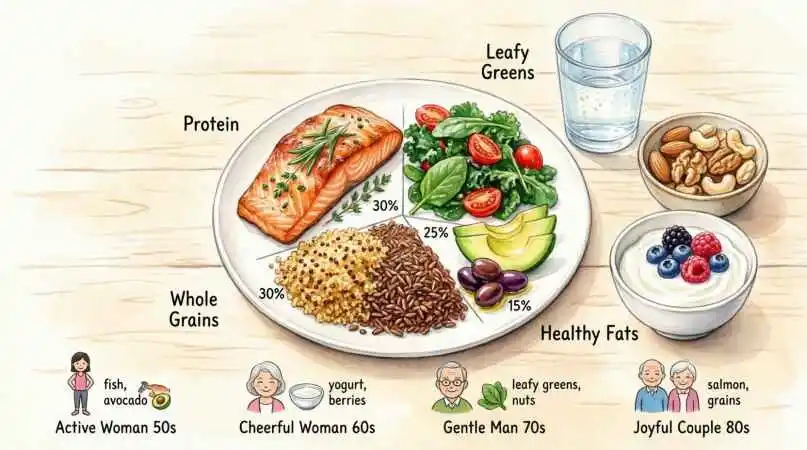
Four life stages, and the foods that matter most in each
In Your 50s: Building the Foundation Before Decline Accelerates
This decade is where prevention has the most leverage, since most age-related decline has not yet significantly progressed. Priorities center on preserving muscle mass, protecting bone density as hormonal shifts begin (particularly during perimenopause and menopause), and supporting cardiovascular health as metabolic rate slows. Lean proteins such as chicken, fish, eggs, and legumes should appear at every meal to counter the natural onset of muscle loss. Calcium-rich foods — dairy, fortified plant milks, leafy greens like kale and bok choy — become more important as bone density protection becomes a priority rather than an afterthought. Fatty fish such as salmon and sardines deliver omega-3 fatty acids that support both heart and brain health during a decade when cardiovascular risk factors often first appear on lab work. Fiber-rich whole grains, beans, and vegetables help manage the gradual metabolic slowdown that makes weight management more difficult than it was a decade earlier. This is also a good decade to establish habits — regular meal timing, consistent hydration, routine bloodwork — that pay compounding dividends over the following decades rather than waiting until a specific deficiency or diagnosis forces the issue.
In Your 60s: Prioritizing Protein and Bone Density
By this decade, the effects of sarcopenia become more measurable, and adequate protein intake stops being optional if functional strength is a priority. Nutrition guidance for this age group generally recommends higher protein intake per meal than younger adults need, since older muscle tissue responds less efficiently to protein for building and maintaining mass — a phenomenon researchers call anabolic resistance. Foods like Greek yogurt, cottage cheese, lentils, tofu, and lean meats distributed evenly across three meals tend to outperform the same total protein concentrated in one meal. Vitamin D becomes a bigger priority here as well, both for bone health and because natural synthesis from sunlight becomes less efficient with age; fatty fish, fortified dairy, and egg yolks help, though many people in this age group benefit from supplementation after a blood test confirms a deficiency. Potassium-rich foods such as bananas, sweet potatoes, and beans support healthy blood pressure regulation, which becomes an increasingly common concern in this decade. This is also a common decade for retirement and daily routine changes, both of which can inadvertently disrupt regular meal timing — worth watching for, since consistent eating patterns support both energy levels and healthy blood sugar regulation.
In Your 70s: Guarding Against Deficiency and Frailty
This decade often brings a real drop in stomach acid production, which directly impairs vitamin B12 absorption from food even in people eating adequate amounts of animal protein. Fortified cereals, fortified nutritional yeast, and B12-fortified plant milks become useful additions, and many physicians recommend a B12 blood test around this age given how common a silent deficiency becomes. Calcium and vitamin D remain essential, but so does a renewed focus on total calorie adequacy, since appetite naturally declines in the 70s and unintentional weight loss becomes a genuine risk factor for frailty. Nutrient-dense foods — nut butters, olive oil, avocado, eggs, full-fat dairy — help pack more nutrition into smaller portions when appetite shrinks. Fiber from vegetables, fruits, and whole grains supports digestive regularity, which tends to become a more persistent challenge as gut motility slows. Social factors matter here too — eating alone more often, a common reality in this decade, is independently associated with reduced appetite and food variety, which is worth being mindful of when possible.
In Your 80s and Beyond: Preserving Independence Through Nutrition
At this stage, the nutritional priority shifts meaningfully toward preserving muscle strength, cognitive function, and enough caloric intake to prevent unintentional weight loss, which is strongly associated with declining independence and increased hospitalization risk. Protein remains critical, and softer, easier-to-chew sources — eggs, fish, yogurt, well-cooked legumes, smoothies with protein powder — matter more here as dental issues and swallowing difficulty become more common. Hydration deserves particular emphasis in this decade, since thirst sensation diminishes substantially with age and dehydration is one of the most common, preventable causes of hospital admission among people in their 80s and 90s. Brightly colored fruits and vegetables rich in antioxidants — berries, leafy greens, colorful peppers — support cognitive health, while omega-3-rich foods continue to matter for both brain and cardiovascular protection. Small, frequent, nutrient-dense meals often work better than three large meals when appetite has diminished substantially. Family members and caregivers can play a meaningful role here simply by noticing changes in appetite or eating patterns early, since small interventions at this stage tend to be far more effective than addressing significant weight loss after the fact.
The Nutrients That Deserve Extra Attention With Age
Across every decade covered above, a handful of specific nutrients come up repeatedly because they are the ones most commonly under-consumed or poorly absorbed as the body ages. Rather than treating each decade as an entirely separate set of rules, it helps to think of these seven nutrients as a running checklist that becomes more important, not less, with every passing year.
Protein
Needs increase relative to younger adulthood due to anabolic resistance, making muscle preservation dependent on higher and more evenly distributed intake across meals.
Calcium and Vitamin D
Both work together to protect bone density, with needs rising sharply for postmenopausal women and for adults over 70 of any gender.
Vitamin B12
Absorption declines with reduced stomach acid, making fortified foods or supplementation increasingly relevant from the late 60s onward.
Fiber
Supports digestive regularity and cardiovascular health, both of which become more relevant as gut motility and metabolic efficiency decline.
Potassium
Plays a central role in blood pressure regulation, a growing concern through the 60s and beyond.
Omega-3 Fatty Acids
Support cardiovascular and cognitive health across every decade covered here, with particular relevance to brain health preservation in the 70s and 80s.
Water and Fluids
Hydration needs stay constant or increase with age even as the natural sensation of thirst becomes less reliable, making deliberate fluid intake more important than relying on thirst alone.
Warning Signs Worth Discussing With a Doctor
Certain patterns are common enough with age that they can be dismissed as normal, when they actually warrant a conversation with a physician or registered dietitian. Unintentional weight loss of more than five percent of body weight over six to twelve months is one of the clearest red flags, since it is strongly associated with frailty and increased hospitalization risk. Persistent fatigue, tingling in the hands or feet, and cognitive fog can all be signs of a vitamin B12 deficiency that is easily corrected once identified through a simple blood test. Frequent muscle cramps, irregular heartbeat, or unusually high blood pressure readings can point toward inadequate potassium or magnesium intake. And any noticeable decline in grip strength or difficulty rising from a chair without using the arms can be an early signal of sarcopenia that responds well to increased protein intake paired with resistance exercise, especially when addressed early rather than after significant strength has already been lost.
Foods Worth Limiting as the Decades Add Up
Nutrition for aging well is not only about what to add — a handful of dietary patterns become more costly with age and deserve more scrutiny than they might have received at 30 or 40.
Excess Sodium
Processed and packaged foods remain the largest source of dietary sodium, and as blood pressure regulation becomes more sensitive with age, excess sodium places additional strain on cardiovascular health. Reading labels and cooking more meals from scratch meaningfully reduces intake without requiring a completely different diet.
Added Sugars
Beyond calorie contribution, diets high in added sugar are linked to inflammation and blood sugar volatility, both of which become harder for an aging metabolism to buffer against. This does not mean eliminating dessert — it means treating sugary foods as occasional rather than daily staples.
Excess Alcohol
Alcohol tolerance changes with age as liver function and body composition shift, and alcohol also interferes with sleep quality, medication effectiveness, and balance — all of which carry higher stakes for older adults than for younger ones.
Ultra-Processed Foods
These tend to be simultaneously calorie-dense and nutrient-poor, which is a particularly unhelpful combination for older adults who need every bite to work harder nutritionally as appetite naturally declines.
What a Well-Balanced Day Can Look Like at 70
Abstract nutrient targets are useful, but a concrete example often makes the guidance easier to apply. A well-structured day for a healthy 70-year-old might start with Greek yogurt topped with berries and a spoonful of ground flaxseed for breakfast, delivering protein, calcium, antioxidants, and omega-3s in a single bowl. A mid-morning snack of a hard-boiled egg or a handful of walnuts adds another modest protein boost without requiring a full meal.
Lunch built around a serving of salmon or lentils alongside a mix of leafy greens and a whole grain like quinoa or brown rice covers fiber, potassium, and a second solid dose of protein. An afternoon snack of cottage cheese with sliced fruit, or a fortified plant milk smoothie, helps close any remaining protein or vitamin D gap for the day. Dinner centered on lean poultry or tofu with roasted vegetables and a source of healthy fat like olive oil rounds out the day’s protein target while keeping sodium and processed ingredients to a minimum.
None of this requires unusual ingredients or complicated preparation — the emphasis is simply on consistent protein distribution, colorful produce, and enough total volume to prevent the gradual, easy-to-miss calorie deficit that often develops in this decade.
Practical Habits That Make This Easier to Sustain
- Spread protein intake across all three meals rather than concentrating it at dinner, since older muscle tissue uses protein more efficiently in smaller, more frequent doses.
- Keep a visible water bottle or set reminder alarms for fluid intake, since thirst becomes an unreliable signal well before dehydration symptoms appear.
- Choose fortified foods — cereals, plant milks, nutritional yeast — as a practical way to close common gaps in vitamin B12 and vitamin D without relying solely on supplements.
- Favor nutrient-dense, calorie-dense foods like nut butters, olive oil, avocado, and full-fat dairy when appetite naturally declines, rather than trying to eat larger volumes of low-calorie foods.
- Get key nutrient levels checked periodically through bloodwork — particularly vitamin B12, vitamin D, and iron — rather than assuming diet alone guarantees adequate levels as absorption efficiency changes with age.
Final Thoughts
Aging well is not about eating perfectly — it is about recognizing that the body’s requirements shift, sometimes subtly, sometimes dramatically, and adjusting the plate accordingly rather than assuming what worked at 40 will still work at 75. The good news is that most of these adjustments are additions rather than restrictions: more protein spread across meals, more calcium and vitamin D, more attention to fluids, and a handful of nutrient-dense staples that punch above their weight when appetite naturally declines.
None of this requires a nutritionist’s precision or a dramatically overhauled kitchen. It requires a working awareness of which nutrients tend to become harder to get enough of at each stage, and a handful of reliable foods that reliably supply them. Applied consistently across a decade, that kind of awareness does more for long-term independence, strength, and cognitive health than almost any other single lifestyle change available.
It is also worth remembering that these guidelines describe general tendencies, not fixed rules that apply identically to every individual. Existing health conditions, medications, and family history all shape how these recommendations should be personalized, which is exactly why a periodic conversation with a physician or registered dietitian remains valuable even for someone who already eats reasonably well. The goal is not perfection at any single meal, but a pattern, sustained across years, that keeps pace with what the body actually needs at each stage of the journey.
Frequently Asked Questions
| # | Question | Answer |
| 1 | Why do nutritional needs change with age? | Muscle mass, bone density, stomach acid, kidney function, and thirst sensation all decline gradually with age, changing how much of certain nutrients the body needs or can absorb. |
| 2 | What nutrient becomes harder to absorb with age? | Vitamin B12 absorption declines as stomach acid production decreases, often starting in the late 60s and 70s. |
| 3 | How much protein do older adults need? | Older adults generally need more protein per meal than younger adults due to anabolic resistance, and benefit from spreading it evenly across meals. |
| 4 | What foods are best for bone health after 50? | Dairy, fortified plant milks, leafy greens like kale, and calcium-fortified foods paired with adequate vitamin D. |
| 5 | Why is vitamin D important for aging adults? | It works with calcium to protect bone density and becomes harder to produce naturally from sunlight as skin ages. |
| 6 | What is sarcopenia? | The age-related loss of muscle mass and strength, which accelerates notably after age 60 without adequate protein and resistance exercise. |
| 7 | What foods help prevent muscle loss in older adults? | Lean meats, fish, eggs, Greek yogurt, cottage cheese, tofu, and legumes distributed across meals. |
| 8 | Why does hydration become more important with age? | Thirst sensation becomes less reliable with age, making dehydration more likely even when fluid needs stay the same or increase. |
| 9 | What are signs of vitamin B12 deficiency in older adults? | Persistent fatigue, tingling in the hands or feet, and cognitive fog are common signs worth discussing with a doctor. |
| 10 | Should older adults take supplements instead of eating fortified foods? | Fortified foods are a practical first step, but supplementation is often recommended once bloodwork confirms an actual deficiency. |
| 11 | What foods support heart health in the 50s and 60s? | Fatty fish rich in omega-3s, fiber-rich whole grains, beans, and potassium-rich foods like bananas and sweet potatoes. |
| 12 | Why is potassium important for older adults? | It plays a central role in regulating blood pressure, which becomes a more common concern from the 60s onward. |
| 13 | What foods are easiest for older adults with chewing difficulty? | Eggs, fish, yogurt, well-cooked legumes, and smoothies with added protein powder. |
| 14 | How can appetite loss in the 70s and 80s be managed nutritionally? | Smaller, more frequent meals using nutrient-dense foods like nut butters, olive oil, and full-fat dairy help maximize nutrition in smaller portions. |
| 15 | What is anabolic resistance? | A reduced ability of aging muscle to build and maintain mass in response to protein intake, requiring higher protein amounts to achieve the same effect. |
| 16 | Why is fiber important for aging adults? | It supports digestive regularity and cardiovascular health, both of which become more relevant as gut motility slows with age. |
| 17 | What foods support cognitive health in older adults? | Berries, leafy greens, colorful vegetables rich in antioxidants, and omega-3-rich foods like fatty fish. |
| 18 | Is unintentional weight loss a concern for older adults? | Yes, losing more than five percent of body weight over six to twelve months is a red flag associated with frailty and increased hospitalization risk. |
| 19 | What foods help with blood pressure regulation in older adults? | Potassium-rich foods such as bananas, sweet potatoes, and beans, alongside reduced sodium intake. |
| 20 | Why does calcium need increase after menopause? | Estrogen decline speeds up bone loss, making calcium and vitamin D intake more critical for postmenopausal women. |
| 21 | Can dehydration cause hospitalization in older adults? | Yes, dehydration is one of the most common preventable causes of hospital admission among adults in their 80s and 90s. |
| 22 | What is the best way to increase protein intake without large meals? | Spreading moderate protein portions evenly across three meals rather than concentrating it at one meal. |
| 23 | Should older adults get their vitamin levels tested? | Yes, periodic bloodwork for vitamin B12, vitamin D, and iron helps catch deficiencies that diet alone may not reveal. |
| 24 | What foods are good sources of omega-3 fatty acids? | Fatty fish such as salmon and sardines, along with walnuts and flaxseed for plant-based options. |
| 25 | Why is grip strength related to nutrition in older adults? | Declining grip strength can be an early sign of sarcopenia, which often responds well to increased protein and resistance exercise. |
| 26 | What foods should be prioritized in the 80s and beyond? | Protein-rich, easy-to-chew foods, hydrating fluids, and nutrient-dense options like eggs, yogurt, and colorful fruits and vegetables. |
| 27 | Are fortified cereals helpful for older adults? | Yes, they are a practical way to help close common gaps in vitamin B12 and vitamin D. |
| 28 | How often should older adults eat protein-rich foods? | At every meal, since spreading protein intake throughout the day supports muscle maintenance more effectively than one large serving. |
| 29 | What role does stomach acid play in nutrient absorption? | Stomach acid helps release vitamin B12 from food, and declining acid production with age reduces how much B12 the body can absorb. |
| 30 | When should someone consult a dietitian about aging nutrition needs? | If unintentional weight loss, persistent fatigue, muscle weakness, or suspected nutrient deficiencies appear, a registered dietitian or physician can help tailor a plan. |
Disclaimer: This content offers general health and nutrition information. It is not intended as medical advice, diagnosis, or treatment. Individual dietary needs vary. Please consult a qualified health professional with any questions about your personal health before implementing new meal plans or dietary changes. You are responsible for ensuring recipes are safe for your specific allergies and dietary needs.
