
Table of Contents
The Infection That Turns Into an Emergency Hours Before Anyone Notices
Sepsis kills more people worldwide each year than most cancers combined, and it often starts with something as ordinary as a scraped knee or a urinary tract infection. Here is what actually happens in the body, and why recognizing it fast matters more than almost any other medical emergency.
A Medical Emergency Hiding Inside an Ordinary Infection
Sepsis does not begin as its own distinct illness. It begins as an ordinary infection, a urinary tract infection, a chest infection, an infected cut, an abdominal issue like appendicitis, and then something goes wrong with how the body responds to it. Instead of the immune system fighting the infection in a contained, localized way, it launches an extreme, dysregulated response that spreads throughout the entire body, damaging tissue and organs that were never actually infected in the first place.
This is precisely what makes sepsis so dangerous and so frequently missed in its early stages: the underlying infection may look mild or unremarkable, while the body’s own overwhelming reaction to it is what actually becomes life-threatening. Global health estimates attribute roughly eleven million deaths a year to sepsis, making it one of the leading causes of death worldwide, and a substantial share of those deaths are considered preventable with faster recognition and treatment.
What Is Actually Happening Inside the Body
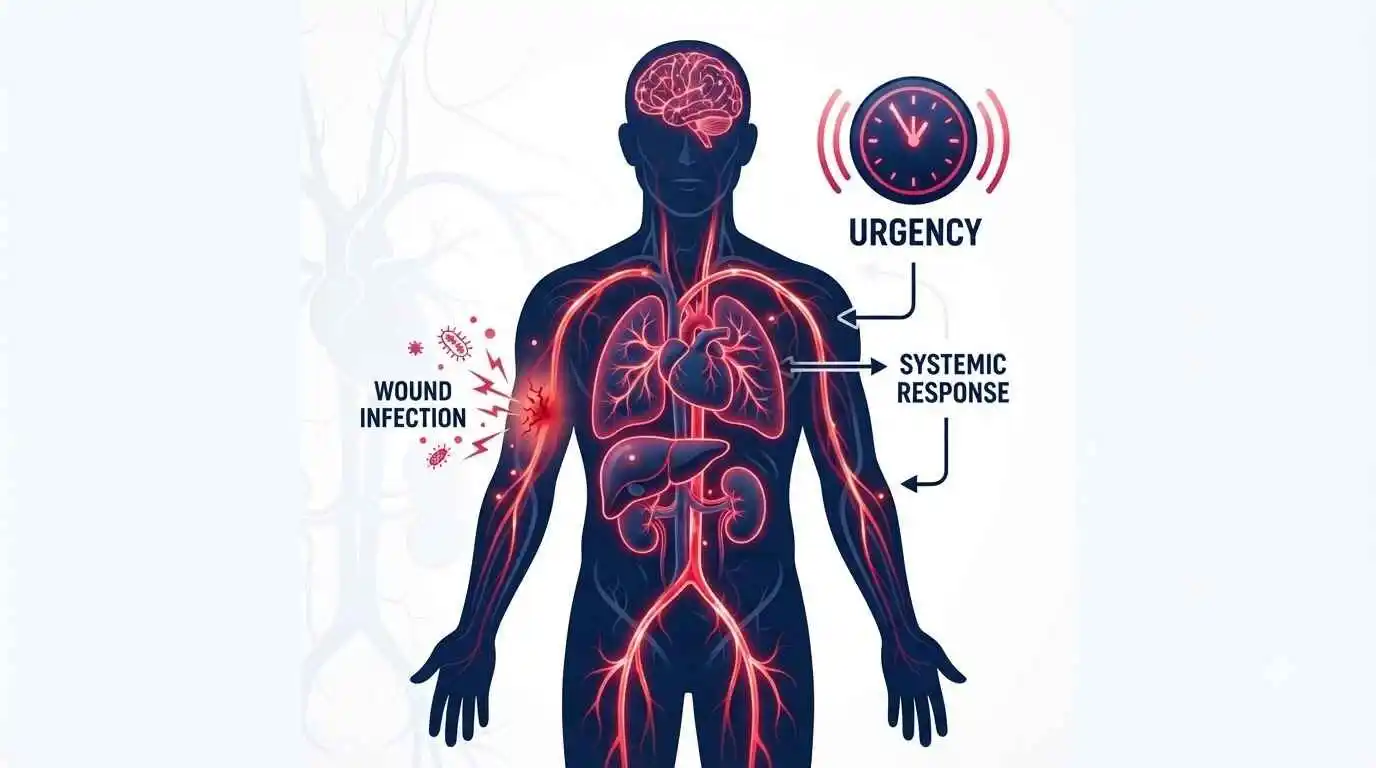
When an infection triggers sepsis, the immune system releases a flood of inflammatory chemicals meant to fight the infection, but at a scale and intensity that damages the body’s own blood vessels and tissues in the process. Blood vessels become abnormally leaky and dilated, blood pressure can drop dangerously, and blood clotting mechanisms can become disrupted, sometimes causing small clots to form throughout the bloodstream even as, elsewhere, the person may bleed more easily than normal.

This combination starves organs of adequate blood flow and oxygen even though the heart may still be beating normally, which is why sepsis can rapidly progress to multiple organ dysfunction, kidneys, lungs, liver, and the cardiovascular system all potentially failing simultaneously, not because they were directly infected, but because the body’s own systemic inflammatory response cut off their ability to function properly.
From Sepsis to Septic Shock
Clinicians describe sepsis as existing on a spectrum of severity. Sepsis itself refers to a life-threatening organ dysfunction caused by a dysregulated response to infection. When this progresses to the point that blood pressure drops severely and cannot be maintained despite fluid resuscitation, requiring medication to support blood pressure, the condition is classified as septic shock, the most severe and highest-mortality stage of the condition.
Medical understanding and classification of sepsis has evolved considerably over the past decade; earlier terminology included a separate category called “severe sepsis,” which has since been folded into the current definition of sepsis itself, since any organ dysfunction from a dysregulated infection response is now considered inherently severe. This shift reflects a broader medical push to treat sepsis as urgently as a heart attack or stroke from the earliest recognizable stage, rather than waiting for a more advanced, clearly deteriorating presentation.
What Actually Triggers Sepsis
Nearly any infection has the potential to trigger sepsis, though certain infection types are more commonly implicated. Lung infections, including pneumonia, are among the most frequent triggers, followed closely by urinary tract infections, abdominal infections such as appendicitis or a perforated bowel, skin and soft tissue infections, and bloodstream infections. Bacterial infections are the most common cause, though viral and fungal infections can trigger sepsis as well, a distinction that matters significantly for treatment since antibiotics are ineffective against viral or fungal causes.
It is worth emphasizing that sepsis frequently develops from infections that, on their own, would not typically be considered dangerous, a urinary tract infection in an otherwise healthy young adult, for instance, which is part of why the condition can catch both patients and, in some documented cases, clinicians off guard when the underlying infection does not initially appear serious.
The Warning Signs Worth Memorizing
Public health campaigns in several countries have promoted simplified symptom checklists to help people recognize sepsis early, since rapid recognition is directly tied to survival outcomes. Common warning signs include a high or abnormally low body temperature, a rapid heart rate, rapid breathing, confusion or a noticeable change in mental clarity, extreme pain or discomfort described as feeling “worse than ever before,” clammy or discolored skin, and significantly reduced urine output.
One widely used public awareness framework uses the acronym TIME: temperature that is unusually high or low, infection signs or a known recent infection, mental decline including confusion or extreme sleepiness, and extremely ill feeling, including severe pain or shortness of breath, all intended as a prompt to seek emergency medical attention immediately rather than waiting to see if symptoms improve on their own.
Sepsis symptoms are frequently mistaken for the flu or a bad infection getting slightly worse, right up until the point they become a medical emergency.
Who Faces the Highest Risk
While sepsis can affect anyone with an infection, certain populations face meaningfully elevated risk. Infants and young children, adults over 65, people with chronic conditions including diabetes, kidney disease, and lung disease, people with weakened immune systems from conditions like cancer treatment or organ transplantation, and people recently hospitalized or who have undergone recent surgery all face a higher likelihood of an infection progressing to sepsis.
Pregnant and recently postpartum individuals also face an elevated, sometimes underrecognized risk, with maternal sepsis remaining a significant, preventable contributor to maternal mortality in both higher- and lower-resource healthcare settings, a pattern that has prompted specific awareness and screening protocols in obstetric care in many hospital systems in recent years.
Why Speed of Treatment Matters So Much
Sepsis treatment outcomes are strongly tied to how quickly appropriate treatment begins, a relationship so well-documented that many hospitals now operate under formal “sepsis bundles,” standardized protocols requiring specific interventions, blood cultures, antibiotics, and intravenous fluids, to begin within a defined window, often referred to informally as the golden hour, after sepsis is first suspected or identified. Research has consistently shown that mortality risk increases with each hour that appropriate antibiotic treatment is delayed once septic shock has developed.
This urgency is a major reason emergency departments increasingly treat suspected sepsis with a level of immediate priority similar to a heart attack or stroke, since, unlike many medical conditions where a delay of a few hours carries limited consequence, sepsis outcomes can meaningfully worsen within a comparatively short window, making early recognition and rapid treatment initiation one of the single most impactful factors in a patient’s eventual outcome.
How Sepsis Is Diagnosed
There is no single definitive test for sepsis; diagnosis relies on a combination of clinical assessment and laboratory findings. Clinicians typically evaluate vital signs, mental status, and specific clinical scoring systems, such as the quick Sequential Organ Failure Assessment, commonly called qSOFA, which considers respiratory rate, mental status, and blood pressure to help quickly flag patients at elevated risk. Blood tests measuring markers like lactate levels, white blood cell counts, and specific inflammatory markers, alongside blood cultures to identify the causative organism, all contribute to confirming a diagnosis and guiding treatment.
Because these various indicators can each individually be caused by conditions other than sepsis, accurate diagnosis often requires synthesizing several pieces of clinical information together rather than relying on any single test result in isolation, part of why sepsis, despite growing awareness, can still occasionally be missed or diagnosed later than would be ideal, particularly in patients whose initial presentation does not include a clearly identified source of infection.
How Sepsis Is Actually Treated
Standard sepsis treatment centers on identifying and addressing the underlying infection, typically with broad-spectrum antibiotics administered as quickly as possible while more specific culture results are still pending, alongside intravenous fluids to help support blood pressure and organ perfusion. In more severe cases progressing toward septic shock, medications called vasopressors may be required to help maintain adequate blood pressure when fluids alone are insufficient, and some patients require intensive care unit admission for close monitoring and, in the most severe cases, mechanical ventilation or other organ support.
Once blood culture results identify the specific infecting organism, antibiotic treatment is typically narrowed from an initial broad-spectrum approach to a more targeted medication, balancing the urgency of immediate treatment against the broader public health goal of avoiding unnecessary antibiotic use that can contribute to antibiotic resistance over time.
Life After Sepsis: What Recovery Actually Looks Like
Surviving sepsis, particularly a severe episode requiring intensive care, does not always mean a full, immediate return to prior health. A significant portion of sepsis survivors experience what is now recognized as post-sepsis syndrome, a cluster of lasting physical, cognitive, and psychological effects that can include persistent fatigue, muscle weakness, difficulty concentrating or memory problems, and an increased risk of anxiety, depression, or post-traumatic stress symptoms following the experience of critical illness.
Some sepsis survivors also face an elevated risk of future health complications, including a higher likelihood of cardiovascular events and, notably, an increased risk of experiencing another episode of sepsis in the future, a pattern that has led to growing clinical interest in dedicated post-sepsis follow-up care and rehabilitation programs, though access to this kind of specialized follow-up care remains inconsistent across different healthcare systems.
Can Sepsis Be Prevented?
While not every case of sepsis can be prevented, since it can arise from infections that were entirely unpredictable or unavoidable, several practical measures meaningfully reduce overall risk. Staying current on recommended vaccinations, particularly for pneumonia and influenza, promptly treating infections rather than waiting to see if they resolve on their own, practicing careful wound care and hygiene, and managing chronic health conditions like diabetes effectively all contribute to reducing the likelihood that an infection progresses to sepsis.
For anyone with a known infection, being alert to worsening symptoms rather than assuming a slow, steady recovery is guaranteed, and seeking prompt medical attention if symptoms escalate rather than improve, represents one of the most directly actionable prevention strategies available to individuals and families, given how strongly outcomes are tied to how early the condition is recognized and treated.
Why Awareness Still Lags Behind the Danger
Despite its significant global mortality burden, public awareness and recognition of sepsis remains notably lower than for other major medical emergencies like heart attack and stroke, a gap public health organizations have specifically worked to close through awareness campaigns and simplified symptom checklists in recent years. Part of this awareness gap likely stems from sepsis’s nature as a complication of another condition rather than a single, easily identifiable illness with one clear cause, making it harder to build the same immediate public recognition achieved for conditions with a more singular, well-defined presentation.
Closing this awareness gap matters directly for outcomes, since sepsis remains one of the relatively rare medical emergencies where a family member or bystander recognizing the warning signs and prompting urgent medical evaluation can meaningfully change the course of the illness, making basic public awareness of sepsis warning signs a genuinely high-value piece of health literacy for the general public to carry, not just healthcare professionals.
The Antibiotic Resistance Connection
Sepsis treatment and the broader public health challenge of antibiotic resistance are closely intertwined in ways that add another layer of urgency to the condition. Because rapid, broad-spectrum antibiotic treatment is so central to sepsis survival, the rise of antibiotic-resistant bacteria poses a direct and growing threat to treatment effectiveness, with drug-resistant infections increasingly implicated in cases where initial antibiotic treatment fails to adequately control the underlying infection driving sepsis.
This dynamic creates a genuine tension in clinical practice: the urgency of starting antibiotics immediately in suspected sepsis has to be balanced against the broader, longer-term public health goal of using antibiotics judiciously to slow the development of further resistance, a balance hospital antibiotic stewardship programs are specifically designed to help manage without compromising the speed of initial sepsis treatment.
What Researchers Are Working On Next
Sepsis research remains an active area of medical investigation, particularly around improving early detection before a patient reaches a clearly critical state. Researchers are exploring various biomarkers and artificial-intelligence-assisted early warning systems designed to flag subtle patterns in vital signs and lab results that may indicate developing sepsis before it becomes obvious through traditional clinical assessment alone, an approach several hospital systems have begun piloting with promising, though still developing, results.
Beyond earlier detection, ongoing research is also examining more targeted treatment approaches aimed at calming the body’s excessive inflammatory response itself, rather than only treating the underlying infection, a potentially significant shift given that organ damage in sepsis often stems more directly from this dysregulated immune response than from the infection itself, though such targeted immune-modulating therapies remain in earlier stages of clinical research rather than standard practice today.
Frequently Asked Questions
| Question | Answer |
| What is sepsis? | It is a life-threatening condition caused by the body’s extreme, dysregulated response to an infection. |
| What causes sepsis? | Bacterial, viral, or fungal infections can trigger sepsis, with bacterial infections being most common. |
| What is septic shock? | It is the most severe stage of sepsis, involving dangerously low blood pressure requiring medication support. |
| What are common early warning signs of sepsis? | High or low temperature, rapid heart rate, confusion, and extreme pain or discomfort are common signs. |
| What does the TIME acronym stand for in sepsis awareness? | Temperature, infection signs, mental decline, and extremely ill feeling. |
| Who is at highest risk for sepsis? | Infants, older adults, people with chronic illness, and those with weakened immune systems face higher risk. |
| Can a minor infection lead to sepsis? | Yes, even seemingly mild infections like a urinary tract infection can progress to sepsis. |
| How is sepsis diagnosed? | Diagnosis relies on clinical assessment, scoring systems like qSOFA, and blood tests including lactate levels. |
| What is qSOFA? | It is a quick clinical scoring tool assessing respiratory rate, mental status, and blood pressure for sepsis risk. |
| How is sepsis treated? | Treatment includes prompt antibiotics, intravenous fluids, and sometimes vasopressors or intensive care support. |
| Why is speed of treatment so important in sepsis? | Mortality risk increases with each hour that appropriate antibiotic treatment is delayed. |
| What is the golden hour in sepsis treatment? | It refers to the critical early window when starting treatment significantly improves survival outcomes. |
| What is post-sepsis syndrome? | It is a cluster of lasting physical, cognitive, and psychological effects following sepsis recovery. |
| Can sepsis happen more than once? | Yes, sepsis survivors face an increased risk of experiencing another episode in the future. |
| Is sepsis contagious? | No, sepsis itself is not contagious, though the underlying infection triggering it sometimes can be. |
| Can sepsis be prevented? | Not always, but vaccination, prompt infection treatment, and good hygiene reduce overall risk. |
| What organs can be affected by sepsis? | Sepsis can affect the kidneys, lungs, liver, heart, and other organs due to impaired blood flow. |
| Is sepsis more dangerous than the infection that caused it? | Yes, the body’s extreme response to the infection is often what becomes life-threatening. |
| How common is sepsis globally? | It is estimated to contribute to roughly eleven million deaths worldwide each year. |
| Can children get sepsis? | Yes, infants and young children are among the higher-risk populations for sepsis. |
| What is maternal sepsis? | It refers to sepsis occurring during pregnancy or the postpartum period, a significant maternal health risk. |
| Does sepsis always require hospitalization? | Yes, sepsis is considered a medical emergency requiring prompt hospital-based treatment. |
| What blood marker is commonly tested for sepsis severity? | Lactate levels are commonly measured to help assess sepsis severity and organ perfusion. |
| Can antibiotics alone cure sepsis? | Antibiotics address the underlying infection, but supportive care like fluids is often also necessary. |
| Why do doctors start broad-spectrum antibiotics before test results return? | Speed is critical, so broad treatment begins immediately while specific culture results are pending. |
| What increases the risk of sepsis after surgery? | Surgical wounds and hospital stays increase infection risk, which can progress to sepsis. |
| Is confusion a serious sign in suspected sepsis? | Yes, sudden confusion or mental decline is a significant warning sign requiring urgent evaluation. |
| Can sepsis be mistaken for the flu? | Yes, early symptoms can resemble flu-like illness, contributing to delayed recognition. |
| How can I help prevent sepsis in myself or a loved one? | Seek prompt care for worsening infections and stay current on relevant vaccinations. |
| Why is public awareness of sepsis considered important? | Early recognition by patients or family members can meaningfully improve treatment speed and outcomes. |
⚕️Medical Disclaimer:
The information provided on this website is for general educational and informational purposes only and is not intended as a substitute for professional medical advice, diagnosis, or treatment. Always seek the advice of your physician or other qualified health provider with any questions you may have regarding a medical condition. Never disregard professional medical advice or delay in seeking it because of something you have read on this website.
