
Table of Contents
We Put Protein Ice Cream to the Test, and the Science Explains Why Most of It Used to Fail
What actually separates a chalky, icy protein pint from one that tastes like real dessert, and how to build a genuinely creamy version at home.
The Category That Earned Its Bad Reputation Honestly
For years, “protein ice cream” was a phrase that made people wince before the spoon even reached their mouth. Early versions were icy, chalky, and left an odd, lingering sweetness that did not resemble sugar so much as a memory of it. That reputation was not undeserved; the earliest wave of high-protein frozen desserts genuinely struggled with texture and flavor, and a lot of people wrote off the entire category after one disappointing pint.
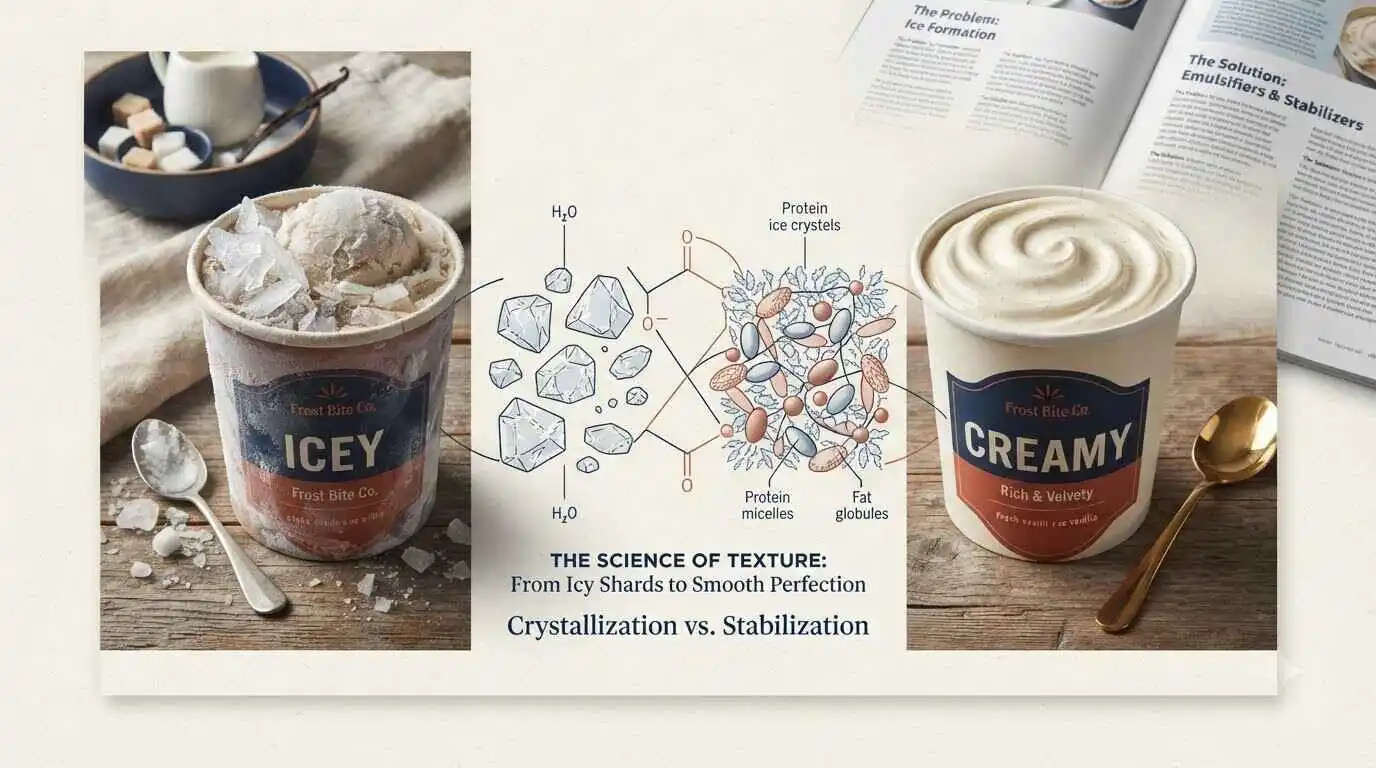
The category has changed considerably since then, driven by real advances in ingredient science rather than just clever marketing. Comparing an early high-protein pint side by side with a current one reveals a genuinely different product, and understanding why requires looking at the specific food science problems the category has been solving one at a time: ice crystal formation, fat content, protein source, and sweetener chemistry.
Why Early Protein Ice Cream Tasted the Way It Did
Traditional ice cream relies heavily on fat and sugar to control ice crystal formation and deliver a smooth, creamy mouthfeel; both ingredients physically interfere with large ice crystals forming as the mixture freezes. Early protein ice cream formulations, built around stripping out fat and sugar to hit aggressive macro targets, removed exactly the ingredients responsible for texture, which is why so many early products froze into a hard, icy block riddled with large, crunchy ice crystals rather than the smooth, scoopable texture consumers expected.

Compounding this, the whey protein concentrate commonly used in early formulations behaves differently in a frozen matrix than dairy fat and sugar do, and at the concentrations needed to hit high protein targets, it can contribute to a grainy, slightly chalky mouthfeel that no amount of flavoring could fully mask. The sugar alcohols used to sweeten these early products without added sugar, erythritol in particular, brought their own well-documented cooling aftertaste and, in larger quantities, digestive discomfort for many consumers, adding yet another strike against the category’s early flavor profile.
What Actually Changed in the Formulation
The current generation of protein ice cream addresses these problems directly rather than simply improving flavoring on top of the same flawed base. Many newer formulations use milk protein isolate or a blend of milk proteins rather than relying solely on whey protein concentrate, since milk protein isolate behaves more favorably in a frozen matrix and contributes less of the grainy texture associated with earlier whey-heavy formulations.
Fat content has also crept back upward in many newer products, with manufacturers recognizing that a small but meaningful amount of fat, even in a product marketed around protein, is difficult to fully substitute for when it comes to achieving a genuinely creamy, scoopable texture. This reflects a broader formulation lesson the category has absorbed: hitting an impressive protein number on the label means little if the resulting product is unpleasant enough that people stop eating it after a few bites.
The Sweetener Breakthrough Nobody Talks About Enough
One of the more significant, underappreciated shifts in recent protein ice cream formulation involves the sweetener itself. Allulose, a rare sugar that occurs naturally in small quantities in foods like figs and raisins, has become increasingly common in newer formulations because it behaves remarkably similarly to real sugar in terms of sweetness profile, browning behavior, and, critically for frozen desserts, freezing point depression, meaning it helps prevent the product from freezing into an overly hard block the way many sugar substitutes fail to do.
Unlike erythritol and other sugar alcohols, allulose does not typically produce the same cooling sensation or digestive discomfort in moderate quantities, and it is metabolized differently by the body, contributing minimal usable calories despite tasting close to real sugar. This single ingredient swap, from erythritol-heavy formulations to allulose-based ones, is frequently cited by both food scientists and consumers as one of the most significant single factors separating older, disappointing protein ice cream from the notably improved versions available today.
The single ingredient swap from erythritol to allulose may be the most underrated reason protein ice cream stopped tasting like a compromise.
The Main Categories on Shelves Today
Modern protein ice cream broadly falls into a few distinct formulation categories, each with a somewhat different texture and flavor profile. Whey- and milk-protein-isolate-based pints, the most common category found in most grocery freezers, aim for a traditional ice cream texture while hitting a moderate-to-high protein count, typically in the range of fifteen to twenty grams per pint or per serving depending on the specific brand and product line.
A separate category built around Greek yogurt as a base protein source offers a tangier, denser flavor profile closer to frozen yogurt than traditional ice cream, appealing to a different taste preference. More recently, casein-based “slow melt” formulations, designed specifically to resist melting quickly at room temperature, have entered the market, offering a notably different, denser eating experience that some consumers prefer and others find distractingly unlike traditional ice cream.
The Home Blender Method That Went Viral
Alongside commercial products, a home method built around blending cottage cheese into a smooth base has become a widely shared approach for making high-protein “ice cream” at home, gaining significant traction on social media. The method relies on cottage cheese’s naturally high protein content and, once thoroughly blended smooth, a fat and protein structure that freezes with a reasonably creamy texture when combined with a small amount of sweetener and flavoring, then churned or simply frozen and re-blended.
This approach has become popular specifically because it sidesteps some of the formulation challenges commercial products have had to engineer around, since cottage cheese naturally contains both protein and a moderate amount of fat in a single, minimally processed ingredient, rather than requiring the isolated protein powders and stabilizer systems commercial manufacturers rely on to achieve a comparable effect.
What a Careful Side-by-Side Comparison Reveals
Lining up several current-generation protein ice cream products against a traditional full-fat ice cream and a homemade cottage-cheese-based version highlights just how much closer the category has gotten to real dessert texture, while also revealing where meaningful differences remain. Products using milk protein isolate and allulose consistently score closer to traditional ice cream in scoopability and mouthfeel than products still relying primarily on whey protein concentrate and erythritol, a pattern that lines up directly with the formulation science discussed earlier rather than being simply a matter of brand reputation or marketing polish.
Homemade cottage-cheese-based versions tend to land in an interesting middle position: creamier and less icy than older commercial protein ice cream, but with a slightly denser, less airy texture than a well-formulated commercial pint that has been through professional churning and air incorporation, called overrun in ice cream manufacturing, a process genuinely difficult to fully replicate with a home blender and freezer alone.
Reading a Protein Ice Cream Label Correctly
For anyone comparing products directly, a few label details matter more than the headline protein number. The specific protein source listed, milk protein isolate and whey protein isolate generally outperforming whey protein concentrate for texture, offers a more reliable predictor of eating experience than protein grams alone. Total fat content, generally somewhere between three and seven grams per serving in better-performing products, correlates strongly with a less icy, more traditional mouthfeel compared to very low-fat formulations chasing the lowest possible calorie count.
The sweetener list is equally worth checking: products relying primarily on allulose or a blend including allulose tend to avoid the cooling aftertaste associated with erythritol-heavy formulations, while products using multiple different sugar alcohols in combination sometimes produce a more pronounced digestive effect in sensitive individuals, worth knowing before eating a full serving rather than discovering it afterward.
The Flavor Development Problem Beyond Texture
Texture is only half the battle; flavor development in a low-sugar, high-protein base presents its own separate formulation challenge. Sugar does more in a frozen dessert than simply sweeten it; it also helps carry and round out flavor compounds, which is part of why early low-sugar protein ice creams often tasted thin or one-dimensional even when the sweetness level itself was reasonably close to a traditional product. Manufacturers have addressed this partly through more sophisticated flavor systems, using natural flavor extracts and compounds specifically selected to remain perceptible and well-rounded in a lower-sugar base, rather than simply increasing sweetener concentration to compensate.
Chocolate and coffee flavors have generally proven easier to execute well in protein ice cream than delicate fruit flavors, since cocoa and coffee’s naturally bold, slightly bitter flavor compounds hold up well against a protein base’s subtle off-notes, while a delicate flavor like strawberry or vanilla bean has less room to mask any remaining textural or aftertaste issues, which is part of why side-by-side comparisons across different flavors within the same product line often reveal noticeably different quality impressions from a single brand.
Price and Value Considerations Worth Weighing
Commercial protein ice cream generally carries a meaningful price premium over traditional ice cream, reflecting both the more expensive isolated protein ingredients involved and the category’s premium market positioning. For consumers regularly incorporating protein ice cream into their diet, this price difference accumulates significantly over time, which is a major part of why the home cottage-cheese-based method has attracted so much interest as a genuinely lower-cost alternative that, while not perfectly identical in texture, gets meaningfully closer to commercial quality than earlier home attempts using protein powder alone typically achieved.
For occasional treat consumption, the price premium of a well-formulated commercial pint is a reasonable trade for the convenience and more polished texture professional manufacturing achieves; for frequent, near-daily consumption, the cost savings of a home method become considerably more compelling, a calculation worth making individually based on how often protein ice cream actually fits into a person’s regular eating pattern rather than assuming one approach is universally the better value.
Common Mistakes When Making It at Home
The most common failure point in homemade protein ice cream is insufficient blending, since any remaining texture from unblended cottage cheese curds becomes considerably more noticeable and unpleasant once frozen than it was in the creamy, freshly blended base. A high-powered blender run for a full two to three minutes, well past the point where the mixture looks smooth at a glance, produces a meaningfully better final texture than a quick blend that leaves microscopic curd structure intact.
A second common mistake is skipping a re-blend or churn step partway through freezing, which allows large ice crystals to form uninterrupted, producing the same icy texture home cooks are usually trying to avoid by making a protein-forward dessert in the first place. Briefly re-blending or vigorously stirring the mixture once or twice during the freezing process meaningfully improves the final texture compared to freezing the base in one uninterrupted block.
Recipe Card
| SERVINGS
4 servings |
PREP TIME
10 min |
CHILL/COOK
4 hrs freeze |
Ingredients
| Ingredient | Amount |
| Full-fat cottage cheese | 2 cups |
| Milk (any kind) | 1/4 cup |
| Allulose or preferred sweetener | 1/3 cup |
| Vanilla extract | 1 tsp |
| Pinch of salt | 1 pinch |
| Optional: cocoa powder or fruit puree | 2-3 tbsp |
Method
- Add cottage cheese, milk, sweetener, vanilla, and salt to a high-powered blender.
- Blend on high for 2 to 3 minutes, scraping down the sides as needed, until completely smooth with no visible curds.
- If using cocoa powder or fruit puree, add now and blend again until fully incorporated and evenly colored.
- Pour the mixture into a freezer-safe container and freeze for 1 hour.
- Remove and stir vigorously or re-blend briefly to break up forming ice crystals. Return to the freezer.
- Repeat the stir or re-blend step once more after another hour of freezing.
- Freeze for a final 1 to 2 hours until scoopable. Let sit at room temperature for 5 minutes before serving if too firm.
Frequently Asked Questions
| Question | Answer |
| Why did protein ice cream used to taste bad? | Removing fat and sugar for protein targets stripped out the ingredients responsible for smooth texture. |
| What causes ice crystals in protein ice cream? | Insufficient fat and sugar allow larger ice crystals to form during freezing, creating an icy texture. |
| What is allulose? | It is a rare sugar that mimics real sugar’s taste and freezing behavior with minimal calories. |
| How is allulose different from erythritol? | Allulose typically avoids the cooling aftertaste and digestive discomfort associated with erythritol. |
| What protein source works best in ice cream texture? | Milk protein isolate generally produces a smoother texture than whey protein concentrate. |
| Does fat content matter in protein ice cream? | Yes, a moderate fat content significantly improves creaminess and reduces iciness. |
| What is casein-based slow melt ice cream? | It is a formulation designed to resist melting quickly, offering a denser eating experience. |
| Can cottage cheese be used to make ice cream at home? | Yes, blended cottage cheese creates a high-protein base that freezes with a creamy texture. |
| Why does cottage cheese need to be blended thoroughly? | Unblended curds become noticeably grainy once frozen if not fully smoothed out first. |
| Why should homemade protein ice cream be stirred during freezing? | Stirring interrupts ice crystal formation, resulting in a smoother final texture. |
| How much protein is typically in a serving of protein ice cream? | Many commercial products contain fifteen to twenty grams of protein per serving. |
| Is Greek yogurt based ice cream different from whey based? | Yes, it tends to be tangier and denser, closer to frozen yogurt in flavor and texture. |
| What is overrun in ice cream production? | It refers to air incorporated during churning, which affects texture and is hard to replicate at home. |
| Does homemade protein ice cream taste as good as commercial versions? | It can be creamier than older commercial versions but may lack the airiness of professionally churned pints. |
| What should I check on a protein ice cream label? | Protein source, fat content, and sweetener type are more informative than the protein number alone. |
| Can too much erythritol cause digestive issues? | Yes, sugar alcohols like erythritol can cause bloating or discomfort in larger quantities for some people. |
| Is protein ice cream healthier than regular ice cream? | It generally offers more protein and often less sugar, though nutritional value depends on the specific product. |
| Why do some protein ice creams taste chalky? | Whey protein concentrate at high concentrations can create a grainy, chalky mouthfeel when frozen. |
| Can I use a sweetener other than allulose in the homemade recipe? | Yes, though texture and sweetness may vary compared to allulose’s sugar-like freezing behavior. |
| How long does homemade protein ice cream last in the freezer? | It is best eaten within one to two weeks for optimal texture before ice crystals accumulate further. |
| Why does my homemade version freeze too hard? | Lower fat and sweetener content compared to commercial formulas can result in a harder frozen texture. |
| Can I add mix-ins to the homemade recipe? | Yes, chocolate chips, fruit, or nut butter can be folded in before the final freeze. |
| What is the ideal fat content for a creamy protein ice cream? | Roughly three to seven grams of fat per serving tends to produce a noticeably smoother texture. |
| Does blending time really make a noticeable difference? | Yes, longer blending significantly reduces graininess from unblended cottage cheese curds. |
| Are commercial protein ice creams processed heavily? | Many use isolated proteins and stabilizers, making them more processed than a simple homemade version. |
| Why do some people prefer slow melt ice cream? | Its denser texture and slower melt appeal to those who dislike traditional ice cream melting quickly. |
| Can protein ice cream fit into a weight management plan? | It can, given its typically higher protein and often lower sugar content compared to traditional options. |
| What is the biggest improvement in recent protein ice cream formulas? | The shift from erythritol to allulose is frequently cited as the most significant texture and flavor improvement. |
| Is homemade protein ice cream cheaper than store-bought? | Generally yes, since cottage cheese and basic sweeteners cost less than commercial protein pints. |
| What is the biggest mistake people make with homemade protein ice cream? | Insufficient blending and skipping the mid-freeze stir are the most common texture mistakes. |
Disclaimer: The content on this blog is for informational purposes only. The author’s opinions are personal and not endorsed. Efforts are made to provide accurate information, but completeness, accuracy, or reliability are not guaranteed. The author is not liable for any loss or damage resulting from the use of this blog. It is recommended to use the information on this blog at your own discretion.
